
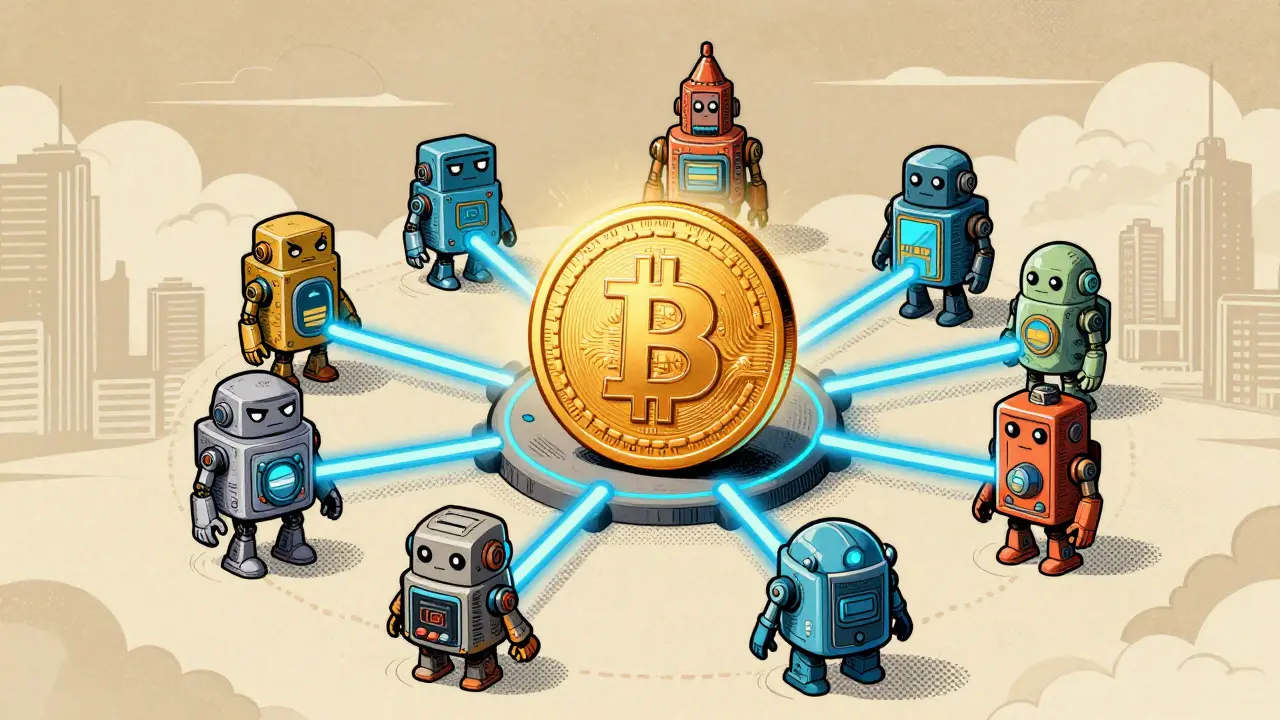
Imagine holding Bitcoin on Solana without trusting a single company to keep your keys safe. That’s the core promise of Zenrock, a blockchain infrastructure project launched in 2023 that focuses on decentralized custody solutions for wrapped Bitcoin assets. Its native utility and governance token, ROCK, powers this ecosystem by securing operations and managing protocol parameters. If you’ve stumbled upon ROCK on an exchange or heard about it in DeFi circles, you’re probably wondering if it’s just another hype cycle or a genuine solution to a major problem in crypto: how to move Bitcoin value across different blockchains securely.
The short answer? It’s a technical bet on the future of cross-chain liquidity. Zenrock uses advanced cryptography called Distributed Multi-Party Computation (dMPC) to let groups of nodes share custody of Bitcoin, meaning no single entity can steal your funds. While the tech is impressive, the project is still early-stage, with limited liquidity and a small user base compared to giants like WBTC. Here’s what you need to know before deciding if ROCK belongs in your portfolio.
Key Takeaways
- Zenrock (ROCK) is a hard-capped token (1 billion supply) used for governance and fees in a decentralized Bitcoin custody network.
- The project’s main product, zenBTC, allows users to hold yield-bearing wrapped Bitcoin on high-performance chains like Solana and SEI.
- Security relies on a threshold signature model where at least 34 out of 51+ nodes must sign transactions, eliminating single points of failure.
- Risks include low current trading volume, limited exchange listings (primarily Gate.io), and the challenge of attracting enough node operators to maintain decentralization.
- Current market cap is under $4 million, making it a high-risk, high-reward speculative asset rather than a stable blue-chip investment.
How Zenrock Works: The Tech Behind the Token
To understand why ROCK exists, you have to look at the problem it solves. Most wrapped Bitcoin tokens, like WBTC, rely on centralized custodians. If that custodian gets hacked or goes bankrupt, your “wrapped” Bitcoin might be gone. Zenrock flips this model using its proprietary Decentralized Custody Token (DCT) standard.
At the heart of this system is Distributed Multi-Party Computation (dMPC). Instead of one person holding the private key, the key is mathematically split among many independent nodes. To execute a transaction-like converting zenBTC back into real Bitcoin-you need signatures from a specific percentage of these nodes. Specifically, the protocol requires at least 34 out of 51 participating nodes to approve a move. This creates a robust security layer; even if half the nodes go offline or get compromised, your assets remain safe.
This process happens on zrChain, a purpose-built blockchain designed specifically for these custody operations. It’s not a general-purpose chain like Ethereum or Solana; it’s a specialized engine optimized for speed and reliability in handling Bitcoin bridges. During testnet phases, Zenrock demonstrated the ability to process these complex cryptographic operations in under 8 seconds, which is crucial for maintaining a smooth user experience when bridging assets.
ROCK Token Utility and Tokenomics
So, what do you actually use ROCK for? It serves two primary functions within the Zenrock ecosystem:
- Governance: Holding ROCK gives you voting rights on protocol upgrades, fee structures, and treasury management. As the project moves toward full decentralization, this becomes increasingly important.
- Fees and Staking: Users pay fees in ROCK when interacting with the protocol. Additionally, there are plans for staking mechanisms where node operators and validators lock up ROCK to secure the network.
The tokenomics are designed to be deflationary. Every time a transaction occurs on zrChain, 0.25% of the involved ROCK is burned, reducing the total supply over time. The total supply is hard-capped at 1,000,000,000 tokens, with no inflation mechanism. As of mid-2024, approximately 220 million ROCK were in circulation, with around 42,000 already burned through transaction activity.
| Attribute | Value |
|---|---|
| Ticker Symbol | ROCK |
| Total Supply | 1,000,000,000 |
| Circulating Supply (Est.) | ~220,000,000 |
| Blockchain | Ethereum (ERC-20), Bridged to Solana |
| Decimals | 18 |
| Burn Rate | 0.25% per transaction |

zenBTC: The Product Driving Adoption
You don’t buy ROCK just for the token itself; you buy it because of the underlying product: zenBTC. This is the wrapped Bitcoin asset that runs on high-performance chains like Solana and SEI. Why does this matter? Because Bitcoin’s native chain is slow and expensive for everyday DeFi applications. By wrapping Bitcoin into zenBTC, users can use their BTC value in fast, cheap environments while keeping the security benefits of decentralized custody.
A major differentiator for zenBTC is its integration with EigenLayer, a restaking protocol. This allows holders of zenBTC to earn additional yield (estimated between 3.2% and 4.7% APY) by restaking their assets to secure other networks. In contrast, many other wrapped Bitcoin solutions, like SoBTC, offer no native yield. This feature makes zenBTC attractive to passive investors who want exposure to Bitcoin price action plus extra income, all without relying on a central bank or corporation to hold their keys.
Market Position and Competitive Landscape
The wrapped Bitcoin market has grown explosively, expanding from $1.2 billion in 2022 to over $12.7 billion in mid-2024. However, Zenrock occupies a niche corner of this pie. Currently, centralized solutions like WBTC dominate, controlling over 60% of the market. Decentralized alternatives like tBTC (now part of Threshold Network) exist but face their own adoption hurdles.
Zenrock’s competitive edge lies in its combination of speed, yield, and decentralization. Compared to tBTC, which requires 100 signatures for finality, Zenrock’s 34-signature requirement allows for faster transaction times. Compared to SoBTC, zenBTC offers yield generation. But there are trade-offs. Liquidity is currently thin. As of July 2024, the Total Value Locked (TVL) for zenBTC was around $1.82 million, a tiny fraction of WBTC’s $11.3 billion. This means large trades can suffer from slippage, and exiting positions quickly might be difficult due to limited exchange listings. Currently, ROCK is primarily traded on Gate.io, with daily volumes often hovering below $15,000, indicating low retail and institutional interest so far.

Risks and Challenges to Consider
If you’re considering buying ROCK, you need to weigh the technological promise against the execution risks. Here are the biggest hurdles facing the project:
- Node Centralization Risk: The security model only works if there are enough independent, honest nodes. If too few people run nodes, the system could become vulnerable to collusion. Critics argue that achieving true decentralization is a chicken-and-egg problem: you need users to attract nodes, and nodes to attract users.
- Liquidity Constraints: With low trading volume and few exchange listings, volatility can be extreme. A small sell order could crash the price significantly.
- Regulatory Uncertainty: While decentralized custody aims to avoid being classified as a money transmitter, regulatory landscapes are shifting. Any new rules targeting wrapped assets could impact the project’s viability.
- Competition from Native Solutions: Bitcoin’s own development, such as the Taproot upgrade and potential Layer-2 solutions, might reduce the need for wrapped Bitcoin entirely.
Expert opinions are mixed. Some analysts praise the technical soundness and security guarantees, while others point out that the economic model for generating demand for the ROCK token hasn’t been proven yet. Until usage scales up, the token’s value accrual remains theoretical.
How to Get Started with Zenrock
If you decide to explore the ecosystem, here’s the practical path forward. First, you’ll need a compatible wallet. For Solana-based interactions, Phantom or Sollet are the standard choices. For Ethereum-based ROCK holdings, MetaMask works well.
To convert Bitcoin to zenBTC, you typically bridge your assets through Zenrock’s portal. The process involves KYC verification for some services, which can take 15-20 minutes. Be aware that during periods of high network congestion, transactions may fail or require higher gas fees. Support is primarily available through the project’s Discord community, which has over 4,000 members. Response times average around 4 hours, so patience is key if you run into issues.
For those interested in running a node, the barrier to entry is moderate. You’ll need a server with at least 8GB RAM, 200GB SSD storage, and a stable 10Mbps internet connection. The setup process is documented but can take up to 40 hours to complete fully, according to operator feedback. It’s not a plug-and-play hobby; it requires technical proficiency in blockchain operations.
Frequently Asked Questions
Is Zenrock (ROCK) a good investment in 2026?
It depends on your risk tolerance. Zenrock addresses a real problem in crypto (secure cross-chain Bitcoin custody), but it is still an early-stage project with low liquidity and unproven long-term token demand. If you believe in the growth of decentralized finance and restaking, ROCK could offer high upside. However, if you prefer stability and deep liquidity, established assets like ETH or BTC might be safer bets. Always do your own research and never invest more than you can afford to lose.
Where can I buy ROCK tokens?
As of mid-2024, the primary venue for trading ROCK is the Gate.io exchange. Due to limited listings, you may need to swap via decentralized exchanges (DEXs) on Solana or Ethereum if you hold the bridged versions. Check current listing status on aggregators like CoinGecko or CoinMarketCap before attempting a purchase, as availability can change rapidly.
What is the difference between Zenrock and WBTC?
The main difference is custody. WBTC is issued by a consortium of companies, meaning you trust them to hold the underlying Bitcoin. Zenrock uses a decentralized network of nodes to share custody, eliminating the need to trust a single corporate entity. Additionally, zenBTC (Zenrock’s product) offers yield through restaking, whereas standard WBTC does not natively generate yield.
Do I need to stake ROCK to earn rewards?
Currently, the primary way to earn yield is by holding zenBTC, not necessarily by staking ROCK directly, though staking mechanisms for node operators are part of the roadmap. The most accessible way for retail users to benefit from the ecosystem is by minting zenBTC and earning the associated restaking yield (3.2-4.7% APY). Direct staking for non-node operators may evolve as the governance interface launches later in 2024.
Is Zenrock safe from hacks?
No smart contract or protocol is 100% hack-proof, but Zenrock’s design reduces risk significantly. By requiring 34 out of 51 nodes to sign transactions, it prevents single-point failures. Security audits by firms like Trail of Bits and OpenZeppelin have found the codebase sound, though minor configuration issues were identified and fixed. The main residual risk is not a code bug, but a failure to achieve sufficient node decentralization, which could theoretically allow a minority of nodes to collude.