
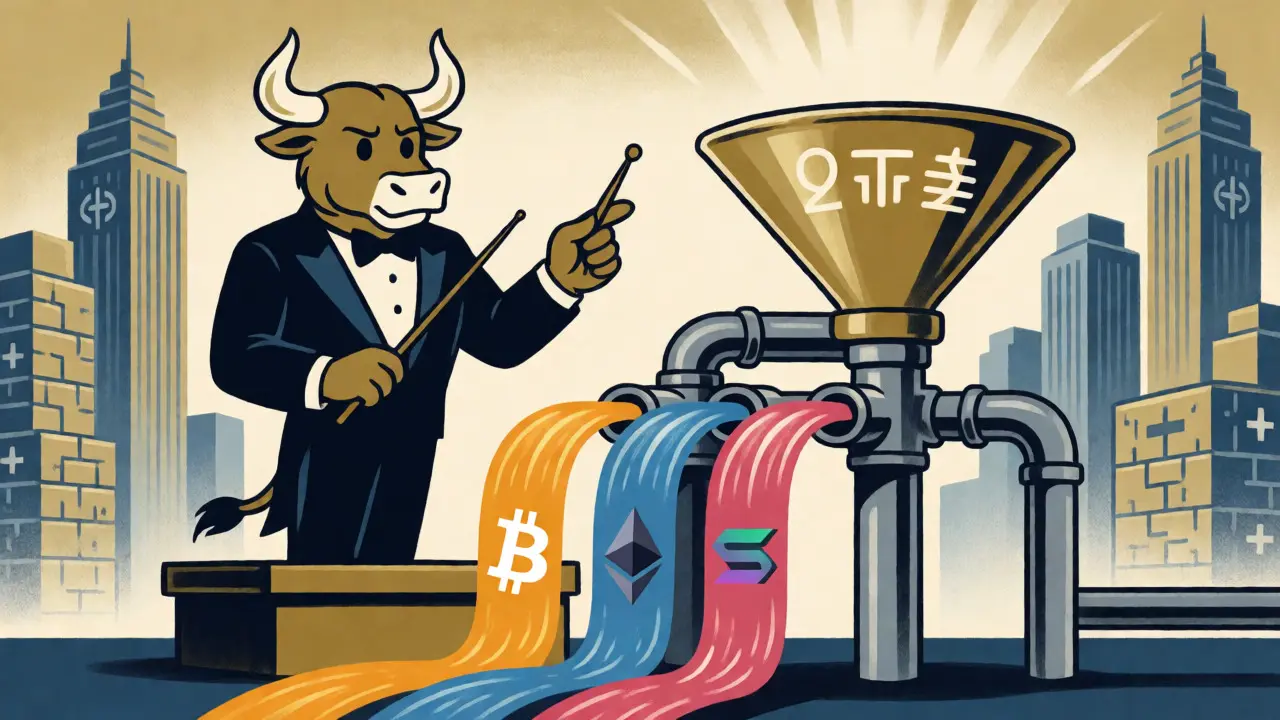
Imagine trying to trade Bitcoin, Ethereum, and Solana all at once without juggling five different accounts, losing money on spread differences, or worrying about which exchange has the deepest liquidity. That’s the problem Troy Trade tries to solve. And sitting at the heart of this solution is a small, often overlooked asset: TROY (TROY), a utility token designed to power fees, incentives, and advanced features within a global prime brokerage ecosystem.
If you’ve seen "TROY" pop up in your wallet or on an exchange and wondered what it actually does, you’re not alone. It’s not one of those flashy meme coins that spike because of a tweet. It’s a functional tool for serious traders. But here’s the catch: there are two different projects using the name TROY, and mixing them up can cost you real money. One is a veteran player in the crypto infrastructure space; the other is a newer DeFi experiment. This guide cuts through the noise to explain exactly what TROY is, how it works, and why its market data looks so confusing right now.
The Core Concept: Prime Brokerage Meets Blockchain
To understand TROY, you first need to understand what it serves. Most people think of crypto exchanges as simple buying-and-selling venues. You deposit cash, buy Bitcoin, and leave. Troy Trade operates differently. It functions as a global prime broker for institutional clients and professional traders. Think of it less like a retail shop and more like a high-end financial concierge.
A prime broker aggregates liquidity from multiple sources. Instead of logging into Binance for spot trading, Kraken for derivatives, and Coinbase for custody, a user with Troy Trade gets access to all these services through a single account. The platform handles:
- Liquidity Aggregation: Pulling order books from various centralized exchanges to find the best price.
- Smart Order Routing: Using algorithms to split large trades across venues to minimize slippage.
- Asset Management: Offering custody, lending, staking, and data analytics in one dashboard.
This model targets sophisticated users who care about execution speed and capital efficiency, not just casual investors looking to HODL. TROY is the fuel for this machine.
Technical Specs: Not a Standalone Blockchain
One common misconception is that TROY runs on its own Layer-1 blockchain, like Bitcoin or Ethereum. It doesn’t. If you look closely at transaction data, you’ll see that TROY operates on the BNB Beacon Chain, specifically as a BEP2 standard token. Its asset code is TROY-9B8.
Why does this matter? Because it dictates how you store and move the coin. You cannot send TROY to a standard Ethereum address (0x...). You must use a BEP2-compatible wallet, such as Trust Wallet or a BNB Chain-enabled hardware wallet. When depositing to an exchange, you almost always need to include a "Memo" field. Forget the memo, and your funds might get lost in the void-a classic beginner mistake with BEP2 assets.
| Attribute | Value / Detail |
|---|---|
| Blockchain Network | BNB Beacon Chain (BEP2) |
| Token Standard | BEP2 |
| Total Supply | 10,000,000,000 (10 Billion) |
| Circulating Supply | ~10 Billion (Effectively fully circulating) |
| Launch Year | 2020 |
| Primary Use Case | Utility & Fee Payment |
Tokenomics: The 10 Billion Question
Let’s talk numbers, because they are surprisingly straightforward compared to many modern tokens. TROY has a fixed maximum supply of 10 billion tokens. There is no inflation mechanism mentioned in major data feeds, meaning new tokens aren’t being minted endlessly to dilute holders.
Data from providers like CoinCarp and Coinbase suggests that nearly the entire 10 billion supply is already in circulation. Some sources cite 86.25% circulating, but given the total equals the max, this likely refers to internal vesting metrics or effective float rather than locked reserves. For practical purposes, if you hold TROY, you are holding a significant portion of the total available supply relative to its market cap.
This capped supply creates scarcity, but scarcity only matters if demand exists. As of late 2026, TROY sits firmly in the micro-cap category. Depending on which aggregator you check, its market cap fluctuates between $1 million and $6 million. This low valuation reflects limited adoption outside of its core user base.
The Name Confusion: Troy Trade vs. TroyVest
Here is where things get tricky for new investors. If you search for "TROY" on CoinGecko or similar sites, you might encounter a project called TroyVest. Despite sharing the ticker symbol, TroyVest is a completely separate entity focused on DeFi governance and volatility insurance.
Do not confuse the two:
- Troy Trade (TROY): Launched in 2020, BEP2 token, used for prime brokerage fees and incentives. Active trading on Pionex and others.
- TroyVest (TROY): A dual-token system (using VNDX for governance) aimed at protecting retail investors via insurance protocols. As of mid-2026, its TROY token was largely unavailable for public trading on major aggregators.
Always verify the contract address or the project description before buying. Buying TroyVest expecting the utility benefits of Troy Trade will lead to disappointment, especially since TroyVest’s liquidity profile is vastly different.
Market Reality: Liquidity and Volatility
You might notice wild discrepancies in TROY’s price depending on where you look. On September 4, 2026, CoinPaprika listed TROY at roughly $0.000439. Meanwhile, TradingView showed a price closer to $0.000137. Why the gap?
The answer lies in liquidity fragmentation. TROY is primarily traded on Pionex, which accounts for the vast majority of its daily volume. Other major exchanges like Binance or Kraken may list the token, but their markets are often thin or inactive. If a large sell order hits Pionex, the price drops sharply there, while stagnant orders on other platforms don’t reflect that change immediately.
This makes TROY susceptible to high volatility during low-volume periods. A $500 sell order could move the price by several percentage points. For institutional users inside the Troy Trade ecosystem, this isn’t a problem-they trade directly on the platform. For external speculators, it means you need to be careful about entry and exit prices.

Utility: What Can You Actually Do With TROY?
Holding TROY isn’t just about speculation. Within the Troy Trade ecosystem, the token unlocks specific privileges:
- Fee Discounts: Paying trading fees in TROY typically reduces costs compared to paying in USDT or BTC.
- Access to Advanced Tools: Certain AI-driven analytics and risk management dashboards require TROY holdings or payments.
- Incentives: Brokers and node operators who contribute liquidity or security to the network receive TROY rewards.
- Governance: While not fully decentralized, holding TROY gives users a voice in platform updates and feature prioritization.
Staking options exist, though detailed APY figures are not consistently published in public market data. Users should check the official Troy Trade documentation for current staking parameters before locking up funds.
Verdict: Is TROY Worth Watching?
TROY is a niche play. It won’t make you rich overnight like a viral meme coin, nor will it replace Bitcoin as a store of value. Its value proposition is tied entirely to the success of Troy Trade as a prime brokerage service. If the platform attracts more institutional clients and increases trading volume, the demand for TROY (for fees and incentives) rises. If the platform stagnates, the token remains a micro-cap curiosity.
For now, TROY represents a bet on the consolidation of crypto trading services. It’s a tool for professionals, not a toy for gamblers. If you’re a trader frustrated with fragmented liquidity, investigating Troy Trade-and by extension, holding some TROY-might offer a tangible workflow improvement. Just remember: check the network (BEP2), check the project (Trade vs. Vest), and watch the liquidity depth before making big moves.
Is TROY a good investment?
TROY is a high-risk, micro-cap asset. Its value depends heavily on the adoption of the Troy Trade platform. It lacks the broad utility of top-tier exchange tokens like BNB, so it is better suited for users who actively use Troy Trade rather than passive long-term holders seeking mass-market growth.
Which blockchain does TROY run on?
The primary TROY token associated with Troy Trade runs on the BNB Beacon Chain using the BEP2 standard. Ensure your wallet supports BEP2 assets and always use the correct Memo/Tag when transferring.
Where can I buy TROY crypto?
Pionex currently offers the highest liquidity for TROY. Other exchanges like BitMart or MEXC may also list it, but volumes can be very low. Always check the 24-hour trading volume before purchasing to avoid getting stuck with illiquid positions.
What is the difference between Troy Trade and TroyVest?
They are unrelated projects sharing a ticker. Troy Trade is a prime brokerage platform launched in 2020. TroyVest is a DeFi protocol focused on volatility insurance and governance. Verify the contract address to ensure you are buying the correct asset.
Can I stake TROY?
Yes, staking is part of the Troy Trade ecosystem, allowing users to earn rewards and potentially reduce fees. However, specific APY rates and lock-up periods vary, so consult the official Troy Trade platform for the most current staking terms.