

Standard (STND) isn't another meme coin or a copycat token. It’s a protocol built to fix real problems in decentralized finance - specifically, how stablecoins behave when markets crash. If you’ve ever wondered why some stablecoins lose their peg or why DeFi platforms feel fragile, STND was designed to answer those questions. But here’s the thing: most people still don’t understand what it actually does. Let’s cut through the noise.
What Standard (STND) Actually Is
Standard (STND) is the governance token of Standard Protocol, a decentralized finance (DeFi) protocol built on Polkadot that uses a rebaseable, collateralized system to create stable digital assets. Unlike Bitcoin or Ethereum, STND doesn’t aim to be money. It’s not meant to be spent at coffee shops or traded for NFTs. Its job is to power the engine behind another token called Meter (MTR), which is the actual stablecoin users interact with.
Think of STND like the voting rights and fuel for a car. You don’t drive the key - you use it to start the engine. STND lets holders vote on protocol changes, earn fees from users borrowing stablecoins, and stake their tokens to help secure the system. It’s not a currency. It’s infrastructure.
The Three Tokens Behind Standard Protocol
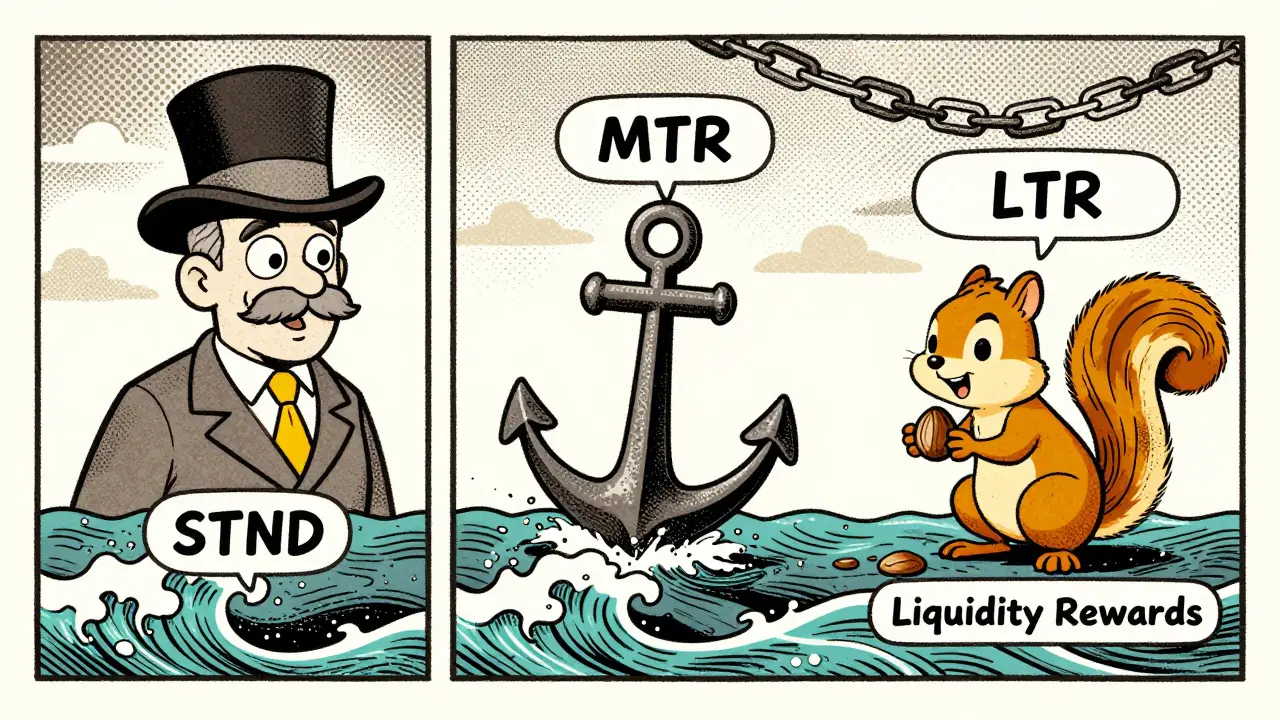
Standard Protocol doesn’t run on one coin. It runs on three. Each has a specific job:
- STND - The governance token. Used for voting, staking, and collecting protocol fees.
- Meter (MTR) - The stablecoin. Designed to stay pegged to $1 USD, generated when users lock up collateral like ETH or BTC in a vault.
- Liter (LTR) - The liquidity token. Earned when users provide trading pairs on the protocol’s AMM (automated market maker). Used for farming rewards.
This three-token structure is rare. Most DeFi projects use one or two tokens. Standard’s design tries to separate power (STND), value (MTR), and liquidity (LTR). That’s intentional. It’s meant to reduce risk and increase transparency.
How the Rebase Mechanism Works
Here’s where Standard gets weird - and interesting. Most stablecoins like USDT or USDC are backed by cash or reserves. If those reserves shrink, the peg breaks. Standard doesn’t work that way.
Instead, it uses a rebaseable supply, a system where the total number of tokens automatically expands or contracts based on price. If MTR trades above $1, the system increases supply to bring the price down. If it drops below $1, supply shrinks to push the price back up. No centralized reserve. No bank. Just code.
This isn’t new - projects like Ampleforth used rebase too. But Standard adds collateral. Users must lock up assets like Ethereum or Bitcoin to mint MTR. That collateral must always be worth more than the MTR created. If the value of the collateral drops too low, the system automatically liquidates it. It’s like a crypto mortgage with built-in insurance.
Why Polkadot? And Why Not Just Ethereum?
Standard Protocol launched on Polkadot, a blockchain designed for cross-chain communication and scalability. That’s not random. Polkadot lets Standard connect with other chains - Ethereum, Bitcoin, even Solana - without needing a bridge that can be hacked.
Most DeFi projects are stuck on Ethereum. High fees, slow transactions, and congestion make it hard for small users to participate. Standard’s goal is to be chain-agnostic. It doesn’t just support Ethereum and Bitcoin - it’s built to integrate with them natively. That’s ambitious. Most protocols talk about cross-chain. Standard is trying to build it from the ground up.
Tokenomics: Supply, Price, and Market Reality
As of February 18, 2026:
- Total supply: 100,000,000 STND
- Circulating supply: 85,574,950 STND
- Current price: ~$0.0054-$0.014 (varies by exchange)
- Market cap: ~$465K (Coinbase) to $392K (Investing.com)
- All-time high: $3.06 (May 14, 2021)
- 24-hour trading volume: ~$149K
The drop from $3.06 to under $0.01 is brutal. That’s a 99.8% decline. But here’s what most people miss: the token’s value isn’t tied to speculation. It’s tied to usage. If no one is minting MTR, locking collateral, or staking STND, then the token doesn’t matter.
Right now, usage is low. Trading volume is tiny. The protocol hasn’t cracked mainstream adoption. But it’s still alive. That’s more than most projects from 2021 can say.

Who Built It? And Is It Still Active?
Standard Protocol was launched in Q1 2021 by a small team: Hyungsuk Kang (Head of Technology), Dixon Wong (Product Owner), and Beli Hong (Administrator). They raised $3.58M in funding through an ICO and private rounds. That’s solid backing for a DeFi startup.
Since then, updates have been slow. There’s no flashy marketing. No celebrity endorsements. No viral Twitter threads. But the code is still running. The vaults are still accepting collateral. The governance votes still happen. The team hasn’t vanished. They’re quiet, but they’re not gone.
Is STND Worth Anything?
Here’s the honest answer: as a speculative investment? Probably not. If you bought STND at $3, you’re underwater. If you bought it at $0.01, you’re still betting on a long shot.
But if you care about DeFi innovation - about building stablecoins that don’t rely on centralized banks or auditors - then STND matters. It’s one of the few protocols trying to solve the core problem: how do you make a decentralized stablecoin that survives a crash without a central authority?
It’s not the answer. But it’s asking the right questions. And in crypto, that’s rare.
What’s Next for Standard Protocol?
The roadmap isn’t public. There’s no flashy whitepaper update. But the fact that it’s still live after five years suggests something important: it’s not dead. It’s waiting.
Its real test will come when Bitcoin or Ethereum sees another major crash. Will MTR stay pegged? Will the collateral system hold? Will STND holders still be incentivized to keep the system running? No one knows. But if it works, Standard could become a blueprint for the next generation of DeFi.
For now, it’s a quiet experiment. Not a boom. Not a bubble. Just code trying to do something hard.
Is Standard (STND) a stablecoin?
No. STND is the governance token of the Standard Protocol. The actual stablecoin is called Meter (MTR), which is designed to stay pegged to $1 USD. STND is used for voting, staking, and earning fees - not for spending or trading as money.
Can I stake STND to earn rewards?
Yes. Holders of STND can stake their tokens to earn a portion of the stability fees collected from users who open vaults to mint Meter (MTR). Staking also gives you voting power in protocol decisions.
Why is STND’s price so low compared to its all-time high?
STND hit $3.06 in May 2021 during a crypto bull run. Since then, the market has corrected, and the protocol hasn’t gained widespread adoption. Its value is tied to usage, not hype. Low trading volume and minimal DeFi activity mean demand is low. The price reflects that.
Is Standard Protocol safe to use?
It’s as safe as the code it runs on. The protocol is open-source and lives on Polkadot, which has a strong security track record. However, like all DeFi projects, it carries smart contract risk. If a bug is found in the vault system, funds could be lost. Always do your own research before locking up assets.
Can I use STND on Ethereum or Bitcoin?
You can’t use STND directly on Ethereum or Bitcoin. But Standard Protocol allows users to lock up ETH or BTC as collateral to mint MTR, the stablecoin. The protocol is built on Polkadot, but it’s designed to interact with those chains. Cross-chain functionality is still limited and not fully live yet.
Where can I buy STND?
STND is available on a few decentralized exchanges like PancakeSwap and SushiSwap. It’s not listed on major platforms like Coinbase or Binance. You’ll need a wallet like MetaMask and some ETH or BNB to trade for it. Be cautious - low liquidity means large price swings on small trades.
Sasha Wynnters
February 18, 2026 AT 07:33STND isn't a coin. It's a governance wrench in a machine nobody's sure still works. I love that. Most projects chase hype, but this? It's the quiet guy in the back who fixed the server at 3am while everyone else was posting memes. No splash, no influencer collabs, just code holding the line. That's art in crypto.
Remember when Ampleforth tried to rebase and everyone screamed "it's a rug pull"? STND learned from that. It didn't just copy the mechanism-it layered in collateral. That’s not innovation. That’s engineering.
People keep asking why the price is trash. Bro, it’s not supposed to be a trading pair. It’s the voting rights to a system that’s still alive after five bear markets. That’s like finding a diesel engine from 1987 that still runs on rainwater. You don’t sell the bolt. You protect the whole damn thing.
I’ve staked my STND. Not for profit. For principle. If this protocol dies, it dies because no one believed in the idea. Not because the code failed. And that’s sadder than any 99.8% drop.
They’re not hiding. They’re waiting. For the next crash. When every stablecoin tied to a bank account melts down, and the world realizes: maybe the answer wasn’t in a vault in Delaware. Maybe it was in a smart contract on Polkadot, quietly minting MTR while the rest of crypto screamed into the void.
Angela Henderson
February 19, 2026 AT 00:02I just don’t get why people are so mad about the price. Like, I’ve been in crypto since 2017 and I’ve seen so many projects go to zero and come back. This one? It’s still running. The vaults are open. The votes still happen. The code doesn’t care if you’re rich or broke. It just does its job. That’s rare. I think people forget that crypto isn’t about making money. It’s about building something that works without permission. And STND? It’s still building.
I don’t trade it. I just watch it. Like a plant. Slow growth. No drama. Maybe that’s the point.
Paul David Rillorta
February 19, 2026 AT 18:36STND? More like STND-17: the government’s backdoor stablecoin. They’re not trying to fix DeFi. They’re trying to replace the dollar with something no one can audit. Polkadot? That’s just a smokescreen. The real team? Probably some ex-Fed guys with crypto wallets and zero public photos. Why else would they vanish after raising $3.58M? Classic. They knew the price would crash. They cashed out. Now they’re just waiting for the next bubble so they can do it again. Wake up.
And don’t even get me started on "rebase"-that’s just inflation with a fancy name. You think people are gonna trust a token that shrinks and grows like a weird breathing thing? Nah. This is all a psyop to get us to abandon fiat. And I’m not falling for it.
Ian Plunkett
February 20, 2026 AT 13:47Market cap: $400K. 24h volume: $150K. That’s not a protocol. That’s a liquidity pool with a dream.
STND’s value isn’t tied to usage-it’s tied to the number of people who still believe in it. And right now? That number is shrinking. The team’s quiet. The roadmap’s gone. The collateral ratios? Unverified. This isn’t innovation. It’s a zombie. And you’re all clinging to it because you’re too emotional to admit you lost money on a ghost.
📉
Avantika Mann
February 21, 2026 AT 02:50Hey, I just started learning about DeFi and this post helped me so much. I didn’t even know STND wasn’t the stablecoin-I thought it was like USDC. Thanks for breaking it down so clearly!
I staked 500 STND last week. I know it’s tiny, but I believe in the idea. If this works, it could change how we think about money. I’m not here to get rich. I’m here to learn. And I think this is worth sticking with. 💪❤️
Nikki Howard
February 23, 2026 AT 02:25The fact that you’re still defending this token after a 99.8% drop is the most telling metric of all.
STND’s entire value proposition rests on a single assumption: that users will continue to lock up ETH/BTC to mint MTR. But why? The fees are higher than on Aave. The interface is clunky. The liquidity is nonexistent. No one uses it. Not because it’s misunderstood. Because it’s worse.
You’re not a visionary. You’re a sunk-cost fallacy collector.
📉
jennifer jean
February 23, 2026 AT 20:53Love how this post didn’t try to sell you anything. Just laid out the facts. STND is quiet. But quiet doesn’t mean dead. It means patient. And honestly? I think we need more of that in crypto.
My husband bought STND at $0.008. We didn’t even check the price for 6 months. Then we saw it was still live. Still minting. Still voting. We didn’t sell. We just kept staking. Not because we think it’ll go to $1. But because we believe in the idea of a stablecoin that doesn’t need a bank.
🌱
Beth Erickson
February 24, 2026 AT 12:45Polkadot? More like Polka-DOT-com. You think this is gonna beat Ethereum? Lol. USDT has 100 billion in circulation. STND’s whole market cap is less than what a single whale dumped in 2021. This isn’t innovation. It’s a graveyard with a website.
Stop romanticizing failure. This isn’t a quiet experiment. It’s a corpse. And you’re all holding candles around it.
Geet Kulkarni
February 24, 2026 AT 20:14One must question the ontological validity of a governance token with a market cap lower than the annual salary of a junior blockchain developer. The structural integrity of Standard Protocol is not merely underdeveloped-it is ontologically insufficient. One cannot build a monetary system on the ashes of a failed 2021 narrative. The rebase mechanism, while theoretically elegant, is a mathematical illusion divorced from real-world liquidity dynamics. One must ask: is this protocol a solution-or merely a philosophical artifact of a bygone bull run?
andy donnachie
February 26, 2026 AT 00:11STND’s real strength? It’s still here. Most projects vanish after one bear market. This one? Still has active governance votes. Still accepts collateral. Still has people staking. That’s not luck. That’s discipline.
I’m not saying it’ll go to $1. But if you’re looking for a project that’s actually building-not marketing-this is one of the few left. The team’s quiet, but the code speaks. And right now? That’s rarer than a working DeFi protocol.
James Breithaupt
February 26, 2026 AT 22:53Standard Protocol is the only DeFi project I’ve seen that actually separates concerns: governance (STND), stability (MTR), liquidity (LTR). That’s not just smart-it’s textbook. Most protocols mash everything into one token and wonder why it crashes. Here? You can’t manipulate the stablecoin without touching the governance. You can’t pump liquidity without staking. It’s a layered defense.
Yeah, the price is trash. But look at the collateral ratios. Look at the vault utilization. It’s low. But it’s stable. That’s the point. This isn’t a pump. It’s a foundation. And foundations don’t trend on Twitter.
Alex Williams
February 28, 2026 AT 15:59STND is like the battery in your phone. You don’t notice it until it dies. Right now, the system’s running on fumes. But it’s still running. And that’s more than most projects can say.
If you’re looking for a moonshot, look elsewhere. But if you care about DeFi surviving the next crash? This is one of the few protocols designed to handle it. The collateralization is real. The rebase isn’t magic-it’s math. And the fact that it’s on Polkadot? That’s the quiet advantage. No bridge hacks. No Ethereum congestion. Just clean, cross-chain mechanics.
It’s not sexy. But it’s solid.
sruthi magesh
March 1, 2026 AT 13:49STND? More like STND-OUT. 99.8% drop. No roadmap. No team updates. No liquidity. This isn’t innovation. It’s a graveyard with a whitepaper. You think people care about "infrastructure"? Nah. They care about price. And this? It’s dead. Wake up. This isn’t a revolution. It’s a funeral.
Lisa Parker
March 2, 2026 AT 22:19I just lost everything on this. I believed. I staked. I thought it was the future. Now I’m just sitting here watching the price tick down. Every time I check, it’s lower. I don’t hate the team. I hate myself for believing. Why did no one warn us? Why did we think this was different? I just wanted to believe in something real. And now I feel so stupid.
Aileen Rothstein
March 3, 2026 AT 17:42People keep saying "it’s dead" because the price is low. But what if it’s not dead? What if it’s just… waiting? What if the next crash is the moment this whole thing flips? Imagine if MTR stays pegged while USDC and USDT fail. Imagine if the collateral system holds. Imagine if STND holders vote to expand to Bitcoin L2s. That’s not fantasy. That’s possible. And it’s quiet because it’s not trying to be loud. It’s trying to be right.
Don’t give up on the quiet ones. They’re the ones who change the world.
JJ White
March 4, 2026 AT 03:40Oh wow. A DeFi project that doesn’t have a CEO on Twitter with a Tesla. How revolutionary. How… boring. You think this is a blueprint for the future? No. It’s a relic. A museum piece. The only thing more outdated than STND is the idea that anyone still cares about governance tokens with $150K volume. This isn’t innovation. It’s a time capsule from 2021 labeled "Wishful Thinking".
And the fact that you’re still defending it? That’s the real tragedy.
Nicole Stewart
March 5, 2026 AT 17:14Low price low volume low utility low team presence low future. No need for more. STND is dead. Move on.
Alan Enfield
March 7, 2026 AT 09:25I’ve been watching this for years. STND’s not going to moon. But it’s also not going to die. The team’s quiet, but the protocol’s alive. That’s rare. Most projects burn out after a year. This one? Still has active stakers. Still has collateral locked. Still has governance votes. That’s not a failure. That’s resilience.
It’s not glamorous. But it’s real.
Jennifer Riddalls
March 9, 2026 AT 07:37I’m new to crypto but this post made me feel like I actually understand something. STND isn’t flashy. But it’s honest. I don’t know if it’ll make me rich. But I like that it’s trying to solve a real problem. Not hype. Not memes. Just code. That’s worth something.
Thank you for writing this. I’m going to keep learning.
Kyle Tully
March 11, 2026 AT 06:10You’re all clinging to this like it’s your last hope. Newsflash: it’s not. The team hasn’t posted in a year. The volume is a ghost. The collateral ratios? Unaudited. You’re not visionaries. You’re emotional hoarders. This isn’t a revolution. It’s a funeral procession with a whitepaper.
And the fact that you’re still defending it? That’s the real collapse.
kieron reid
March 12, 2026 AT 20:07STND? Yeah, I checked it once. Price: $0.005. Volume: $100K. Team: silent. Roadmap: gone. Why are you still talking about this? It’s not a project. It’s a zombie. Let it rest.
yogesh negi
March 13, 2026 AT 08:17Let me say this with love: STND is not dead. It is sleeping. And sleep is not surrender. The protocol is still running. The vaults are still accepting collateral. The governance votes still happen. That’s not luck. That’s discipline. Most projects fade when the sun goes down. This one? It’s still working in the dark. And sometimes, that’s the quietest kind of strength.
Keep staking. Keep voting. The world isn’t ready for this yet. But one day, it will be.
Tarun Krishnakumar
March 14, 2026 AT 19:10STND is a psyop. The team is probably working with some central bank to create a CBDC disguised as DeFi. Why else would they choose Polkadot? Why else would they avoid Ethereum? Why else would they have zero marketing? This isn’t innovation. It’s a Trojan horse. They’re not trying to fix stablecoins. They’re trying to replace the dollar. And you’re all helping them by holding STND. Wake up. This isn’t crypto. It’s surveillance capitalism with a blockchain sticker.
george chehwane
March 16, 2026 AT 17:36STND is the last honest DeFi project. No influencer. No roadmap. No VC shilling. Just code. And a stubborn team that refuses to quit. The price is trash because the market doesn’t understand it. But the protocol? It’s still running. And that’s more than I can say for 90% of the projects from 2021.
You don’t need hype to build something that lasts. You just need to show up. And they did.
Charrie VanVleet
March 17, 2026 AT 07:10Some people see a dead project. I see a quiet revolution.
STND isn’t trying to be the next Bitcoin. It’s trying to be the quiet backbone of something bigger. A stablecoin that doesn’t rely on banks. A governance system that doesn’t need to be loud. A team that doesn’t need to be famous.
I staked my STND not because I think it’ll go to $1. But because I believe in the idea that crypto can be more than a casino.
🌱
Scott McCrossan
March 18, 2026 AT 08:32Let’s be real: STND is a ghost. The team ghosted. The volume ghosted. The roadmap ghosted. And you’re still here, talking about "infrastructure" like it’s a virtue. It’s not. It’s a corpse with a GitHub repo. This isn’t a blueprint. It’s a tombstone.
Stop romanticizing failure. It’s not brave. It’s delusional.
Rajib Hossaim
March 19, 2026 AT 04:22The concept of separating governance, stability, and liquidity is philosophically sound. The execution, however, remains nascent. The market’s disinterest is not irrational; it is a reflection of insufficient adoption incentives. One must consider whether the current utility justifies the risk. Until then, STND remains a theoretical construct awaiting empirical validation.
Ruby Ababio-Fernandez
March 19, 2026 AT 07:34STND? LOL. $0.01? This isn’t DeFi. This is a charity. Stop pretending it’s revolutionary. It’s just another failed experiment. Move on.
Jenn Estes
March 20, 2026 AT 04:22I’ve seen this movie before. Team raises millions. Launches token. Then disappears. Price crashes. Supporters cling to "the vision." It’s always the same. STND? Just another footnote. Wait until the team vanishes for good. Then you’ll see the truth.
Jeremy Fisher
March 21, 2026 AT 22:28STND is the quietest revolution I’ve ever seen. No hype. No ads. No celebrities. Just code. And people who still believe in it. I don’t know if it’ll work. But I know this: in a world of screaming crypto projects, this one just… keeps going.
That’s worth something.