

When you stake Ethereum (ETH), your coins get locked up. You can’t trade them, use them in DeFi, or move them around until Ethereum fully unlocks withdrawals - and that didn’t happen until April 2023. But what if you could still earn staking rewards while keeping your ETH liquid? That’s where sETH2 comes in.
What Exactly Is sETH2?
sETH2 is a token issued by StakeWise that represents your staked ETH on Ethereum 2.0. Every sETH2 token you hold equals one ETH that’s actively staking on the network - plus any rewards you’ve earned along the way. Unlike regular staking, where your ETH sits idle for months or even years, sETH2 lets you use your staked assets right away.
Think of it like a receipt. You deposit 1 ETH into StakeWise’s smart contracts. In return, you get 1 sETH2. As your ETH earns staking rewards (around 3-5% APY as of early 2023), your sETH2 balance grows automatically. You don’t need to claim rewards manually. They’re baked into the token value.
This isn’t just a gimmick. It solves a real problem. Before liquid staking tokens like sETH2, staking ETH meant giving up liquidity. Now, you can hold sETH2 in your wallet, send it to another address, or trade it on decentralized exchanges like Uniswap or 1inch - all while still earning rewards.
How Does sETH2 Work?
The process is simple, but the tech behind it is advanced. Here’s how it works step by step:
- You connect a Web3 wallet (like MetaMask) to StakeWise’s dApp.
- You deposit ETH - minimum 0.01 ETH, which is way lower than the 32 ETH needed for solo staking.
- StakeWise’s smart contracts lock your ETH and assign it to one or more validator nodes on Ethereum 2.0.
- In return, you receive sETH2 tokens at a 1:1 ratio.
- As your ETH earns staking rewards, your sETH2 balance increases automatically.
- You can use sETH2 in DeFi apps like Aave, Curve, or Yearn.finance to earn even more yield.
StakeWise uses a dual-token system internally: sETH2 tracks your original staked ETH, and rETH2 tracks your rewards. But in most interfaces, these are combined into one balance so you don’t have to manage two tokens.
All of this runs on Ethereum’s mainnet. The smart contracts were audited by OpenZeppelin and SigmaPrime - two of the most respected security firms in crypto. No major exploits have happened since launch in 2020.
Why Choose sETH2 Over Other Liquid Staking Tokens?
You’ve probably heard of stETH from Lido or rETH from Rocket Pool. So why pick sETH2?
Here’s the breakdown:
| Feature | sETH2 (StakeWise) | stETH (Lido) | rETH (Rocket Pool) | cbETH (Coinbase) |
|---|---|---|---|---|
| Market Share | <2% | ~74% | ~15% | ~5% |
| Minimum Stake | 0.01 ETH | 0.001 ETH | 16 ETH + RPL | 0.001 ETH |
| DeFi Integration | 12+ protocols | 15+ protocols | 8+ protocols | 3-4 protocols |
| Validator Transparency | Yes - choose your own | No - centralized | Yes - node operator based | No - Coinbase controls all |
| Institutional KYC/AML | Yes - via Blockdaemon | No | No | Yes - but limited DeFi use |
| Daily Trading Volume | $1.2M | $150M | $35M | $25M |
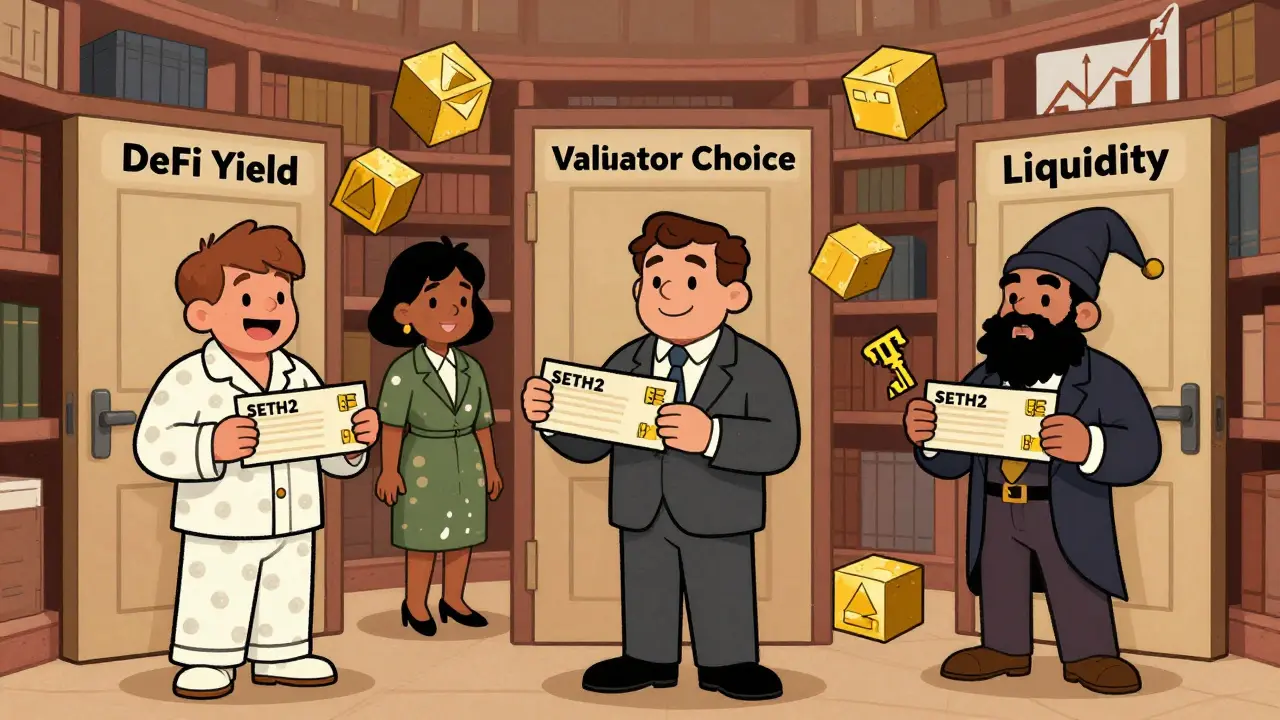
sETH2 doesn’t lead in market share or liquidity. But it stands out in two areas: validator choice and institutional compliance. With StakeWise, you can pick which node operators stake your ETH. That’s a big deal if you care about decentralization. And unlike Lido or Coinbase, StakeWise offers a KYC/AML-compliant staking option for banks and funds - something no other liquid staking protocol offered in 2021-2022.
Who Is sETH2 For?
sETH2 isn’t for everyone. It’s best suited for:
- Retail investors who want to stake ETH without locking it up and still use it in DeFi.
- DeFi power users who want to stack yields - for example, depositing sETH2 into Aave to earn interest while still getting staking rewards.
- Institutional investors who need compliance features and transparency in validator selection.
- Long-term ETH holders who believe in Ethereum’s future but don’t want to miss out on DeFi opportunities.
If you’re a beginner who just wants to stake ETH and forget about it, stETH might be easier. But if you want control, transparency, and DeFi flexibility, sETH2 gives you more tools.
Real User Experiences
People who use sETH2 often praise its flexibility. One Reddit user, StakeMaster420, said using sETH2 in Aave boosted their total yield from 3.8% to 8.2% - without extra risk.
Another user, CryptoFarmer88, said they were able to quickly sell sETH2 during the FTX crash in November 2022, cashing out before prices dropped further. That kind of liquidity saved them money.
But there are downsides. Some users report slippage when trading large amounts of sETH2. Because it’s not as widely traded as stETH, selling 50 sETH2 might require multiple trades across different DEXs, which can cost more in gas and price impact.
Trustpilot reviews show a 4.1/5 average rating. Common compliments: easy interface, responsive support. Common complaints: limited exchange listings and complexity for total beginners.
Security and Risks
There’s no such thing as zero risk in crypto. sETH2 relies on smart contracts. If one has a bug, you could lose funds. But StakeWise’s contracts have been audited twice and have held over $110 million in total value locked (TVL) since 2021 without a single breach.
The bigger risk is systemic. If Ethereum’s staking rewards drop, or if regulators crack down on staking tokens as securities, sETH2’s value could be affected. The SEC hasn’t targeted sETH2 specifically, but it has warned that many staking derivatives could be unregistered securities.
Another concern: market consolidation. Experts predict only 3-4 liquid staking protocols will survive by 2025. Lido and Coinbase have massive resources. StakeWise is smaller. But its focus on institutional-grade security and validator transparency gives it a niche.

Future of sETH2
With Ethereum’s Shanghai upgrade in April 2023, users can now withdraw staked ETH directly. That removes the main reason liquid staking tokens existed - liquidity during lock-up.
But sETH2 isn’t dead. StakeWise’s roadmap includes:
- Cross-chain bridging to Polygon and Optimism
- Institutional API access for hedge funds and asset managers
- Integration with centralized exchanges
The goal? Become the go-to liquid staking solution for institutions that need compliance, transparency, and DeFi compatibility - not just for retail users who want a quick yield boost.
According to Ethereum Foundation researcher Danny Ryan, protocols that prioritize validator diversity and institutional use cases are more likely to survive long-term. That’s exactly what StakeWise is building.
How to Get Started With sETH2
If you want to try sETH2, here’s how:
- Install MetaMask or another Web3 wallet.
- Go to stakewise.io and connect your wallet.
- Deposit ETH (minimum 0.01).
- Receive sETH2 tokens instantly.
- Use them in DeFi apps or hold them for staking rewards.
First-time users might struggle with wallet connections or gas fees. StakeWise has a 4.5/5-rated troubleshooting guide and 27 tutorial videos to help. Their Discord server has over 4,800 members and answers questions in under 30 minutes on average.
Don’t stake more than you’re comfortable losing. And always test with a small amount first.
Final Thoughts
sETH2 isn’t the biggest liquid staking token. It’s not the easiest. But it’s one of the most thoughtful. It doesn’t just solve a technical problem - it addresses real concerns about control, transparency, and compliance.
If you’re someone who values decentralization, wants to earn yield without giving up flexibility, or works in finance and needs KYC/AML-ready tools, sETH2 is worth a closer look. It’s not for passive holders. But for active crypto users, it’s one of the most powerful tools on Ethereum right now.
christal Rodriguez
February 1, 2026 AT 04:52Calvin Tucker
February 1, 2026 AT 12:17Gustavo Gonzalez
February 3, 2026 AT 01:03mary irons
February 3, 2026 AT 11:20Katie Teresi
February 3, 2026 AT 13:08Moray Wallace
February 4, 2026 AT 08:09Jeremy Dayde
February 5, 2026 AT 02:59Akhil Mathew
February 6, 2026 AT 06:39Tom Sheppard
February 8, 2026 AT 03:02Aaron Poole
February 9, 2026 AT 23:37Devyn Ranere-Carleton
February 10, 2026 AT 17:06Kevin Thomas
February 11, 2026 AT 02:35Jerry Ogah
February 13, 2026 AT 01:50Joseph Pietrasik
February 13, 2026 AT 13:17Nickole Fennell
February 15, 2026 AT 11:28Edward Drawde
February 17, 2026 AT 01:19Richard Kemp
February 17, 2026 AT 17:16Gurpreet Singh
February 18, 2026 AT 18:16