
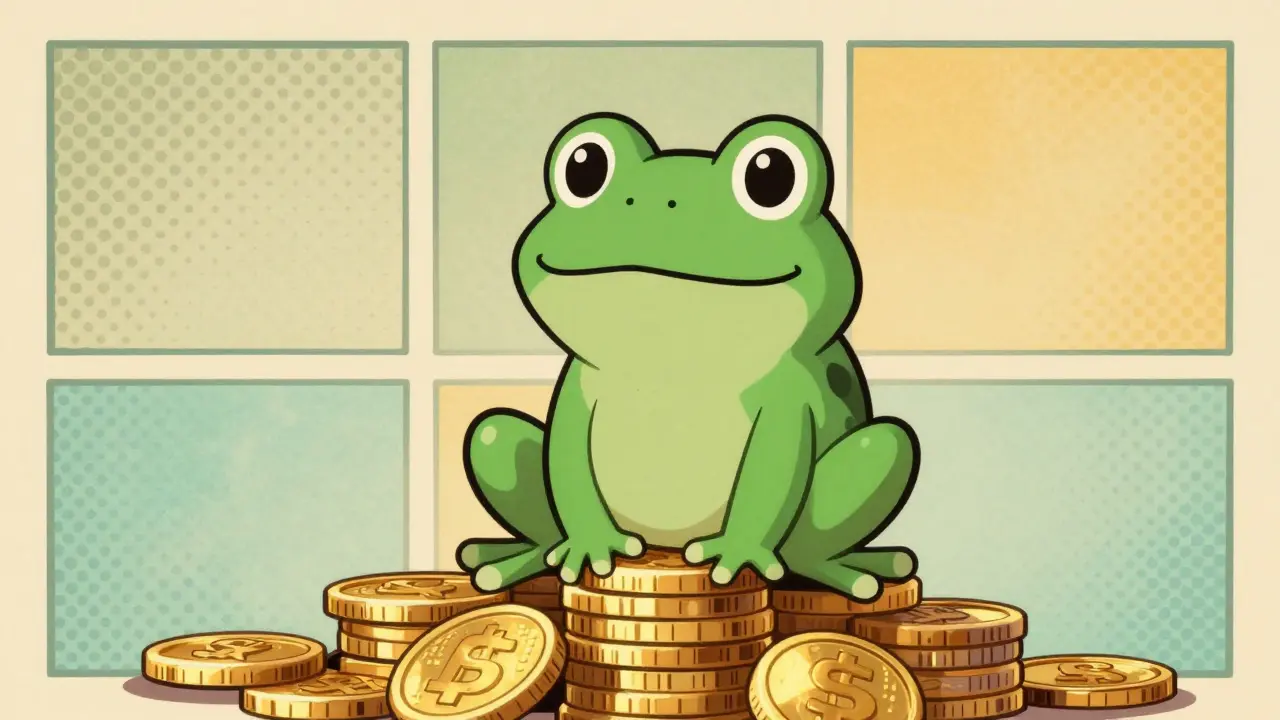
You’ve probably seen the frog. He’s everywhere on social media, from Twitter threads to Instagram stories. But when you hear "Pepe is a decentralized meme-based cryptocurrency built on the Ethereum blockchain as an ERC-20 token." launched in April 2023, it stops being just a joke and starts looking like a financial instrument. Or does it?
If you are wondering what PEPE actually is, how it works, and whether it’s worth your attention in 2026, you are not alone. This coin exploded onto the scene with viral speed, capturing the imagination of retail investors who were tired of serious, utility-heavy projects. It represents the purest form of internet culture meeting finance: no roadmap, no team, just vibes and volatility.
The Origin Story: From Comic Strip to Cryptocurrency
To understand PEPE, you have to look back at its roots. The character Pepe the Frog was created by cartoonist Matt Furie in 2005 for his comic series The Boy and His Fiend. Over the years, the image evolved into one of the most recognizable memes on the internet. However, the creators of the PEPE cryptocurrency have no official connection to Furie or the original artwork. They simply took the cultural icon and built a token around it.
The token went live in April 2023. Unlike Bitcoin, which had a whitepaper and a clear vision, or Ethereum, which aimed to revolutionize computing, PEPE arrived with zero announcements. There was no founding team revealed to the public. No venture capital firms backed it. Just anonymous developers who wanted to create a playful homage to meme culture. This anonymity is both its strength and its biggest risk. You don’t know who is running the show, which means there is no one to blame if things go wrong, but also no one to hold accountable.
How PEPE Works: Technical Specs and Tokenomics
Under the hood, PEPE is an ERC-20 token. This means it lives on the Ethereum network. It doesn’t have its own blockchain. Instead, it piggybacks on Ethereum’s security and infrastructure. If you want to buy, sell, or hold PEPE, you need an Ethereum-compatible wallet like MetaMask. You interact with it through decentralized exchanges (DEXs) like Uniswap.
Here is where the numbers get interesting-and intentionally absurd. The total supply of PEPE was capped at exactly 420.69 trillion tokens. Yes, you read that right. That number is a nod to cannabis culture numerology (420) and internet humor (69). It is designed to be funny, not precise. Because the supply is so massive, the price per individual token is tiny. This allows traders to feel like they own billions of dollars worth of assets, even if the actual value is much lower.
One of the key mechanisms driving PEPE’s value proposition is deflation. The protocol includes a burn mechanism. A small percentage of tokens is destroyed with each transaction. Additionally, the development team has conducted periodic large-scale burns. For example, on October 24, 2023, they burned 6.9 trillion tokens. By late 2025, the circulating supply had dropped to approximately 409.59 trillion tokens. In theory, reducing supply while demand stays constant should increase price. In practice, it mostly serves as a marketing tool to keep the community engaged.
| Feature | Detail |
|---|---|
| Blockchain | Ethereum (ERC-20) |
| Total Supply | 420.69 Trillion (Initial), ~409.59 Trillion (Current) |
| Transaction Tax | 0% (No buy/sell fees) |
| Liquidity | Permanently locked/burned |
| Smart Contract | Immutable (Cannot be altered) |
| Consensus Mechanism | Ethereum Proof-of-Stake (PoS) |
PEPE vs. Other Meme Coins: How Does It Stack Up?
You can’t talk about PEPE without comparing it to the giants: Dogecoin (DOGE) and Shiba Inu (SHIB). All three are meme coins, but they operate very differently.
Dogecoin runs on its own blockchain. It is older, established, and has faster transaction speeds (up to 33 TPS compared to Ethereum’s 12-14 TPS). It also has broader merchant adoption. Shiba Inu has tried to build an ecosystem, launching its own layer-2 solution called Shibarium and a decentralized exchange called ShibaSwap. SHIB is trying to become more than a meme.
PEPE, by contrast, refuses to grow up. It has no staking platform, no metaverse, and no NFT collection attached to it. Its only utility is its status as a meme. Some purists argue this is its greatest strength. It is a pure play on sentiment. If you believe in the power of the internet to move markets, PEPE is the cleanest bet. If you want technology, you will find nothing here.
In terms of market cap, PEPE consistently trails behind DOGE and SHIB. As of Q4 2025, PEPE ranked #23 with a market cap of around $3.2 billion. DOGE sat at #9 with $22.7 billion, and SHIB was #12 with $11.4 billion. PEPE is smaller, which means it has higher potential for explosive growth-but also higher risk of collapse.
The Risks: Why Experts Are Skeptical
Let’s be honest: buying PEPE is gambling. Not investing. Gambling.
Financial analysts warn that PEPE has zero fundamentals. Sarah Young, a crypto analyst at the Financial Times, rated it 1.5 out of 5 stars in late 2025, calling it "speculative excesses of the crypto market." Benjamin Horne, Chief Strategist at Gemini, noted that while it has viral momentum, it lacks utility, staking, or a development team. These are features usually required for long-term sustainability.
The primary risks include:
- Extreme Volatility: PEPE has seen 24-hour price swings of over 37%. You can wake up to a 20% gain or a 40% loss. This makes it unsuitable for conservative portfolios.
- Ethereum Gas Fees: Since PEPE lives on Ethereum, every trade costs gas fees. During peak congestion, these fees can spike to over $45 per transaction. For small trades, this eats into profits significantly.
- No Utility: Without a product or service backing it, the value relies entirely on people believing other people will buy it later. This is the classic "greater fool theory."
- Regulatory Uncertainty: While the U.S. SEC classified it as a non-security utility token in 2025, the European Securities and Markets Authority (ESMA) issued warnings about the heightened risks for retail investors. Regulations could change overnight.
Community and Culture: The Real Engine
If PEPE has no tech, what drives it? Community. The "PEPE Army" is massive. Telegram groups boast tens of thousands of members, and Discord channels are active 24/7. User data from Glassnode shows that 92.3% of PEPE addresses hold less than $1,000 worth of tokens. This is a retail-driven asset, fueled by young investors aged 18-24 who are comfortable with short-term trading strategies.
Trustpilot reviews from early 2026 highlight a split opinion. Positive reviews praise the zero transaction taxes and the fun, engaging community. Negative reviews cite the lack of utility and the stress of watching prices swing wildly. One Reddit user documented turning $500 into $3,200 in a month, only to see it drop back to $750 shortly after. This cycle repeats constantly.
The community also drives innovation, albeit informally. Projects like "PepePay," a proposed payment processor, have emerged from grassroots efforts. None have gained significant traction yet, but they show the desire to give the token real-world use.

Future Outlook: Will PEPE Survive?
Predicting the future of a meme coin is like predicting the weather in a hurricane. Standard Chartered’s 2026 report suggests PEPE could consolidate as a top 30 asset with a sustained $2-5 billion market cap, driven by enduring meme culture. On the other hand, JPMorgan’s Blockchain Research Team forecasts a gradual decline to irrelevance beyond 2028, arguing that novelty fades.
CoinDesk’s analysis points out that most pure meme coins fade within 3-5 years of launch. PEPE launched in 2023. We are entering that danger zone. Unless it develops tangible utility or maintains its cultural relevance, it may struggle to survive past 2030. However, as long as the internet loves frogs, PEPE will likely have a place in the speculative corner of the crypto market.
How to Buy and Store PEPE Safely
If you decide to take the plunge, here is how to do it safely. First, set up a non-custodial wallet like MetaMask. Connect it to a decentralized exchange like Uniswap. Swap ETH for PEPE. Always check the contract address to avoid scams-there are many fake PEPE tokens. Second, consider the timing. Avoid trading during peak Ethereum hours when gas fees are high. Finally, never invest more than you can afford to lose. Treat it as entertainment money, not retirement savings.
Is PEPE a good investment?
PEPE is highly speculative and carries extreme risk. It has no intrinsic utility or underlying business model. While it has shown significant price gains in the past, it is equally prone to sharp declines. It is generally considered suitable only for experienced traders who understand meme coin volatility and can afford to lose their entire investment.
Who created the PEPE coin?
The PEPE coin was launched by anonymous developers in April 2023. There is no publicly identified founding team or organization behind it. The creators have no official connection to Matt Furie, the artist who created the original Pepe the Frog character.
What is the maximum supply of PEPE?
The initial total supply of PEPE was capped at 420.69 trillion tokens. Due to periodic token burns, the circulating supply has decreased. As of late 2025, the circulating supply was approximately 409.59 trillion tokens. The supply is deflationary due to these burn mechanisms.
Does PEPE have any utility?
Currently, PEPE has no inherent utility. It does not offer staking rewards, governance rights, or access to specific platforms. Its value is derived entirely from community engagement, brand recognition, and speculative trading demand. Some community-driven projects aim to add utility, but none have achieved widespread adoption yet.
How does PEPE compare to Dogecoin?
Dogecoin operates on its own blockchain with faster transaction speeds and broader merchant acceptance. PEPE is an ERC-20 token on Ethereum, inheriting its security but also its slower speeds and higher gas fees. Dogecoin has a larger market cap and longer history, while PEPE is a newer, more volatile pure-play meme coin with no ecosystem development.
Is PEPE regulated?
Regulation varies by region. In the U.S., the SEC categorized PEPE as a non-security utility token in 2025 due to its decentralized nature. However, regulatory bodies like ESMA in Europe have issued warnings about the risks of meme coins. Investors should stay informed about local regulations as they evolve.