
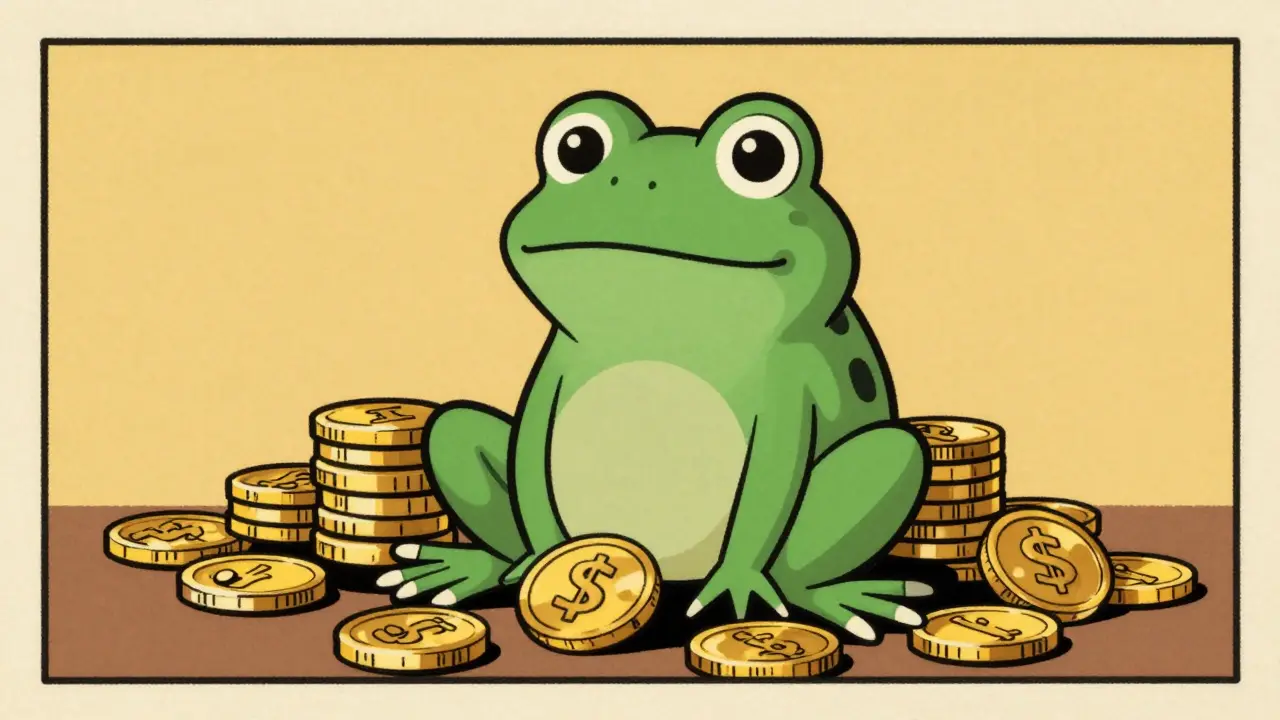
Picture this: you’re scrolling through social media late at night, and there it is again-that green frog staring back at you. But this time, instead of just a funny image, that frog represents billions of dollars in market value. That’s Pepe Community (PEPE), a decentralized meme-based cryptocurrency built on the Ethereum blockchain. Launched in April 2023 by anonymous developers, PEPE isn’t your typical tech-heavy crypto project with whitepapers full of complex algorithms. It’s pure internet culture wrapped in code.
If you’ve heard whispers about PEPE in crypto forums or seen it trending on Twitter, you might be wondering what makes it tick. Is it worth your attention? Or is it just another passing fad? Let’s break down exactly what PEPE is, how it works, and why it has captured the imagination of millions of traders worldwide.
The Origin Story: From Comic Strip to Crypto Star
To understand PEPE, you first need to understand its namesake. The token pays homage to "Pepe the Frog," a character created by cartoonist Matt Furie for his comic series *Boy’s Club*. Over the years, Pepe became one of the most recognizable memes on the internet, used to express everything from sadness to triumph.
However, here’s the catch: the creators of the PEPE token have absolutely no official connection to Matt Furie or the original artist. In fact, the development team behind PEPE remains completely anonymous. There’s no CEO, no public roadmap, and no corporate headquarters. This lack of a central authority is actually part of its appeal to some investors who prefer truly decentralized assets, but it also raises questions about accountability.
When PEPE launched in April 2023, it didn’t come with a massive marketing budget or celebrity endorsements. Instead, it relied on viral momentum. Within weeks, it had amassed a significant following, driven largely by retail investors looking for the next big thing in the meme coin space-a sector already dominated by giants like Dogecoin and Shiba Inu.
How PEPE Works: Technical Basics Without the Jargon
Under the hood, PEPE operates as an ERC-20 token on the Ethereum blockchain. If you’re new to crypto, think of Ethereum as a digital ledger where transactions are recorded securely. An ERC-20 token is simply a standard format that allows different tokens to interact smoothly within that ecosystem.
Here’s what sets PEPE apart technically:
- Zero Transaction Taxes: Unlike many other meme coins that charge fees on every buy or sell, PEPE imposes zero taxes. You keep exactly what you trade.
- Burned Liquidity: To build trust, the developers sent the liquidity pair tokens to a "dead" address (specifically
0xdead). This means no one-not even the creators-can withdraw the funds backing the token’s price stability. - Immutable Smart Contract: Once deployed, the code governing PEPE cannot be changed. This prevents any future manipulation by hidden owners.
One unique feature is its deflationary mechanism. While PEPE doesn’t burn a percentage of tokens automatically with every single transaction like some competitors, it conducts periodic community-driven burns. For example, on October 24, 2023, over 6.9 trillion tokens were burned. More recently, on December 18, 2025, another 4.2 trillion tokens were removed from circulation. These actions reduce the total supply, which theoretically increases scarcity if demand remains constant.
Supply Mechanics: The 420.69 Trillion Number
You can’t talk about PEPE without mentioning its initial supply: exactly 420.69 trillion tokens. Yes, really. Those numbers are a nod to cannabis culture numerology, fitting perfectly with the playful, irreverent spirit of the brand.
| Attribute | Value |
|---|---|
| Initial Total Supply | 420.69 Trillion |
| Circulating Supply (Dec 2025) | ~409.59 Trillion |
| Token Type | ERC-20 |
| Blockchain | Ethereum |
As of early 2026, the circulating supply sits around 409.59 trillion tokens after various burn events. While these burns sound impressive, remember that we’re dealing with trillions of units. A reduction of 11 trillion tokens might seem huge, but it represents less than a 3% decrease in total supply. Still, for a token with no utility beyond speculation, maintaining scarcity is key to keeping holders interested.

PEPE vs. The Giants: How It Stacks Up Against DOGE and SHIB
PEPE didn’t emerge in a vacuum. It entered a market already crowded with established meme coins. To see where it fits, let’s compare it directly with the two biggest players: Dogecoin (DOGE) and Shiba Inu (SHIB).
| Feature | PEPE | Dogecoin (DOGE) | Shiba Inu (SHIB) |
|---|---|---|---|
| Blockchain | Ethereum | Own Chain (PoW) | Ethereum + Shibarium (L2) |
| Transaction Speed | 12-14 TPS (limited by ETH) | Up to 33 TPS | Faster via Layer 2 solutions |
| Utility/Ecosystem | None (Pure Speculation) | Tips, Payments, Charity | ShibaSwap DEX, NFTs, Metaverse |
| Market Cap Rank (Q4 2025) | #23 (~$3.2B) | #9 (~$22.7B) | #12 (~$11.4B) |
| Team Visibility | Anonymous | Community-Driven (Originators Known) | Anonymous Founder (Shytoshi Kusama) |
Notice the stark differences. Dogecoin runs on its own blockchain, allowing faster transactions and lower fees compared to Ethereum-dependent tokens. Shiba Inu has evolved into a mini-ecosystem with its own decentralized exchange (ShibaSwap) and layer-2 scaling solution called Shibarium. PEPE, by contrast, offers none of this. It has no staking rewards, no NFT marketplace, and no planned dApps. Its entire value proposition rests on community sentiment and viral hype.
This simplicity is both its strength and weakness. On one hand, it’s easy to understand: you buy PEPE hoping others will buy it too. On the other hand, it lacks the fundamental anchors that help other projects survive bear markets.
The Risks: Volatility, Gas Fees, and Regulatory Uncertainty
Let’s get real for a moment. Investing in PEPE is not like buying shares in a stable company. It’s closer to betting on a horse race where the rules change daily based on social media trends.
Extreme Volatility: PEPE prices can swing wildly. In January 2026, CoinGecko reported 24-hour price swings as high as 37.2%. One day you could be up 50%, the next you’re down 40%. This makes it unsuitable for risk-averse investors or those needing predictable returns.
Ethereum Gas Fees: Since PEPE lives on Ethereum, every transaction requires paying gas fees to network validators. During peak congestion times, these fees can skyrocket. Data from Etherscan shows average costs ranging from $1.20 during quiet periods to over $45 during busy hours. For small trades, these fees can eat up your profits entirely.
No Fundamental Value: Unlike Bitcoin, which aims to be digital gold, or Ethereum, which powers smart contracts, PEPE has no intrinsic utility. As Sarah Young, a crypto analyst at the Financial Times, noted in October 2025, "PEPE represents the speculative excesses of the crypto market with zero fundamentals." She rated it just 1.5 out of 5 stars, warning that it’s suitable only for high-risk speculators prepared to lose their entire investment.
Regulatory Gray Area: Governments are still figuring out how to handle meme coins. In the U.S., the SEC categorized PEPE as a non-security utility token due to its decentralization, but the European Securities and Markets Authority (ESMA) issued warnings in November 2025 about the heightened risks to retail investors. Regulations could tighten further, potentially impacting exchanges that list PEPE.

Who Is Actually Holding PEPE?
If you’re curious about who else is in the boat with you, the data tells an interesting story. According to Glassnode’s Retail Adoption Report from December 2025, a staggering 92.3% of PEPE addresses hold less than $1,000 worth of tokens. Compare that to Dogecoin, where 78.6% of holders fall into that same bracket. This suggests PEPE is overwhelmingly held by individual retail traders rather than institutional whales.
User behavior studies reinforce this. CoinGecko user feedback from Q4 2025 showed that 58% of users hold PEPE for less than 30 days. Most people aren’t treating it as a long-term savings account; they’re trading it actively, often chasing short-term gains. French crypto forum CryptoFrance reported in December 2025 that 78% of PEPE discussion threads among users aged 18-24 focused on short-term trading strategies rather than long-term holding.
Community support comes primarily from peer-to-peer networks. There’s no official customer service hotline. Instead, traders rely on Telegram groups like "PEPE Army" (which had over 87,000 members in early 2026) and Discord channels for advice and news. YouTube tutorials from creators like "Crypto Meme Master" also play a huge role in educating newcomers, with millions of views across dozens of videos.
Is PEPE a Good Investment in 2026?
That depends entirely on your goals. If you’re looking for a stable store of value or a technology with real-world applications, PEPE is likely not for you. However, if you enjoy the thrill of high-risk, high-reward speculation and believe in the enduring power of internet memes, PEPE offers a unique entry point.
Industry analysts remain divided. Standard Chartered’s 2026 Crypto Report predicts PEPE will consolidate as a top 30 asset with a sustained market cap between $2-5 billion, citing its strong brand recognition. Conversely, JPMorgan’s Blockchain Research Team forecasts a gradual decline to irrelevance beyond 2028, arguing that meme coin novelty fades quickly without underlying utility.
CoinDesk’s analysis in late 2025 added a sobering perspective: "PEPE's survival beyond 2030 appears unlikely without development of tangible utility, as historical precedent shows most pure meme coins fade within 3-5 years of launch." Given that PEPE launched in 2023, we’re entering that critical window now.
Final Thoughts: Play Smart, Not Hard
PEPE is a fascinating case study in modern finance and internet culture. It proves that community and narrative can drive value just as much as technology can. But it also serves as a stark reminder of the risks involved in speculative assets.
If you decide to dip your toes into the PEPE pool, do so with money you can afford to lose. Keep an eye on Ethereum gas fees, stay informed about regulatory developments, and never invest more than you’re comfortable watching disappear overnight. After all, in the world of meme coins, the only constant is change-and sometimes, that change happens faster than you can blink.
What is the purpose of the PEPE token?
The PEPE token has no intrinsic utility or technological function. Its primary purpose is community engagement and speculative trading. It exists purely as a meme-based asset designed for entertainment and social interaction within the crypto space.
Is PEPE connected to the original Pepe the Frog creator?
No. The developers of the PEPE cryptocurrency have no official affiliation with Matt Furie, the artist who created the original Pepe the Frog character. The token is an unofficial homage created by anonymous developers.
How does PEPE differ from Dogecoin?
PEPE runs on the Ethereum blockchain as an ERC-20 token, inheriting Ethereum's transaction speeds and gas fees. Dogecoin operates on its own independent blockchain, offering faster transactions (up to 33 TPS) and lower fees. Additionally, Dogecoin has broader adoption for payments and tips, while PEPE is purely speculative.
Can I earn passive income with PEPE?
Currently, no. PEPE does not offer staking rewards, yield farming opportunities, or dividend distributions. Some sources mention hourly redistributions, but these are not standardized features of the core contract. Any potential earnings would come solely from capital appreciation (selling at a higher price than you bought).
Where can I buy PEPE?
PEPE is traded on major centralized exchanges like Binance and Coinbase, as well as decentralized exchanges (DEXs) such as Uniswap. To trade on DEXs, you’ll need an Ethereum-compatible wallet like MetaMask and sufficient ETH to pay for gas fees.
What are the main risks of investing in PEPE?
The main risks include extreme price volatility, dependence on Ethereum gas fees (which can be expensive), lack of fundamental utility, and regulatory uncertainty. Because PEPE relies entirely on social media trends, its value can drop rapidly if interest wanes.
Does PEPE have a maximum supply?
Yes, the initial total supply was capped at 420.69 trillion tokens. However, this number decreases over time due to periodic token burns conducted by the community and developers, making the actual circulating supply lower than the initial cap.