
KYC Verification Checklist
KYC Document Checklist
Verify your documents meet requirements before submitting to crypto exchanges. This tool checks for the most common reasons for KYC rejection.
Simulated check based on photo quality criteria
Simulated check based on photo quality criteria
Please fill out the form and click "Check My KYC Preparation" to see your results.
When you sign up for a crypto exchange like Coinbase or Binance, you’re asked to upload a photo of your ID, take a selfie, and confirm your address. It feels invasive. You might wonder: Why does cryptocurrency need KYC? After all, Bitcoin was built to be anonymous, right? The truth is, KYC isn’t about controlling you-it’s about keeping the system from collapsing under fraud, money laundering, and scams. Without it, crypto would be too risky for banks, governments, and most everyday users to touch.
What Exactly Is KYC in Crypto?
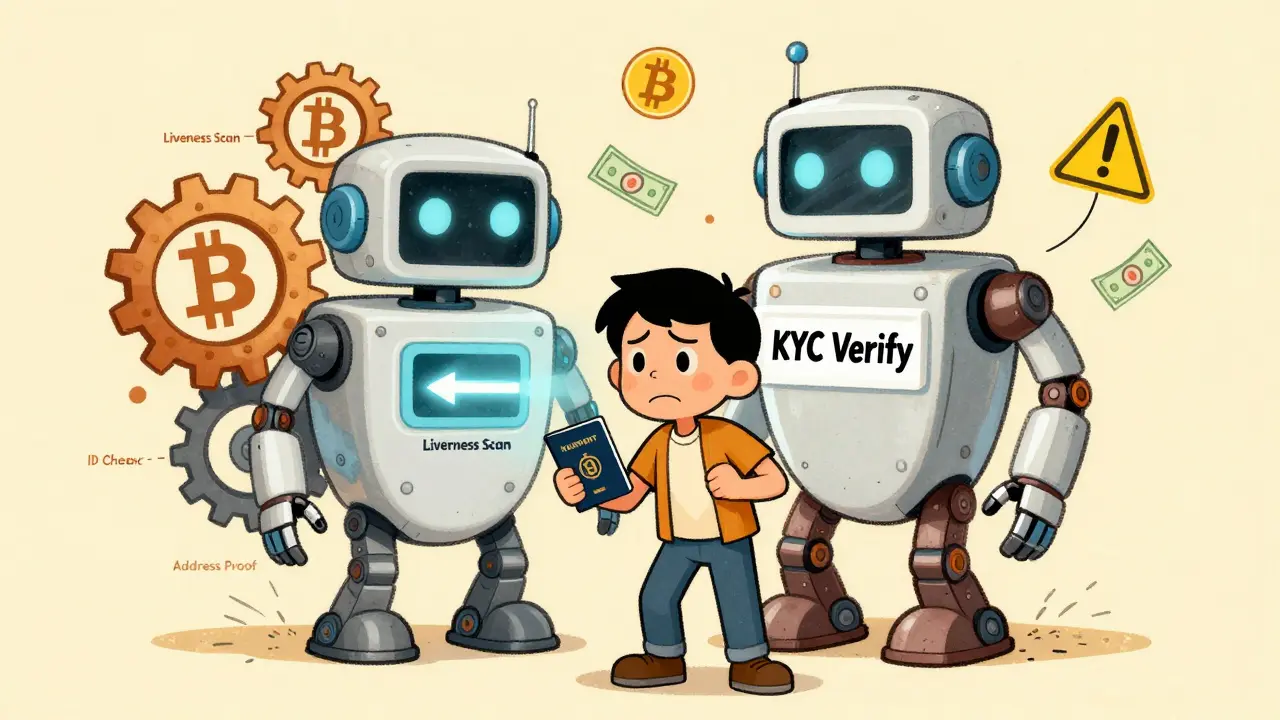
KYC stands for Know Your Customer. It’s a process used by financial institutions to confirm who you are before letting you use their services. In crypto, that means exchanges collect your name, date of birth, address, and a government-issued ID-like a passport or driver’s license-and verify it using automated tools. This isn’t new. Banks have done this since the 1970s under the U.S. Bank Secrecy Act. But in crypto, it became mandatory around 2014-2015 after regulators decided exchanges were essentially money transmitters.Today, 98% of the top 50 crypto exchanges by trading volume require KYC. If you want to buy Bitcoin with USD, EUR, or AUD, you’ll almost always need to go through it. The goal? Stop criminals from using crypto to hide stolen money, fund terrorism, or launder proceeds from scams. Without KYC, crypto platforms would be flooded with illegal activity-and regulators would shut them down.
How Does Crypto KYC Actually Work?
It’s not just uploading a photo. Modern crypto KYC uses multiple layers of verification:- Identification: You enter your full legal name, date of birth, and residential address.
- Document Verification: Your ID is scanned and checked against government databases. AI tools can detect fake IDs with 99.8% accuracy by spotting subtle errors in fonts, holograms, or watermarks.
- Liveness Check: You take a live selfie. The system uses 3D depth sensing to confirm you’re a real person-not a photo, video, or mask. Success rates for detecting spoofing are above 99.5%.
- Address Verification: You might need to upload a recent utility bill or bank statement showing your name and address.
- Risk Scoring: Based on your location, transaction history, and ID type, the system assigns a risk level. Higher risk? More documentation needed.
Most exchanges use tiered systems. Basic verification lets you trade up to $500-$1,000 per day. Full verification-adding proof of income or source of funds-can unlock limits of $50,000 or more. Institutional traders need even more: corporate registration papers, proof of ownership for all major shareholders, and sometimes even board resolutions.
Why Do Crypto Exchanges Even Do This?
It’s not because they want to spy on you. It’s because they have no choice.Regulators like the U.S. Treasury’s FinCEN, the European Union’s MiCA rules, and the Financial Action Task Force (FATF) now treat crypto exchanges like banks. If they don’t verify users, they risk fines up to $500,000 per violation-or losing their license entirely. Singapore and Switzerland have already revoked licenses for non-compliant platforms. In 2023, the U.S. Treasury cracked down on Bybit for failing to enforce KYC properly.
There’s also business logic. Without KYC, banks won’t let you deposit or withdraw fiat money. Over 92% of all crypto-to-fiat trades happen on KYC platforms. If you want to cash out your Bitcoin to pay rent or buy groceries, you need a verified account.
What About No-KYC Exchanges? Are They Still an Option?
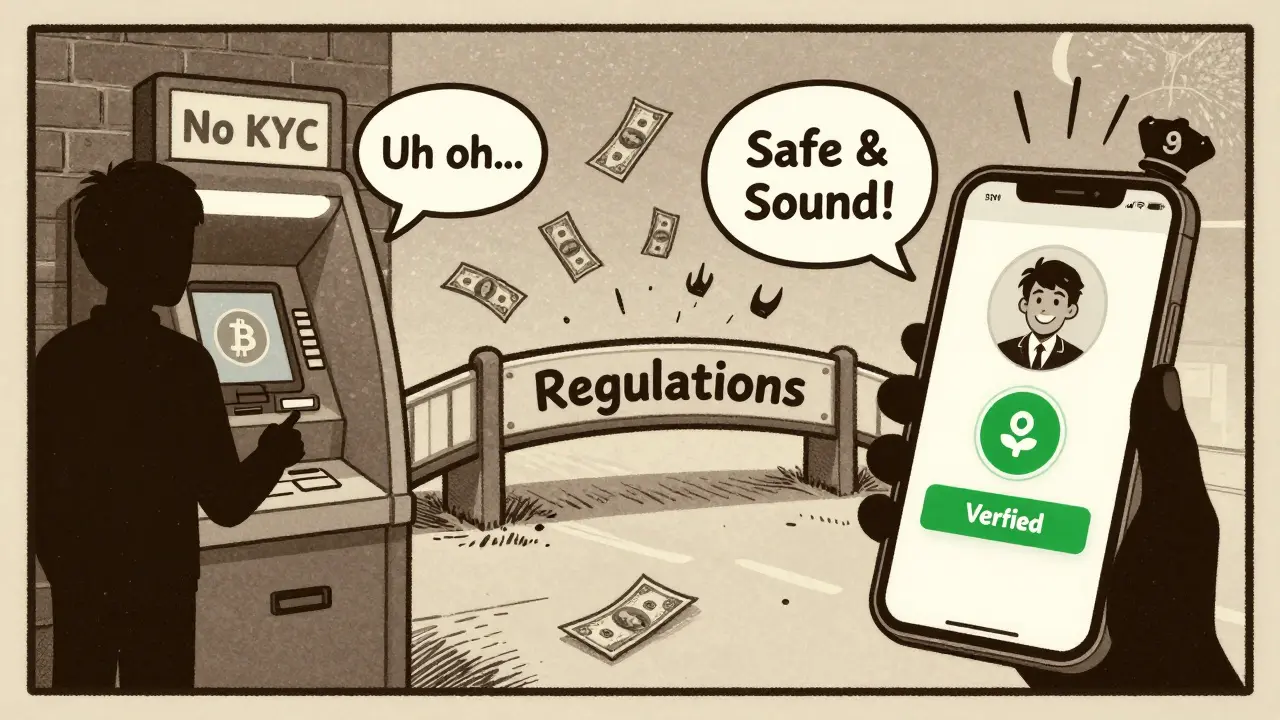
Yes-but they’re shrinking fast.Decentralized exchanges (DEXs) like Uniswap and PancakeSwap don’t require KYC. You connect your wallet and trade directly. But here’s the catch: you can’t buy crypto with a credit card or bank transfer on most DEXs. You need to already have crypto-usually Ethereum or BNB-to trade. That means you had to get it from a KYC exchange first.
Bitcoin ATMs are another no-KYC option. About 70% of U.S. ATMs allow purchases under $900 without ID. But above that? You’re asked to verify. And even those are being phased out. The EU’s 6th Anti-Money Laundering Directive and U.S. crackdowns on mixing services have forced many anonymous on-ramps offline. Since 2020, viable no-KYC options have dropped by 45%.
And here’s the reality: if you’re trading more than $10,000, 98% of those transactions happen on KYC platforms. If you’re trading under $100, only 32% do. For most people, no-KYC isn’t practical-it’s a dead end.
Privacy Concerns: Is KYC Too Much?
You’re not wrong to worry. In a 2023 survey, 68% of crypto users said privacy was their top reason for avoiding KYC. And it’s valid. Your ID, face, and address are sensitive. What if the exchange gets hacked? What if they sell your data? What if governments misuse it?But here’s what most people don’t realize: the biggest privacy risks aren’t from KYC itself-they’re from using unregulated platforms. A 2023 Harvard study found that 72% of illicit crypto funds still move through KYC exchanges, but not because KYC fails. It’s because bad actors use fake IDs, stolen documents, or synthetic identities that pass basic checks. KYC catches the low-hanging fruit, but it’s not a silver bullet.
Some experts argue KYC creates a false sense of security. Dr. Marion Laboure’s research shows that sophisticated criminals still slip through. But former FinCEN Director James H. Freis counters that KYC helped identify 83% of transactions linked to sanctioned entities in 2022. The truth? It’s not perfect-but it’s the best tool we have.
What Are the Common Problems With KYC?
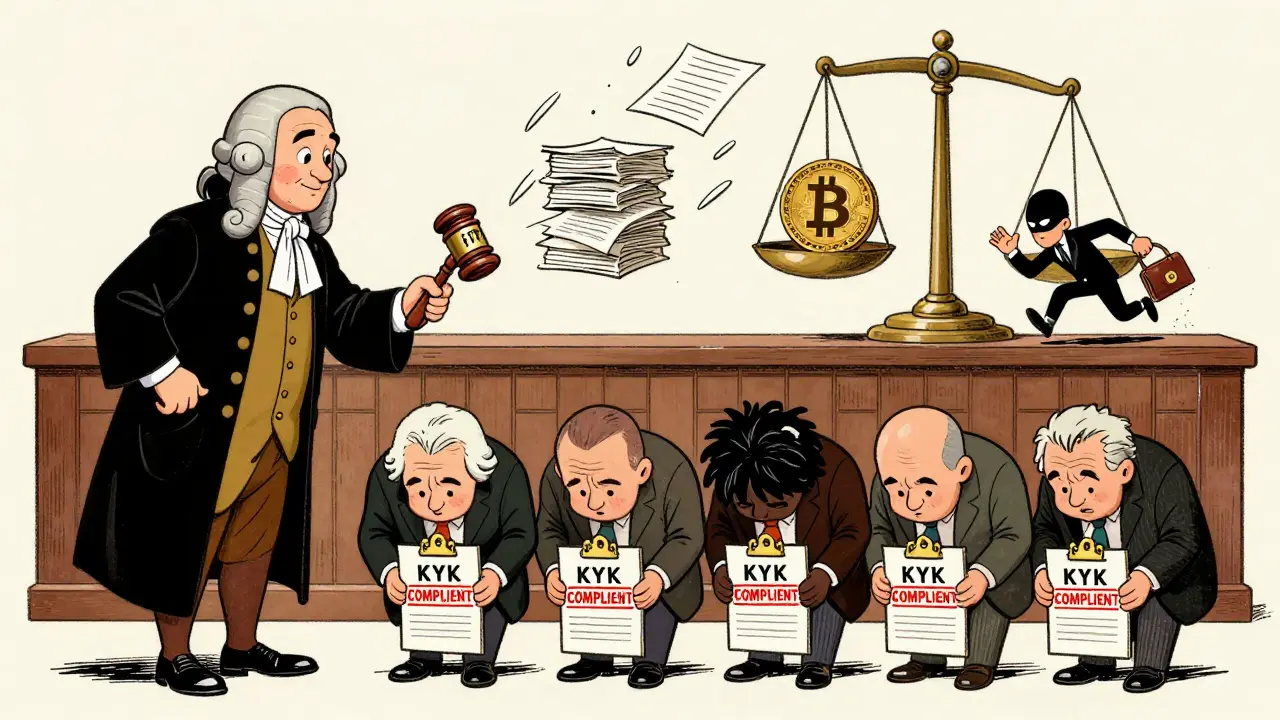
Most people don’t get rejected because they’re hiding something. They get rejected because of tiny mistakes:- Glare on your ID (34% of failures)
- Expired documents (21%)
- Mismatched name spelling (18%)-like “Jon” vs. “John”
- Blurry photos or bad lighting
Fixing these is easy:
- Use your phone’s camera in natural light, not under fluorescent bulbs.
- Make sure your ID is less than five years old.
- Match your name exactly to your government record-no nicknames.
- Use the exchange’s mobile app, not a desktop browser. Apps handle lighting and focus better.
Verification times vary. On Coinbase, most people get approved in under 24 hours. But during spikes-like after a Bitcoin rally-it can take 72 hours. Reddit users complain about delays, but that’s usually because they submitted low-quality photos or expired IDs. If you follow the guidelines, it’s usually fast.
Is KYC Here to Stay?
Absolutely. And it’s getting stricter.The IRS is rolling out mandatory 1099-DA reporting for all crypto transactions in 2026. That means every taxable trade-no matter how small-must be tied to a verified identity. No-KYC options won’t survive that. The EU’s MiCA rules, effective June 2024, require every crypto service provider in Europe to enforce full KYC. Australia, Canada, Japan, and the UK are following suit.
Even privacy-focused projects are adapting. Microsoft’s ION and the W3C’s Verifiable Credentials are testing decentralized identity systems that let you prove who you are without handing over your full ID. Think of it like showing a digital driver’s license that only reveals your age-not your home address. Twenty-three pilot programs are running in Europe right now.
But here’s the bottom line: 89% of global financial regulators say KYC requirements will expand, not shrink, over the next five years. Crypto isn’t going to become a lawless wild west. It’s becoming a regulated financial system-and KYC is the gatekeeper.
Should You Use KYC Exchanges?
If you’re buying, selling, or holding crypto as an investment-yes. The benefits outweigh the inconvenience:- You can deposit and withdraw fiat money.
- You get insurance and customer support if your account is hacked.
- You’re protected from scams and fraudulent platforms.
- You comply with tax laws and avoid legal trouble.
One Reddit user, u/SecureTrader55, recovered $12,000 after his Kraken account was compromised. The exchange flagged the suspicious withdrawal because of KYC-linked activity monitoring. Without KYC, that money would’ve been gone forever.
For casual users trading under $100 a month, KYC might feel like overkill. But if you’re serious about crypto-whether you’re holding long-term, trading regularly, or using it to pay for goods-KYC isn’t optional. It’s the price of entry.
It’s not about trust. It’s about safety. And in a space where $2 billion was stolen in scams last year, that’s worth a few minutes of your time.
Kathleen Sudborough
December 10, 2025 AT 04:31I get why people hate KYC, but honestly? I’d rather give up a little privacy than risk losing my entire portfolio to some sketchy exchange that got hacked. I’ve seen friends get wiped out because they used a no-KYC platform with zero support. This isn’t about surveillance-it’s about having someone to call when things go wrong.
And yeah, the process is annoying. But if you take a clear photo, use natural light, and match your name exactly? It’s usually done in under an hour. No drama.
Stop treating KYC like a prison sentence. It’s more like a seatbelt. You don’t love wearing it, but you’re glad it’s there when you need it.
Vidhi Kotak
December 10, 2025 AT 22:58Been using crypto since 2017 and I’ve gone through KYC on 7 different platforms. Honestly? The worst part is when your ID expires and you forget to update it. I got locked out for 3 days because my passport was 2 weeks past expiry. Stupid, right?
But here’s the thing-without KYC, I couldn’t have bought my first ETH with my bank account. No KYC = no fiat on-ramp. And without that, crypto stays in a tiny bubble. I’d rather be verified than isolated.
amar zeid
December 11, 2025 AT 22:23While the regulatory framework underpinning KYC is undeniably necessary for institutional adoption, one must also acknowledge the epistemological tension between decentralized ethos and centralized verification protocols. The very architecture of blockchain seeks to obviate trust intermediaries, yet KYC re-centers authority in the hands of corporate entities and state actors.
This contradiction is not merely technical-it is philosophical. Are we building a new financial system, or merely digitizing the old one? The answer may determine whether crypto evolves-or expires.
Alex Warren
December 12, 2025 AT 03:36KYC isn't perfect but it's the least bad option we have. No-KYC exchanges are either dead or useless for real-world use. You can't pay rent in Bitcoin unless you cash out. And you can't cash out without KYC. End of story.
Also, if your ID photo gets rejected, it's probably because you took it in a dark room with a flash. Not because the system is spying on you.
Ian Norton
December 12, 2025 AT 17:51Let’s be real. KYC doesn’t stop criminals. It just makes it harder for amateurs. The big players? They use shell companies, fake IDs, and offshore accounts. The system catches the 16-year-old in Ohio trying to buy $200 of BTC, not the Russian oligarch laundering $20M through a Dubai LLC.
So what’s the point? It’s not security. It’s compliance theater. Regulators feel good. Exchanges avoid fines. Users get hassled. Criminals? They laugh all the way to the bank.
Sue Gallaher
December 14, 2025 AT 05:12Why should Americans have to jump through hoops for crypto when China and Russia just ignore it? We’re the only ones playing by the rules. Meanwhile, our money gets locked up while foreign actors trade freely. This isn’t safety-it’s self-sabotage. If you want freedom, go to a no-KYC platform. Or stop complaining and move to Singapore.
Also, my passport photo got rejected because of a shadow. That’s not security. That’s incompetence.
Jeremy Eugene
December 16, 2025 AT 03:56While I understand the privacy concerns, the reality is that financial systems require identity verification to function at scale. The alternative is chaos. KYC is not an infringement-it’s a foundation. Without it, crypto cannot integrate with the global economy.
Moreover, the technological safeguards employed by reputable exchanges are far more secure than most traditional banking systems. The risk of data breach is low, and the benefits of compliance are immense.
Nicholas Ethan
December 16, 2025 AT 21:51KYC is a scam. It doesn't prevent crime. It just makes it harder for regular people to use crypto. The real criminals? They use mixers. They use privacy coins. They use offshore exchanges. The system targets the wrong people. You think they care if your ID photo has glare? No. They care if you're a billionaire hiding money.
So why are you being punished? Because the system is lazy. And you're the easy target.
Rakesh Bhamu
December 17, 2025 AT 20:41Been through KYC on 5 exchanges. Took 45 minutes total. Used my phone’s camera, natural light, didn’t use a selfie stick. Approved in 12 hours.
People make it sound like a nightmare, but it’s just a form. If you treat it like a DMV appointment, it’s fine. If you treat it like a witch hunt? Yeah, it’s gonna suck.
Also, I’m from India. We’ve been doing KYC for bank accounts since 2005. It’s normal. Crypto is just catching up.
Hari Sarasan
December 19, 2025 AT 13:56Let me break this down with the precision of a quant model. KYC introduces systemic friction into a permissionless network. The cost of compliance is not merely financial-it’s cognitive, social, and existential. You are not verifying identity; you are surrendering autonomy to a centralized trust architecture that is fundamentally incompatible with the cryptographic ethos of decentralization.
Furthermore, the 98% statistic is misleading. It conflates trading volume with user count. The majority of users on KYC platforms are retail speculators. The whales? They use OTC desks with bespoke compliance. So who’s really being policed? The small fry.
This is not regulation. This is social engineering disguised as security.
Stanley Machuki
December 19, 2025 AT 23:06Just did KYC on Kraken. Took 8 minutes. Used my phone. Natural light. No flash. Done.
Stop making it harder than it is. You’re not being hunted. You’re just filling out a form. Chill.
Lynne Kuper
December 21, 2025 AT 02:42Oh wow. So we’re pretending KYC is about safety now? Let me guess-next you’ll tell me that banks are friendly librarians who just want to help you find your money.
Meanwhile, my friend got his account frozen because he used ‘Rob’ instead of ‘Robert’ on his ID. He had to send a notarized letter. For $300. That’s not security. That’s extortion with a UX overlay.
And don’t even get me started on how they sell your data to advertisers. ‘We don’t sell your data’? Sure, Jan. Just like ‘We don’t track you’ on Facebook.
John Sebastian
December 22, 2025 AT 01:07You people act like KYC is the end of the world. But you’re fine with handing your entire life over to Google and Facebook every day. You take selfies for TikTok, share your location, post your vacation pics. But when a crypto exchange asks for a photo of your license? Suddenly it’s ‘Big Brother’.
Choose your hypocrisy.
Tiffany M
December 23, 2025 AT 18:39Okay so let me get this straight-you’re mad that you have to prove you’re not a criminal… but you’re fine with your bank knowing everything about you? You’re fine with your phone knowing where you sleep? You’re fine with Amazon knowing you bought a toaster in 2021?
It’s not about privacy. It’s about control. You don’t like being told what to do. But guess what? The world doesn’t run on vibes. It runs on paperwork.
And if you think Bitcoin is gonna save you from bureaucracy? Honey, it’s already a credit card with extra steps.
Eunice Chook
December 25, 2025 AT 07:08KYC is a lie. It’s not about security. It’s about control. The moment you submit your ID, you become a data point in a surveillance matrix designed to monetize your identity. You think they’re protecting you? They’re protecting their business model.
And let’s be honest-no one is safer because you verified your face. The hackers don’t care if you’re verified. They care if your password is ‘password123’.
Abhishek Bansal
December 26, 2025 AT 13:41Wait so now KYC is ‘the price of entry’? So crypto isn’t decentralized anymore? It’s just Wall Street 2.0 with better graphics?
And you call that progress? I thought Bitcoin was supposed to be the anti-bank. Now you’re begging for a government stamp like a dog begging for scraps.
Also, my cousin used a Bitcoin ATM in Texas and bought $800 in BTC without ID. So much for ‘no no-KYC options left’.
Bridget Suhr
December 27, 2025 AT 00:54my kyc got rejected bc my id had a smudge and i was so mad at first but then i realized… i just took a pic with my phone in a dim room like an idiot. duh.
also the app auto-crops and brightens it. why would you use a desktop? it’s 2025.
Anselmo Buffet
December 27, 2025 AT 11:40Used to hate KYC. Now I’m grateful. Got hacked once on a no-KYC site. Lost everything. Had no recourse. Now I’m on Coinbase. They reversed a fraudulent withdrawal in 3 hours. That’s worth my ID photo.
Also, I use the app. Takes 2 minutes. Stop overthinking it.
Kathryn Flanagan
December 27, 2025 AT 23:22Let me tell you something sweet, honey. KYC isn’t about spying on you. It’s about protecting you. Think of it like a seatbelt. You don’t wear it because you love it. You wear it because you don’t want to fly through the windshield if someone hits you.
And the system? It’s not perfect. Sometimes your photo gets rejected because the lighting’s bad. But that’s not the system’s fault-that’s just you being in a hurry. Take a breath. Go outside. Take the pic in daylight. It’s not hard.
And if you’re worried about your data? Pick a big, reputable exchange. They’ve got insurance, they’ve got lawyers, they’ve got audits. The sketchy ones? They vanish overnight. You think that’s safe? Please.
Also, I’ve helped over 30 friends get through KYC. None of them got hacked. All of them got their money back when something went wrong. That’s not luck. That’s structure.
So yes, it’s a pain. But it’s a small pain for a huge gain. And if you’re still mad? Just remember-you’re not giving up freedom. You’re buying safety. And that’s worth a little paperwork.
Steven Ellis
December 29, 2025 AT 00:39There’s a quiet dignity in compliance. It’s easy to romanticize the outlaw, the anonymous trader dodging regulators-but real financial stability doesn’t come from chaos. It comes from accountability.
Yes, KYC is imperfect. Yes, it can feel invasive. But the alternative isn’t freedom-it’s fragility. When every transaction is traceable, when every wallet is tied to a real person, you create a system where fraud has consequences.
And let’s not pretend that privacy is dead. Decentralized identity is coming. Projects like Verifiable Credentials will let you prove your age, your citizenship, your income-without handing over your entire life. That’s the future. Not anonymity. Not surveillance. Just selective, secure proof.
KYC isn’t the enemy. It’s the bridge.
Claire Zapanta
December 29, 2025 AT 22:09Let’s not pretend this is about safety. This is about control. The same governments that spy on you through your phone are now demanding your face for crypto. And you’re thanking them for it?
Meanwhile, the Fed is printing trillions. The banks are rigged. The IRS is coming for your $10 Bitcoin trade. And you think KYC is the answer?
Wake up. This is the beginning of financial fascism. They’re not stopping criminals. They’re stopping you. From buying. From trading. From being free.
And when they ban Bitcoin ATMs completely? Don’t say I didn’t warn you.
Kathy Wood
December 30, 2025 AT 05:53So now we’re supposed to be grateful for KYC? Like it’s a gift? What’s next? Mandatory blood tests to buy Dogecoin?
They’re not protecting us. They’re protecting themselves. Every time you verify your ID, you’re giving them a new way to track you. And when the government decides crypto is ‘too dangerous’? You think they’ll ask nicely?
They’ll freeze your account. They’ll seize your coins. And you’ll have no recourse because you gave them your face.
This isn’t safety. It’s surrender.