

Integral (ITGR) isn’t another meme coin or a flash-in-the-pan DeFi project trying to ride the latest trend. It was built for one very specific job: helping big players trade large amounts of crypto without crashing the market. If you’ve ever heard of someone needing to buy $5 million worth of ETH without pushing the price up 20% in minutes, that’s what Integral was made for.
What Exactly Is Integral (ITGR)?
Integral is a decentralized finance (DeFi) tool designed to execute large crypto orders with minimal price impact. Its main product, called SIZE, works like an over-the-counter (OTC) desk - but on-chain. Instead of relying on a middleman to match big trades privately, SIZE uses a Time-Weighted Average Price (TWAP) algorithm to break up huge orders into tiny pieces and spread them out over time. This keeps the market stable and prevents slippage.
Think of it like this: if you’re buying a house and you walk into a real estate office and say, “I want to buy every house on this street,” the prices will skyrocket because everyone knows you’re desperate. But if you quietly buy one house a week for six months, prices stay flat. That’s what Integral does for crypto.
It’s not trying to be a full exchange like Uniswap or a wallet like MetaMask. It’s a specialized engine built for institutions, DAOs, and large holders who need to move big volumes without getting ripped off by the market. The project claims to be the only DeFi primitive with a working solution for this exact problem - and while that’s debatable, it’s still one of the few trying to solve it in a truly decentralized way.
How Does ITGR Work?
The ITGR token powers the Integral protocol. It’s not used for payments or staking like many other coins. Instead, it’s the governance and utility token for the SIZE platform. Users who trade large amounts on SIZE pay fees in ITGR, and token holders can vote on protocol upgrades, fee structures, and new features.
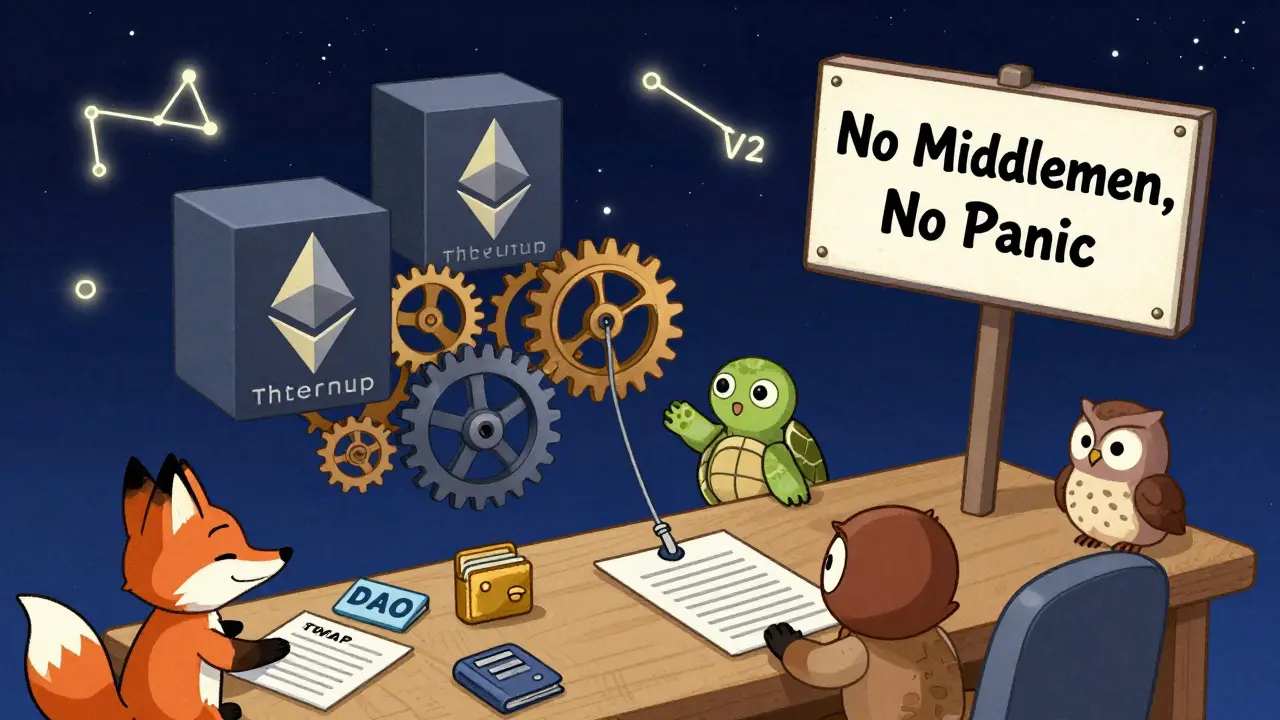
Here’s the technical side: when someone wants to execute a large trade, they submit it to SIZE. The system automatically splits the order into hundreds of smaller trades, each spaced out over minutes or hours. These trades are executed across liquidity pools on Uniswap V2 and other decentralized exchanges. The TWAP algorithm ensures the average price paid is as close as possible to the market price at the time the order was placed.
Unlike traditional OTC desks, which are centralized and require trust in a third party, Integral runs entirely on Ethereum. That means no single entity controls the funds or the execution logic. The code is open, transparent, and auditable - a big deal in a space full of shady OTC brokers.
ITGR Token Supply and Distribution
Integral has a fixed maximum supply of 300 million ITGR tokens. As of December 2025, about 219 million are in circulation - meaning roughly 73% of all tokens are already out in the market. The remaining 81 million are either locked in vesting schedules, reserved for team incentives, or held in protocol treasury wallets.
Token distribution data isn’t fully public, but based on blockchain analysis, early investors and the founding team received the largest allocations. A significant portion was allocated to liquidity mining and community incentives during 2021-2022, which helped kickstart adoption. However, the token’s price has since collapsed, and many early holders have long since sold.
There’s no inflationary mechanism. No new ITGR will be minted. The supply is capped, and the protocol’s long-term sustainability depends on transaction volume, not token issuance.
Current Price and Market Performance
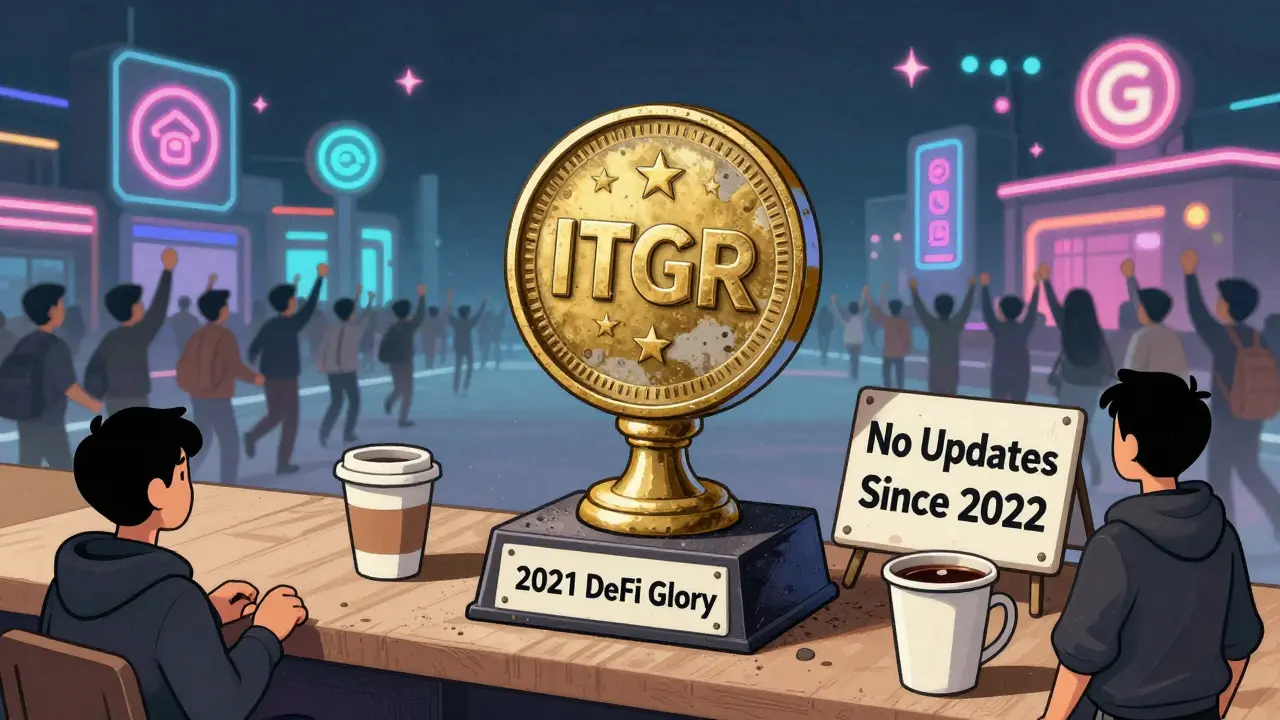
Integral’s peak was in September 2021, when ITGR hit $3.31. That was during the height of the DeFi boom, when everyone was chasing the next big thing. Today, as of December 2025, ITGR trades around $0.0016 - a drop of over 99.95% from its all-time high.
Market cap sits at roughly $342,000, and the fully diluted valuation (if all 300 million tokens were circulating) is around $468,000. That’s tiny compared to even the smallest major DeFi protocols. The 24-hour trading volume is under $25,000, with nearly all of it happening on Gate.io in the ITGR/USDT pair. Uniswap V2 sees barely $140 in volume per day.
On CoinMarketCap, ITGR ranks #2556 out of thousands of cryptocurrencies. That’s not a typo. It’s buried deep in the bottom tier. The 7-day price change is down 17.6%, while the broader crypto market is only down 5.7%. That means ITGR is underperforming even in a bear market.
Despite this, the protocol still holds $719,070 in Total Value Locked (TVL) - higher than its market cap. That’s unusual. Normally, if a project’s market cap is higher than its TVL, it’s a red flag. Here, the opposite is true. It suggests that while traders aren’t buying the token, the actual platform is still being used to execute trades. That’s a good sign for utility, but a bad sign for speculation.
Where Can You Buy ITGR?
There are only two places where ITGR is actively traded:
- Gate.io - The ITGR/USDT pair accounts for over 99% of all trading volume. This is where 9 out of 10 trades happen.
- Uniswap V2 (Ethereum) - The ITGR/WETH pair has minimal liquidity, with daily volume under $150.
That’s it. No listing on Binance, Coinbase, Kraken, or any other major exchange. You won’t find ITGR on MetaMask’s built-in swap or on most DeFi aggregators. If you want to buy it, you need to go to Gate.io, create an account, deposit USDT, and trade manually.
There’s no easy way to buy ITGR with a credit card. No fiat on-ramp. No mobile app. This isn’t a coin for casual investors. It’s for people who already understand DeFi, have a wallet set up, and are willing to dig through obscure exchanges.
Who Uses Integral? Is It Actually Used?
According to on-chain data, Integral has around 1,690 token holders. That’s not a community. That’s a small group of early adopters, speculators, and possibly a few institutional wallets that still hold it for governance purposes.
But here’s the key: the number of token holders doesn’t tell the whole story. The real metric is how many large trades are happening on SIZE. Public data shows that trades over $100,000 are still being executed on the platform - sometimes daily. That means someone, somewhere, still needs this service.
Who? Likely DAO treasuries managing multi-million-dollar budgets, hedge funds that can’t access traditional OTC desks, or large holders trying to exit positions quietly. These users don’t care about price charts. They care about execution quality. And Integral delivers that - even if no one else is buying the token.
Why Has ITGR Fallen So Hard?
There are three big reasons:
- Too niche. The problem Integral solves is real, but it’s only relevant to a tiny fraction of crypto users. Most people trade small amounts. Most institutions still use centralized OTC desks because they’re faster, more reliable, and come with customer support.
- Competition. Projects like 1inch, Matcha, and even Dune Analytics have built better aggregation tools that include TWAP-like features. Big players don’t need a single-purpose protocol when they can use a multi-chain aggregator.
- Timing. Integral launched in 2021, right before the crypto market crashed. The hype cycle died, funding dried up, and developers moved on. The team hasn’t shipped major updates in years.
There’s no active marketing, no social media buzz, no influencer promotions. The website hasn’t been updated since 2022. The GitHub repo shows minimal commits. This isn’t a dead project - but it’s not growing either.
Is Integral Worth Anything Today?
If you’re looking to make a quick profit - no. ITGR is not a speculative play. It’s a graveyard for early investors.
If you’re a DeFi builder, a DAO treasurer, or someone who needs to move large crypto amounts without moving the market - maybe. The protocol still works. The TWAP engine still executes trades. The code hasn’t been hacked. The TVL is still positive.
But here’s the hard truth: even if the tech is solid, the market has moved on. No new users are coming in. No new liquidity is being added. The token’s value is almost entirely based on nostalgia and a few stubborn holders.
Integral (ITGR) is a reminder that in crypto, having a good idea isn’t enough. You need adoption, marketing, community, and timing. Integral had the idea. It just didn’t get the rest.
Final Thoughts: A Useful Tool, a Dead Token
Integral’s technology is clever. Its solution to price impact is elegant. And for a small group of users, it still serves a real need.
But the ITGR token? It’s a shadow of what it once was. The price collapse isn’t just market volatility - it’s a vote of no confidence. The market decided that a decentralized OTC engine, without a team pushing growth or a community rallying behind it, isn’t worth holding.
If you’re curious about how large trades work on-chain, study Integral. It’s a fascinating case study in DeFi specialization. But if you’re thinking of buying ITGR because you think it’ll bounce back - think again. This isn’t a coin waiting to explode. It’s a tool still running quietly in the background, while the world moves on to the next thing.
Mark Cook
December 18, 2025 AT 16:14Bradley Cassidy
December 19, 2025 AT 18:50Samantha West
December 21, 2025 AT 09:19Craig Nikonov
December 23, 2025 AT 01:30Greg Knapp
December 23, 2025 AT 04:12Jesse Messiah
December 24, 2025 AT 01:13Rebecca Kotnik
December 25, 2025 AT 14:59Sally Valdez
December 27, 2025 AT 00:04Elvis Lam
December 27, 2025 AT 14:22Sammy Tam
December 27, 2025 AT 21:52Jonny Cena
December 29, 2025 AT 06:51George Cheetham
December 30, 2025 AT 16:04Sue Bumgarner
December 30, 2025 AT 21:38Kayla Murphy
December 31, 2025 AT 19:35Dionne Wilkinson
January 1, 2026 AT 13:38Emma Sherwood
January 2, 2026 AT 20:34Florence Maail
January 4, 2026 AT 13:44Chevy Guy
January 4, 2026 AT 15:33Kelsey Stephens
January 6, 2026 AT 12:28Tom Joyner
January 7, 2026 AT 16:44Amy Copeland
January 9, 2026 AT 09:31Abby Daguindal
January 10, 2026 AT 05:23Patricia Amarante
January 11, 2026 AT 09:20SeTSUnA Kevin
January 12, 2026 AT 04:33Timothy Slazyk
January 13, 2026 AT 21:02Emma Sherwood
January 14, 2026 AT 04:21