
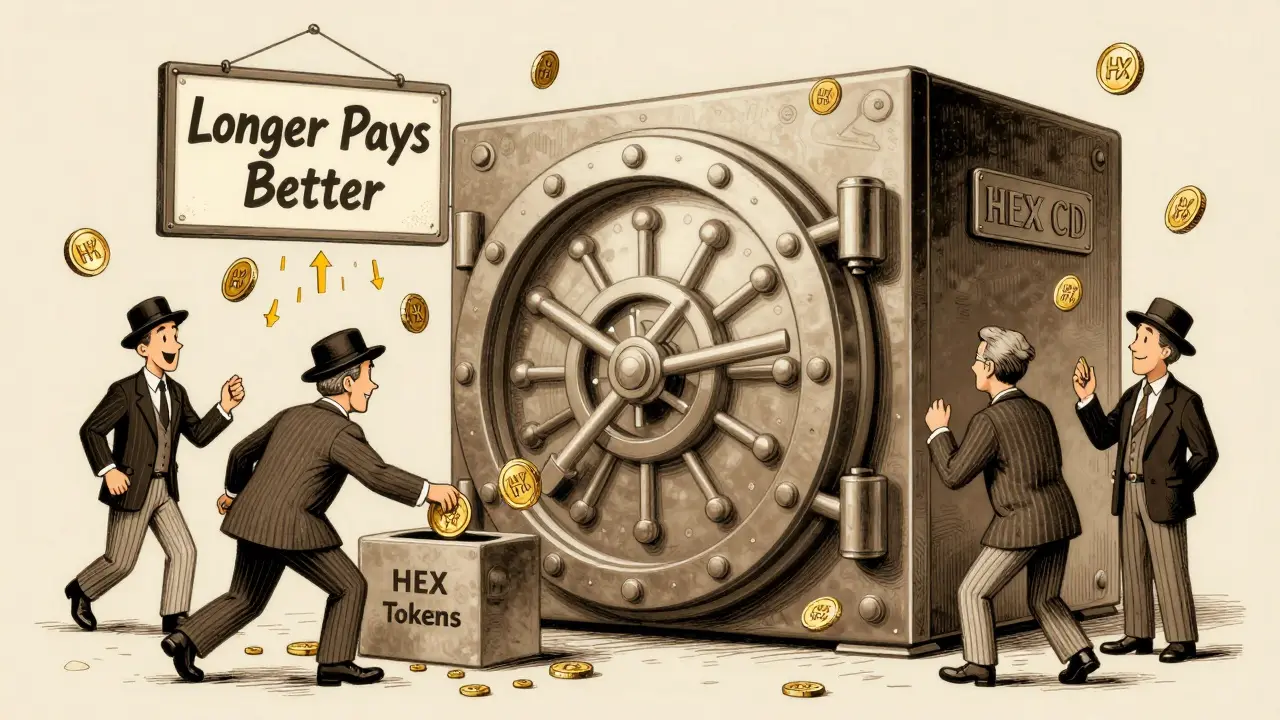
HEX isn't another Bitcoin clone. It doesn't mine. It doesn't just trade. It HEX is a crypto project built to mimic a bank certificate of deposit - but without banks, regulators, or middlemen. Launched in December 2018 on the Ethereum blockchain, HEX promises users high interest rates for locking up their tokens, with rewards paid out in more HEX. It’s not a typical cryptocurrency. It’s a financial experiment wrapped in blockchain code - and it’s one of the most polarizing projects in crypto history.
How HEX Works: Staking Like a CD
Imagine putting $10,000 in a 5-year CD at a bank that pays 3% interest. At the end of five years, you get your money back plus $1,500 in interest. HEX does something similar - but on the blockchain. Instead of a bank, you stake your HEX tokens for a period between 1 and 5,555 days. The longer you lock them up, the higher your return. The system calls this "Longer Pays Better."
When you stake HEX, your tokens are burned and converted into something called "T-Shares." These T-Shares earn interest daily. The interest isn’t paid in cash - it’s paid in new HEX tokens created by the network. This is where HEX gets its inflation model: the system mints new tokens to reward stakers. The more people stake, the more new HEX gets created. And here’s the twist: if the price of HEX goes up, fewer tokens need to be minted to pay the same dollar value. If the price crashes? The system floods the market with new tokens to keep rewards steady.
There’s no mining. No validators. No proof-of-work. You don’t need a GPU or a server. You just need to run a simple script once to lock your tokens. Then, once your term ends, you run it again to collect your rewards. The entire process is automated through smart contracts on Ethereum. No one controls it. No one can pause it. That’s the promise.
PulseChain: The Faster, Cheaper Alternative
In 2021, Richard Heart - the anonymous founder behind HEX - launched PulseChain. This wasn’t just another token. It was a new blockchain, designed to replace Ethereum. PulseChain uses proof-of-stake (PoS), which is far more energy-efficient than Ethereum’s old mining system. It also promised to slash transaction fees to a fraction of Ethereum’s costs - sometimes less than a penny per transaction.
PulseChain didn’t start from scratch. It took a snapshot of the Ethereum blockchain at a specific block height. Every ETH holder got an equal amount of PLS (PulseChain’s native token). Same with every ERC-20 token, NFT, or DeFi position. If you had 100 ETH, you got 100 PLS. If you owned a CryptoPunk, you got a copy of it on PulseChain. This was called the "sacrifice" phase - users could donate ETH, BTC, or even fiat to support the network and get bonus PLS tokens in return.
PulseChain also introduced PulseX, a decentralized exchange built into its ecosystem. It allowed users to swap tokens without relying on Uniswap or PancakeSwap. The idea was simple: create a self-contained ecosystem where everything - trading, staking, payments - happens on one chain.
The Controversy: Is HEX a Ponzi?
HEX’s biggest selling point - its 38% average annual yield - is also its biggest red flag. Critics say the system can’t last. How can it keep paying 38% returns forever? The answer, according to skeptics, is that early stakers are being paid with money from new users. That’s the textbook definition of a Ponzi scheme.
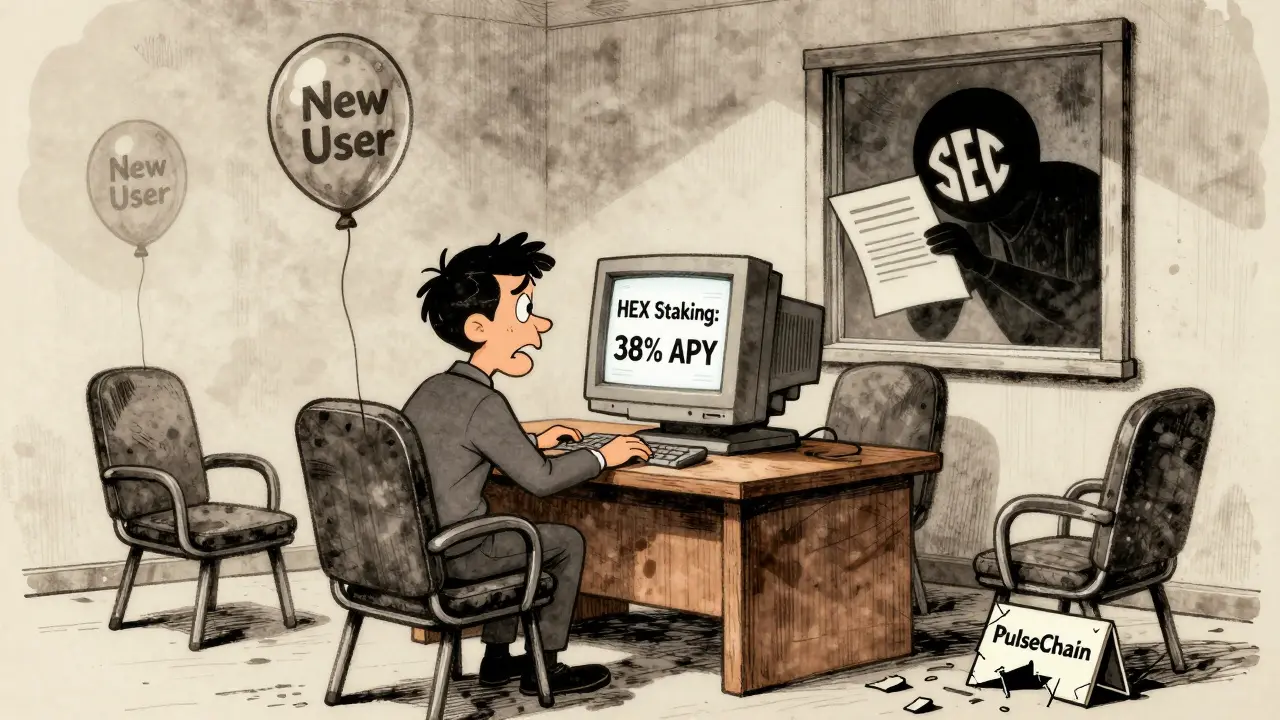
Then there’s the SEC allegation. In 2023, the U.S. Securities and Exchange Commission claimed that the HEX presale - which raised over $678 million in ETH - was manipulated. According to the SEC, only $34 million of that was real investor money. The rest? Recycled funds. Wallets were used to send ETH to the presale, then immediately sent back out as new deposits. This artificially inflated the presale numbers, making HEX look like a massive success. The result? Richard Heart and his inner circle ended up holding over 90% of the total HEX supply.
But here’s the twist: Richard Heart fought back. In late 2024, a U.S. court ruled in his favor, stating that HEX’s decentralized structure and lack of centralized control meant it didn’t qualify as a security under U.S. law. Supporters say this sets a precedent: if no one controls the system, it can’t be a security. Critics say the ruling was narrow and doesn’t change the economic reality.
The Launch of PulseChain: High Hopes, Broken Promises
PulseChain’s launch in 2022 was supposed to be the next big thing. Thousands of HEX holders believed it would replace Ethereum. But the reality was messy.
- Major exchanges like Binance and Coinbase refused to list PLS.
- Transaction fees didn’t drop as promised - they stayed high due to congestion.
- Counterfeit PLS tokens flooded the market, tricking users into sending real assets to fake contracts.
- The "freemium PLS" feature - meant to let ETH holders test the network without risk - was misunderstood and abused.
Today, PulseChain still exists. It processes transactions. It has a working blockchain. But it has no real utility for most people. No major DeFi protocols moved over. No big brands adopted it. It’s a ghost town with a working engine.
Market Reality: Where HEX and PLS Stand Today
As of February 2026, HEX trades at around $0.00726 per token. That’s down from a peak of over $0.04 in 2021. Trading volume is thin - over 90% happens on Bitcointry Exchange, a small, obscure platform. There’s no deep liquidity. No institutional interest. No ETFs. No futures markets.
PLS, PulseChain’s native token, trades at a fraction of a cent. Its market cap is under $200 million. Compare that to Ethereum’s $400 billion. Or even Solana’s $60 billion. PulseChain is a niche experiment with a loyal fanbase - but not a mainstream alternative.
HEX staking still works. People still lock up their tokens. The smart contracts still run. But the number of new stakers has dropped sharply since 2022. The network is sustained by a small group of die-hard believers - not new investors.
Who Should Even Consider HEX or PulseChain?
If you’re looking for a safe, stable crypto investment - walk away. HEX’s returns are not guaranteed. They’re mathematically dependent on new users joining and token prices holding steady. If either fails, the system collapses.
If you’re a hardcore believer in decentralized finance and think traditional banking is broken - HEX might appeal to you. It’s the closest thing to a blockchain-based savings account.
If you’re interested in PulseChain as a faster, cheaper Ethereum - you’ll be disappointed. It doesn’t have the developers, the users, or the infrastructure to compete. Ethereum’s upgrade to PoS killed the main reason PulseChain existed.
HEX and PulseChain aren’t investments. They’re social experiments. And like all experiments, they come with risks no financial advisor would ever endorse.
Is HEX a scam?
HEX isn’t officially classified as a scam by any government agency, but it’s under heavy scrutiny. The SEC accused its founder of manipulating the presale to inflate investment numbers. A court later ruled that HEX’s decentralized structure means it’s not a security - but that doesn’t mean it’s safe. The high returns rely on constant new inflows of capital. If new users stop joining, the system can’t pay existing stakers. Many experts call it a Ponzi-like model. Whether it’s a scam depends on your definition - but the risks are very real.
Can I make money staking HEX?
Yes - but only if you’re already in. People who staked early and held through price swings have made large returns. But staking today is risky. The rewards are still high - around 35-40% APY - but they’re paid in HEX tokens. If the price drops, your rewards are worth less. And if the network loses traction, your staked tokens could become worthless. There’s no insurance. No safety net. You’re betting on a community that’s shrinking, not growing.
What’s the difference between HEX and PLS?
HEX is an ERC-20 token on Ethereum. It’s used for staking and earning interest. PLS is the native token of PulseChain - a separate blockchain. PLS is used to pay transaction fees, stake for network security, and trade on PulseX. HEX doesn’t run on PulseChain. They’re two different projects with the same founder. You can’t swap HEX for PLS directly. You need to use a bridge or exchange.
Why does HEX have such high inflation?
HEX’s inflation is built into its design. It needs to create new tokens to pay stakers. The annual inflation rate is capped at 3.69%, but that’s not the full story. The system mints more tokens when the price drops to keep rewards stable in dollar terms. If HEX crashes to $0.001, the system might mint 10x more tokens than when it was at $0.04. This protects stakers’ dollar returns - but it floods the market with new supply, which can drive the price down further. It’s a feedback loop with no clear end.
Can I buy HEX on Coinbase or Binance?
No. HEX is not listed on any major exchange. You can only buy it on small, obscure platforms like Bitcointry Exchange. That means you’re dealing with low liquidity, wide bid-ask spreads, and higher risk of scams. If you want to buy HEX, you’ll need to use a decentralized exchange like Uniswap - but you’ll need ETH first, and you’ll need to understand how to use wallets and smart contracts. It’s not beginner-friendly.
Is PulseChain still active?
Yes, but barely. PulseChain’s blockchain is still running. Transactions are being processed. The network has a small number of active users and developers. But it has no exchange listings, no major DeFi apps, and no institutional backing. It’s technically alive, but functionally irrelevant for most people. The dream of replacing Ethereum never materialized.
What happened to Richard Heart?
Richard Heart - real name Richard Schueler - still runs the projects. He’s active on YouTube and Telegram, promoting HEX and PulseChain. He’s a controversial figure: a self-styled financial guru who claims to have beaten the SEC, while critics say he exploited a legal loophole to avoid regulation. He owns a massive portion of HEX and PLS. His influence keeps the projects alive - but also fuels distrust. He’s not hiding - but he’s not accountable either.