
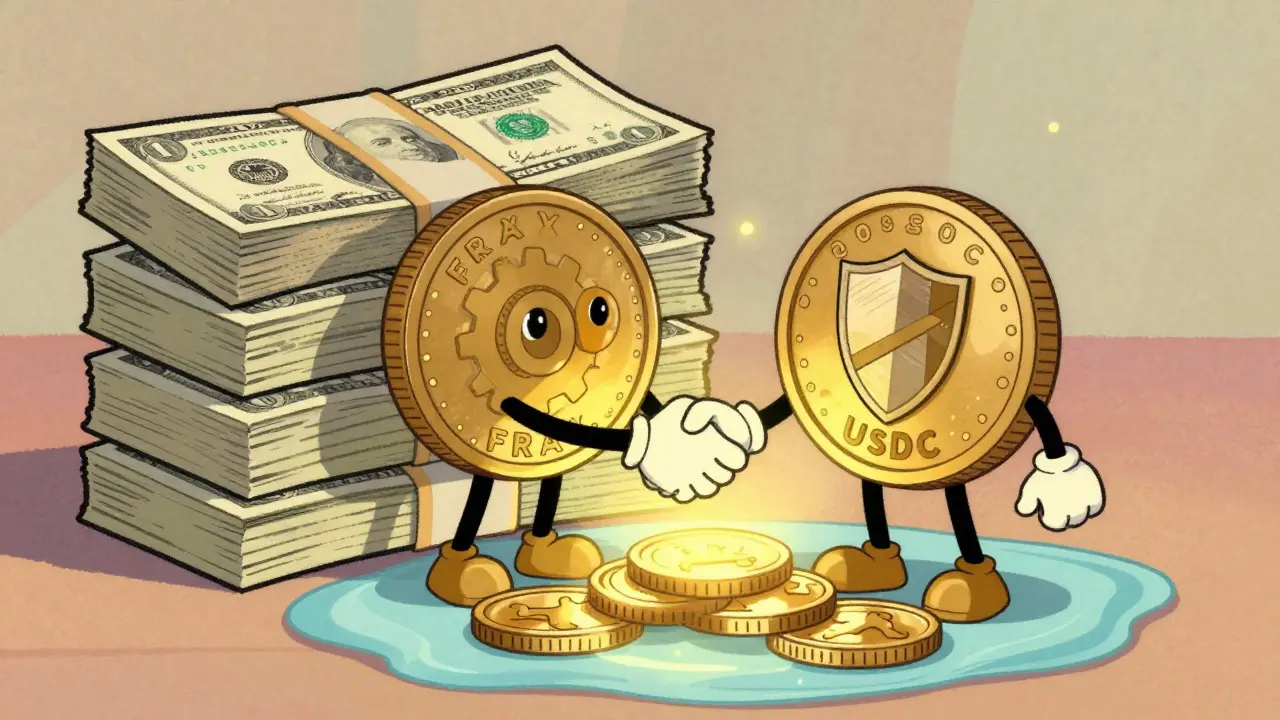
Imagine you have a pile of cash sitting in your pocket. It’s safe, sure, but it isn’t earning you anything. Now imagine if that same cash could work for you, generating interest every time someone else uses it to make a trade. That is essentially what CRVFRAX is a liquidity pool token representing ownership in the FRAX/USDC trading pool on Curve.fi. If you are new to decentralized finance (DeFi), this might sound like jargon. But strip away the complex terms, and it is just a receipt proving you lent money to a digital exchange so others can swap currencies easily.
Specifically, CRVFRAX is not a standalone cryptocurrency you buy to hold long-term in hopes it will moon. It is a Liquidity Provider (LP) token. When you deposit two specific stablecoins-FRAX is a fractional-algorithmic stablecoin issued by Frax Finance and USDC is a fiat-collateralized stablecoin pegged to the US Dollar-into the Curve.fi is a decentralized exchange optimized for low-slippage trading of similar assets platform, you get CRVFRAX tokens in return. These tokens represent your share of that specific pool. As people trade between FRAX and USDC, they pay fees. Those fees go back to you, proportional to how much of the pool you own via your CRVFRAX tokens.
How the FRAX/USDC Pool Actually Works
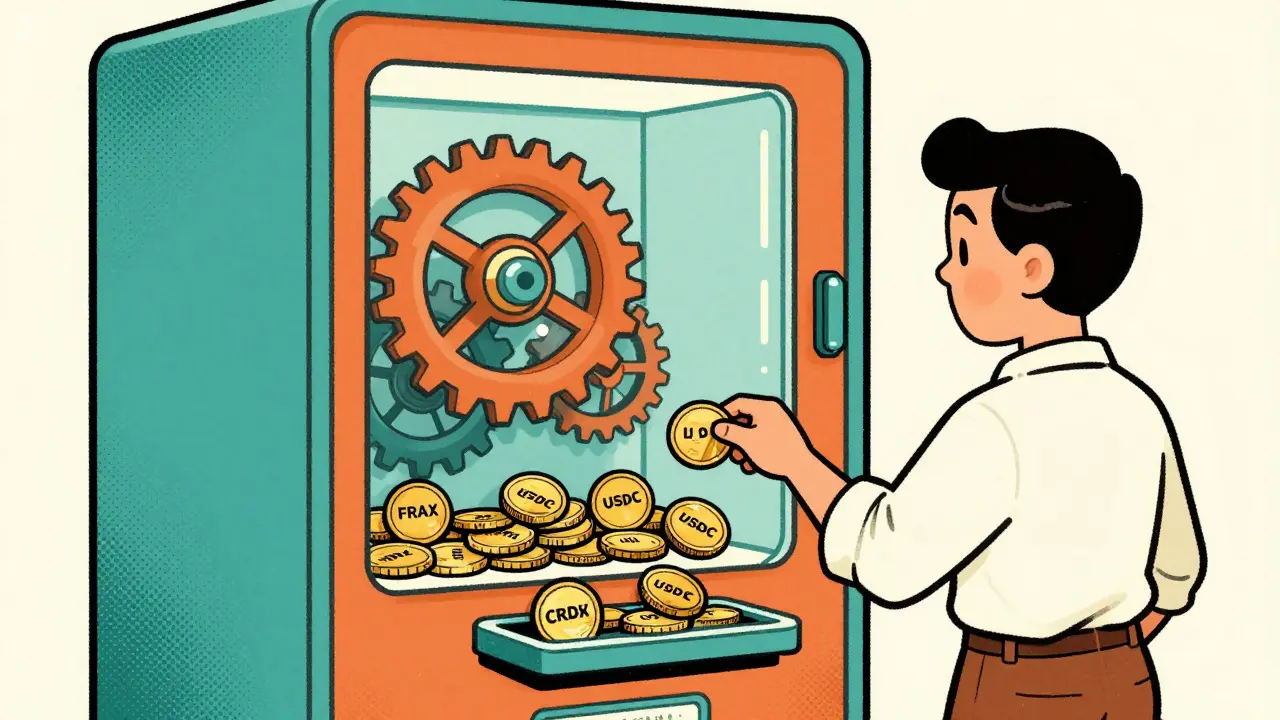
To understand why CRVFRAX exists, you need to look at the problem it solves. In traditional banking, if you want to change dollars into euros, a bank handles the conversion. In crypto, there are no banks. Instead, we use Automated Market Makers (AMMs). Think of an AMM as a vending machine. You don’t wait for another person to want exactly what you have; you interact with a smart contract that holds reserves of both assets.
The Curve.fi platform specializes in swapping assets that are supposed to be worth the same thing-in this case, stablecoins pegged to $1. Because FRAX and USDC are both designed to stay near $1, the risk of one crashing while the other stays steady is very low compared to trading Bitcoin for Ethereum. This makes the FRAX/USDC pool highly efficient. The price slippage-the difference between the expected price and the executed price-is minimal. For traders, this means getting a fair deal. For you, the liquidity provider holding CRVFRAX, this efficiency translates into consistent trading volume and, consequently, steady fee income.
Here is the simple flow:
- You deposit equal values of FRAX and USDC (e.g., $500 of each).
- The protocol mints CRVFRAX tokens and sends them to your wallet.
- Traders swap FRAX for USDC or vice versa using the pool.
- A small fee is charged on each trade.
- Fees accumulate in the pool, increasing the value of your underlying assets.
- When you burn your CRVFRAX tokens, you get back your original FRAX and USDC plus your share of the accumulated fees.
Understanding the Value and Price of CRVFRAX
If you check the price of CRVFRAX on a chart, you will see it hovers around $1.01 to $1.02. Why? Because its value is directly tied to the underlying assets in the pool. Since the pool contains FRAX and USDC, which are both worth approximately $1, the LP token must also reflect that combined value. If the pool held volatile assets like ETH and BTC, the price of the LP token would swing wildly. With stablecoins, the price remains relatively flat, but the *yield* grows over time.
As of mid-2026, data indicates that CRVFRAX has a total supply of roughly 55.43 million tokens. The market capitalization fluctuates based on the total value locked (TVL) in the pool. Reports from early 2026 show a market cap hovering around $56 million, though some data sources may show discrepancies due to how circulating supply is calculated across different block explorers. The all-time high was recorded at $1.12 in August 2023. Currently, the token trades slightly below that peak, reflecting normal market conditions rather than distress.
| Metric | Value | Context |
|---|---|---|
| Underlying Assets | FRAX & USDC | Both are USD-pegged stablecoins |
| Approximate Price | $1.01 - $1.02 | Reflects the $1 peg of underlying assets |
| Total Supply | ~55.43 Million | Represents total shares of the pool |
| Blockchain | Ethereum | Requires ETH for gas fees to interact |
| Primary Function | Liquidity Provision | Earn trading fees and potential staking rewards |
Rewards: More Than Just Trading Fees
Holding CRVFRAX gives you access to more than just the base trading fees. The DeFi ecosystem is built on layers of incentives. When you provide liquidity to the FRAX/USDC pool on Curve, you often earn additional rewards in the form of governance tokens.
For example, Frax Finance is the protocol behind the FRAX stablecoin frequently incentivizes liquidity providers by distributing FXT or FXS tokens. Similarly, Curve itself may distribute CRV tokens. These rewards are separate from the principal value of your CRVFRAX tokens. They act like a bonus dividend. To claim these, you usually need to stake your CRVFRAX tokens in a gauge contract within the Curve interface. This process locks your tokens temporarily but maximizes your annual percentage yield (APY).
This multi-layered reward structure is why many users prefer CRVFRAX over simply holding USDC in a savings account. While a bank might offer 4-5% APY, a well-incentivized DeFi pool can sometimes offer significantly higher returns, albeit with different risks.
Risks You Cannot Ignore
No financial instrument is risk-free, and CRVFRAX is no exception. Before you deposit your funds, you need to understand where things can go wrong.
Smart Contract Risk: Everything runs on code. If there is a bug in the Curve.fi smart contracts or the underlying ERC-20 token contracts for FRAX or USDC, hackers could exploit it. While Curve has been audited extensively and has a strong reputation, no code is perfect. Always remember that you are trusting mathematics and developers, not a regulated bank.
Depegging Risk: The whole model relies on FRAX and USDC staying at $1. USDC is backed by fiat currency in reserve accounts, making it very stable. FRAX is fractional-algorithmic, meaning part of it is backed by collateral (DAI) and part is algorithmically stabilized. If confidence in the FRAX mechanism drops, FRAX could trade at $0.90 while USDC stays at $1.00. This imbalance hurts liquidity providers because the pool becomes inefficient, and you might suffer impermanent loss when you withdraw.
Impermanent Loss: Even with stablecoins, impermanent loss can occur if the ratio of assets in the pool changes drastically relative to the price ratio. If FRAX depegs, the automated market maker will adjust the pool balance, potentially leaving you with more of the depreciated asset (FRAX) and less of the stable one (USDC) compared to if you had just held them separately.
Who Should Use CRVFRAX?
Not everyone needs this token. If you are looking for high-growth speculation, CRVFRAX is probably not for you. Its price won’t double overnight because it tracks the dollar. However, it is ideal for:
- Yield Farmers: Users who want to maximize returns on idle stablecoins by capturing trading fees and governance token rewards.
- Stablecoin Holders: People who already hold USDC or FRAX and want their assets to work harder without taking on significant volatility risk.
- DeFi Participants: Traders who frequently swap between FRAX and USDC and want to support the infrastructure they use, often receiving rebates or priority status.
If you are a beginner, start small. Connect your wallet (like MetaMask) to the Curve.fi dashboard, review the pool details carefully, and deposit an amount you are comfortable locking up for a while. Remember that interacting with Ethereum requires paying gas fees, so ensure your transaction costs don’t eat into your profits if you are moving small amounts.

Comparing CRVFRAX to Other Stablecoin Pools
Why choose FRAX/USDC over, say, a USDT/USDC pool? The answer lies in the incentives and the nature of the assets. USDT is centralized and has faced regulatory scrutiny, whereas USDC is transparently regulated. FRAX offers a hybrid approach that appeals to those who believe in algorithmic stability mechanisms. By providing liquidity to FRAX/USDC, you are supporting the growth of the Frax ecosystem, which often results in higher incentive payouts from Frax Finance compared to pools involving only fully centralized stablecoins.
| Token | Assets | Risk Profile | Primary Benefit |
|---|---|---|---|
| CRVFRAX | FRAX / USDC | Low-Medium (Algorithmic risk) | High incentives from Frax Finance |
| crvUSD-USDC | crvUSD / USDC | Low (Native Curve stablecoin) | Deep integration with Curve ecosystem |
| 3Crv (Tri-Crypto) | DAI / USDC / USDT | Low (Centralized counterparty risk) | Maximum liquidity depth |
Getting Started with CRVFRAX
Ready to try it out? Here is a simplified checklist to get you started safely:
- Set Up a Wallet: Install MetaMask or another Ethereum-compatible wallet. Secure your seed phrase offline.
- Acquire Assets: Buy ETH for gas fees, and acquire USDC and FRAX. You can buy FRAX on exchanges like Binance or KuCoin, or swap USDC for FRAX directly on Curve.
- Connect to Curve: Go to the official Curve.fi website. Double-check the URL to avoid phishing sites.
- Select the Pool: Find the FRAX/USDC pool. Verify the address matches known records.
- Deposit: Approve the token spending limits and deposit equal values of FRAX and USDC.
- Receive CRVFRAX: Once confirmed, you will see CRVFRAX tokens in your wallet. Consider staking them in the Gauge to earn extra rewards.
Remember, the crypto space moves fast. Always do your own research (DYOR) before committing funds. Check the current APY, read recent community updates from Curve and Frax, and monitor the health of the stablecoins involved. CRVFRAX is a powerful tool for passive income in DeFi, but it requires active awareness to manage effectively.
Is CRVFRAX a good investment for beginners?
It depends on your goals. If you want high capital appreciation, no. If you want steady yield on stablecoins, yes, but with caution. Beginners should start with small amounts to understand the mechanics of liquidity pools, gas fees, and smart contract interactions before committing significant capital.
What happens if FRAX loses its peg?
If FRAX depegs (drops below $1), you will experience impermanent loss. When you withdraw your liquidity, you will receive more FRAX and less USDC than you deposited. If FRAX recovers, your position heals. If it stays depegged, you will have a loss in USD value compared to holding USDC alone.
Can I lose my entire principal in the CRVFRAX pool?
While unlikely due to the nature of stablecoins, it is possible in extreme scenarios such as a critical smart contract hack or a total collapse of the FRAX algorithm. Diversification and insurance protocols can mitigate some of these risks.
How do I claim my rewards from CRVFRAX?
Trading fees are automatically added to the pool value. Governance rewards (like CRV or FXS) usually require you to stake your CRVFRAX tokens in a Gauge contract on the Curve interface. You then manually claim these rewards periodically through the dashboard.
What is the minimum amount to deposit?
There is technically no minimum set by the protocol, but practically, you should deposit enough to cover Ethereum gas fees multiple times over. Depositing $10 might cost $5 in gas, making it unprofitable. Most users deposit at least $100-$500 to make the fees worthwhile.