
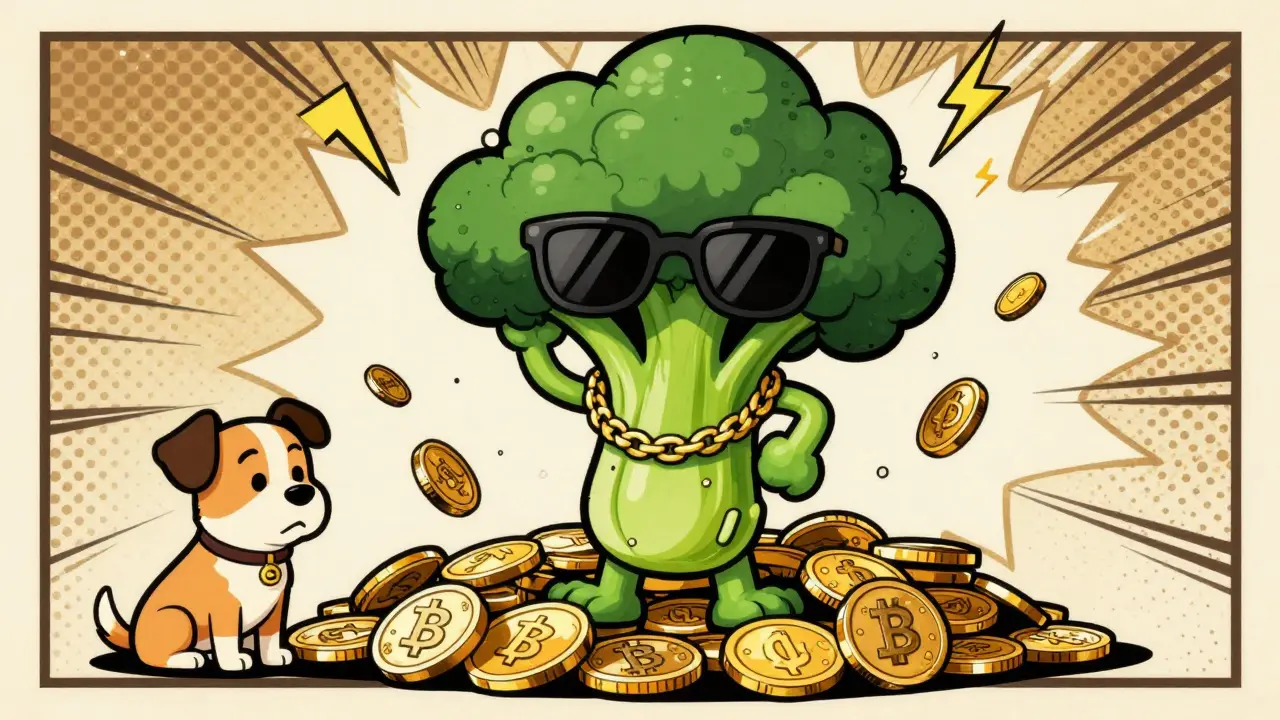
You’ve probably heard of Dogecoin or Shiba Inu. But have you heard of Broccoli? It sounds like a joke, and honestly, it started as one. The BROCCOLI token, operating on the Binance Smart Chain (BSC), launched in 2021 with a simple premise: it was a meme coin celebrating Binance founder Changpeng Zhao (CZ) finally naming his dog. If that’s your first time hearing about it, you’re not alone. This isn’t Bitcoin. It’s not even close to Ethereum. It’s a niche, high-risk asset that blends internet humor with vague promises of environmental sustainability.
If you are reading this because you saw a ticker symbol flash by on a social media feed or a friend mentioned "green" crypto gains, stop for a second. You need to understand exactly what you are looking at before you connect your wallet. Is it a legitimate investment? Is it a scam? Or is it just another fleeting internet trend? Let’s break down the reality behind the hype, the numbers, and the risks involved with holding $BROCCOLI in 2026.
The Origin Story: More Than Just a Vegetable?
To understand where this token is going, you have to look at where it came from. The project originated from broccolibnb.org, a website that positions itself as more than just a meme. According to their official narrative, the token aims to create a decentralized ecosystem focused on sustainability. They claim holders can participate in governance and support environmentally friendly ventures.
However, let’s be real. At its core, Broccoli (BROCCOLI) is a meme coin. Its primary value driver has always been community sentiment and viral marketing, not utility. The connection to CZ’s dog gave it an initial burst of attention in the Binance ecosystem, but that novelty wears off quickly. Unlike major cryptocurrencies that solve specific problems-like fast transactions or smart contract scalability-Broccoli solves the problem of boredom. That’s a fragile foundation for long-term wealth.
The development team remains anonymous. In the world of crypto, anonymity is a red flag. When you don’t know who is building the product, you can’t hold anyone accountable if things go wrong. There is no public roadmap with verified milestones, just general statements about future partnerships and features. This lack of transparency is common in meme coins but dangerous for investors expecting serious returns.
Technical Specs: How Does It Actually Work?
Under the hood, Broccoli runs on the Binance Smart Chain (BSC). This is important because BSC is known for low transaction fees and fast processing times compared to Ethereum. For a low-value token, this makes sense. You don’t want to pay $5 in gas fees to buy $1 worth of memes.
Here are the hard facts you need to check before buying:
- Token Standard: BEP-20 (This means it works with wallets like MetaMask and Trust Wallet).
- Contract Address: 0x23D3...a28F2b (Always verify this on BscScan to avoid fake tokens).
- Total Supply: 1 Billion BROCCOLI tokens.
- Circulating Supply: Approximately 184.61 million tokens.
- Market Cap: Around $1.17 million to $1.48 million (depending on the exchange data source).
The gap between total supply and circulating supply is significant. With over 800 million tokens still locked or held by the team, there is a risk of inflation later on. If the developers decide to dump those tokens onto the market, the price could crash instantly. Always keep an eye on the liquidity pools and token distribution charts on blockchain explorers.
Price Performance: The Rollercoaster Ride
Let’s talk money. Or rather, the lack of it. As of mid-2026, Broccoli trades at roughly $0.006. That might sound cheap, but remember how many tokens you get per dollar. More importantly, look at the volatility.
In February 2025, the token hit an all-time high of $0.2888. Since then, it has dropped by nearly 98%. To put that in perspective, if you bought at the peak, you would have lost almost everything. The all-time low recorded around the same period was $0.00396. This extreme swing is typical for micro-cap meme coins. They pump hard when there is news (like a partnership announcement) and dump harder when the hype fades.
| Metric | Value | Implication |
|---|---|---|
| Current Price | $0.006391 | Highly volatile; subject to rapid changes |
| Market Cap | $1.17 Million | Micro-cap status; high risk, low liquidity |
| 24h Volume | $421k - $672k | Volume exceeds market cap ratio (~35%), indicating speculative trading |
| Ranking | #2170 | Low visibility among thousands of competitors |
| Holders | 13,900 | Small community; susceptible to whale manipulation |
Notice the volume-to-market cap ratio. At 35%, it’s unusually high. While some see this as activity, experts view it as a warning sign. When trading volume is a large percentage of the total market value, it often means a few big players (whales) are moving prices up and down to attract retail buyers before selling off. This is the classic "pump and dump" mechanic.

Is It Listed on Major Exchanges?
Here is a crucial detail: Binance does not list Broccoli for trading. Yes, they provide price data for it, but you cannot buy it directly on the Binance exchange. This is a massive hurdle for most users. It means you have to use decentralized exchanges (DEXs) like PancakeSwap.
Trading on a DEX comes with its own set of headaches. You need to connect a Web3 wallet, manage private keys, and deal with slippage. Users have reported slippage rates of 8-12% on standard trades due to low liquidity. That means if you try to sell $100 worth of tokens, you might only receive $88 after fees and price impact. These hidden costs eat into profits quickly.
The Sustainability Angle: Greenwashing or Genuine?
The project claims to fund tree planting initiatives through token burns. Some community members praise these quarterly transparency reports. However, independent verification of these claims is scarce. In the crypto space, "greenwashing"-making false or misleading claims about environmental benefits-is a growing concern.
Regulators are watching closely. The U.S. Securities and Exchange Commission (SEC) has increased scrutiny on tokens that mix meme culture with sustainability claims without proof. Commissioner Hester Peirce warned in 2025 that unsubstantiated environmental claims could lead to enforcement actions. Until Broccoli provides audited, third-party proof of its environmental impact, treat these claims with skepticism.
How to Buy (And What Could Go Wrong)
If you still want to proceed, here is the practical path. First, ensure you have a wallet like MetaMask installed. Second, add the Binance Smart Chain network manually if it isn’t already there. Third, navigate to PancakeSwap and paste the correct contract address. Never trust links from random tweets; scammers create fake tokens with similar names.
Be prepared for technical issues. About 23% of new users report wallet connection errors, often requiring manual RPC configuration. Support is limited to a Telegram group with average response times of 12-24 hours. There is no customer service hotline. You are on your own.
Expert Outlook: Should You Invest?
Analysts are divided, but mostly cautious. Quantitative models predict a short-term decline, with potential drops below $0.005 in late 2025 and early 2026. Long-term forecasts are equally uncertain, with some algorithms suggesting a recovery to $0.012 by 2027, while others see a 68% probability of continued stagnation.
Crypto analyst Michael van de Poppe noted that meme coins with sustainability narratives face an uphill battle unless they show tangible results. Delphi Digital reports that such hybrid tokens have a 32% higher failure rate within 18 months of launch. The combination of meme volatility and unproven utility creates a perfect storm for losses.
Ultimately, Broccoli is a speculative gamble, not an investment. It appeals to those who enjoy the thrill of the chase and the community aspect of crypto culture. But if you are looking for stable growth or reliable passive income, this is not the place for your capital. Treat any money you put into $BROCCOLI as entertainment expense-money you are fully prepared to lose.
Is Broccoli (BROCCOLI) a good investment?
Broccoli is considered a high-risk, speculative asset rather than a traditional investment. With a market cap under $2 million and significant price volatility, it is suitable only for traders willing to lose their entire principal. It lacks the utility and institutional backing of major cryptocurrencies.
Where can I buy BROCCOLI token?
You cannot buy BROCCOLI on centralized exchanges like Binance or Coinbase. It must be purchased via decentralized exchanges (DEXs) such as PancakeSwap using a Web3 wallet connected to the Binance Smart Chain (BSC). Always verify the contract address to avoid scams.
What is the purpose of the Broccoli token?
Originally launched as a meme coin referencing Binance CEO CZ's dog, the project now claims to focus on sustainability and community governance. However, its primary function remains speculative trading within the meme coin sector.
Is the Broccoli team anonymous?
Yes, the development team behind Broccoli remains anonymous. This increases the risk for investors as there is no accountability for the project's direction or financial management.
Does Broccoli really plant trees?
The project claims to fund tree planting through token burns, but independent verification of these environmental impacts is limited. Investors should be cautious of potential greenwashing until third-party audits confirm these activities.
Lee Paige
June 9, 2026 AT 01:55There is a distinct pattern to these anonymous teams, they are almost certainly shell companies designed to siphon wealth from the unsuspecting masses while evading regulatory oversight. The lack of transparency is not an accident but a calculated feature of this predatory system.
Caitlin Donahue
June 10, 2026 AT 16:05i think its just fun honestly dont overthink it lol
Dr Lynea LaVoy
June 10, 2026 AT 17:30It is important to understand that meme coins operate on community sentiment rather than intrinsic value. When you engage with assets like Broccoli, you are participating in a social experiment where trust is placed in strangers rather than verified entities. This dynamic creates high volatility because the foundation is emotional rather than structural. Many investors overlook this fundamental difference between utility tokens and speculative memes. Understanding this distinction can help protect your financial well-being in the long run.
dan kaffeman
June 12, 2026 AT 16:07This entire industry is a scam built on nothing but hype and greed. You people are foolish for believing any of this nonsense. Real value comes from hard work and tangible assets, not digital pictures of vegetables or dogs. It is pathetic how easily everyone is manipulated by these internet trends.
Meg Gran
June 13, 2026 AT 03:34oh wow another coin trying to save the planet while printing money out of thin air? classic. the irony is palpable here. maybe if they burned more trees instead of planting them it would be honest about its destruction.
Alexander DeVries
June 14, 2026 AT 03:56You must approach this market with extreme caution and discipline. The data clearly indicates that micro-cap tokens are highly susceptible to manipulation by large holders. Do not let emotion drive your decisions when dealing with such volatile instruments. Protect your capital at all costs.
Mark Corpuz
June 15, 2026 AT 08:09The technical specifications provided in the article are accurate regarding the BEP-20 standard and the Binance Smart Chain infrastructure. However, the risk assessment regarding the circulating supply versus total supply is critical. Investors should monitor the token distribution charts closely to detect any unusual movements from whale wallets before significant price impacts occur.
Steven Jacobowitz
June 16, 2026 AT 12:51Why does nobody talk about the liquidity pool mechanics properly? It's super simple really. Slippage eats you alive if you don't know what you're doing. You need to check the depth of the order book on PancakeSwap before you even think about clicking swap. Most retail traders ignore this basic step and wonder why they lose money instantly.
Yogendra Dwivedi
June 18, 2026 AT 06:32I have observed similar patterns in other meme coins launched during the previous bull cycle. The initial hype often masks the underlying lack of utility. It is advisable to treat such investments as entertainment expenses rather than serious financial commitments. The psychological aspect of trading these tokens is often more significant than the financial outcome.
Sylvia Mossman
June 19, 2026 AT 15:48Everyone says it's a scam but I bet some lucky person made millions. Why am I always wrong? I bought in early last time and lost everything. Now I'm just waiting for the next pump to happen so I can finally get rich. It's probably going to moon soon.
Alexis Abster
June 20, 2026 AT 16:20Oh my gosh, the drama surrounding this token is absolutely thrilling! One minute it's up, the next it's down. It feels like a rollercoaster ride through the clouds of uncertainty. I love the energy of the community, even if it is chaotic. Let's keep the vibes positive!
Brad Ranks
June 21, 2026 AT 13:38Wait, did anyone else notice the contract address matches one of those honeypot scams from last year? I checked Etherscan and BscScan multiple times. It looks suspiciously like the same developer wallet structure used in three other rug pulls. We need to be careful here.
Karthikeyan S
June 22, 2026 AT 02:26lol u guys r so dumb 😂😂 this is gonna go to the moon 🚀🚀 stop being haters and just buy the dip. easy money right there 💰💰
Dinesh Pattigilli
June 23, 2026 AT 03:48typical reddit crowd cant handle real alpha. this is obvious greenwashing but the tech is solid. anon team means no distractions just pure profit motive. smart money is already accumulating. fools will cry later.
Madhu Menon
June 24, 2026 AT 17:33In the grand tapestry of existence, what is a token but a symbol of our collective desire for meaning? Perhaps the broccoli represents growth, resilience, and the organic nature of human connection in the digital age. 🌱
Narendra Kulkarni
June 25, 2026 AT 00:37hey friends just wanted to say thanks for sharing this info. i was thinking about buying some but now im a bit worried. maybe we should wait and see what happens first? no rush at all.
verna kennedy
June 26, 2026 AT 13:15It is frankly embarrassing how many people fall for these basic tricks. If you cannot verify the team, do not invest. Period. This is elementary financial literacy that seems to be missing from the current discourse.
Kelly Tenney
June 28, 2026 AT 13:12Please remember to take care of yourselves during these volatile times. Investing should never cause stress or anxiety. If you feel overwhelmed, it is perfectly okay to step back and reassess your goals. Your mental health is far more valuable than any potential gains.
Caralee Robertson
June 28, 2026 AT 16:20i mean its kinda cute i guess but yeah prob not worth the risk. too much hassle with the dex stuff anyway. ill stick to my savings account lol.
Greg Lewis
June 29, 2026 AT 01:48so you think the government is behind this to track our spending habits? probably. they want to control every penny we spend. wake up sheeple. this is just another tool for surveillance capitalism.
JEVON HALL
June 29, 2026 AT 10:16just a tip make sure you double check the contract address on bscscan before you connect your wallet. i seen too many people get drained by fake links. stay safe out there 👍
aaliyah zahid
June 30, 2026 AT 20:20Oh, look at us judging each other based on financial choices. How quaint. In reality, this is just culture reflecting itself back at us. The absurdity is the point. Enjoy the show.
Erik Kirana
July 1, 2026 AT 01:12This analysis is superficial at best. A true expert would recognize the nuanced interplay between community governance and market dynamics. You are all missing the bigger picture entirely. Disappointing.
Matthew Malone
July 2, 2026 AT 13:35Typical foreign influence trying to disrupt our markets. These anonymous teams are likely operating from jurisdictions with no oversight. We need stricter regulations to protect American investors from this garbage.