

Most people think of stablecoins like USDT or USDC as digital versions of cash sitting in a bank. But Balanced Dollar, known by its ticker bnUSD, works differently. It is a decentralized, cross-chain stablecoin designed to stay pegged to the US dollar without relying on traditional banks. Instead of holding cash reserves, bnUSD uses an over-collateralized model built on the ICON blockchain ecosystem. This means you lock up crypto assets to borrow dollars, keeping control of your funds while accessing liquidity.
If you have ever wanted to leverage your crypto holdings without selling them, or if you are tired of trusting centralized companies with your stablecoin reserves, bnUSD offers a different path. It operates across ten different blockchains, making it one of the more flexible options in the decentralized finance (DeFi) space. However, this flexibility comes with specific risks and mechanics that you need to understand before using it.
How bnUSD Maintains Its Value
The core question for any stablecoin is: what backs it? For centralized tokens, the answer is usually fiat currency held in reserve accounts. For bnUSD, the backing is cryptocurrency collateral deposited by users. This is called a Collateralized Debt Position (CDP). When you deposit assets like native ICON (ICX) tokens or tokenized US Treasury bills, the protocol allows you to mint bnUSD against that value.
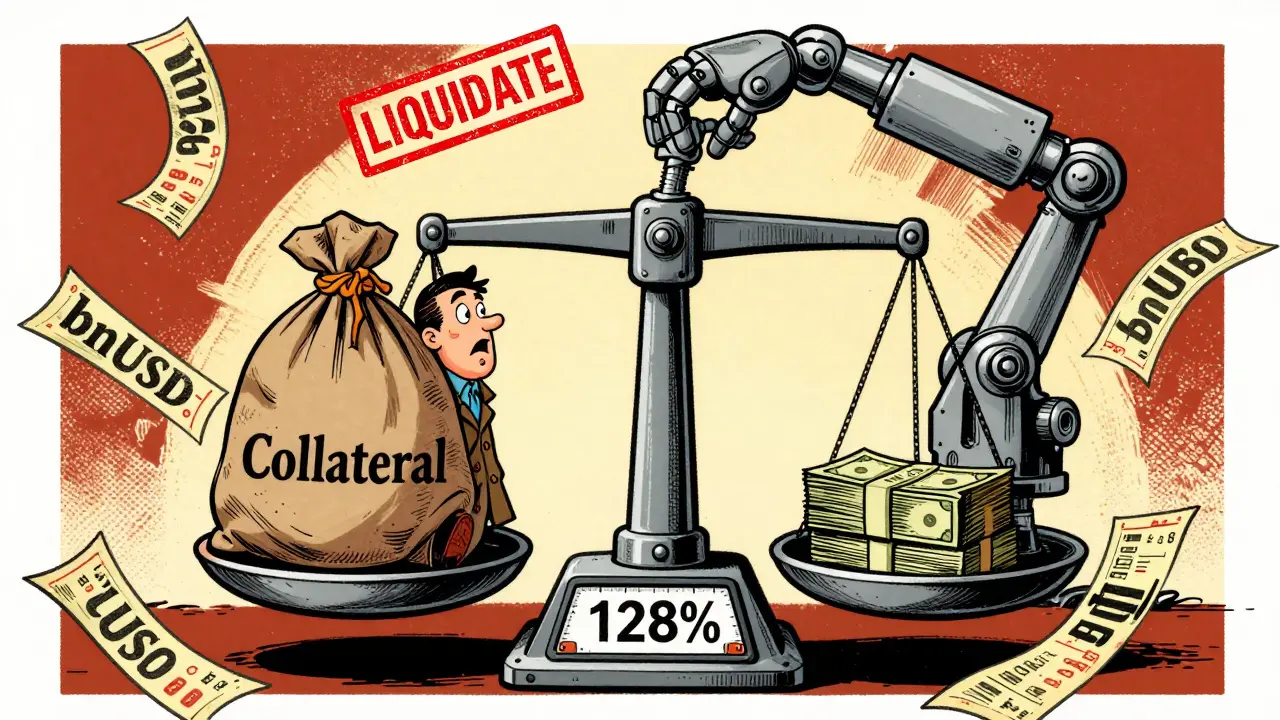
To keep the system safe, bnUSD enforces a strict minimum collateralization ratio of 128%. This means for every $1 of bnUSD you borrow, you must lock up at least $1.28 worth of collateral. If the value of your collateral drops too low, the system automatically liquidates your position to repay the debt. This mechanism protects the stability of the entire network. Unlike algorithmic stablecoins that failed in the past due to lack of real backing, bnUSD’s supply cannot exceed the value of its underlying assets.
The protocol also uses a Stability Fund. This fund holds most of the stablecoin liquidity and allows users to swap bnUSD for other approved stablecoins at a 1:1 rate. There is a small fee for reverse transactions, but this ensures that bnUSD remains usable across different platforms. As of late 2025, bnUSD has demonstrated resilience, maintaining its peg even during periods of market volatility, though it occasionally trades slightly above $1, such as reaching $1.10 during high-demand periods.
Costs and Rewards: What You Pay and Earn
Using bnUSD isn’t free, but the costs are transparent and often lower than traditional lending. When you mint bnUSD, you pay a one-time fee of 0.2%. On top of that, there is an annual interest rate of 2% on your debt position. Compare this to many DeFi lending protocols where rates can fluctuate wildly or start higher, and bnUSD looks attractive for long-term holders.
On the flip side, if you already hold bnUSD and don’t want to spend it, you can earn rewards. The Savings Rate mechanism lets you deposit idle bnUSD to earn yields. These rewards come in three forms: BALN governance tokens, additional bnUSD, and sICX tokens. The exact Annual Percentage Yield (APY) changes based on market conditions and protocol parameters. This dual-sided incentive structure encourages both borrowing and saving within the ecosystem.
| Feature | Balanced Dollar (bnUSD) | USDT / USDC |
|---|---|---|
| Backing | Crypto collateral (Over-collateralized) | Fiat reserves & Treasuries |
| Decentralization | High (No central issuer) | Low (Centralized company) |
| Collateral Ratio | Minimum 128% | N/A (Not applicable) |
| Cross-Chain Support | 10+ Blockchains | Varies by bridge/wrapper |
| Counterparty Risk | Smart contract risk only | Issuer solvency risk |
Cross-Chain Functionality
One of bnUSD’s biggest strengths is its ability to move across chains. It currently operates on ten different blockchains. This multi-chain presence means you can use bnUSD in various DeFi applications without needing complex bridges or wrapped versions of the token. For example, if you are working in the ICON ecosystem but want to trade on a platform connected to Ethereum, bnUSD facilitates this movement seamlessly.
This versatility sets it apart from competitors like DAI, which, while robust, has a more limited native cross-chain footprint compared to bnUSD’s integrated approach. The protocol aims to expand further, with plans announced in December 2025 to integrate with three additional blockchain networks by the second quarter of 2026. This expansion will bring the total supported chains to thirteen, enhancing liquidity and accessibility for users.
Risks and User Challenges
No financial tool is without risk, and bnUSD is no exception. The primary danger lies in market volatility. Because your loan is backed by crypto, a sudden drop in asset prices can trigger liquidation. Users have reported being caught off guard by flash crashes. One Reddit user noted losing their position during an ICON mainnet upgrade because they didn’t monitor their collateral ratio closely enough. To mitigate this, experts recommend setting price alerts at 140-150% collateralization, well above the 128% liquidation threshold.
Another challenge is complexity. The interface for managing collateral can be confusing for beginners. Surveys from exchanges like MEXC showed that 27% of negative reviews cited unclear liquidation warnings. While the documentation is rated highly (4.2/5), understanding the nuances of the Stability Fund and Savings Rate requires some study. Most users report needing two to three hours to become proficient with the core features.
There is also regulatory uncertainty. With frameworks like the EU’s MiCA coming into effect, protocols that use tokenized real-world assets (like US Treasury bills) may face stricter disclosure requirements. Additionally, analysts like Dr. Elena Rodriguez from MIT have questioned the long-term viability of fixed low interest rates in high-inflation environments. If inflation rises significantly, the 2% cost of borrowing might become unsustainable for the protocol’s economic model.

Who Should Use bnUSD?
bnUSD is ideal for experienced DeFi users who want to maintain exposure to their crypto assets while accessing dollar-denominated liquidity. If you hold ICX or other supported collaterals and don’t want to sell them during a bear market, bnUSD lets you borrow against them cheaply. It is also great for those who prioritize decentralization and want to avoid counterparty risk associated with centralized issuers.
However, it is not suitable for absolute beginners who are uncomfortable with smart contract risks or volatile collateral values. If you need a simple, plug-and-play stablecoin for everyday payments without worrying about liquidation thresholds, USDC or USDT might be safer choices. bnUSD excels in niche scenarios: cross-chain arbitrage, leveraging positions in the ICON ecosystem, and earning yield through the Savings Rate.
Getting Started with bnUSD
To start using bnUSD, you need a compatible wallet like ICONex or Binance Web3 Wallet. First, connect your wallet to the Balanced Network dashboard. Next, deposit supported collateral assets such as ICX. Once your deposit is confirmed, you can mint bnUSD against your collateral. Remember to keep an eye on your collateralization ratio. Setting up alerts is crucial to avoid unexpected liquidations.
If you already have bnUSD, you can deposit it into the Savings Rate pool to earn rewards. The process is straightforward, but always double-check the current APY and gas fees on the specific chain you are using. Community support is available via Discord, where developers hold weekly AMAs, though response times can take four to six hours during busy periods.
Is bnUSD safe compared to USDT?
bnUSD is considered safer in terms of transparency and decentralization because it is fully backed by on-chain collateral and auditable code. USDT relies on trust in a central company to hold reserves. However, bnUSD carries smart contract risk and liquidation risk, whereas USDT does not have these specific technical risks.
What happens if my collateral value drops below 128%?
If your collateralization ratio falls below 128%, your position becomes eligible for liquidation. The protocol will automatically sell your collateral to repay the bnUSD debt. To prevent this, you should add more collateral or repay part of your loan when the ratio approaches this threshold.
Can I use bnUSD outside the ICON blockchain?
Yes, bnUSD is a cross-chain stablecoin. As of late 2025, it operates on ten different blockchains. This allows you to transfer and use bnUSD across various DeFi platforms without needing to wrap or bridge the token manually in most cases.
How much does it cost to borrow bnUSD?
Borrowing bnUSD involves a 0.2% minting fee and an annual interest rate of 2% on the outstanding debt. These costs are generally lower than many other DeFi lending protocols, making it attractive for long-term loans.
Does bnUSD lose its peg to the dollar?
bnUSD aims to maintain a 1:1 peg with the US dollar. While it generally stays close to $1, it can deviate slightly during extreme market volatility. For instance, it traded at $1.10 in December 2025. The Stability Fund helps correct these deviations by allowing swaps with other stablecoins.