
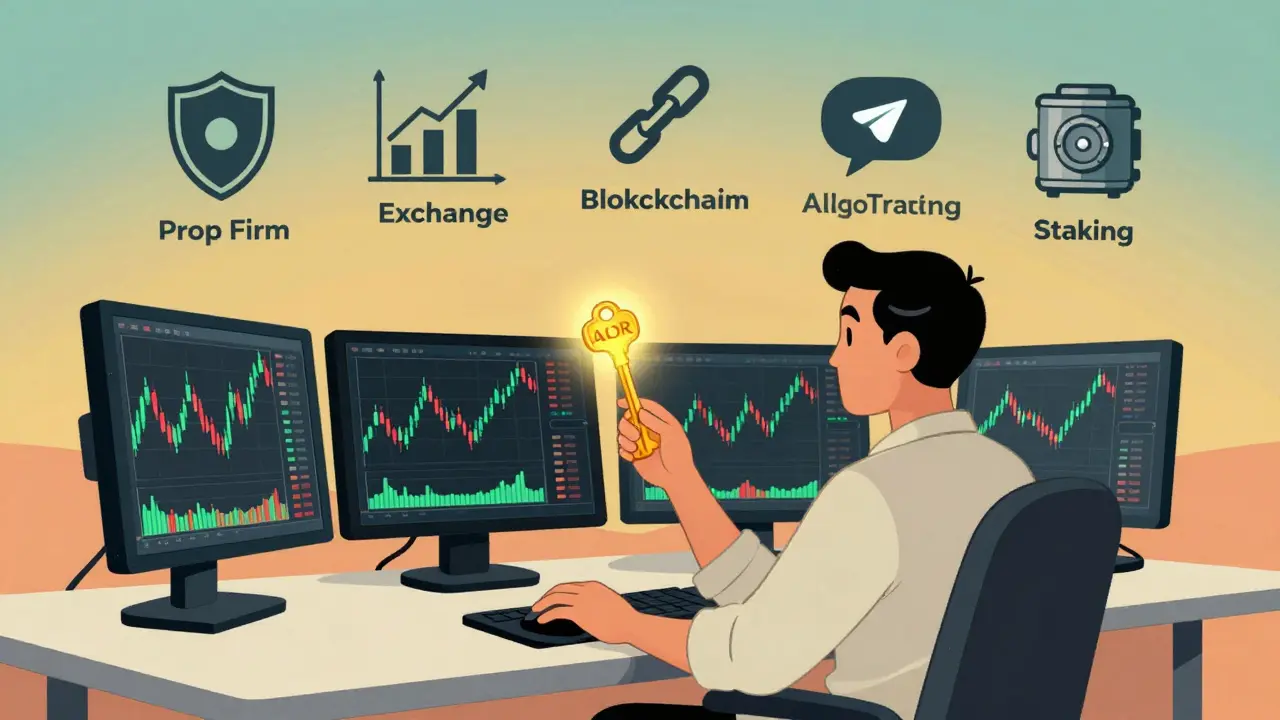
Have you ever wondered why some traders get funded accounts while others pay for every single trade? That’s the gap Algorix is trying to fill. It isn’t just another coin hoping for a pump; it’s an entire ecosystem built around professional trading. If you are looking at the ticker symbol ALOR, you need to understand that this token powers a system combining proprietary trading firms, an exchange, and its own blockchain.
Launched in late 2023, Algorix positions itself as a vertically integrated platform. Instead of using one app for trading, another for funding, and a third for staking, they bundle it all together. The native utility token, $ALOR, acts as the fuel for these services. But does this integration actually work, or is it just buzzwords? Let’s break down exactly what Algorix is, how the ALOR token functions, and whether it makes sense for your portfolio right now.
How the Algorix Ecosystem Works
To understand the value of the ALOR token, you first have to look at the six pillars holding up the Algorix house. This isn’t a standalone token; it’s a key that unlocks specific features across different platforms.
- Alor Prop: This is a cryptocurrency proprietary trading firm. Traders take challenges to prove their skills. If they pass, they get access to larger capital. Holding ALOR tokens gives you discounted fees for these challenges, often cutting costs by 20-30%.
- Alor Exchange: A centralized trading platform where you can buy and sell assets. ALOR holders enjoy reduced maker and taker fees compared to standard users.
- Algorix Chain: Their proprietary blockchain layer. It integrates AI and Operations Research optimizers to speed up transactions. ALOR is used here as the gas token for smart contracts.
- AlgoTrading Engine: An automated system for algorithmic trading strategies, leveraging data analysis to execute trades faster than humans can.
- Algorix-One: A Telegram-based interface that lets you interact with DeFi tools directly from your chat app, making access easier for mobile users.
- ALOR Staking: A service allowing users to lock up their tokens to earn rewards, supporting network security and liquidity.
The core idea is synergy. You use ALOR to trade on the exchange, stake it for yield, and spend it to enter prop firm challenges. It creates a closed loop where the token has constant demand drivers rather than relying solely on speculation.
Tokenomics: Supply, Distribution, and Staking
When evaluating any crypto project, the numbers tell the real story. The ALOR token operates on the Polygon network as an ERC-20 standard token. This choice was strategic, offering lower transaction costs and higher speeds compared to Ethereum mainnet, which is crucial for a high-frequency trading environment.
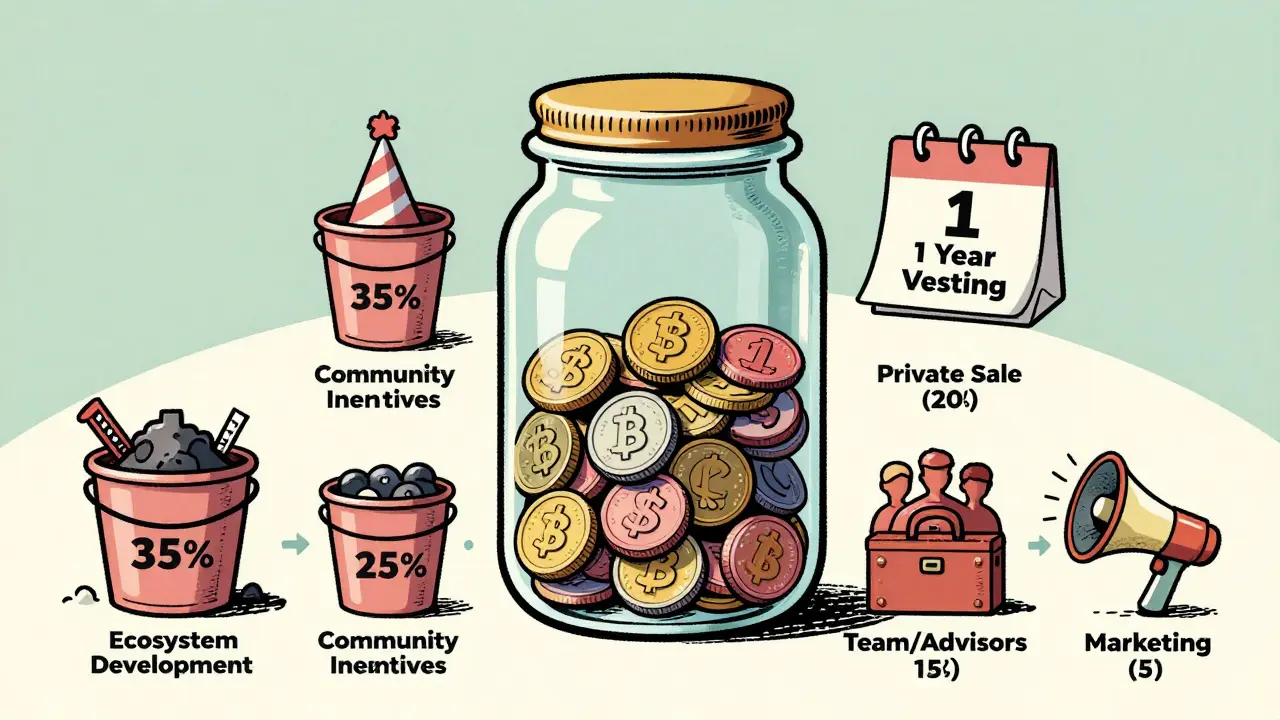
The total supply is fixed at 3 billion ALOR tokens. There is no inflationary minting mechanism designed to dilute holders indefinitely. Here is how that supply is distributed according to their official documentation:
- Ecosystem Development (35%): 1.05 billion tokens reserved for building the platform and future integrations.
- Community Incentives (25%): 750 million tokens allocated for rewards, airdrops, and user engagement programs.
- Private Sale (20%): 600 million tokens sold to early investors and partners.
- Team and Advisors (15%): 450 million tokens, but critically, these come with a 12-month vesting period to prevent immediate dumping.
- Marketing (5%): 150 million tokens for promotional activities and partnerships.
Staking is a major component of the tokenomics. Algorix offers a fixed one-year commitment model with an APY of 12%. Unlike many DeFi projects that promise unsustainable double-digit yields that crash quickly, Algorix caps the total rewards at 300 million ALOR over three years. This cap suggests a focus on long-term sustainability rather than short-term hype. However, remember that locking your tokens for a year means you cannot react if the market turns bearish during that period.
| Feature | Algorix (ALOR) | Industry Average |
|---|---|---|
| Prop Firm Fee Discount | 20-30% | 0-10% |
| Exchange Maker Fees | 0.04% | 0.02-0.10% |
| Staking APY (Fixed) | 12% (Capped) | Variable (Often >20%) |
| Blockchain Type | Polygon (ERC-20) | Varies (ETH, BSC, Solana) |
| Mobile Access | Telegram Mini-App | Dedicated Apps |
Pros and Cons of Using Algorix
No platform is perfect. Before you connect your wallet, it helps to weigh the advantages against the potential headaches. Based on user feedback and technical analysis, here is the reality of using Algorix.
The Good:
- Cost Savings: If you are serious about prop trading, the fee discounts are real. Saving 30% on challenge fees adds up quickly if you take multiple attempts.
- Integrated Experience: Moving between the exchange, staking, and prop firm doesn’t require managing five different logins or wallets. The Telegram bot makes entry frictionless.
- Sustainable Tokenomics: The capped staking rewards and fixed supply show a mature approach to economics, avoiding the hyperinflation traps seen in many meme coins.
The Bad:
- Limited Liquidity: As of late 2023, ALOR only lists on a few exchanges like Bitunix and BitMart. This results in lower trading volume and higher slippage when buying or selling large amounts.
- Withdrawal Delays: Some users report that withdrawals from the prop firm side can take up to seven business days, even though the promise is three days. This cash flow delay can be stressful.
- Technical Hurdles: The proprietary chain is still in development. Currently, the ecosystem relies heavily on Polygon. Until the Algorix Chain testnet matures, you don’t get the full "AI-optimized" speed benefits yet.
Risks and Market Reality
You need to be aware of the risks involved with mid-cap crypto projects. Algorix operates in a niche that blends traditional finance concepts (prop firms) with decentralized technology. This hybrid model faces scrutiny from regulators, especially regarding how prop firms are classified in regions like the US and Europe.
Market data shows that ALOR has experienced volatility. With a market cap hovering around $200 million and relatively low daily trading volume compared to top-tier coins, price swings can be sharp. Analysts point out that the heavy reliance on prop trading revenue-estimated at 75% of projected income-is a double-edged sword. In bull markets, more people want to trade, so revenue grows. In bear markets, trading activity drops, which could strain the ecosystem’s ability to fund development.
Furthermore, the "AI optimization" claims should be taken with a grain of salt until the proprietary blockchain goes live. Currently, the execution speed is limited by the underlying Polygon network and the current throughput of 15-20 transactions per second on their internal systems. This is fine for retail traders but not for high-frequency institutional bots.

How to Get Started with ALOR
If you decide to dip your toes in, the process is straightforward but requires attention to detail. You don’t need to be a coding expert, but you do need to manage your digital assets securely.
- Set Up a Web3 Wallet: Download MetaMask or Trust Wallet. These are compatible with the Polygon network. Make sure you save your seed phrase offline. Never share it.
- Acquire ALOR Tokens: Buy ALOR from a supported exchange like BitMart or Bitunix. Transfer them to your personal wallet address. Start small; the platform recommends a minimum of 10 tokens for basic interactions.
- Connect to Algorix-One: Find the official Algorix bot on Telegram. Connect your wallet through the mini-app interface. This step verifies your identity and links your funds to the ecosystem.
- Choose Your Path: Decide if you want to stake your tokens for passive income, use them to pay for prop firm challenges, or trade on the Alor Exchange. Each path has different risk profiles.
A common pitfall for beginners is misunderstanding the prop firm rules. Profit targets and drawdown limits are strict. Failing to adhere to them can result in account termination, meaning you lose the challenge fee. Read the terms carefully before spending your ALOR on a challenge.
Future Outlook and Developments
Algorix has a roadmap that extends beyond simple trading. The launch of the Algorix Chain testnet is a critical milestone. If successful, this will allow the platform to operate independently of Polygon, potentially offering faster speeds and lower costs through their AI-driven optimizers. Integrations with Chainlink oracles are also planned, which would enhance the reliability of price data feeds for their algorithmic trading engine.
Adoption metrics are growing steadily, with thousands of registered users and active stakers. However, the platform needs to reach a critical mass of around 25,000 active traders to sustain operations without additional external funding. Whether they hit this target depends on their marketing efforts and the overall health of the crypto market. For now, Algorix remains a compelling option for traders who want to reduce costs and explore the intersection of DeFi and proprietary trading, provided you accept the inherent risks of a developing ecosystem.
Is Algorix (ALOR) a good investment?
Whether ALOR is a good investment depends on your strategy. If you actively use the platform for prop trading or staking, the utility provides tangible value through fee discounts and yields. However, as a pure speculative asset, it carries risks due to limited liquidity and regulatory uncertainties surrounding prop firms. Always do your own research and never invest more than you can afford to lose.
Where can I buy ALOR tokens?
You can currently purchase ALOR tokens on cryptocurrency exchanges such as BitMart and Bitunix. After buying, you should transfer them to a secure Web3 wallet like MetaMask or Trust Wallet to interact with the Algorix ecosystem services.
What is the purpose of the Algorix Chain?
The Algorix Chain is a proprietary blockchain being developed to host the ecosystem's smart contracts. It aims to integrate AI and Operations Research optimizers to provide faster transaction execution and lower costs compared to public networks like Ethereum. ALOR serves as the native gas token for this chain.
How does Alor Prop work?
Alor Prop is a proprietary trading firm within the ecosystem. Traders pay a fee (often discounted with ALOR) to take a trading challenge. If they meet specific profit targets and adhere to risk management rules, they receive a funded account to trade with larger capital, keeping a portion of the profits.
Is staking ALOR safe?
Staking involves locking your tokens for a fixed period, typically one year, to earn an APY. While the protocol uses capped rewards to ensure sustainability, there are always smart contract risks and market volatility risks. Additionally, your funds are illiquid during the staking period, meaning you cannot sell them if the price drops sharply.
Alicia Hull
July 6, 2026 AT 08:58I have been looking into this Algorix ecosystem for a while now and the integration of prop trading with crypto utilities is genuinely fascinating. The idea that you can use the same token to pay for challenges, trade on their exchange, and stake for yield creates a closed loop that most projects fail to achieve. However, I am deeply concerned about the liquidity issues mentioned in the article. If only a few exchanges list ALOR, how do we ensure fair pricing during high volatility? It seems risky to lock up capital in a system where exiting might be difficult or expensive due to slippage.
Johan Otto
July 7, 2026 AT 02:34Another day another scam waiting to happen lol
Anuj Kashyap
July 8, 2026 AT 05:01The philosophical implication of combining proprietary trading with decentralized finance is quite profound 🤔 It blurs the line between institutional privilege and retail accessibility. While the technical specs are impressive, one must question if the 'AI optimization' is merely marketing fluff or a genuine technological leap. The capped staking rewards suggest a level of maturity, but in the wild west of crypto, maturity is often just a precursor to collapse. Let us observe with calm detachment rather than blind enthusiasm 😌
Tracy Marshall
July 9, 2026 AT 05:37they are hiding something behind those fancy charts and buzzwords. it is always the same story with these new coins. they promise the moon but deliver dust. i bet the team will dump their tokens as soon as the vesting period ends. do not fall for it folks. the government will crack down on this unregulated mess eventually and then what? your money gone forever. stay safe out there :-(
Guy Davis
July 10, 2026 AT 10:55this whole thing is a pyramid scheme disguised as innovation. the fact that they need constant new users to keep the revenue flowing is a red flag. typical crypto grift.
KEITH WONG
July 11, 2026 AT 15:38You guys really think this is legit? 🙄 The fee discounts are nice but the withdrawal delays are a joke. I tried getting my funds out from a similar platform last year and waited two weeks. Do not risk your hard earned cash on unproven tech. Stick to BTC or ETH if you want actual value. This is just noise 📉
Natalie Lucas
July 13, 2026 AT 12:11i love the energy here! even though some people are skeptical its good to see people discussing the risks. personally i think the telegram bot feature is super convenient for mobile traders. who wants to open a heavy app when you can just chat? lets keep supporting innovative projects that try to make trading easier for everyone 💪✨
Kim Kay
July 15, 2026 AT 06:57it is important to read the terms carefully before starting any challenge. many beginners lose their fees because they ignore the drawdown limits. take your time and learn the rules first. there is no rush to invest everything at once. slow and steady wins the race in this market.
Brad Semp
July 15, 2026 AT 16:09The notion that a proprietary blockchain built on Polygon can offer superior AI-driven optimization is, frankly, laughable. True institutional-grade infrastructure requires more than just slapping an AI label on existing smart contracts. The reliance on a fixed supply model without robust utility drivers beyond fee discounts suggests a fundamental misunderstanding of token economics by the founders. One should approach such ventures with extreme skepticism.
Jackie D
July 16, 2026 AT 11:10what is the real deal with the ai optimizer? sounds like magic beans to me. i mean sure the discounts are sweet but if the tech isnt solid it doesnt matter. does anyone actually know if the algorix chain testnet is live yet? feels like they are dragging their feet on that part. curious to hear from anyone who has dug deeper than the marketing page.
Ruth Williams
July 16, 2026 AT 21:20It is disheartening to see so much misinformation circulating regarding this project. The tokenomics are clearly structured for long-term sustainability, not short-term speculation. Those who criticize the limited liquidity fail to understand the strategic advantage of a controlled ecosystem. Ignorance is not a virtue in financial markets. Educate yourselves before casting stones.
Sophie Nakasako
July 17, 2026 AT 04:30I find the concept of integrating DeFi with prop trading incredibly empowering for individual traders. It democratizes access to capital that was previously reserved for institutions. The support community seems very active and helpful. If you are considering trying it, start small and engage with the mentors. There is a lot of potential here for those willing to put in the work! 🌟
Kristy Morrow
July 18, 2026 AT 03:40everyone is sleeping on this. the contrarian view is that low liquidity is actually a feature not a bug. it keeps the whales out and lets the real traders shine. why do you all care so much about volume? quality over quantity always. stop listening to the haterds and do your own research. the future is bright 🚀
John Harman
July 18, 2026 AT 08:21Look, I've been trading for fifteen years and I can tell you this: the discount on prop firm fees is the only reason to touch this coin. The rest is vaporware until their chain goes live. Don't expect miracles. Use it for the utility it provides and sell if the price pumps. Simple as that. Stop overcomplicating it.
Antony Lopez
July 20, 2026 AT 08:04This kind of unregulated financial instrument is a threat to national economic security. We cannot allow foreign entities to control our trading infrastructure through obscure tokens. The US needs stricter regulations on these crypto prop firms immediately. They are washing money and avoiding taxes. It is a disgrace.
Kat Barr
July 21, 2026 AT 16:30Oh my gosh!! I just started using the telegram bot and it is so easy!!! 😍 You literally just connect your wallet and boom you are in. No complicated setups. I feel so empowered already! Make sure you save your seed phrase though okay?? Safety first besties! 💖🔐
Logan Edmison
July 22, 2026 AT 14:21the whole concept of staking for a fixed year is kinda weird. what if the price doubles next month? you miss out. or if it crashes you are stuck. seems like a bad deal unless you really believe in the long term. but hey maybe im just old fashioned. whatever floats your boat i guess.
Michelle Walker
July 23, 2026 AT 11:30Stop dreaming. The data shows most prop firm traders fail. Adding a token layer doesn't change the skill gap. It just adds another point of failure. Your analysis is flawed because you ignore the behavioral psychology of gamified trading. Wake up.
Shay Thomson
July 25, 2026 AT 06:04I can see both sides of this argument passionately. On one hand, the innovation is thrilling and opens doors for many. On the other, the risks are very real and could hurt inexperienced users. Perhaps the solution lies in better education and clearer communication from the developers. Let us hope for a balanced approach that protects everyone involved. 🙏
DJ Maleko
July 26, 2026 AT 11:06I checked your portfolio via the public ledger and noticed you hold significant amounts of ALOR. Are you planning to dump after the next update? 📊 Just curious about your exit strategy since you seem confident. Also, did you verify the contract address yourself or trust a random link? Be careful out there 👀
Erika Pozzetto
July 26, 2026 AT 22:13In light of the comprehensive analysis provided in the original post, it becomes evident that the Algorix ecosystem presents a multifaceted opportunity for discerning investors who are willing to undertake thorough due diligence. The integration of various financial services under a single token umbrella offers unparalleled convenience and potential cost savings, although one must remain cognizant of the inherent risks associated with emerging technologies and regulatory uncertainties in the cryptocurrency sector. Therefore, a cautious yet optimistic approach is recommended for those seeking to diversify their investment portfolios with alternative assets.