
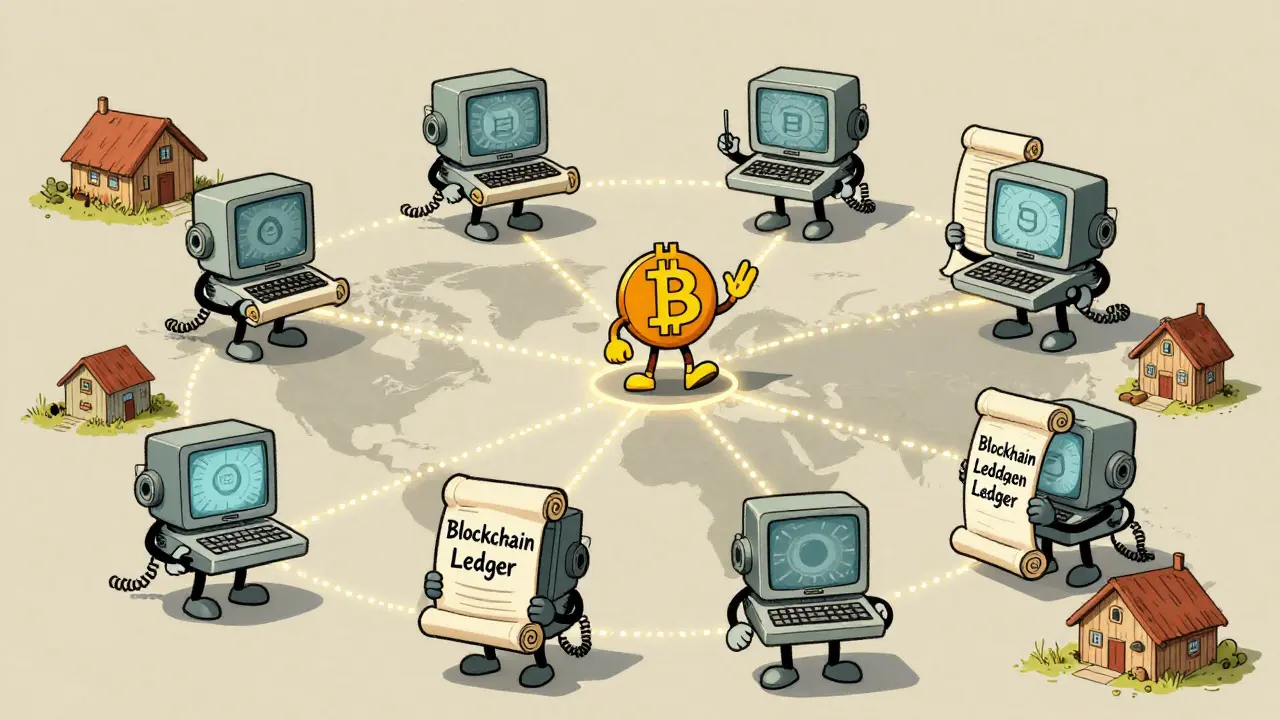
Think of a blockchain like a public spreadsheet that everyone can see but no one can delete or secretly change. Now, imagine that spreadsheet isn’t stored on one server in a company’s basement-it’s copied across thousands of computers around the world. Each of those computers? That’s a node.
What Exactly Is a Node?
A node is just a computer connected to a blockchain network. It doesn’t need to be fancy-just enough power to run the blockchain’s software and stay online. Every node holds a full or partial copy of the blockchain’s ledger. That means every transaction ever made on that network is recorded and stored across all these machines. No single company owns it. No central server controls it. The network lives because of these nodes.When someone sends Bitcoin or updates a smart contract, that message doesn’t go to a bank or a cloud server. It gets sent out to the network. Nodes pick it up, check if it’s valid, and then pass it along. If enough nodes agree it’s legit, the transaction gets bundled into a block and added to the chain. That’s how trust is built-not by a CEO or a government, but by code and consensus.
Types of Nodes: Full, Lightweight, and Miner
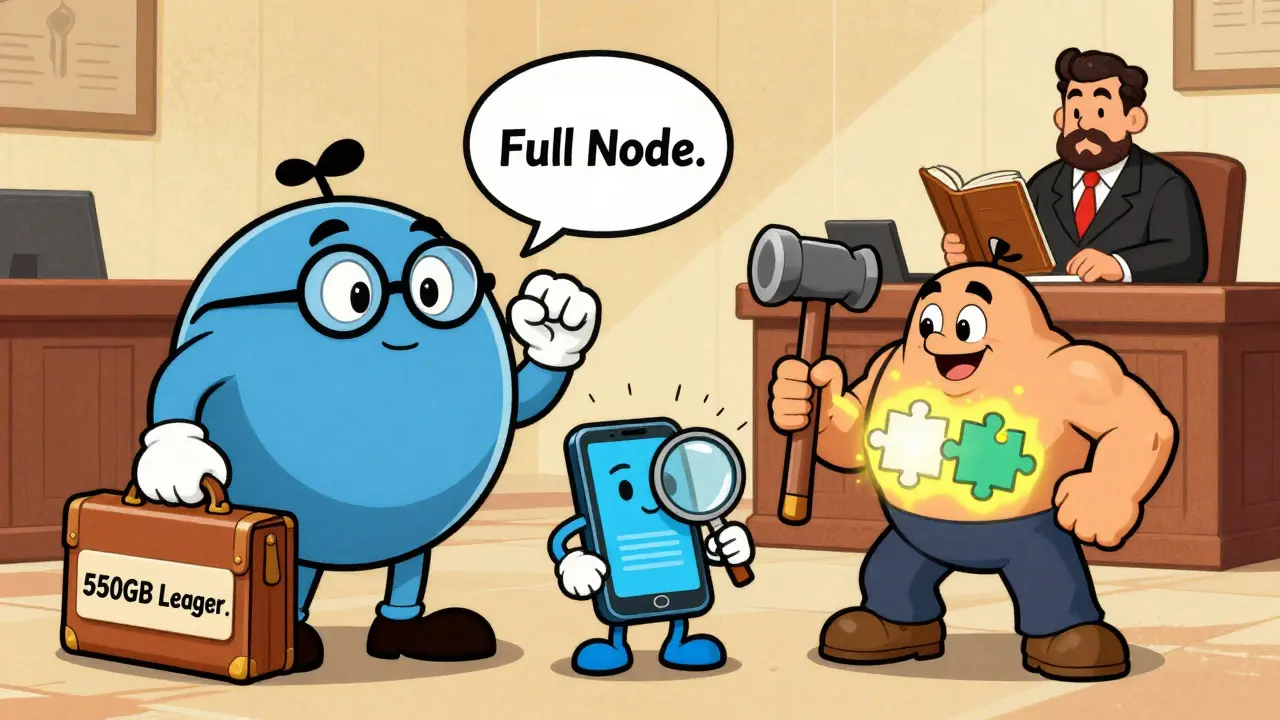
Not all nodes are the same. There are three main types, each with different jobs and requirements.Full nodes are the backbone of any blockchain. They download and store the entire history of the blockchain-from the very first block (called the genesis block) to the latest one. That’s hundreds of gigabytes for Bitcoin, and even more for Ethereum. Full nodes check every transaction and block against the network’s rules. If a block tries to create fake coins or double-spend, the full node rejects it. They’re the referees. Without them, the network would be open to fraud.
Lightweight nodes (also called SPV nodes-Simplified Payment Verification) don’t store the whole blockchain. They only download block headers and ask full nodes for specific transaction info when needed. These are common on phones or low-power devices. You can use a lightweight node to check your Bitcoin balance without running a full node. But here’s the catch: they don’t verify everything themselves. They trust full nodes to give them accurate data. So while they’re convenient, they’re less secure.
Miner nodes do something special. They don’t just store data-they create new blocks. In proof-of-work blockchains like Bitcoin, miners solve complex math puzzles using powerful hardware. The first one to solve it gets to add the next block and is rewarded with newly minted cryptocurrency. This process is called mining. Miner nodes are full nodes too-they have the whole ledger-but they’re also active participants in block creation. They’re the ones keeping the blockchain growing.
How Nodes Keep the Network Secure
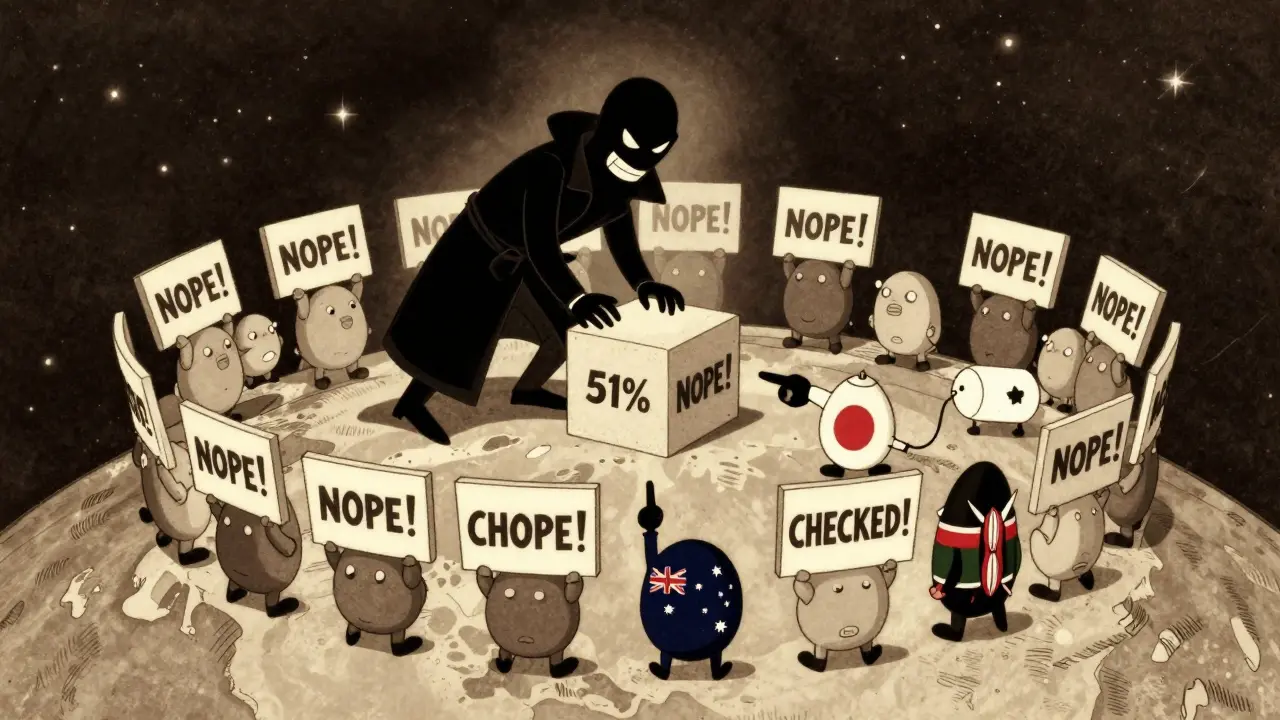
The real power of blockchain comes from how nodes work together. Imagine you’re in a room with 10,000 people, and each one has a copy of the same document. If one person tries to sneak in a fake page, the other 9,999 will notice. They’ll reject it. That’s decentralization in action.Nodes constantly talk to each other. When a new transaction appears, it’s broadcast to all connected nodes. Each one checks: Is the sender allowed to spend these coins? Is the digital signature valid? Has this coin already been spent? If even one node spots a problem, it won’t pass the message along. That’s why hacking a blockchain isn’t about breaking into one server-it’s about taking over more than half of all nodes at once. That’s called a 51% attack. It’s theoretically possible, but incredibly expensive and hard to pull off on large networks like Bitcoin or Ethereum.
More nodes = more security. That’s why geographic diversity matters. If all the nodes were in the U.S., a government shutdown could crash the network. But if nodes are spread across Australia, Nigeria, Japan, and Brazil? That’s much harder to disrupt. That’s why running a node from your home in Perth or a small town in Kenya helps make the whole system stronger.
Why Nodes Matter Beyond Cryptocurrency
People often think blockchain is just about Bitcoin. But nodes are the foundation for far more. In supply chains, nodes can record every step a product takes-from factory to store. In healthcare, nodes can securely share patient records without a central database that can be hacked. In voting systems, nodes can verify ballots without needing trusted election officials.These applications rely on the same thing: trust without a middleman. Nodes make that possible. They’re not just tech gadgets-they’re the new infrastructure for transparency.
How to Run Your Own Node
You don’t need to be a coder to run a node. Here’s how it works in practice:- Choose a blockchain. Bitcoin and Ethereum are the most popular to start with.
- Download the official software from the project’s website (not a third party).
- Let it sync. This can take hours or days, depending on your internet and hard drive speed. Bitcoin’s full chain is over 500 GB as of 2026.
- Keep your computer online. Nodes need to stay connected to stay useful.
Running a full node doesn’t earn you cryptocurrency (unless you’re mining, which requires expensive gear). But it gives you total control over your transactions. You don’t have to trust a wallet app or exchange to tell you your balance-you can check it yourself. And you’re helping secure the network for everyone else.
What Happens If Nodes Disappear?
If too many nodes shut down, the network becomes vulnerable. Smaller blockchains have died because they couldn’t keep enough nodes running. Bitcoin and Ethereum have tens of thousands. That’s why they’re still standing after more than a decade.Some people think “I don’t need a node-I use Coinbase or MetaMask.” That’s fine for everyday use. But if you care about true decentralization, running your own node is the only way to fully participate. It’s like owning your own land instead of renting an apartment. You’re not just using the system-you’re helping build it.
Nodes Are the Real Decentralization
Blockchain gets a lot of hype. But the real magic isn’t in the coins or the smart contracts. It’s in the quiet, steady work of thousands of computers around the world, all keeping the same record, checking each other’s work, and refusing to let anyone cheat.Nodes are the unsung heroes. They don’t get headlines. They don’t have CEOs. But without them, blockchain wouldn’t exist. They’re what makes it possible for a system to be open, fair, and resistant to control by any single group.
If you want to understand blockchain, stop thinking about the price of Bitcoin. Start thinking about the computers. The ones running quietly in homes, offices, and data centers. Those are the real power behind the chain.
Do I need to run a node to use blockchain?
No, you don’t need to run a node to use blockchain applications. Wallets like MetaMask or exchanges like Coinbase handle the node side for you. But if you want to verify transactions yourself, avoid trusting third parties, or help secure the network, running your own node gives you full control and stronger security.
Can I mine cryptocurrency with a regular computer?
Not anymore for Bitcoin or Ethereum. Mining now requires specialized hardware called ASICs or powerful GPUs, and even then, the cost of electricity often outweighs the rewards. Most mining is done by large pools with industrial setups. Regular home computers can’t compete. But you can still run a full node without mining-it just helps the network.
How much storage do I need for a full node?
As of 2026, Bitcoin’s full blockchain requires about 550 GB of storage. Ethereum’s full node needs around 1.2 TB. Lightweight nodes need much less-sometimes under 10 GB-but they rely on others for verification. Make sure you have enough space and a reliable internet connection before starting.
Are all blockchains the same when it comes to nodes?
No. Bitcoin and Ethereum use proof-of-work and require full nodes to validate everything. Some newer blockchains like Solana or Cardano use proof-of-stake, where nodes (called validators) are chosen based on how much cryptocurrency they hold and are willing to lock up. The role of nodes changes slightly depending on the consensus method, but the core idea-distributed trust-stays the same.
Why should I care if nodes are decentralized?
Because if nodes are controlled by a few companies or governments, the system becomes centralized again. That defeats the whole point of blockchain. Decentralized nodes mean no single entity can censor transactions, shut down the network, or change the rules. It’s what makes blockchain resistant to corruption and control.
Freddy Wiryadi
January 26, 2026 AT 21:31christal Rodriguez
January 28, 2026 AT 13:05Gareth Fitzjohn
January 29, 2026 AT 11:25Dahlia Nurcahya
January 30, 2026 AT 05:23Dylan Morrison
January 30, 2026 AT 22:39Lori Quarles
February 1, 2026 AT 22:08Jeremy Dayde
February 3, 2026 AT 04:13josh gander
February 4, 2026 AT 09:14Akhil Mathew
February 5, 2026 AT 19:19Aaron Poole
February 7, 2026 AT 11:39Devyn Ranere-Carleton
February 8, 2026 AT 13:18Richard Kemp
February 8, 2026 AT 15:54Christopher Michael
February 9, 2026 AT 07:12Parth Makwana
February 10, 2026 AT 14:30Elle M
February 12, 2026 AT 09:46Meenal Sharma
February 13, 2026 AT 04:43Brianne Hurley
February 13, 2026 AT 17:23Sunil Srivastva
February 14, 2026 AT 22:28Kevin Thomas
February 16, 2026 AT 09:34Steven Dilla
February 16, 2026 AT 21:22William Hanson
February 16, 2026 AT 22:39mary irons
February 18, 2026 AT 18:35Brandon Vaidyanathan
February 19, 2026 AT 17:45Wayne mutunga
February 21, 2026 AT 04:31Rico Romano
February 21, 2026 AT 21:53josh gander
February 23, 2026 AT 05:46