
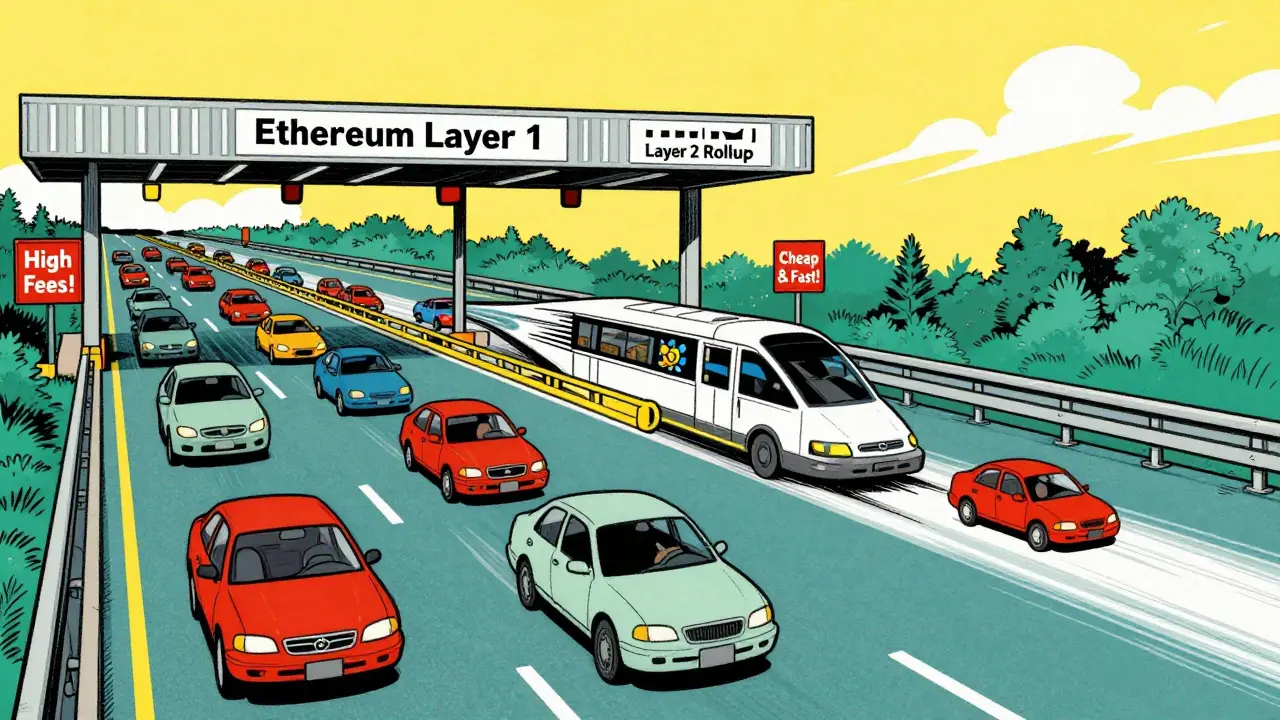
Blockchain networks like Ethereum were never meant to handle millions of transactions per second. Back in 2017, when CryptoKitties crashed the network, users paid over $50 just to send a simple NFT. Today, that same transaction costs less than a penny - not because Ethereum got faster, but because Layer 2 solutions stepped in to fix the problem.
Layer 2 isn’t a new blockchain. It’s not a replacement. It’s a sidekick. It works on top of the main blockchain - called Layer 1 - to process transactions faster and cheaper, then snaps the results back to the main chain for security. Think of it like a toll road built next to a congested highway. You still need the highway to exist, but now you’ve got a faster way to get where you’re going.
How Layer 2 Solutions Work
Layer 2 solutions take transactions off the main blockchain, process them in bulk, and then submit a single cryptographic proof back to Layer 1. This cuts down on the number of transactions the main chain has to verify. Instead of recording 10,000 individual payments, Layer 2 records one proof that says: "Here are 10,000 payments. They’re valid. Trust me." There are three main types of Layer 2 systems:
- Rollups - These bundle hundreds or thousands of transactions into one. They come in two flavors: Optimistic Rollups and ZK-Rollups.
- State Channels - These are like private conversations between two or more people. Only the final result gets recorded on the main chain. The Lightning Network for Bitcoin is the most famous example.
- Sidechains - These are separate blockchains that connect to Ethereum but run on their own rules. Polygon PoS is the most well-known, though it’s debated whether it truly counts as a Layer 2.
Rollups are the most popular today. They’re the reason you can now swap tokens on Uniswap for $0.02 instead of $5.
Optimistic Rollups: The Trust-but-Verify Approach
Optimistic Rollups assume transactions are valid by default. If someone tries to cheat - say, by submitting a fake transaction - anyone can challenge it within a 7-day window. That’s why withdrawals from Optimistic Rollups like Optimism and Arbitrum take about a week. It’s not slow by accident. It’s a security feature.
These systems are great for developers because they’re fully compatible with Ethereum’s existing tools. If you built a DeFi app on Ethereum, you can move it to Optimism with almost no changes. That’s why 65% of all Ethereum Layer 2 transactions happen on Optimistic Rollups as of late 2023.
But there’s a catch. If no one is watching to challenge a fraud, the system could be exploited. That’s why sequencers - the nodes that order and submit transactions - are critical. In Q2 2023, 87% of Optimism transactions were processed by a single sequencer. That’s a centralization risk.
ZK-Rollups: The Math-Based Security Model
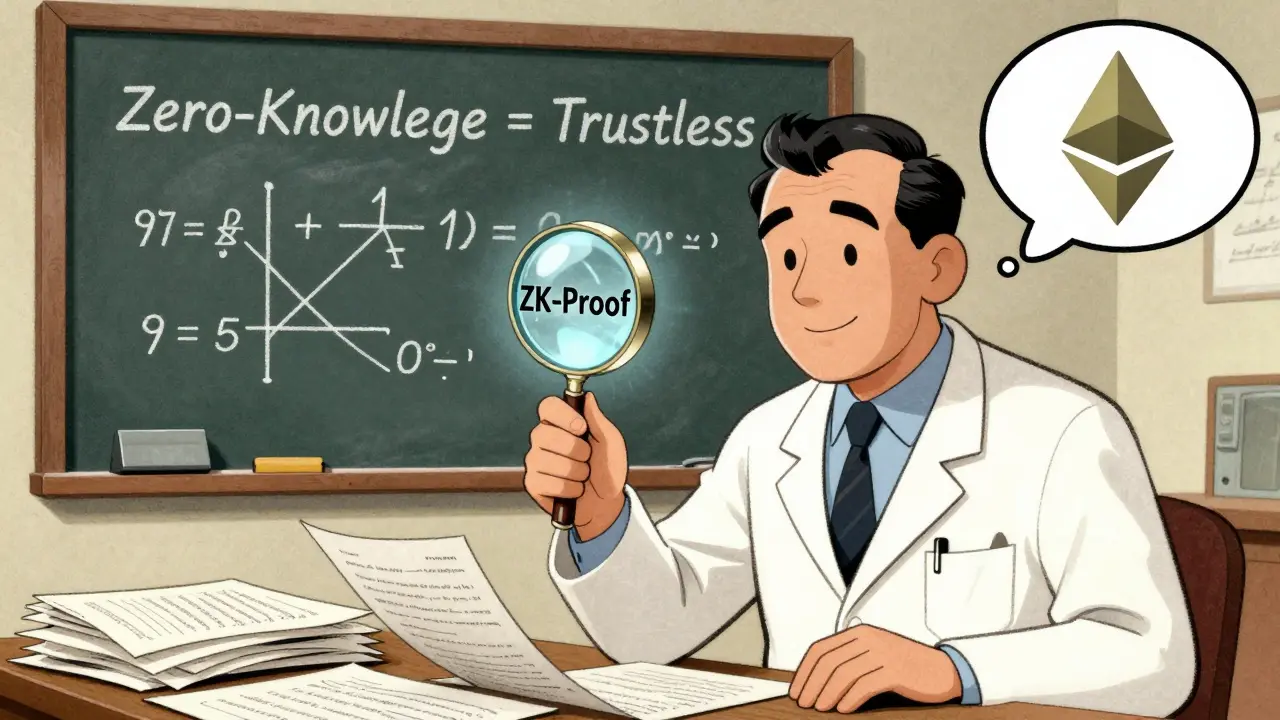
ZK-Rollups use zero-knowledge proofs to prove transactions are valid without revealing the details. Think of it like proving you know a secret password without saying the password. These proofs are mathematically verified on Layer 1, so there’s no waiting period. Withdrawals take 10-15 minutes, not 7 days.
StarkNet and zkSync Era are the biggest players here. They’re faster, more secure, and use less data on Ethereum. But they’re harder to build for. Most ZK-Rollups don’t yet support all Ethereum smart contracts. Only about 30% of Ethereum apps can run on them without rewriting code.
Still, adoption is growing fast. ZK-Rollups handled 32% of all Layer 2 transactions in 2023 and are growing at 35% year-over-year. Developers are betting on them because they don’t need trust - just math.
State Channels: Instant, Private, and Limited
State channels are perfect for small, repeated payments. The Lightning Network for Bitcoin lets users send each other micropayments - even 1 satoshi (a fraction of a cent) - with near-instant settlement. Fees are pennies. Speed is milliseconds.
But they’re not for everyone. You need to lock up funds to open a channel. Both parties must stay online. And you can’t interact with complex DeFi apps like lending or yield farming. The Lightning Network handles only 5,000-10,000 daily transactions on Bitcoin. It’s powerful, but narrow.
On Ethereum, state channels are rare. Most users don’t need them. Rollups do the job better.
Sidebar: Are Sidechains Layer 2?
Polygon PoS is often called a Layer 2. It processes 7,000 transactions per second and has block times of just 2 seconds. But here’s the thing: it doesn’t use Ethereum’s security. It has its own set of validators. That means if Polygon’s network is hacked - like the Ronin bridge was in 2022 - your funds aren’t protected by Ethereum.
True Layer 2s inherit Ethereum’s security. Sidechains don’t. That’s why experts debate whether Polygon counts as a Layer 2 at all. For users, it’s a trade-off: speed and low cost vs. security.
Real-World Impact: Where Layer 2s Are Used
Layer 2s aren’t theoretical. They’re running the show.
- Uniswap processes 85% of its trading volume on Layer 2 networks.
- OpenSea sees 73% of all NFT sales happen off Ethereum’s main chain.
- Axie Infinity moved its entire economy to Ronin (a sidechain) to handle 1.5 million daily transactions at $0.001 per swap.
Before Layer 2s, gaming and DeFi were nearly impossible on Ethereum. Now, they’re thriving. Transaction fees dropped from $1.50 on Ethereum to $0.0005 on Layer 2s during normal conditions. That’s not a small improvement - it’s a revolution.
The Downsides: What You Should Know
Layer 2s aren’t perfect. Here are the real problems users face:
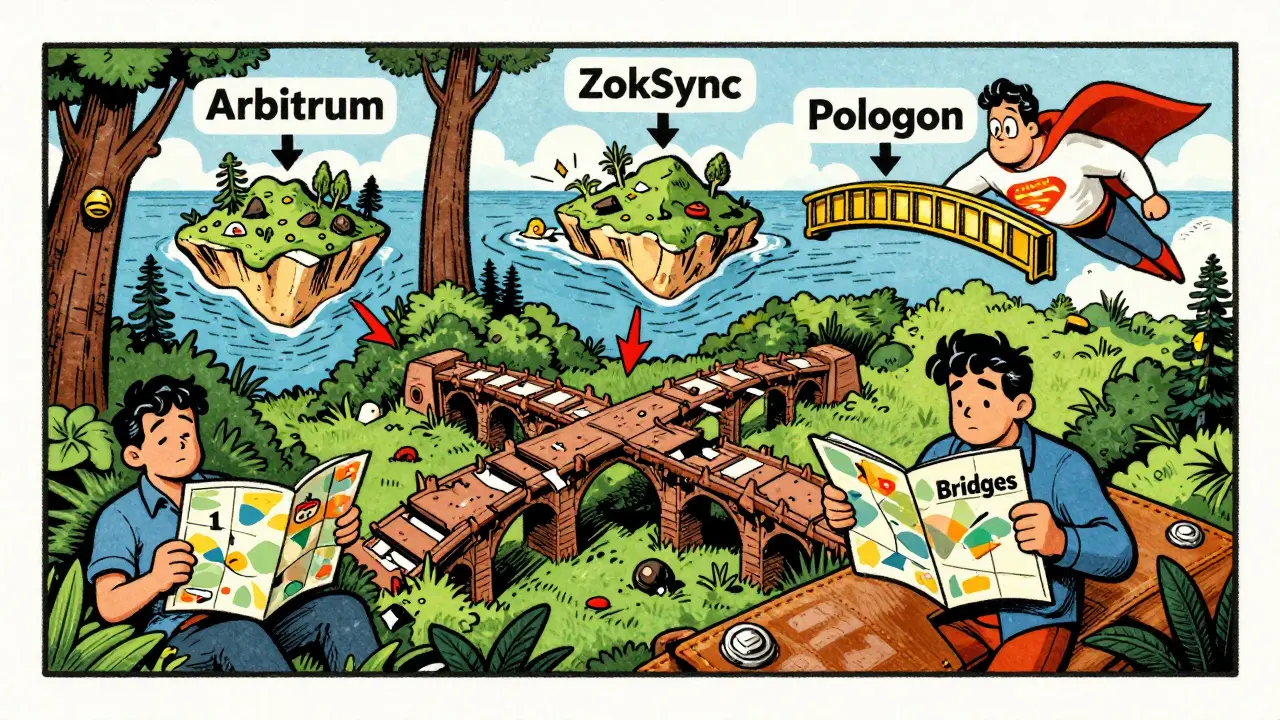
- Bridging is confusing. Moving money between Ethereum and a Layer 2 requires a bridge. There are 17 different ones. Some are slow. Some are broken. In 2023, 68% of users said bridging was their biggest headache.
- Security gaps. $1.2 billion in assets were lost between 2021 and 2023 - but almost all of it was through bridge hacks, not Layer 2 protocol flaws. The Layer 2 itself is usually safe. The bridge isn’t.
- Liquidity is spread thin. Your tokens might be on Arbitrum. Your NFTs on zkSync. Your gaming assets on Polygon. Managing all of them is a chore.
- Wallets still struggle. MetaMask supports 97% of Layer 2s, but adding a new network isn’t always smooth. Some users report funds getting stuck during transfers.
And there’s another silent issue: fragmentation. If you’re a developer, you have to support multiple Layer 2s. If you’re a user, you have to pick one. That’s why companies like Optimism are building the "Superchain" - a network of interconnected Layer 2s that share security and tools.
What’s Next? The Road to 2026
Layer 2s are still evolving.
- Ethereum’s Dencun upgrade in early 2024 introduced "proto-danksharding," which will cut Layer 2 fees by 90-95% by making data storage cheaper.
- StarkNet hit 100,000 TPS in testnet - 6,000 times faster than Ethereum’s base layer.
- Polygon is investing $1 billion into ZK-Rollup tech through 2025.
By 2026, experts predict 3-5 Layer 2 solutions will dominate. The rest will fade. The goal isn’t to have 20 options. It’s to have one great experience.
For users, that means fewer bridges. Faster transactions. Lower fees. For developers, it means one standard to build for, not five.
Final Thoughts: Why Layer 2s Matter
Ethereum’s co-founder Vitalik Buterin said Layer 2 scaling isn’t optional - it’s necessary. He’s right. Without Layer 2s, blockchain would be stuck as a niche tool for speculators. With them, it can become infrastructure - for payments, games, finance, and more.
Layer 2s turned a slow, expensive system into something fast, cheap, and usable. They didn’t replace Ethereum. They made it scalable. And that’s the real win.
Are Layer 2 solutions safe?
Layer 2 solutions themselves are generally secure because they inherit the security of Ethereum’s main chain. Optimistic Rollups use fraud proofs that allow anyone to challenge bad transactions, while ZK-Rollups use mathematical proofs that are verified on-chain. However, the bridges that connect your wallet to Layer 2 networks have been hacked multiple times - over $1.2 billion lost between 2021 and 2023. Always use trusted bridges and never send large amounts without testing first.
Which Layer 2 is the fastest?
ZK-Rollups like StarkNet and zkSync Era are the fastest for finality, with transactions confirmed in 10-15 minutes. Optimistic Rollups like Arbitrum and Optimism take up to 7 days for full security, though users can often withdraw funds faster using optimistic withdrawal services. State channels like Lightning Network offer near-instant settlements, but only for simple payments between two parties.
Do I need a new wallet for Layer 2?
No. Wallets like MetaMask support 97% of Ethereum Layer 2 networks. You just need to add the network manually - for example, selecting "Arbitrum One" or "zkSync Era" from the network dropdown. Once added, your wallet automatically handles transactions on that Layer 2. Some users report delays when switching networks, but no separate wallet is required.
Can I use DeFi on Layer 2?
Yes - and most DeFi activity already happens there. Platforms like Uniswap, Aave, and Curve process the majority of their trading and lending volume on Layer 2s. Fees are a fraction of what they are on Ethereum mainnet, making it practical for frequent use. You can stake, lend, borrow, and trade just like on Layer 1 - just faster and cheaper.
Why are some Layer 2s called "EVM-compatible"?
EVM stands for Ethereum Virtual Machine. It’s the engine that runs smart contracts on Ethereum. EVM-compatible Layer 2s - like Optimism and Arbitrum - can run the exact same code as Ethereum. That means developers can deploy their apps without rewriting them. ZK-Rollups are less compatible right now, requiring more work to adapt existing contracts.
Layer 2 solutions are the quiet engine behind today’s blockchain boom. They didn’t make headlines like NFTs or crypto winters, but they made the whole thing usable. And that’s why they’re here to stay.