
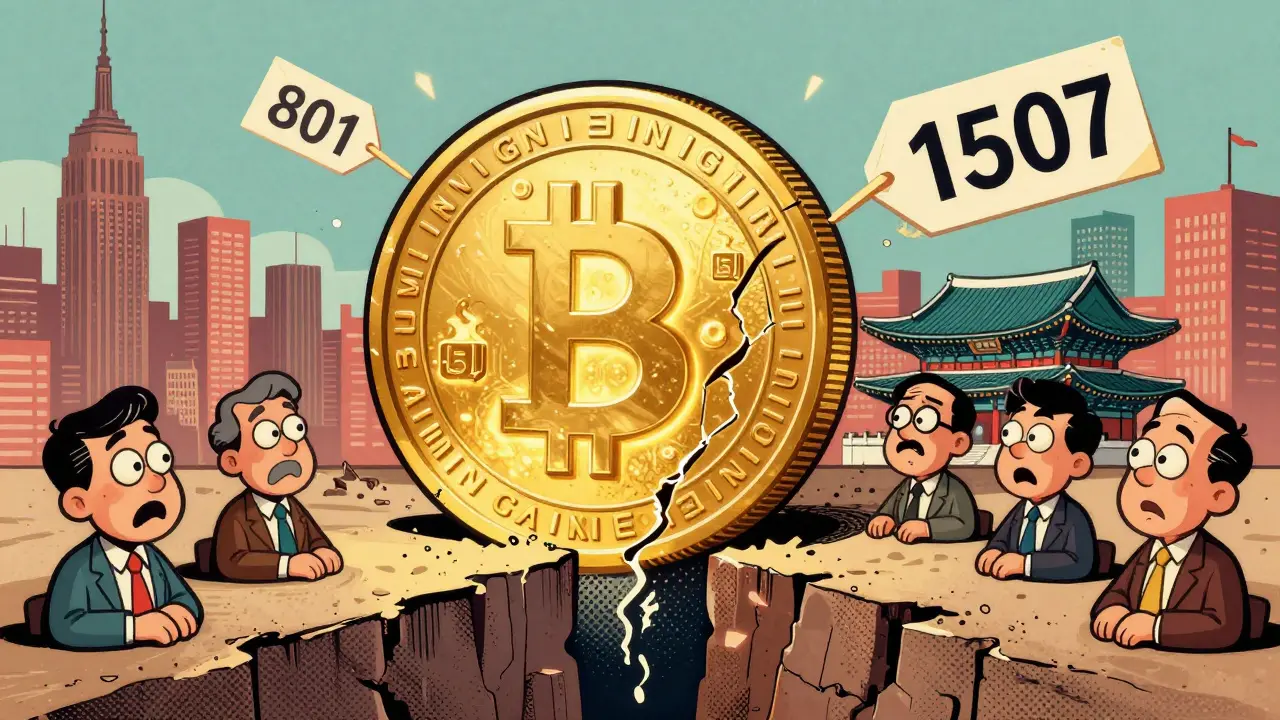
Imagine finding a way to buy a gold coin for $2,000 in New York and instantly selling it for $2,500 in Seoul. In the world of traditional finance, this kind of gap usually disappears in seconds. But in the world of digital assets, there is a strange glitch in the matrix called the Kimchi premium is a market phenomenon where cryptocurrencies trade at a significantly higher price on South Korean exchanges than on global platforms. It's a quirk of the market that proves even "borderless" money can be trapped by national borders.
The Basics of the Price Gap
At its simplest, the premium is just a price difference. If Bitcoin is the world's first decentralized digital currency is trading at $60,000 on a global exchange like Binance is a global cryptocurrency exchange that facilitates the trading of various digital assets , but costs $63,000 on a Korean platform, that 5% difference is the premium. It's named after Korea's famous fermented cabbage because it's a uniquely Korean flavor of market inefficiency.
This isn't just a minor ripple. While it usually hovers around 4.5%, history shows it can go wild. Back in January 2018, the gap hit a staggering 55%. In some extreme cases, the difference has even soared to 80%. You'd think traders would jump on this immediately to make a quick profit-buy low globally, sell high in Korea-but that's where the wall comes in.
| Feature | Global Markets (e.g., USA/EU) | South Korean Market |
|---|---|---|
| Price Level | Baseline Market Value | Often higher (Premium) |
| Demand Profile | Balanced Institutional/Retail | Extreme Retail Enthusiasm |
| Capital Movement | Relatively Fluid | Strictly Controlled |
| Account Access | Open to most nationalities | Requires local residency/ID |
Why Does the Premium Exist?
You might wonder why the market doesn't just "fix itself." Usually, arbitrageurs act as the glue that keeps prices the same globally. However, South Korea has created a financial fortress that makes this nearly impossible for outsiders. The first major hurdle is the Korean Central Bank is the central banking system of South Korea responsible for monetary policy and financial stability and its strict capital control measures. These rules limit how much money people can move in and out of the country, effectively trapping liquidity inside the peninsula.
Then there is the sheer level of obsession. South Koreans have a massive appetite for risk and a deep enthusiasm for crypto trading. This creates a constant surge in local demand that far outweighs the available supply. When everyone in a small geographic area wants to buy Kimchi premium assets but can't easily import more from the outside, the price naturally spikes.
Regulatory restrictions also play a huge role. The government has implemented strict anti-money laundering laws and rules that make it difficult to use international exchanges. For most Koreans, using local giants like UpBit is one of the largest cryptocurrency exchanges in South Korea by trading volume or Bithumb is a prominent South Korean digital asset trading platform is the only practical option. This isolation turns the Korean market into a "walled garden" where prices can drift away from the rest of the world.

The Psychology of Speculation and "Listing Pumps"
The Korean market isn't just about slow money movement; it's about high-energy trading. Speculative behavior often amplifies the premium during volatile periods. When the global market gets shaky, Korean traders often double down, pushing local prices even higher. This creates a feedback loop: the premium rises, which attracts more speculators, which further drives up the price.
One of the most fascinating local phenomena is the "listing pump." When a new coin gets listed on a major exchange like UpBit, the price doesn't just tick up-it often rockets. Because the community is so concentrated and reactive, these listings cause immediate price surges that can widen the premium in minutes. It's a high-stakes game of musical chairs where the local exchange holds all the power.

The Arbitrage Trap: Why You Can't Just "Print Money"
On paper, the Kimchi premium looks like a gold mine. If you see Bitcoin for $60k on Coinbase and $65k on UpBit, you'd assume you can just buy and move. In reality, you'll likely hit a brick wall. To trade on a Korean exchange, you need a local bank account and a resident ID. For a trader in Perth or New York, this is a non-starter.
Even for those who manage to get an account, the transfer process is a nightmare. The capital controls mentioned earlier mean that moving large sums of money across the border takes time. By the time your funds clear the regulatory hurdles and land in your Korean account, the premium might have crashed or disappeared entirely. You're essentially racing against a clock while wearing lead boots.
What the Premium Tells Us About the Future
Analysts use the Kimchi premium as a barometer for market sentiment. When the premium spikes, it often signals extreme optimism (or FOMO) within the Asian markets. Conversely, when it drops, it can reflect a cooling of local interest or a fear of new government crackdowns. It is a living case study in the tension between the decentralized dream of blockchain and the reality of centralized government power.
As we move through 2026, the premium persists, though it's less extreme than the 2018 bubble. It proves that even in a digital age, geography and law still matter. The Korean government continues to balance the need to protect consumers from volatility with the desire to maintain financial stability. Until capital controls are loosened or the market matures to a point of global synchronization, the "Kimchi price" will remain a distinct feature of the crypto landscape.
Is the Kimchi premium still a thing in 2026?
Yes, it is. While it doesn't always reach the 50%+ levels seen during the 2018 boom, there is almost always some level of price disparity between South Korean exchanges and the rest of the world due to persistent capital controls and high local demand.
Can foreigners trade on UpBit or Bithumb to profit from this?
It is extremely difficult. South Korean exchanges require strict "Know Your Customer" (KYC) verification, which typically involves a Korean phone number, a local bank account, and residency identification. This prevents most international traders from accessing the market.
Why doesn't the Korean government just ban crypto to stop the premium?
Banning it entirely is nearly impossible given the decentralized nature of the technology and the massive popularity among the population. Instead, the government focuses on regulation, taxation, and capital controls to mitigate risks and prevent money laundering.
Does the premium apply to all coins or just Bitcoin?
While Bitcoin is the most famous example, the premium can affect various other cryptocurrencies. However, it is most prominent in assets with high liquidity and high local demand. Some smaller coins may even see a "reverse premium" if they are developed in Korea and are more liquid there than elsewhere.
How do I calculate the Kimchi premium?
You can calculate it using this formula: ((Korean Price - Global Price) / Global Price) * 100. For example, if BTC is $60,000 globally and $63,000 in Korea, the calculation is ((63,000 - 60,000) / 60,000) * 100 = 5%.
Amanda Faust
April 11, 2026 AT 09:20Everyone knows the capital controls are the only thing keeping this bubble from popping permanently
jennelle williams
April 11, 2026 AT 18:23money is just an idea
borders are ideas too
william manes
April 13, 2026 AT 06:29USA is where the real money is! 🇺🇸 🚀 Korea just copies us 🤡
Kelly Cantrell
April 14, 2026 AT 16:49It's funny how they call it a "glitch" when it's clearly a coordinated effort by the central banks to trap retail investors in a closed loop. If you actually look at the flow, it's almost like they want the price inflated for some reason they aren't telling us. Very suspicious.
Rima Dinar
April 15, 2026 AT 19:42I think it is so important for us to realize that this phenomenon is actually a great learning opportunity for anyone trying to get into the world of trading because it shows us that market efficiency is not a guaranteed law of nature but rather a result of open systems, and when we see a system as closed as the South Korean one, we can start to appreciate how much the friction of regulation actually impacts the final price of an asset which is a lesson that applies to almost every other financial instrument in the world including stocks and forex if you look closely enough at the emerging markets.
Artavius Edmond
April 16, 2026 AT 20:31Man, the energy in the Korean crypto scene sounds wild! I love how people just go all in. It's like a digital gold rush over there.
aletheia wittman
April 17, 2026 AT 15:56omg the listing pumps are literally so unfair!! imagine just wakin up and your coin is 10x because of some korean exchange 😭 i need that luck
Samson Selleck
April 17, 2026 AT 22:09The simplistic interpretation of this as a "glitch" is frankly insulting to anyone with a basic grasp of macroeconomics. We are discussing a systemic failure of arbitrage caused by asymmetric information and stringent regulatory barriers that create a localized liquidity vacuum. It is a textbook example of market fragmentation where the cost of capital transfer exceeds the potential alpha from the price discrepancy, rendering the arbitrage opportunity theoretically existent but operationally void. The retail fervor is merely a symptom of a deeper pathological speculation culture that ignores fundamental valuation metrics in favor of momentum trading. Honestly, the lack of nuance in these discussions is exhausting. One must consider the exogenous shocks that maintain this equilibrium. The divergence is not an accident but a structural necessity of the Korean financial architecture. Any attempt to bridge this gap without legislative reform is a fool's errand. The volatility is a feature, not a bug. This is simply basic game theory applied to a restricted geographic zone. I find it amusing that some people think they can just "find a way" around residency requirements. Good luck with that. The systemic inertia is far too strong. Stop pretending this is a simple gap. It is a fortress.
Heather Warren
April 19, 2026 AT 18:40For those who are new to this, remember that trying to force an arbitrage trade in a restricted market can be very risky and might lead to your funds being frozen. It is always better to stick to exchanges where you have full legal compliance!
daniella davis
April 21, 2026 AT 13:37Um, hello? The
daniella davis
April 21, 2026 AT 22:02Um, hello? The fact that people think this is "fascinating" is just sad. Like, it's literally just a lack of liquidity and people being desperate for gains. I've known about the Kimchi premium since like 2018, so acting like it's some new "mystery" is just embarrassing for everyone involved honestly lol
7stargee Emmanuel Obani
April 22, 2026 AT 01:34Lol this is just a joke. Korean traders are just gambling 🤣
Carroll Foster
April 23, 2026 AT 23:26Oh sure, because nothing says "financial stability" like a 55% price gap. Great job on the regulation there, guys. Truly a masterpiece of economic planning
Jason Davis
April 25, 2026 AT 05:40I've seen some people try to use P2P networks to bypass this but it usually ends in a scam or the bank locking the account. Be careful with those "shortcuts" folks
Agnessa Dale
April 25, 2026 AT 06:23It's actually quite inspiring to see how much interest there is in new technology in Korea!
Swati Sharma
April 26, 2026 AT 23:14The interplay between the retail demand and the capital controls creates a fascinating liquidity trap that fundamentally alters the slippage and volatility profiles for any asset listed on those exchanges.
Scott Fenton
April 27, 2026 AT 22:31The regulatory framework in South Korea is designed to ensure the integrity of their financial system, and while the premium is an interesting side effect, it is a necessary consequence of their strict KYC protocols.
Mikayla Murphy
April 27, 2026 AT 23:07It is really interesting how different cultures approach risk. The high-energy trading mentioned here shows a very different perspective on wealth and speculation compared to what I see in other regions.
logan bates
April 29, 2026 AT 15:35Who cares if Korea has higher prices. We have the best markets in the world right here.
Alan Seiden
May 1, 2026 AT 07:55Absolute rubbish. This is just an excuse for an inefficient market to exist. It's pathetic that we're calling this a "phenomenon" when it's just bad policy.
Tyler Webb
May 3, 2026 AT 05:15I can totally see why people would feel the FOMO when they see those local prices climbing 😊
Hope Johnson
May 3, 2026 AT 15:42I wonder if we can view this as a reflection of the human desire to belong to a specific group or trend, where the value of the asset is not just in its utility but in the collective belief of a local community. When we think about the blockchain as a tool for liberation, we must also acknowledge that human psychology is often tethered to the physical and social environments we inhabit, meaning that the "borderless" nature of crypto is always going to be fighting an uphill battle against our innate tribalism and the legal structures that reinforce those boundaries, which ultimately suggests that true decentralization is as much a psychological journey as it is a technical one.
Prasanna Shembekar
May 4, 2026 AT 04:30this is just a nightmare lol i cant even imagine the stress of those listing pumps
Jonathan Chamma
May 5, 2026 AT 12:38It's quite a colorful situation, really! It's like a financial puzzle where the pieces just don't fit together across the ocean.