

You’ve probably seen the ads or heard the rumors. A platform called "Steam Crypto Exchange" promises high returns, easy trading, and seamless integration with your favorite gaming library. It sounds too good to be true, doesn’t it? Here is the hard truth you need to hear right now: There is no such thing as a legitimate Steam crypto exchange.
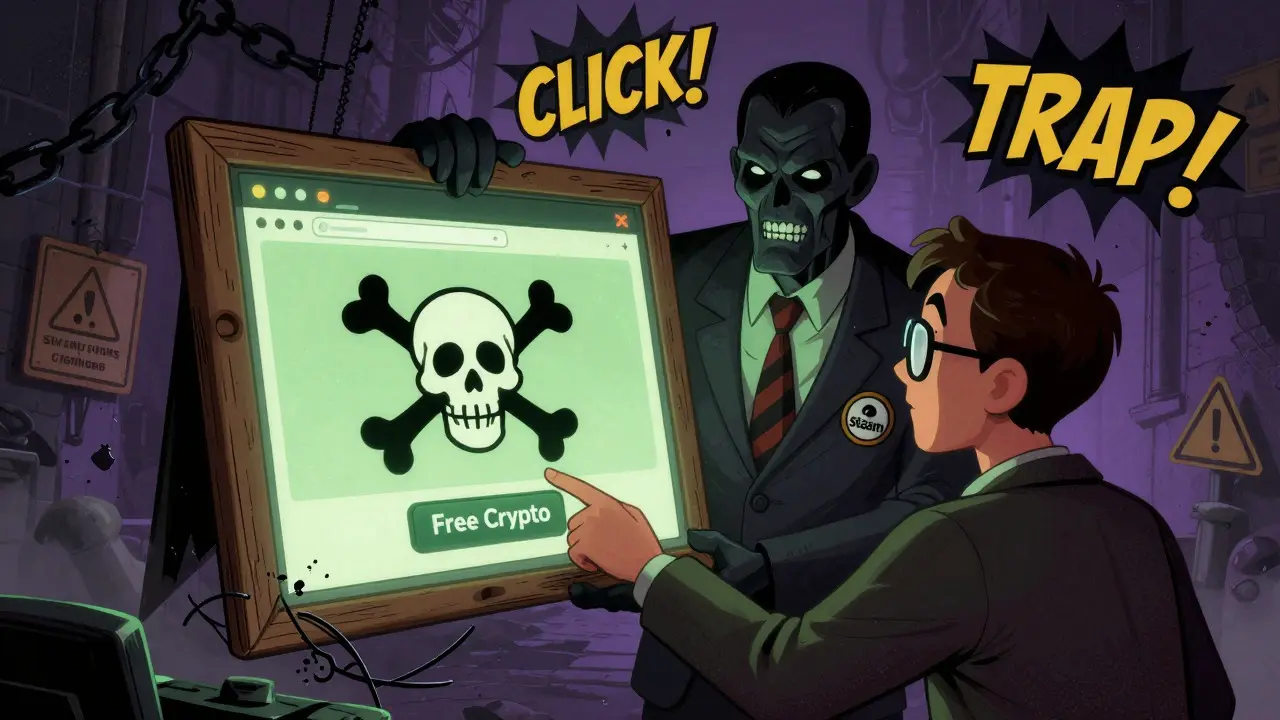
If you are looking at a website claiming to be "Steam Crypto," you are likely staring at a phishing site designed to steal your funds. This confusion stems from a mix of historical context and clever scammer marketing. To protect your wallet, we need to separate the gaming giant Valve Corporation from the digital asset world and understand exactly what happened in the past that fuels this myth today.
The Origin of Confusion: Steam’s Brief Crypto Experiment
To understand why people still search for "Steam crypto," we have to look back at a specific window in time. Between February 2016 and July 2017, Valve, the company behind the Steam gaming platform, actually accepted Bitcoin as a payment method. This was not an exchange; it was a simple checkout option. You could buy games using Bitcoin, but you couldn't trade it, store it, or withdraw it as crypto.
This experiment ended abruptly on July 3, 2017. Why? Because transaction fees skyrocketed. During peak usage periods, network congestion caused fees to reach 40-50% of the purchase value. Imagine paying $30 in fees to buy a $60 game. That math didn’t work for gamers or for Valve. In their official announcement, they cited "transaction fee volatility" as the primary reason for dropping support. Crucially, Valve never stored user cryptocurrency. Payments were processed instantly through a third-party processor called BitPay, which converted the Bitcoin into fiat currency (like USD or EUR) before the money ever touched Valve’s accounts.
Tom Bui, a security engineer at Valve, clarified this in a July 2017 community post: "We never stored user cryptocurrency." There was no custody, no ledger, and no exchange functionality. Just a one-way payment pipe that got clogged by high fees and shut down.
Identifying the Scam: What "Steam Crypto Exchanges" Really Are
So, if Valve stopped accepting crypto nearly a decade ago, where are these "exchanges" coming from? They are scams. Cybersecurity firm Kaspersky issued a warning in January 2026 about a surge in "Steam Crypto Scams." Their data showed 1,247 active phishing sites in Q4 2025 alone, all impersonating non-existent Steam cryptocurrency services.
These fraudulent platforms use the trust associated with the Steam brand to lure users. Here is how they typically operate:
- Fake Interfaces: They copy the visual design of the Steam client or website, adding fake "Trade" or "Wallet" buttons that don’t exist in the real software.
- Phishing Links: Scammers send emails or Discord messages claiming you won a free game or crypto bonus, directing you to a login page that steals your credentials.
- Rug Pulls: Some sites allow you to deposit crypto but block withdrawals, citing "verification issues" until the operators disappear with the funds.
Nicholas Merten, founder of Data Dash, noted in a December 2023 CoinDesk article that "Steam's brief foray into cryptocurrency payments was purely transactional and never constituted exchange functionality." Blockchain security firm Chainalysis explicitly excludes platforms like Steam from their analysis of legitimate exchanges because they lack the core mechanisms of an exchange: custody, trading pairs, and liquidity pools.
How to Safely Use Crypto for Steam Games Today
Just because there is no direct exchange doesn’t mean you can’t use your crypto to buy games. Many gamers want to spend their Ethereum or Bitcoin on new releases without converting to fiat first. The legitimate way to do this is through third-party gift card vendors.
Bitrefill is the most prominent example. As of Q4 2025, Bitrefill processes approximately $2.7 million monthly in transactions related to Steam gift cards. This represents a tiny fraction (0.0003%) of Steam’s total transaction volume, proving it’s a niche workaround rather than a native feature. When you use Bitrefill, you aren’t trading on Steam; you are buying a digital code that you redeem in your Steam Wallet. Once the funds are in your Steam Wallet, they are locked. Valve’s Terms of Service (Section 4.3, updated November 2025) state clearly: "Steam Wallet funds may only be used to purchase content on Steam and cannot be redeemed for cryptocurrency or transferred to external wallets."
This distinction is vital. If a site tells you you can transfer Steam Wallet funds *out* to a crypto wallet, it is lying.
Real Alternatives: Legitimate Cryptocurrency Exchanges
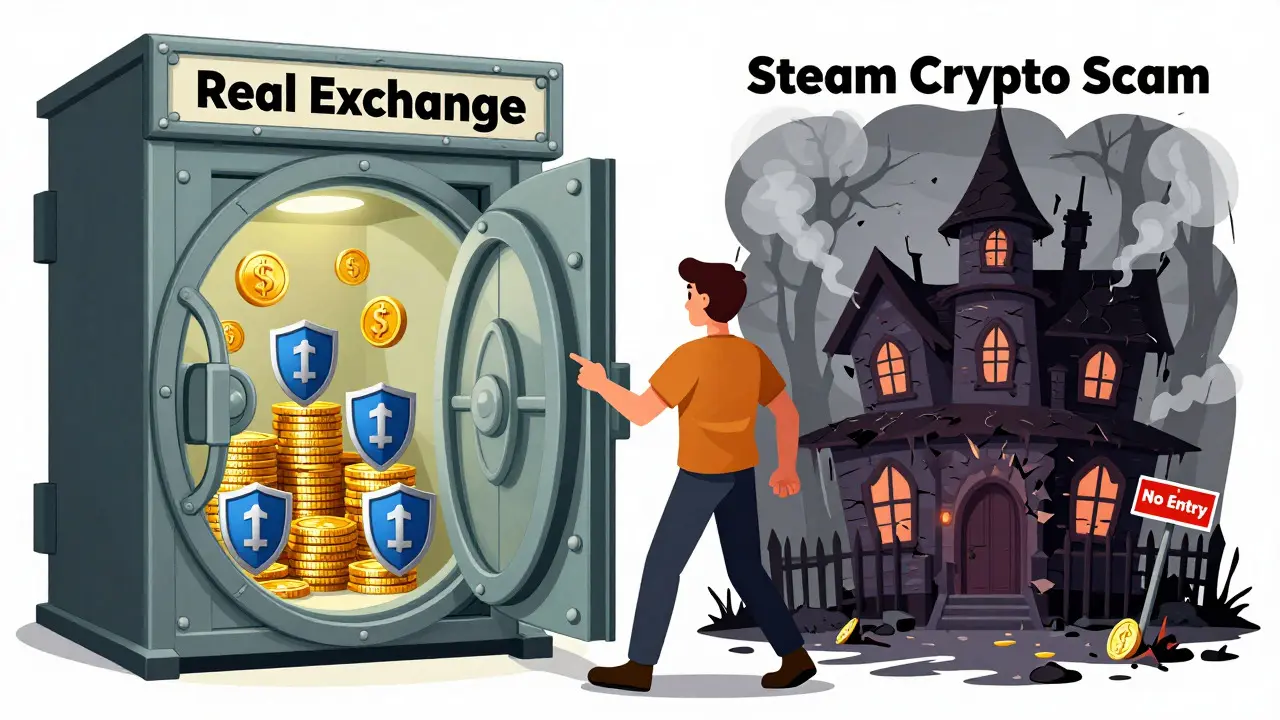
If your goal is to trade, hold, or swap cryptocurrencies, you need a dedicated exchange. These platforms operate under strict regulatory frameworks and offer features that Steam never did. Let’s compare the actual market leaders to see what a real exchange looks like.
| Feature | Binance | Coinbase | Kraken | "Steam Crypto" (Scam) |
|---|---|---|---|---|
| Regulatory Status | Licensed globally (varies by region) | d>Licensed in US/EU d>Licensed in US/EU d>Unregistered/Fake|||
| Security Model | d>Cold storage (98% assets offline) d>Cold storage (98% assets offline) d>Cold storage (95%+ assets offline) d>None (Funds vanish)||||
| Daily Volume | d>$69.1 billion (Q3 2023 avg) d>$2.5 billion+ d>$1.2 billion+ d>$0 (Non-existent)||||
| User Control | d>Full withdrawal/trading rights d>Full withdrawal/trading rights d>Full withdrawal/trading rights d>No withdrawals||||
| Trustpilot Rating | d>High volume, mixed reviews d>8.7/10 (98k+ reviews) d>9.2/10 (45k+ reviews) d>N/A or Fake Reviews
Binance, Coinbase, and Kraken are the titans of the industry. They process billions in daily volume and maintain transparency reports detailing their security audits. For instance, Coinbase’s 2023 transparency report confirms that 95-98% of customer assets are stored in cold storage solutions, meaning they are offline and protected from hacks. None of these features exist in any "Steam" branded crypto service because none of those services exist.
Why Valve Isn’t Coming Back to Crypto (Yet)
Many gamers hope Valve will reinstate crypto payments. After all, the landscape has changed since 2017. Layer-2 solutions like the Lightning Network have reduced Bitcoin fees significantly. However, industry analysts remain skeptical. Bernstein Research maintained a "Hold" rating on potential Steam crypto integration in their January 12, 2026 report. They cite "insufficient payment stability and regulatory uncertainty" as primary barriers.
The probability of Steam reintroducing direct cryptocurrency payments before 2030 is projected at less than 5%. Valve’s focus remains on game distribution. Their October 2023 security update focused entirely on developer authentication-requiring SMS codes for game updates to prevent malware distribution-not payment systems. Steam’s 2025 roadmap, published in January 2026, lists "Improved regional payment options" as priority #7, but makes zero mention of blockchain or crypto.
Furthermore, the global games market is valued at $200.8 billion (Newzoo 2025), while the digital asset market sits at $4.3 trillion (CoinGecko 2025). While huge, integrating crypto brings massive compliance headaches regarding anti-money laundering (AML) and know-your-customer (KYC) laws across 127 countries where Steam operates. For a platform that prioritizes ease of use, adding complex identity verification for every gamer is a dealbreaker.
Red Flags: How to Spot a Steam Crypto Scam
Before you click any link, run through this checklist. If any of these apply, close the tab immediately.
- The URL is wrong: Official Steam pages always end in
store.steampowered.comorsteamcommunity.com. Anything else is suspect. - Promises of High Returns: Steam sells games; it does not invest your money. Any promise of profit is a lie.
- Requests for Private Keys: No legitimate gaming platform will ever ask for your crypto wallet private key or seed phrase.
- Urgency Tactics: "Claim your free Bitcoin now!" or "Your account will be suspended unless you verify crypto ID." These are pressure tactics used by scammers.
- Social Media DMs: Valve does not contact users via random Discord or Telegram messages offering crypto bonuses.
User feedback on the Steam Community reflects the lingering confusion. Thread #601910715108127050, titled "Bring back the Crypto payments," has over 1,200 comments as of January 2026. While some users nostalgic for the 2016-2017 era share positive memories, others warn newcomers: "I lost $47 in transaction fees on a $60 game during Bitcoin's 2017 spike," wrote user 'Gamer420'. More importantly, recent comments highlight the rise of scams targeting hopeful traders.
Conclusion: Stick to the Real Platforms
The bottom line is simple. Steam is a gaming platform, not a financial instrument. If you want to play games, use Steam. If you want to trade crypto, use Binance, Coinbase, or Kraken. If you want to bridge the two, use a reputable gift card vendor like Bitrefill.
Don’t let the name "Steam" fool you into thinking there’s a hidden crypto exchange waiting to make you rich. There isn’t. Protect your assets by sticking to verified, regulated platforms and keeping your gaming life separate from your investment portfolio.
Does Steam accept Bitcoin in 2026?
No. Steam discontinued direct Bitcoin payments in July 2017 due to high transaction fees. As of 2026, Steam accepts credit cards, PayPal, and various regional payment methods, but no cryptocurrencies directly.
Is "Steam Crypto Exchange" a legitimate website?
No. There is no official Steam crypto exchange. Websites using this name are likely phishing scams designed to steal your login credentials or cryptocurrency funds. Always verify URLs end in steampowered.com.
Can I buy Steam games with Ethereum?
Not directly on Steam. However, you can use third-party services like Bitrefill to purchase Steam Gift Cards using Ethereum or other cryptocurrencies. You then redeem the card code in your Steam Wallet.
Will Valve bring back crypto payments?
It is unlikely in the near future. Analysts project less than a 5% chance of reintroduction before 2030 due to regulatory complexity and payment stability concerns. Valve’s current focus is on regional fiat payment options.
What is the safest way to trade cryptocurrency?
Use established, regulated exchanges like Coinbase, Binance, or Kraken. These platforms offer cold storage for assets, transparent security audits, and legal recourse in case of issues. Avoid any platform linked to gaming brands like Steam unless officially announced by Valve.
Can I withdraw Steam Wallet funds to a crypto wallet?
No. According to Valve’s Terms of Service, Steam Wallet funds are non-refundable and non-transferable outside the Steam ecosystem. They can only be used to purchase content within the Steam store.