

When Russia legalized cryptocurrency mining in early 2025, it wasn’t just about energy efficiency or tech innovation. It was a calculated move to bypass Western sanctions - and it’s working, but not the way most people think.
After the invasion of Ukraine in 2022, Russia was cut off from the global financial system. SWIFT, dollar clearing, and euro transactions became nearly impossible for its banks. So instead of begging for alternatives, Russia built its own. And crypto mining became the backbone of that new system.
By 2025, Russia had become the third-largest crypto mining country in the world. Not because it had the best hardware or cheapest electricity (though it does), but because mining gave it something no bank could: control over its own money flow. Mining doesn’t require foreign banks. It doesn’t need Visa or Mastercard. It runs on power, hardware, and internet - all things Russia still has access to.
How Russia Turned Mining Into a Sanctions Shield
It started with a quiet policy shift. In 2023, Russia stopped blocking crypto mining. By 2024, it began offering tax breaks to mining farms in Siberia and the Urals. By 2025, it openly encouraged businesses to use crypto for cross-border trade - especially with countries like Turkey, Iran, Kazakhstan, and India.
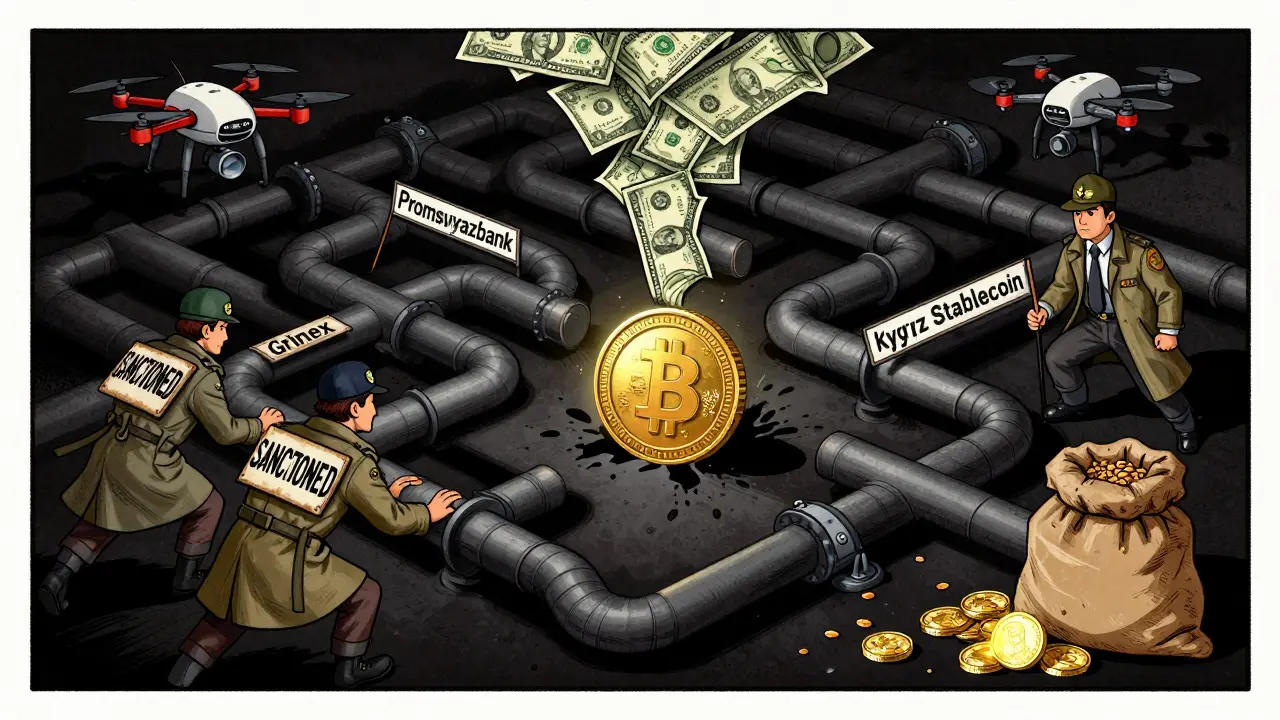
The real game-changer? The A7A5 stablecoin. Launched in February 2025, this ruble-backed digital token was created by a Kyrgyzstan-based company called Old Vector, backed by Russia’s state-owned Promsvyazbank. Unlike Bitcoin, A7A5 doesn’t swing wildly in price. It’s pegged to the ruble, making it reliable for paying for oil, grain, and military parts.
By July 2025, A7A5 had processed over $51 billion in transactions. That’s not retail users buying coffee. That’s factories in Uzbekistan paying Russian suppliers. Shipping companies in Armenia buying diesel. Defense contractors in Syria ordering spare parts. All without touching a Western bank.
And here’s the trick: A7A5 trades mostly on exchanges like Garantex and Grinex - both sanctioned by the U.S. since 2022 and 2025 respectively. These platforms don’t serve Western users. They’re built for Russian businesses that need to move money without being seen.
The Infrastructure Behind the Shadow Network
It’s not just mining. It’s a whole ecosystem.
Russia’s crypto network includes:
- Miners in Siberia running rigs powered by cheap hydroelectric plants
- Exchanges like Grinex, created by ex-Garantex staff to dodge sanctions
- Stablecoin issuers based in Kyrgyzstan and Moldova, far from U.S. jurisdiction
- Banking partners like Transkapitalbank, which quietly processes crypto-to-ruble conversions
- Individuals - including oligarchs like Konstantin Malofeyev - who run networks that link crypto payments to military supply chains
These aren’t random actors. They’re coordinated. The U.S. Treasury and UK’s OFSI called them out in August 2025, sanctioning not just companies but people - eight individuals and entities tied to the A7A5 network. One was a Luxembourg firm. Another was a Kyrgyz bank that paid for drone parts.
Chainalysis, a blockchain analytics firm, says Russia’s system is the most sophisticated “shadow crypto economy” they’ve ever tracked. Every transaction leaves a trail. But because it’s not in dollars or euros, and because it moves through non-Western platforms, it’s harder to freeze, block, or trace in real time.
Why Western Sanctions Are Still Working - Just Slower
Here’s the catch: crypto isn’t magic. It can’t replace the dollar.
Before the war, Russia exported $400 billion in goods a year. Bitcoin’s entire market cap? Around $800 billion. That sounds like enough - until you realize Bitcoin’s price swings 20% in a week. No one wants to pay for a shipment of wheat with a currency that could lose 15% of its value before delivery.
A7A5 fixes that. But it’s still tiny. Only a fraction of Russia’s trade uses it. Most exports still rely on barter, cash, or yuan. The crypto system is a supplement - not a replacement.
The Bitcoin Policy Institute says it plainly: “Bitcoin is ill-suited to help Russia evade sanctions.” It’s too small, too volatile, too slow. A7A5 helps, but it’s not a floodgate. It’s a leak - and Western regulators are plugging it, one exchange at a time.
In August 2025, the U.S. Treasury did something unprecedented: it sanctioned a crypto mining company for helping Russia evade sanctions. That’s never happened before. It sent a message: if you mine crypto to fund war, you’re a target.
Who’s Really Using This System?
It’s not the average Russian citizen. You won’t find A7A5 on Binance or Coinbase. You won’t see it advertised on Instagram.
The users are:
- State-owned energy companies trading oil with India
- Defense contractors buying components from Turkey
- Agribusinesses selling grain to Egypt and Indonesia
- Smugglers moving sanctioned goods through Central Asia
Even then, they’re not using Bitcoin. They’re using A7A5 - because it’s stable. And because it’s tied to Russian banks. You can buy A7A5 with a Promsvyazbank card. That’s how deep the integration goes.
There’s even a new retail angle. The A7A5 website now lets users top up their digital wallets using Russian bank cards. It’s not for tourists. It’s for businesses that need to pay suppliers without triggering SWIFT alerts.
The Limits of Crypto Evasion
Here’s the reality: Russia’s crypto system is clever. But it’s not unstoppable.
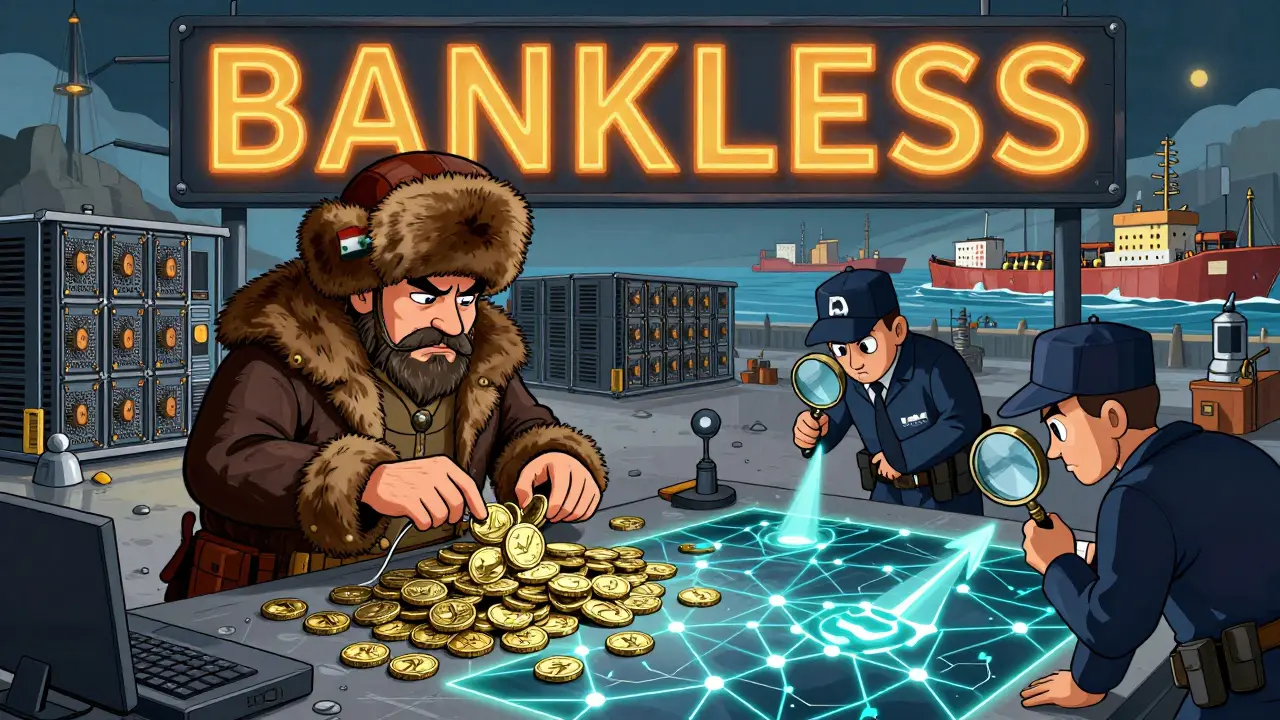
Every transaction is on the blockchain. That means every transfer leaves a digital fingerprint. Chainalysis, Elliptic, and other firms can track where coins go - even if they’re hidden behind layers of mixers or cross-chain swaps.
And when a transaction hits a sanctioned wallet - like Grinex or Old Vector - it gets flagged. Western authorities don’t need to shut down the whole system. They just need to cut off one node. One bank. One exchange. One person.
Since August 2025, over 40 entities and individuals have been sanctioned for helping Russia’s crypto network. That’s not a failure - it’s a strategy. Target the weak links. Freeze the key accounts. Make it risky to participate.
North Korea and Venezuela also use crypto to dodge sanctions. But they’re not building economies. They’re surviving. Russia is trying to rebuild one. And that’s harder.
What This Means for the Rest of the World
Russia’s experiment isn’t unique. It’s a blueprint. Other sanctioned nations - Iran, Syria, Belarus - are watching. They’re building their own stablecoins. Testing their own mining networks.
But the lesson isn’t that crypto breaks sanctions. It’s that blockchain transparency is the ultimate double-edged sword.
Yes, Russia can move money without banks. But every move is recorded. Every wallet is visible. Every connection can be mapped. The U.S. and UK didn’t win by banning crypto. They won by understanding it better than Russia did.
Western regulators now use blockchain analytics like a radar. They don’t need to stop every transaction. They just need to stop the big ones. The ones that fund tanks. The ones that pay for missiles. The ones that keep the war going.
And so far, they’re doing it.
Desiree Foo
February 10, 2026 AT 18:34It's astonishing how people still think crypto can replace the dollar. This isn't innovation-it’s desperation dressed up as strategy. The A7A5 stablecoin? A glorified scrip. You can't build an economy on blockchain ledgers and sanctioned exchanges. This is the financial equivalent of duct tape on a jet engine.
And let's not pretend Russia is some crypto pioneer. They're just the latest regime trying to hack their way out of consequences. The world isn't fooled. We see it. We track it. And we're coming for every node.
Sanctioning a mining company? Long overdue. This isn't about ideology. It's about survival. And if you're mining to fund tanks, you're not a tech entrepreneur-you're an accessory to war.
Claire Sannen
February 11, 2026 AT 05:45While the technical infrastructure described here is undeniably sophisticated, I think the article underestimates the human cost of this system. Behind every A7A5 transaction is a worker in Siberia running rigs 24/7, a logistics manager in Uzbekistan trying to pay for parts without getting flagged, a family in Syria waiting for medical supplies that never arrive because the payment got frozen.
This isn't a game of chess. It's a slow-motion humanitarian crisis masked as economic resilience. The real story isn't how clever Russia is-it's how many ordinary people are being dragged into this shadow economy just to keep their jobs, their homes, their dignity.
Joe Osowski
February 11, 2026 AT 14:40Oh wow, look who’s crying about sanctions now? The West had its chance. They froze Russia’s assets, kicked them out of SWIFT, and acted like they could starve a country the size of Russia into submission. Pathetic.
Now they’re mad because Russia built its own system? Good. Let them keep their dollar hegemony. We’re building the future. With mining rigs, stablecoins, and zero apologies. If you can’t handle it, go cry to your central bank.
🇺🇸 💩
John Doyle
February 13, 2026 AT 13:26Look, I get the skepticism. But this isn’t just about evasion-it’s about adaptation. Russia didn’t get lucky. They studied the problem, identified the gaps in the sanctions framework, and built something functional. That’s not evil. That’s engineering.
And honestly? If the U.S. got cut off tomorrow, would you really want to be begging for euros and dollars while your economy collapses? I’d rather have a stablecoin and a mining rig than a handshake from the IMF.
It’s not pretty. But it’s real.
Donna Patters
February 14, 2026 AT 00:06Let me be clear: this is not a triumph of innovation. It is a grotesque parody of financial sovereignty, orchestrated by oligarchs who treat blockchain like a private ATM for war profiteering. A7A5? A ruble-backed Trojan horse. Mining farms? State-funded sweatshops with GPU rigs.
Do not mistake necessity for legitimacy. This is not a new economic model. It is a criminal enterprise with a whitepaper.
Ben Pintilie
February 15, 2026 AT 15:04So they built a crypto system. Big deal. Still can’t pay for a damn Boeing part. Or buy a microchip. Or import a single turbine. This is like trying to run a hospital with duct tape and hope.
And don’t even get me started on those ‘exchanges’-they’re ghost towns with 3 users and 200 fake trades. Pathetic.
🤣
Ekaterina Sergeevna
February 17, 2026 AT 13:20Ah yes, the ‘A7A5 stablecoin’-the blockchain equivalent of a knockoff Rolex sold in a back-alley stall. You think this is a breakthrough? It’s a spreadsheet with a blockchain logo slapped on it.
And let’s not pretend the U.S. didn’t see this coming. They didn’t just miss the boat-they left the harbor unlocked. This isn’t Russia outsmarting the West. It’s the West sleepwalking into a trap they refused to believe existed.
Blockchain transparency? More like blockchain theater. Everyone’s watching. No one’s acting.
Kaz Selbie
February 18, 2026 AT 00:34Okay, so Russia’s got mining rigs and a stablecoin. Cool. But let’s talk numbers. $51B? That’s less than 10% of what they exported in 2021. This isn’t a new economy-it’s a Band-Aid on a hemorrhage.
And the fact that you’re even calling this ‘clever’ tells me you’ve never worked in supply chain logistics. You think a mining farm in Siberia is gonna deliver turbine blades to Syria? Please. It’s all smoke, mirrors, and sanctioned exchanges with fake volume.
This isn’t innovation. It’s panic with a whitepaper.
Brittany Meadows
February 18, 2026 AT 17:50They say blockchain is transparent. But what if the transparency is a trap? What if the U.S. is letting Russia build this whole system... just so they can trace every single transaction? What if A7A5 was never meant to be untraceable? What if it was designed to be tracked?
Think about it. Every wallet. Every miner. Every exchange. All flagged. All monitored. All recorded.
Maybe the real plan isn’t to stop Russia. Maybe it’s to build a database of every single person who ever touched crypto in this war.
🧠👁️
SAKTHIVEL A
February 19, 2026 AT 02:34The notion that cryptocurrency can replace the petrodollar is fundamentally flawed. The dollar’s dominance is not merely institutional-it is structural, cultural, and algorithmic. A7A5, despite its ruble peg, lacks liquidity depth, market confidence, and systemic integration. It is a synthetic construct, not a sovereign currency.
Furthermore, the reliance on sanctioned exchanges like Grinex exposes the fragility of this architecture. A single jurisdictional crackdown collapses the entire edifice. This is not resilience. It is fragility disguised as innovation.
Santosh kumar
February 20, 2026 AT 14:34It’s not about whether this works. It’s about whether it has to. Russia didn’t choose crypto because it was ideal. They chose it because they had no other choice. And honestly? That’s kind of admirable.
They didn’t beg. They didn’t whine. They just built something, even if it’s ugly, even if it’s messy.
Maybe the real lesson here isn’t about sanctions. Maybe it’s about what people do when they’re backed into a corner.
Christopher Wardle
February 21, 2026 AT 14:33The irony is that blockchain’s greatest strength-immutability-is also its greatest weakness in this context. Every transaction is a permanent record. Every wallet is a fingerprint. Every node is a target.
So while Russia may have built a system that bypasses Western banks, it has created an even more precise map of its own economic activity. The ledger doesn’t lie. And the West now has the key.
They didn’t break the system. They just made it self-incriminating.
Gaurav Mathur
February 23, 2026 AT 13:36They say crypto is decentralized but this whole thing is run by one bank and a few oligarchs. That’s not freedom. That’s just a new kind of control. And the fact that they use Kyrgyzstan and Moldova as front companies? Classic. But also lazy.
Real innovation doesn’t need shell companies. It just works.
This is just sanctions evasion with a blockchain logo.
Jeremy Lim
February 24, 2026 AT 20:40Okay but… why is no one talking about the fact that the entire system runs on Siberian hydro power? Like… imagine these mining farms just… humming away 24/7, powered by rivers nobody else uses. It’s weirdly beautiful.
And the fact that they’re using crypto to pay for grain? That’s actually kind of poetic. Food for war, paid for by energy from the earth.
…I hate what they’re doing. But I can’t stop admiring how they did it.
😮💨
Elizabeth Choe
February 25, 2026 AT 04:24Look, I’m not defending Russia. But let’s be real-this is what happens when you cut off a country’s arteries and expect them to die quietly. They didn’t ask for this. They didn’t want to build a shadow economy. They had to.
And honestly? The fact that they created a stablecoin that actually works? That’s wild. It’s not pretty. It’s not moral. But it’s real.
So next time you hear someone say ‘crypto can’t replace the dollar,’ remind them: someone just used it to buy diesel for a military truck. And they didn’t need a single Western bank to do it.
Grace Mugambi
February 25, 2026 AT 13:58There’s something deeply human about this story. Not the politics. Not the sanctions. But the fact that people-real people-are building something functional, under pressure, with almost no tools.
It’s like watching a family rebuild their home after a fire, using only what’s left in the rubble.
We can hate the cause. We can condemn the actors. But we can’t ignore the ingenuity.
Maybe the lesson isn’t about crypto. Maybe it’s about what people are capable of when they’re told they have no options.
Crystal McCoun
February 27, 2026 AT 05:30I’ve read this article three times. I’ve checked the Chainalysis reports. I’ve looked at the transaction graphs. And I’m still stunned by how precise this system is.
Every link is intentional. Every entity is chosen for jurisdictional distance. Every stablecoin issuance is layered through third countries. It’s not random. It’s a masterclass in financial evasion.
But here’s the thing: it’s also fragile. One regulator shuts down Grinex, and half the network collapses. One bank gets sanctioned, and the A7A5 liquidity evaporates.
This isn’t a revolution. It’s a Rube Goldberg machine made of duct tape and hope.
Elijah Young
February 27, 2026 AT 08:42Let’s not romanticize this. This isn’t innovation. It’s survival. And survival doesn’t make something right.
Yes, Russia found a loophole. Yes, they built a system. But every transaction funded by A7A5 is a transaction that bypassed accountability.
And that’s the real danger-not that crypto works, but that it works too well for the wrong people.
Technology doesn’t care who uses it. But we do.
Beth Trittschuh
February 27, 2026 AT 09:52What if the blockchain isn’t the tool… but the trap?
Every transfer. Every wallet. Every miner. All recorded. All traceable. All exposed.
What if the U.S. didn’t try to stop this… they just waited for it to happen?
Now they have a database of every single person who ever touched this system.
And they’re not even trying to hide it.
👀✨
Benjamin Andrew
March 1, 2026 AT 02:03The entire premise of this article is fundamentally flawed. You cannot decouple economic activity from geopolitical accountability. The blockchain does not exist in a vacuum. It is a digital extension of physical infrastructure, human behavior, and state power.
Therefore, any system built on crypto to evade sanctions is not an innovation-it is a liability. A liability that can be, and has been, weaponized by the very institutions it seeks to circumvent.
Michelle Cochran
March 2, 2026 AT 10:36Let me be clear: this isn’t about sanctions. This is about control. The U.S. didn’t just want to freeze Russia’s assets-they wanted to control how the world thinks about money. And now Russia is saying: ‘No. We’ll make our own rules.’
So they built a shadow economy. And the West is panicking because for the first time… people are choosing a different path.
That’s the real threat. Not the mining rigs. Not the stablecoin. The idea that there’s an alternative.
monique mannino
March 3, 2026 AT 19:24Just saw a video of a guy in Kazakhstan using A7A5 to pay for a shipment of Russian fertilizer. No bank. No paperwork. Just a QR code and a phone.
It’s not glamorous. But it works.
And honestly? That’s kind of beautiful. 😊
Peggi shabaaz
March 4, 2026 AT 05:18People are making this way more complicated than it needs to be.
Russia needed a way to trade. They found one. Simple.
Doesn’t mean it’s right. Doesn’t mean it’s fair.
But it’s real.
Holly Perkins
March 4, 2026 AT 23:18so like… the stablecoin is backed by rubles? but rubles are kinda trash right? so like… is it just a digital version of a bad currency? 😅
Will Lum
March 6, 2026 AT 16:12What’s wild is that this whole system is built on things Russia already had: cheap power, skilled engineers, and a population that’s been forced to get creative.
It’s not magic. It’s just necessity.
And honestly? That’s the most powerful thing here.
Sanchita Nahar
March 7, 2026 AT 12:36They think they’re smart? Using crypto? Please. They’re still buying grain with dollars through Turkey. This is all theater. A distraction. The real economy still runs on cash and barter.
Don’t believe the hype.
Sakshi Arora
March 9, 2026 AT 01:21why do people keep saying blockchain is transparent like its a bad thing
its the only thing keeping this system honest
without it theyd be even more chaotic
bala murali
March 9, 2026 AT 22:13The integration of A7A5 with Promsvyazbank is not merely technical-it is institutional. This represents the convergence of state power and decentralized infrastructure. A hybrid model that challenges the very definition of sovereignty.
Western regulators are reacting to symptoms, not structures. They will continue to sanction nodes while ignoring the systemic architecture beneath.
John Doyle
March 11, 2026 AT 17:34One thing I didn’t see mentioned: what happens when the Siberian hydro plants get overloaded? Or when the grid fails? Or when the hardware dies?
This system runs on aging rigs and seasonal power. It’s not scalable. It’s not sustainable.
It’s a temporary fix. And fixes don’t become systems.
Just saying.
Crystal McCoun
March 12, 2026 AT 13:05Exactly. And that’s why the U.S. doesn’t need to shut it all down. They just need to wait. One mining farm fails. One power line breaks. One bank gets cut off.
The whole thing unravels from the inside.
They didn’t win the war.
They just outlasted it.
Elizabeth Choe
March 14, 2026 AT 03:49And yet… people are still using it. Every day. For food. For medicine. For parts.
Even if it’s fragile. Even if it’s temporary.
It’s still the only thing keeping some things alive.
Desiree Foo
March 14, 2026 AT 05:21And that’s why this will keep going. Not because it’s smart. Not because it’s legal. But because people have no other choice.
And that’s the scariest part.