
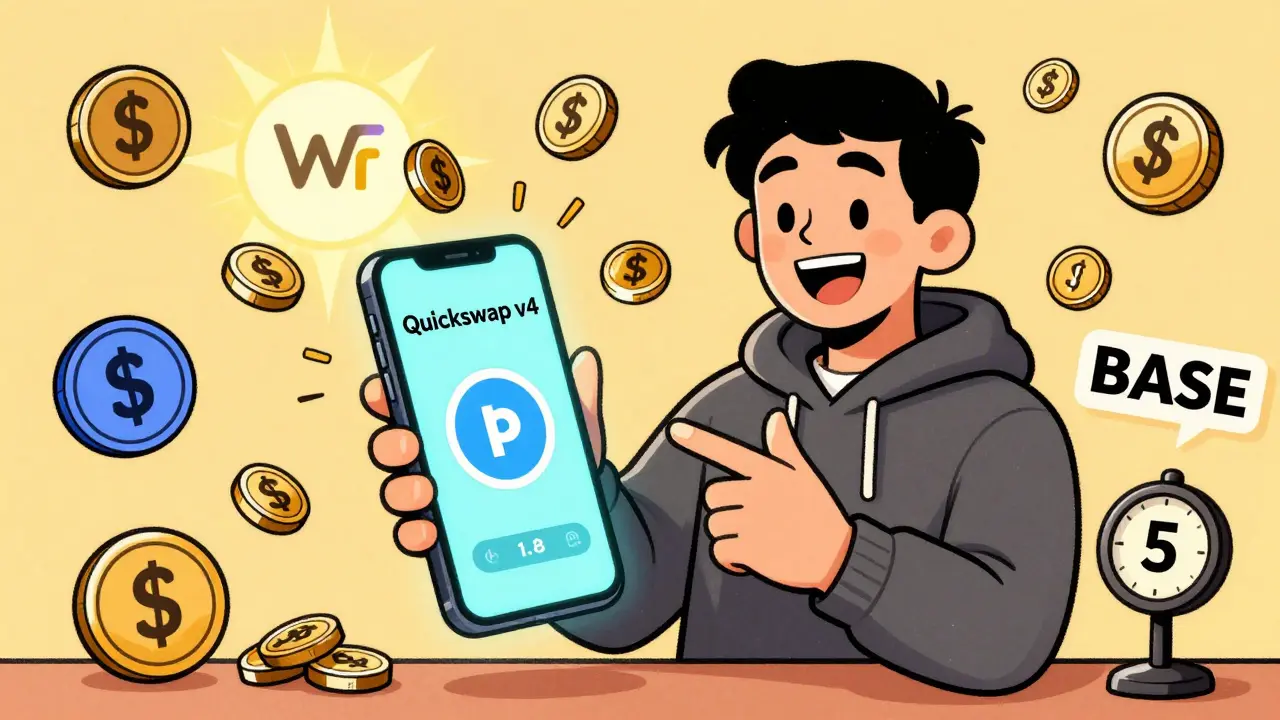
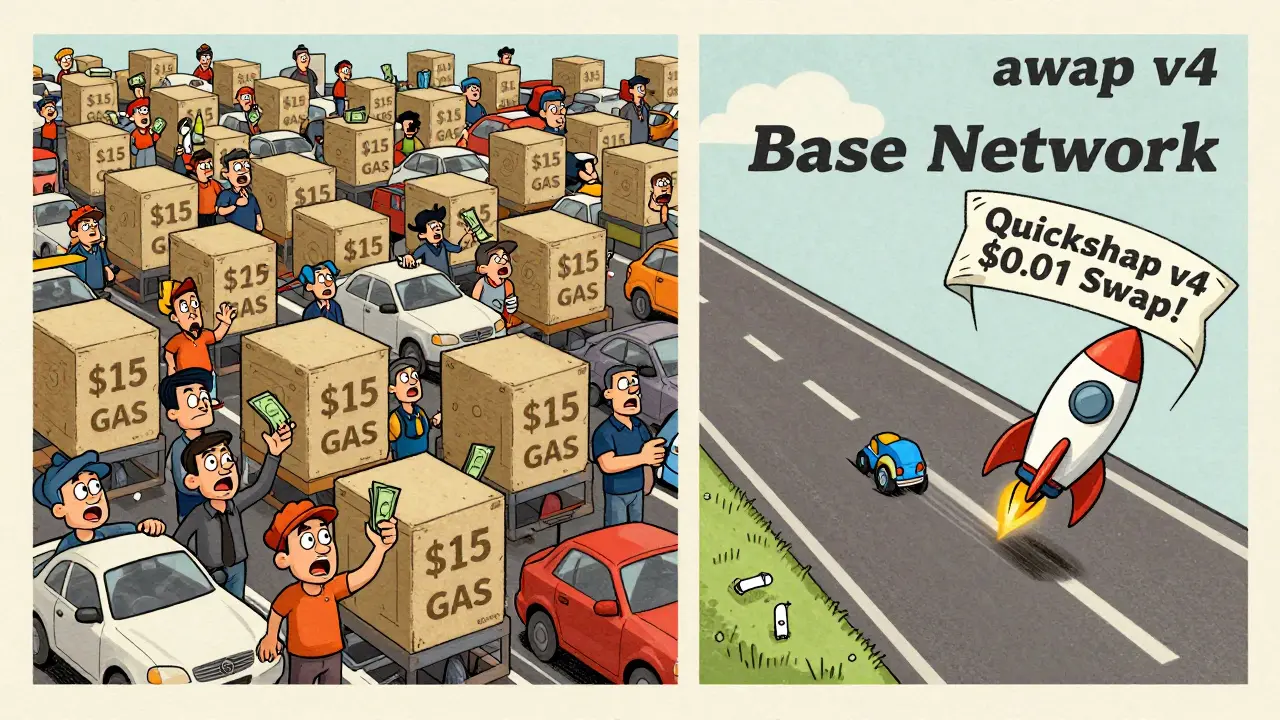
Most people think decentralized exchanges are either too slow or too expensive. If you’ve ever tried to swap tokens on Ethereum during a spike, you know the pain: $15 in gas fees, a 20-second wait, and then your trade gets rejected. That’s why Quickswap v4 on Base isn’t just another DEX-it’s a reset button for retail crypto traders. Launched in early 2024, this version is built directly on Coinbase’s Base network, and it’s already handling over 4 million active users a week. The numbers don’t lie: swaps cost as little as $0.01, complete in under 2 seconds, and it’s the go-to for anyone trading under $100. But is it really that good? Let’s break it down.
How Quickswap v4 on Base Actually Works
Quickswap v4 isn’t built from scratch. It’s an upgraded version of the original Quickswap, which started as a Uniswap fork in 2020 to fix Ethereum’s high fees. But instead of staying on Ethereum, it moved to Base-a Layer 2 blockchain built on Optimism’s OP Stack. This matters because Base isn’t just another sidechain. It processes 2,000 transactions per second, compared to Ethereum’s 15-45. That means no more waiting in line. Your trade executes almost instantly.
The magic behind Quickswap v4 is its use of concentrated liquidity, a model borrowed from Uniswap v3 but optimized for Base. Instead of spreading your funds across a wide price range, you can pin them to a narrow zone where the price is most likely to move. This gives you better returns on your liquidity and reduces slippage. It’s not perfect-more on that later-but for small trades, it’s the most efficient system out there.
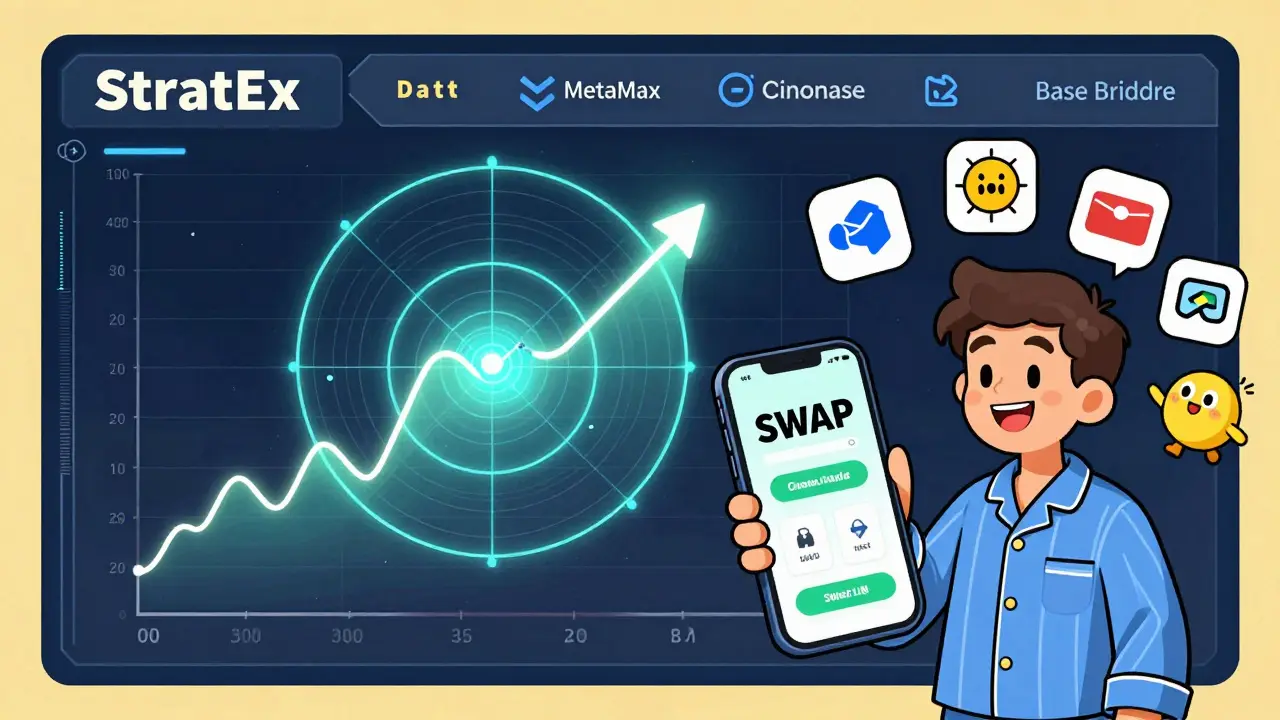
And it’s not just about speed. Quickswap v4 includes StratEx, an AI tool launched in mid-2025 that analyzes historical price patterns and gives traders predictive signals with 78.4% accuracy based on backtests. It doesn’t trade for you, but it tells you when a token is likely to spike or drop. Think of it like a radar for market moves.
What You Can Do on Quickswap v4
You can swap tokens. That’s the core. But you’re not limited to just Base-native coins. Through the Base Bridge v2, launched in March 2025, you can move assets from Ethereum, Polygon, Solana, and Arbitrum into Base. The bridge cuts transfer costs by 25% and speeds up deposits by 40%. If you’re holding USDC on Ethereum and want to trade it for a new Base token, you can do it in under 30 minutes, often for less than $0.05 in total fees.
Quickswap v4 supports over 1,200 trading pairs. The most popular? WETH/USDC. It accounts for nearly 70% of daily volume. That’s because it’s the easiest way to move between stablecoin and ETH without leaving Base. Other common pairs include WBTC/USDC, DAI/USDC, and newer tokens like BASE, TIA, and MKR.
There’s also QuickSwap Perps, a new feature launched in October 2025 that lets you trade perpetual futures with up to 20x leverage. It’s still small-only $427,000 in volume its first week-but it’s a sign the platform is expanding beyond simple swaps. If you’re into margin trading, this could be a future tool. Right now, though, it’s still in early testing.
Costs: Why This Is a Game-Changer
Let’s talk numbers. On Ethereum, swapping USDC for ETH might cost you $4-$15 in gas. On Quickswap v4? You’re looking at $0.01-$0.02. That’s not a typo. The average transaction fee on Base is $0.012, according to Blocknative’s October 2025 data. Even during peak usage, you won’t break $0.05.
Trading fees are 0.30% per swap. That’s higher than Uniswap’s lowest tier (0.05%) and PancakeSwap’s flat 0.25%. But here’s the catch: if you’re trading $50 worth of tokens on Ethereum, you might pay $10 in gas alone. On Base, your total cost is $0.31. That’s a 97% savings.
For retail traders making multiple small trades daily, this changes everything. Dune Analytics shows that 63% of all sub-$50 swaps on Base happen on Quickswap v4. That’s not because people are lazy-it’s because it’s the only viable option.
Liquidity and Slippage: The Trade-Off
Here’s where Quickswap v4 gets tricky. While it’s cheap and fast, it doesn’t have deep liquidity. For major pairs like WETH/USDC, it has about 37% less liquidity than Uniswap v3 on Ethereum. That means if you try to trade $10,000 in one go, you’ll likely see 0.18% slippage. On Uniswap, it’s 0.12%. Not huge, but noticeable.
For trades over $50,000? Forget it. Slippage jumps past 1.5%. That’s why institutions still avoid it. Quickswap v4 is built for people trading $20, $50, $200-not hedge funds moving millions. If you’re a small trader, you’re in the sweet spot. If you’re trying to move large amounts, you’ll need to split your trade or use a different platform.
Security and Reliability
Quickswap v4 uses the same security model as other major DEXs: smart contracts audited by OpenZeppelin, multi-sig treasury managed with Gnosis Safe, and a $150,000 bug bounty program through Immunefi. The last audit was completed in September 2025. No exploits since launch.
It’s also built on Base, which is backed by Coinbase. That means it inherits Coinbase’s infrastructure security, including enterprise-grade monitoring and incident response. It’s not perfect, but it’s one of the most secure Layer 2 DEXs out there.
The only real risk? Its dependence on Base. If Coinbase ever pulls the plug on Base (highly unlikely), Quickswap v4 would collapse. It doesn’t have its own independent blockchain. It’s a rider on Base’s success.
Who Is This For? Who Should Avoid It?
Quickswap v4 on Base is perfect for:
- People who trade small amounts daily (under $200)
- Users who hate high gas fees on Ethereum
- Traders who want instant swaps and don’t need advanced orders
- Anyone using MetaMask, Coinbase Wallet, or Trust Wallet
It’s not for:
- Traders who need stop-loss or limit orders (they don’t exist here)
- Institutional investors moving large sums
- People who want to trade exotic tokens with low volume
- Those who prefer a full-service exchange with customer support
That last point is important. Quickswap has no live chat, no phone support, and no email team that responds quickly. You get Discord, Telegram, and 127 written guides. If you need help, you’ll find it in community forums-not a helpdesk.
How to Get Started
Setting up takes less than 10 minutes:
- Install a Web3 wallet like MetaMask or Coinbase Wallet.
- Connect it to app.quickswap.exchange (the official site).
- If you’re coming from Ethereum, use the Base Bridge to transfer your assets. It takes 15-25 minutes.
- Swap tokens. That’s it.
No KYC. No sign-up. No credit card. You just need crypto in your wallet. The interface is clean, with big buttons and clear labels. Even beginners can figure it out after one try.
The Bottom Line
Quickswap v4 on Base isn’t trying to be Uniswap. It’s not trying to be Binance. It’s trying to be the best place for small, frequent crypto trades. And in that niche, it’s unmatched.
It’s faster, cheaper, and more reliable for micro-transactions than any other DEX. The AI tools are a bonus. The lack of advanced orders is a real limitation, but if you’re not trading large amounts, you won’t miss them.
Is it the future? Maybe not for everyone. But for the millions of retail traders who just want to swap tokens without getting ripped off by gas fees? It’s already here.
Is Quickswap v4 on Base safe to use?
Yes, it’s considered safe for retail use. Quickswap v4 uses audited smart contracts from OpenZeppelin, a multi-sig treasury managed by Gnosis Safe, and runs on Coinbase’s Base network, which has enterprise-grade security. There’s also a $150,000 bug bounty program. No major hacks have occurred since its launch. However, like all DeFi platforms, you’re responsible for your own wallet security. Never share your seed phrase.
Do I need to use Base to trade on Quickswap v4?
You don’t need to hold Base (the token), but you do need to be on the Base blockchain to use Quickswap v4. You can bring assets from Ethereum, Polygon, or Solana using the Base Bridge, but once they’re on Base, you can only swap tokens that exist on that network. Quickswap v4 doesn’t support direct swaps from other chains-it requires assets to be bridged first.
Can I use Quickswap v4 on my phone?
Yes. Quickswap v4 works perfectly on mobile through Web3 wallets like Coinbase Wallet, Trust Wallet, or MetaMask Mobile. The website is fully responsive, and all functions-swapping, bridging, viewing liquidity-are accessible from your phone. Many users trade entirely on mobile.
Why doesn’t Quickswap v4 have limit orders or stop-loss?
Quickswap v4 is built as an Automated Market Maker (AMM), which only supports instant swaps. Limit orders and stop-losses require an order book, which AMMs don’t use. To add those features, Quickswap would need to integrate with a centralized matching engine, which goes against its decentralized design. The team has hinted at future integrations, but as of now, they’re not available.
What’s the difference between Quickswap v4 and Uniswap v3?
Both use concentrated liquidity, but Uniswap v3 runs on Ethereum, where gas fees are high and transactions are slow. Quickswap v4 runs on Base, where fees are near-zero and speed is 100x faster. Uniswap has more liquidity and supports larger trades, but Quickswap wins for small, frequent trades. If you’re swapping $50 every day, Quickswap saves you hundreds of dollars a month in fees.
Is the QUICK token worth holding?
The QUICK token has no utility on Quickswap v4. It’s not used for fees, governance, or staking on the Base version. Its value is tied to the original Quickswap on Polygon, which is now a separate platform. Most users don’t hold QUICK for v4 trading. Analysts warn that the SEC may classify QUICK as a security, which could limit its future. Unless you’re actively involved in Polygon-based DeFi, holding QUICK offers little benefit.
How do I bridge assets to Base for Quickswap v4?
Go to the Base Bridge (base.org/bridge) or use the bridge button on Quickswap’s interface. Connect your wallet, select the asset and chain you’re sending from (like Ethereum), enter the amount, and confirm. The process takes 15-30 minutes. Fees are typically under $0.05. Once your assets arrive on Base, they’ll show up in your wallet and be ready to swap on Quickswap v4.
Anastasia Danavath
March 20, 2026 AT 04:53Ann Liu
March 21, 2026 AT 23:47Graham Smith
March 22, 2026 AT 03:53Jerry Panson
March 22, 2026 AT 07:47Dionne van Diepenbeek
March 23, 2026 AT 07:39anshika garg
March 23, 2026 AT 12:27Bruce Doucette
March 23, 2026 AT 14:19Jessica Beadle
March 25, 2026 AT 12:20Tony Weaver
March 26, 2026 AT 19:41Patty Atima
March 27, 2026 AT 00:35Ernestine La Baronne Orange
March 28, 2026 AT 05:24Manali Sovani
March 29, 2026 AT 15:26Konakuze Christopher
March 29, 2026 AT 21:11S F
March 30, 2026 AT 06:06Angelica Stovall
April 1, 2026 AT 02:24sai nikhil
April 1, 2026 AT 06:57George Hutchings
April 1, 2026 AT 12:10Henrique Lyma
April 2, 2026 AT 22:24shreya gupta
April 3, 2026 AT 09:18Derek Lynch
April 4, 2026 AT 10:01Sarah Zakareckis
April 6, 2026 AT 05:00iam jacob
April 6, 2026 AT 23:53Jesse Pals
April 8, 2026 AT 23:27Diane Overwise
April 9, 2026 AT 07:56Marie Vernon
April 9, 2026 AT 22:34rajan gupta
April 10, 2026 AT 05:52