

Imagine buying a coffee with cash. No one knows who you are, where the money came from, or exactly how much you spent. Now imagine trying to do that same transaction, but your bank demands to know the name of the person who gave you the cash three months ago, and they refuse to process the payment if you can't prove it. That is essentially what happens when you try to trade privacy coins like Monero on a regulated Australian exchange today.
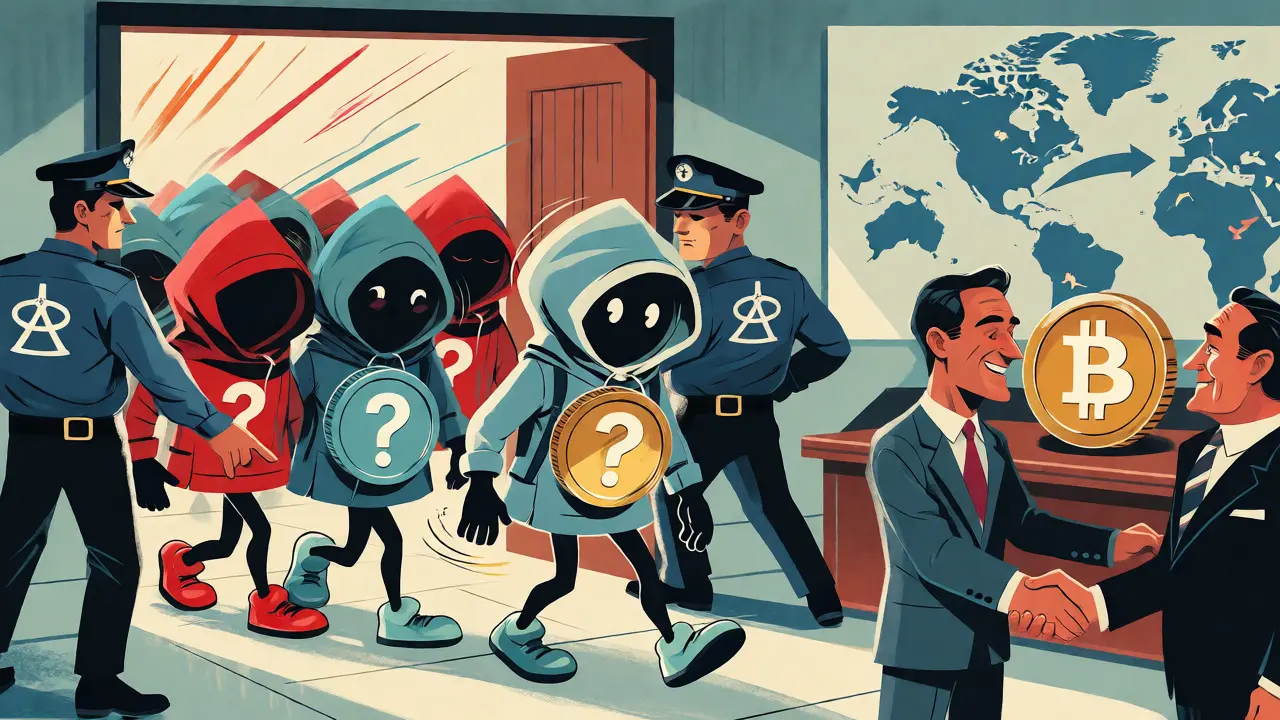
As of September 2026, the landscape for privacy-focused cryptocurrencies in Australia has shifted dramatically. While owning these digital assets remains perfectly legal for individuals, trading them through licensed local platforms has become nearly impossible. This isn't just a minor inconvenience; it's a fundamental change in how Australians interact with the crypto ecosystem. The driving force behind this shift? A relentless push by regulators to eliminate anonymity in financial transactions, aligning Australia with global anti-money laundering standards.
The Regulatory Squeeze: Why Privacy Coins Are Out
You might wonder why regulators have such an issue with coins that promise anonymity. It comes down to one word: traceability. Traditional banks and financial institutions operate on the principle that every dollar must have a known origin and destination. Privacy coins, by design, break this rule. They use advanced cryptography to hide the sender, receiver, and amount of a transaction. For law enforcement and tax authorities, this creates a black box they cannot open.
In Australia, two main bodies oversee this space: the Australian Transaction Reports and Analysis Centre (AUSTRAC) and the Australian Securities and Investments Commission (ASIC). AUSTRAC enforces the Anti-Money Laundering and Counter-Terrorism Financing Act 2006. Their job is to ensure that digital currency exchanges report suspicious activities. If an exchange lists Monero, they struggle to meet these reporting obligations because the technology itself prevents the transparency AUSTRAC requires.
This isn't a new development unique to Australia. It’s part of a global wave. In 2025 alone, 73 exchanges worldwide delisted privacy coins, a 43% jump from previous years. Major players like Binance removed Monero, Zcash, and Dash from their European and US platforms, impacting hundreds of millions in trading volume. Australian exchanges didn't act in isolation; they followed suit to avoid losing their licenses or facing heavy fines.
What Is Actually Banned? Ownership vs. Trading
Here is the crucial distinction that confuses many newcomers: Privacy coins are not illegal to own in Australia. You can hold Monero in your personal wallet. You can send it to a friend. You can receive it as payment. The ban applies specifically to trading services provided by registered exchanges.
Think of it like this: You can legally drive a car without a seatbelt (hypothetically), but no rental agency will rent you one unless it has one installed. Similarly, while you can own privacy coins, most Australian users rely on centralized exchanges like CoinSpot, Swyftx, or Independent Digital Assets Exchange (IDAX) to buy and sell. These platforms have voluntarily removed privacy coins from their order books to stay compliant.
IDAX reported that 78% of its institutional clients actively supported removing privacy coins. Why? Because institutional investors hate regulatory risk. If a bank wants to invest in crypto, they need assurance that the underlying assets won't trigger compliance headaches. By delisting privacy coins, exchanges make themselves more attractive to traditional finance partners.
The Global Context: How Australia Compares
Australia sits in the middle of the global spectrum regarding privacy coin restrictions. Some countries have gone further, while others remain laxer. Understanding where Australia stands helps put local frustrations into perspective.
| Jurisdiction | Status | Key Details |
|---|---|---|
| Australia | Restricted (Exchange Level) | Legal to own; banned on licensed exchanges due to AUSTRAC compliance pressure. |
| Japan | Banned | All registered exchanges ceased support following FSA guidance in 2018. |
| South Korea | Delisted | Top exchanges (Upbit, Bithumb) removed privacy coins in Q1 2025. |
| European Union | Scheduled Ban | Comprehensive ban on anonymous accounts starts July 2027 under new AML rules. |
| Switzerland | Permitted (Regulated) | Limited services available under strict KYC/AML frameworks. |
Notice that Japan implemented a hard ban back in 2018. South Korea followed suit recently. The EU is moving toward a total ban by 2027. Australia’s approach is more subtle-it’s driven by market forces and compliance costs rather than an explicit legislative prohibition on the asset itself. However, the practical effect for the average user is almost identical.
Why Exes Hate Privacy Tech: The Compliance Nightmare
To understand why exchanges are dropping these coins, you need to look at the tech. Privacy coins use features like ring signatures and stealth addresses. Let's break down why this matters to a compliance officer.
- Ring Signatures: Mix your transaction with others so outsiders can't tell which one was yours.
- Stealth Addresses: Generate a new address for every transaction, making it hard to track your balance history.
- Zero-Knowledge Proofs: Prove you have enough funds without revealing the amount or your identity.
For a normal Bitcoin transaction, an exchange can see exactly where the coins came from and where they went. With Monero, that trail goes cold. Under AUSTRAC’s expanded scope, which fully covers all digital asset service providers as of March 31, 2026, exchanges must perform Customer Due Diligence (CDD). If they can't verify the source of funds because the blockchain hides it, they risk non-compliance. The cost of implementing special monitoring tools for privacy coins often outweighs the trading volume they generate.
It’s not just about suspicion; it’s about proof. The US Internal Revenue Service even offered $625,000 bounties for anyone who could crack Monero’s privacy features. When governments throw that kind of money at breaking your encryption, it signals that they view these technologies as significant hurdles to tax collection and law enforcement.

Where Can Australians Buy Privacy Coins Now?
If you’re in Perth or Sydney and want to buy Monero, you can’t just log into your usual app anymore. So, what are your options?
- Peer-to-Peer (P2P) Markets: Platforms like LocalMonero have seen increased activity. Here, you deal directly with another human. You send AUD via bank transfer, and they send XMR to your wallet. The upside is direct access. The downside? Counterparty risk. If the seller disappears, you might lose your money. There is no insurance fund here.
- International Exchanges: Some offshore exchanges still list privacy coins. However, using them means dealing with foreign banking channels, potential withdrawal fees, and less consumer protection under Australian law.
- Decentralized Exchanges (DEXs): You can swap stablecoins for privacy coins on DEXs. But remember, you first need to get those stablecoins out of the Australian banking system onto the chain, which adds friction.
Community discussions on Reddit show mixed reactions. Privacy advocates feel frustrated, viewing the bans as overreach that stifles financial freedom. On the other hand, institutional investors generally cheer the move, seeing it as a maturation step that brings crypto closer to traditional finance standards.
The Future: Will Privacy Coins Survive in Australia?
Looking ahead, the trend points toward tighter restrictions, not looser ones. The expansion of AUSTRAC’s regulatory scope in 2026 formalized many informal practices. We likely won't see a sudden reversal where major exchanges relist Monero tomorrow.
However, technology adapts. Some projects are exploring "semi-compliant" privacy features-ways to offer privacy to users while allowing auditors to verify transactions with a key. Could we see a hybrid model emerge? Maybe. But for now, the core value proposition of absolute anonymity clashes directly with the core requirement of modern banking: transparency.
If you are holding privacy coins, keep them safe in a hardware wallet. Don't panic-sell just because you can't easily trade them on a local platform. Remember, scarcity of supply (due to lack of liquidity) can sometimes lead to price volatility, both up and down. Stay informed, watch for regulatory updates from ASIC, and consider your long-term strategy carefully.
Are privacy coins illegal to own in Australia?
No, owning privacy coins like Monero, Zcash, or Dash is perfectly legal for individuals in Australia. The restrictions apply primarily to trading services offered by licensed cryptocurrency exchanges, which have delisted these assets to comply with anti-money laundering regulations.
Why did Australian exchanges delist privacy coins?
Exchanges delisted privacy coins to meet strict compliance requirements set by AUSTRAC under the Anti-Money Laundering and Counter-Terrorism Financing Act. The anonymity features of privacy coins make it difficult for exchanges to trace transaction origins and destinations, creating significant regulatory risks and operational challenges.
Can I still buy Monero in Australia?
Yes, but not through major local centralized exchanges. You can purchase Monero through peer-to-peer (P2P) platforms, international exchanges that still support it, or decentralized exchanges (DEXs). Be aware that P2P trading carries higher counterparty risk compared to regulated exchanges.
How does Australia's policy compare to other countries?
Australia's approach is moderately restrictive. Unlike Japan, which banned privacy coins outright, or the EU, which plans a comprehensive ban by 2027, Australia relies on market-driven delistings by exchanges. This makes it stricter than jurisdictions with minimal oversight but less prohibitive than full bans.
What is AUSTRAC's role in crypto regulation?
AUSTRAC oversees digital currency exchange providers to prevent money laundering and terrorism financing. As of March 2026, its regulatory scope expanded to cover all digital asset service providers, requiring rigorous customer identification and transaction reporting, which effectively sidelines privacy coins.