
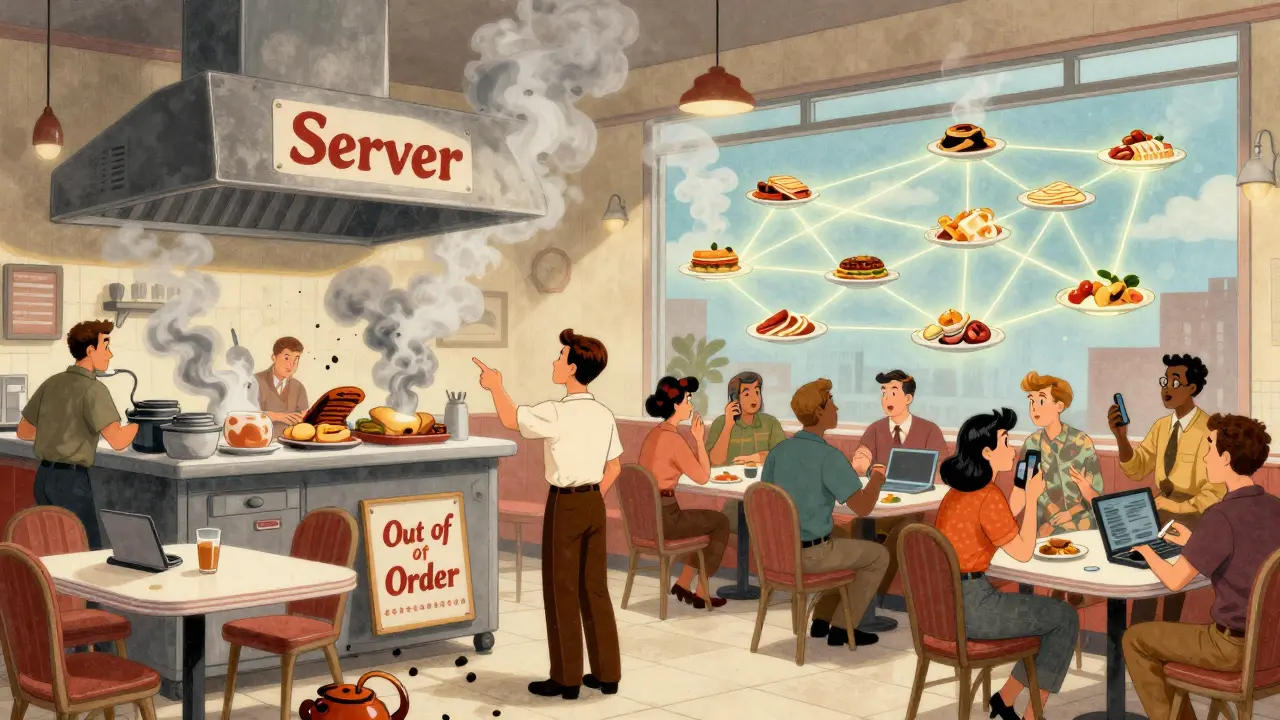
Think about how you normally access a website. You type in a URL, your device sends a request to a server somewhere, and that server sends back the page. That’s the client-server model - simple, familiar, and centralized. But blockchain doesn’t work that way. Bitcoin, Ethereum, and thousands of other blockchains run on something completely different: peer-to-peer (P2P) networks. Why? Because if you want a system that can’t be shut down, censored, or controlled by one company or government, you need to remove the middleman entirely.
How Client-Server Networks Work (And Why They’re Fragile)
Client-server is the backbone of the modern internet. Your phone, laptop, or tablet is the client. It asks for data. A server - a powerful machine in a data center - responds. Think of it like a restaurant: you (the client) order food. The kitchen (the server) prepares it. If the kitchen burns down, no one eats. That’s the problem.
Centralized systems have one big weakness: a single point of failure. If Amazon’s servers go down, Prime Video stops. If PayPal’s servers crash, payments halt. If a government orders a company to freeze an account, it happens. That’s not just inconvenient - it’s dangerous for money and freedom.
Client-server networks also cost a lot. Companies spend millions on servers, cooling systems, security teams, and IT staff. They own the hardware. They control the data. And they’re the only ones who can fix it when things break. That’s fine for Netflix or Google. But for something meant to be open and trustless, like digital money, it’s the opposite of the goal.
What Makes Peer-to-Peer Different
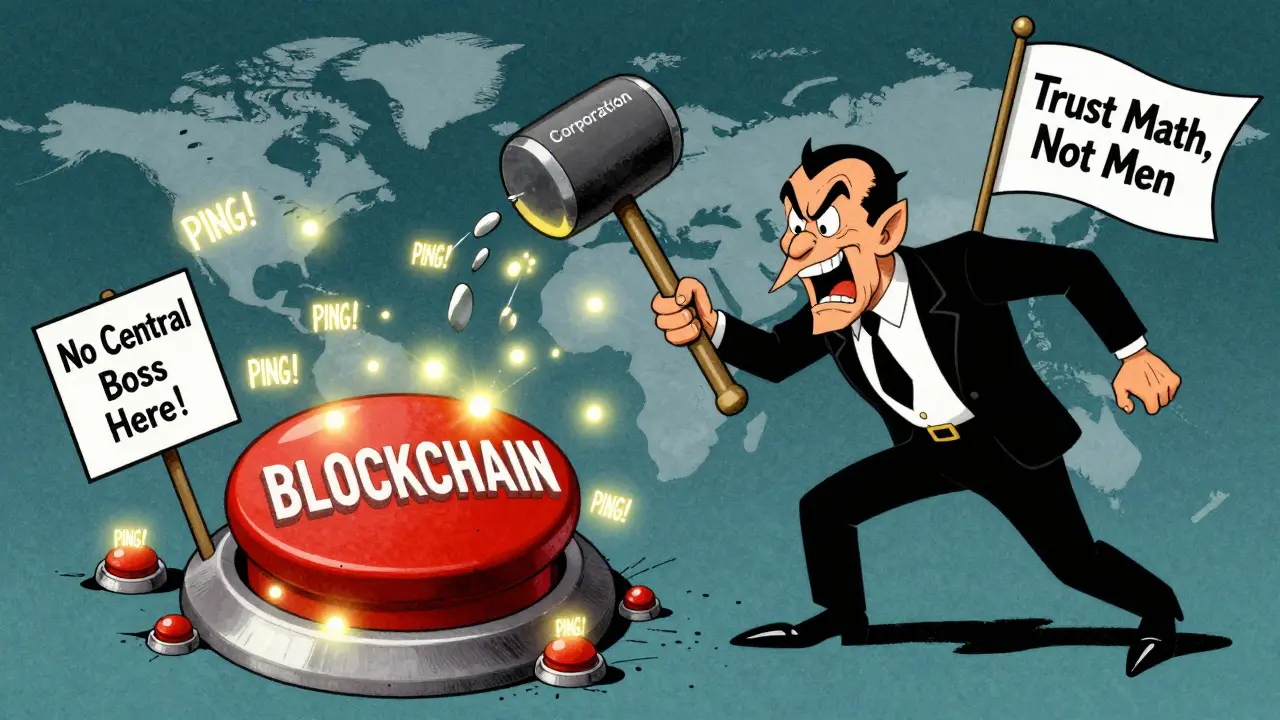
In a P2P network, there are no servers. No central boss. Every device - your phone, a laptop in Berlin, a server in Singapore - is equal. Each one is both a client and a server. You can ask for data. You can also send it to someone else. There’s no single point to attack. No one person to blame when something goes wrong.
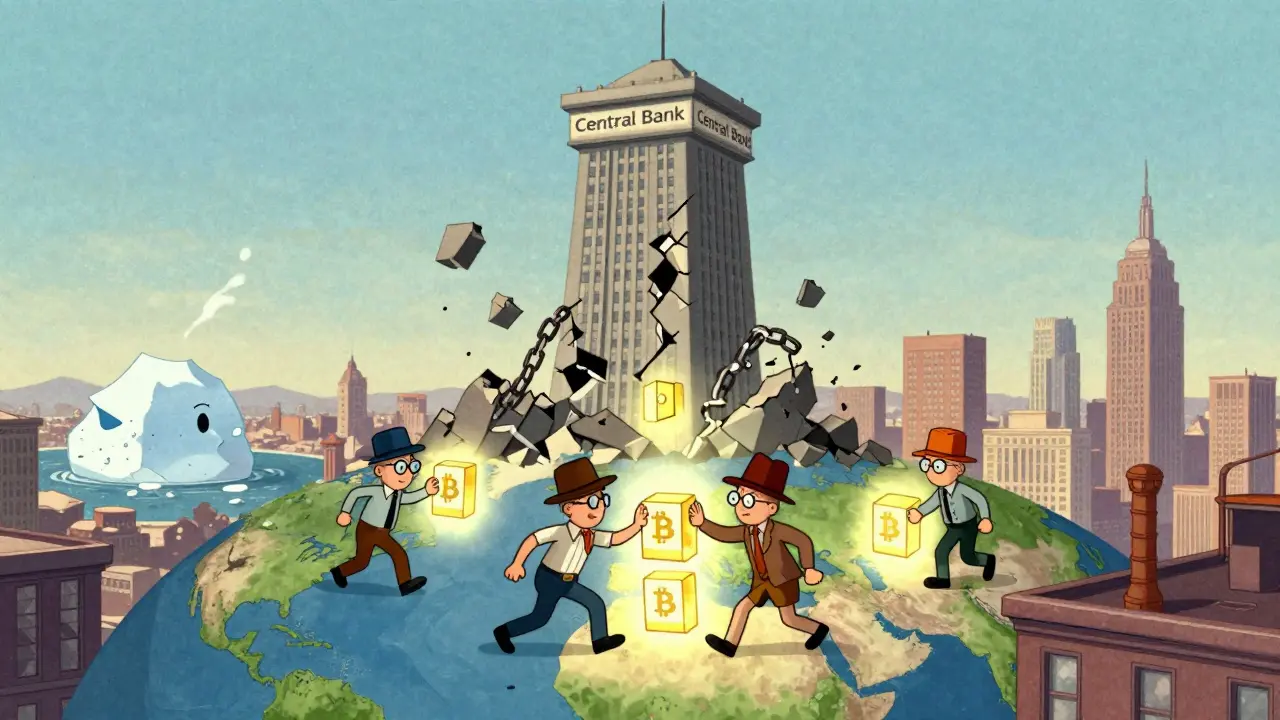
Bitcoin was the first real-world P2P system that worked at scale. When Satoshi Nakamoto built it in 2009, they didn’t want banks or governments involved. So they designed it so that every node - every computer running Bitcoin software - keeps a full copy of the entire blockchain. That’s over 500 gigabytes of transaction history, replicated across tens of thousands of machines worldwide.
That’s not just backup. It’s defense. If one node goes offline, the network keeps going. If someone tries to delete a transaction, it’s still there on 10,000 other machines. If a government shuts down Bitcoin nodes in one country, users in other countries still sync and validate blocks. That’s censorship resistance in action.
Why Blockchain Needs P2P - Not Just for Tech, But for Trust
Blockchain isn’t just about storing data. It’s about agreeing on what’s true without trusting anyone. That’s called consensus. In a client-server world, you trust the server to tell you the truth. In blockchain, you don’t trust anyone. You verify everything yourself.
Here’s how P2P makes that possible:
- Decentralized storage: Every node holds the full ledger. No single entity owns the data.
- Distributed validation: Every transaction is checked by multiple nodes before being added to the chain. No central authority approves it.
- Self-sustaining: Nodes are incentivized to stay online. Miners get paid in Bitcoin. Validators earn ETH. The system pays itself.
- Resilience: Even if 80% of nodes go offline, the remaining 20% can still keep the network alive and secure.
This is why you can’t shut down Bitcoin. You can’t ban Ethereum. You can’t freeze a wallet unless you control the private key. The network doesn’t rely on permission. It relies on math, code, and economics.
Myths About P2P: It’s Not Just for File Sharing
People often think P2P means BitTorrent or old-school file-sharing apps. But those were messy. Files got corrupted. Nodes dropped out. Quality was unreliable. Blockchain solved those problems.
Modern blockchain P2P networks use:
- Distributed Hash Tables (DHTs) to find peers quickly, even with millions of nodes.
- Consensus algorithms like Proof of Work and Proof of Stake to agree on the state of the ledger.
- Cryptographic signatures to prove ownership and prevent tampering.
- Economic incentives to reward honest behavior and punish attacks.
These aren’t just tweaks. They’re breakthroughs. Bitcoin’s P2P network has run continuously for over 14 years. Ethereum’s handles over 1 million transactions per day. These aren’t experiments. They’re production systems running on P2P architecture.
Why Client-Server Still Exists - And Why It Can’t Replace Blockchain
Client-server isn’t dead. It’s better for some things. Netflix doesn’t need decentralization. Your bank doesn’t need to be uncensorable. Centralized systems are faster, easier to update, and cheaper to run at small scale.
But here’s the catch: if you need to trust a third party, you’re already giving up control. And once you do that, you’re vulnerable. To hacks. To regulation. To corruption.
Blockchain’s P2P model doesn’t just solve technical problems - it solves power imbalances. It shifts control from corporations and governments to users. That’s why you see institutions like JPMorgan and the Bank of England building private blockchains - they want the benefits of distributed ledgers without giving up control. But those aren’t true blockchains. They’re databases with fancy labels.
Real blockchain - like Bitcoin and Ethereum - only works when it’s truly decentralized. And that only happens with P2P.
What Happens When P2P Scales?
Early critics said P2P networks couldn’t scale. Too many nodes, too much data, too slow. But blockchain proved them wrong.
Bitcoin handles about 7 transactions per second. That’s slow. But it’s not meant to be a payment network like Visa. It’s digital gold - a store of value. Ethereum handles 15-30 transactions per second, and with Layer 2 solutions like Optimism and Arbitrum, it now processes over 10,000 per second without sacrificing decentralization.
Sharding, rollups, and improved peer discovery protocols have made P2P networks faster and more efficient. The key isn’t to centralize to get speed - it’s to innovate within decentralization. That’s the whole point.
Final Thought: It’s Not About Tech - It’s About Power
Choosing P2P over client-server isn’t a technical preference. It’s a political one. It’s about who controls the system. Client-server puts power in the hands of a few. P2P distributes it to everyone.
Blockchain doesn’t use P2P because it’s trendy. It uses it because nothing else can deliver what it promises: a system that runs without permission, without a boss, and without the risk of being turned off.
If you want to own your money, your data, your identity - you need a network that can’t be controlled. And that’s only possible with peer-to-peer.
Can blockchain work without P2P?
No - not if you want real decentralization. You can build a distributed ledger using client-server, but it’s just a private database. Companies like IBM and Microsoft offer "blockchain" services that run on centralized servers. These are useful for enterprise record-keeping, but they don’t offer censorship resistance, trustlessness, or true ownership. Real blockchain - like Bitcoin and Ethereum - requires P2P to function as intended.
Why do some blockchains use hybrid P2P models?
Some blockchains, especially newer ones, use hybrid models to improve speed and ease of use. For example, they might use a central server to help new nodes find peers quickly. But once connected, all communication happens peer-to-peer. The core ledger validation still runs on P2P. The hybrid part is just a convenience - not a replacement. The moment you rely on central servers for validation, you lose decentralization.
Is P2P more secure than client-server?
It’s more resilient, not necessarily more secure by default. A P2P network can be attacked with Sybil attacks (fake nodes) or eclipse attacks (isolating a node). But blockchain adds layers of security: cryptography, consensus rules, and economic penalties. A hacker can’t just take down a server - they’d need to control 51% of the network’s computing power or stake. That’s astronomically expensive. Client-server systems are easier to hack because they have one target. P2P systems have thousands.
Do I need to run a node to use blockchain?
No. Most users interact with blockchain through wallets and apps that connect to public nodes. But if you want true independence - if you don’t want to trust anyone else’s node - you can run your own. Running a full node means you validate every transaction yourself. It’s the only way to be 100% sure you’re not being lied to. It takes storage, bandwidth, and a little tech know-how, but it’s free and open to anyone.
What’s the future of P2P in blockchain?
P2P is getting smarter. New protocols are reducing bandwidth use, improving peer discovery, and making it easier for low-power devices (like smartphones) to join. Projects like IPFS and libp2p are building the next-gen P2P layer for the web. In the future, you might interact with blockchain through your phone, your car, or your smart fridge - all connected peer-to-peer. The goal isn’t to replace the internet - it’s to make it trustless.
Darrell Cole
January 26, 2026 AT 16:19Blockchain doesn't need P2P it needs trust and P2P is just a workaround for bad architecture
David Zinger
January 28, 2026 AT 03:09Yeah right like the US government can't just shut down all the nodes with a drone strike
Catherine Hays
January 29, 2026 AT 02:02This is why America needs to ban crypto before it destroys our financial sovereignty
Jen Allanson
January 30, 2026 AT 15:49While the technical argument for P2P is compelling, one must consider the moral implications of enabling systems that evade regulatory oversight. Such architectures inherently undermine the social contract that underpins modern governance and financial stability.
Chidimma Catherine
January 31, 2026 AT 06:32in nigeria we use p2p to send money to family when banks freeze accounts and this is why blockchain matters not just tech but survival
Dave Ellender
January 31, 2026 AT 14:40The resilience of P2P networks is undeniable. But let’s not romanticize it. The energy consumption of Proof of Work alone raises serious ethical questions about scalability and sustainability.
Kevin Pivko
January 31, 2026 AT 18:12It’s not decentralization it’s just chaos with better marketing
Athena Mantle
February 1, 2026 AT 07:57obviously you’ve never heard of Web3… this is just the beginning of the decentralized renaissance 🌱✨
Jessica Boling
February 2, 2026 AT 08:23So you’re saying Bitcoin is like a library where everyone owns a copy of every book… and someone pays you to keep the lights on
Brenda Platt
February 3, 2026 AT 00:46Finally someone gets it!! 🙌 This is how we take power back from the banks and the suits!! 💪🔥
Andy Simms
February 4, 2026 AT 16:51Running a full node isn’t hard. You just need a Raspberry Pi, 1TB SSD, and patience. Most people just don’t want to bother.
Paru Somashekar
February 5, 2026 AT 07:04In India, we rely on P2P for remittances and small businesses. Blockchain isn't theoretical-it's practical. The infrastructure is already here.
Steve Fennell
February 6, 2026 AT 23:47True decentralization is not about technology. It’s about human behavior. Most people want convenience over control. That’s why P2P will always be niche.
Abdulahi Oluwasegun Fagbayi
February 8, 2026 AT 06:33Power belongs to the people not the servers
Mike Stay
February 8, 2026 AT 16:57The philosophical shift here is profound. Client-server is feudalism. P2P is direct democracy. One grants permission, the other assumes sovereignty. The real innovation isn’t the code-it’s the redefinition of authority.
MOHAN KUMAR
February 10, 2026 AT 09:41Why do people think decentralization means no rules? There are rules in blockchain just different ones
Ashok Sharma
February 11, 2026 AT 18:06For small businesses, blockchain P2P reduces fees and delays. It’s not magic but it’s better than traditional banking in many countries.
Tselane Sebatane
February 13, 2026 AT 15:47Let me tell you something about power. When your government freezes your account and you still get paid because your Bitcoin node is running in Cape Town-that’s freedom. Not a feature. A revolution. And it’s not going back. Not ever.
They tried to ban it. They tried to tax it. They tried to regulate it. But you can’t regulate math. You can’t censor code. You can’t kill a network that lives in a thousand homes, a thousand laptops, a thousand phones.
They think they control the system because they built the banks, the servers, the firewalls. But they forgot one thing: the people built the network. And the people don’t need permission.
So yes, P2P is the future. Not because it’s faster. Not because it’s cheaper. But because it’s the only thing that refuses to be owned.
And that’s why they’re scared.
george haris
February 14, 2026 AT 07:30wait so if i run a node am i basically a volunteer sysadmin for the world’s most important database?
Jeffrey Dufoe
February 14, 2026 AT 09:38makes sense. i just use wallets but i get why some people want to run their own
katie gibson
February 15, 2026 AT 00:34okay but like… if no one controls it… who fixes the bugs??
Taylor Mills
February 16, 2026 AT 18:18blockchain is just crypto bros pretending they’re hackers
carol johnson
February 17, 2026 AT 16:17you think bitcoin is decentralized?? lol the top 10 wallets own 30% of supply 🤡💎
Mark Estareja
February 17, 2026 AT 22:40The consensus mechanism’s computational overhead introduces a latent vulnerability: if 51% of hash power is concentrated, the entire system becomes susceptible to collusion. P2P architecture merely obscures the centralization-it doesn’t eliminate it.
Arnaud Landry
February 18, 2026 AT 13:04So you’re telling me the government can’t shut this down… but they can just ban mining equipment, freeze bank accounts of node operators, and track IP addresses? That’s not resilience. That’s a fantasy.
And don’t get me started on how many nodes are actually run by institutional miners in China or the US. This isn’t peer-to-peer. It’s corporate-to-corporate with a side of delusion.
Melissa Contreras López
February 20, 2026 AT 06:35You’re right. This isn’t about tech. It’s about dignity. The ability to say ‘no’ to a system that wants to control you. That’s worth every gigabyte, every watt, every minute of setup.
And if you’re still using a bank to hold your money? You’re not just trusting them. You’re letting them decide when you can eat.
Heather Crane
February 20, 2026 AT 19:44I just love how this reminds me of how communities used to work-everyone helping each other, no middlemen, no red tape… just people being human. 🌍💛
Andy Simms
February 22, 2026 AT 10:19Actually, if you run a node, you’re not just a volunteer-you’re a validator. And validators get rewarded. You’re not giving your time, you’re earning it.