
Governance Decision Calculator
This calculator helps determine whether a governance proposal should be handled on-chain or off-chain based on your project's specific needs. The tool considers key factors like cost, speed, security, and privacy.
Imagine a blockchain network where every upgrade, every rule change, every new feature has to be voted on by everyone who holds tokens. Sounds fair, right? But what if that vote costs $50 just to submit? Or what if the whole process takes weeks because the network is clogged? Now imagine the same decision made in a Discord server, with a Google Form poll, and a final vote recorded on-chain only after consensus is reached. Which one is better? The answer isn’t simple. It depends on what you value more: security or speed.
On-Chain Governance: Decisions Written in Stone
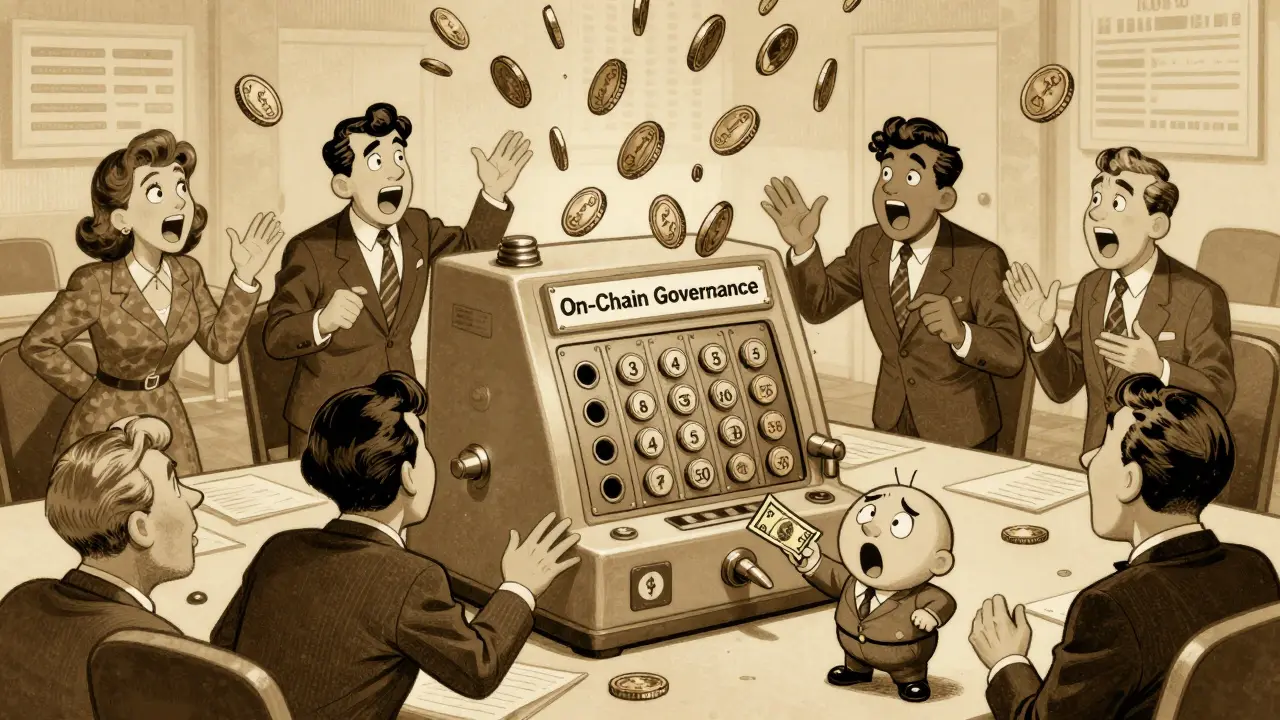
On-chain governance means decisions happen directly on the blockchain. Token holders vote using smart contracts. Proposals are submitted, debated, and executed - all recorded permanently on the ledger. If you hold ETH in a DAO like MakerDAO or SOL in a Solana-based project, you can cast your vote right from your wallet. No middleman. No third-party platform. Just code and consensus.
This model follows five key principles. First, decentralization - no single entity controls the outcome. Second, transparency - every vote, every proposal, every change is public. Third, inclusivity - anyone with tokens can participate. Fourth, immutability - once a decision is finalized, it can’t be undone. And fifth, responsiveness - upgrades can roll out quickly if the community agrees.
Projects like Aave and Compound use on-chain governance for core functions: changing interest rates, adding new collateral types, or adjusting risk parameters. These are high-stakes decisions. If the system lets in a risky asset or sets a bad rate, it could lose millions. So they lock those calls into smart contracts. The code executes automatically. No human error. No backroom deals.
But here’s the catch: every vote costs gas. On Ethereum, a single proposal can cost hundreds of dollars in fees. For smaller holders, that’s a barrier. It’s not just about money - it’s about time. Waiting for blocks to confirm, watching the network slow down, hoping your transaction gets included - it’s exhausting. And if a bad proposal passes? Good luck reversing it. On-chain decisions are permanent. There’s no ‘undo’ button.
Off-Chain Governance: The Human Layer
Off-chain governance is where most of the real discussion happens - outside the blockchain. Think Reddit threads, GitHub issues, Discord debates, Twitter polls, and formal voting platforms like Snapshot. Proposals are drafted, refined, and debated. Community sentiment is gauged. Only when there’s clear agreement does someone submit a final transaction to the blockchain to enact the change.
This is how Bitcoin evolved. No formal voting system exists on-chain. Instead, developers propose changes, miners signal support, and users run updated software. If enough people adopt it, the network shifts. No smart contract needed. No gas fees. Just social coordination.
Off-chain governance is faster and cheaper. A proposal can get 10,000 votes in minutes on Snapshot. A community can rally around a fix in a week. It’s flexible. If a mistake is made, it’s easier to correct - you just draft a new proposal. No need to wait for a chain hard fork or a contentious on-chain vote.
But this flexibility comes at a cost: trust. Who counts the votes? Who decides what counts as consensus? If a small group of whales dominates the discussion, or if a core team pushes a proposal through without real community buy-in, you’re back to centralization. Off-chain governance relies on reputation, social norms, and community pressure - things that can be manipulated.
And here’s the scary part: if the off-chain system fails, the blockchain doesn’t know. A proposal might get 90% support on Snapshot, but if the team ignores it, nothing changes. The blockchain stays unchanged. The vote was real - but meaningless. That’s the risk. Off-chain governance is only as strong as the community’s will to enforce it.
Security: Trustless vs Trusted
On-chain governance is more secure because it’s automated. Smart contracts enforce rules. Votes can’t be altered. Wallets are verified. Transactions are validated by nodes. It’s trustless - you don’t need to believe anyone. You just need to trust the code.
Off-chain governance, by contrast, requires trust. You have to trust the platform hosting the vote (Snapshot, Discord, etc.). You have to trust the people managing the process. You have to trust that the final on-chain transaction actually reflects the community’s will. If any of those links break, the whole system fails.
There’s a reason DeFi protocols keep their core logic on-chain: because money is involved. If a voting system can be hacked or spoofed, someone could drain a treasury. On-chain systems prevent that. Off-chain systems can’t.
But security isn’t just about hacking. It’s about resilience. On-chain governance survives if the developers disappear. The code keeps running. Off-chain governance dies without active community leaders. No one to moderate. No one to submit the final transaction. The project stalls.
Cost and Scalability: The Hidden Trade-Off
On-chain governance is expensive. Storing a 5KB proposal on Ethereum can cost over $200 in gas. For a network with 100,000 token holders, that’s $20 million just to run one vote. Even Layer 2 solutions like Arbitrum or Optimism aren’t cheap enough for frequent, large-scale voting.
Off-chain governance? Nearly free. Snapshot charges nothing. Discord is free. Telegram is free. You can run hundreds of polls a month without spending a cent.
That’s why almost every major DAO uses a hybrid approach. They debate off-chain. They use off-chain tools to measure sentiment. They wait until there’s overwhelming support. Then - and only then - they submit the final vote on-chain.
It’s like drafting a law in Congress. The debates happen in committees. The amendments get worked out in private. But the final vote? That’s on the floor. Public. Recorded. Binding.
Transparency vs Privacy: Can You Have Both?
On-chain governance is completely transparent. Every vote, every wallet address, every proposal - all public. That’s great for accountability. But terrible for privacy.
Imagine you’re voting on a proposal to fund a competitor’s project. Or you’re against a change that could hurt your holdings. You don’t want everyone to know how you voted. On-chain, you can’t hide it. Your wallet is tied to your vote. Your identity is exposed.
Off-chain systems can be anonymous. Snapshot lets you vote with a wallet without revealing your identity. Discord allows pseudonymous discussion. You can express opinions without being tracked.
That’s why some projects use zero-knowledge proofs to blend the best of both. They verify that a vote was cast correctly - without revealing who cast it. It’s still early, but projects like Zcash and Aztec are experimenting with this. The future might be on-chain votes with off-chain privacy.
Real-World Examples: How Projects Do It Today
MakerDAO uses on-chain governance for critical parameters: collateral ratios, stability fees, and risk models. But they use off-chain tools like Discourse for discussion and Snapshot for preliminary polls. Only when consensus is clear do they move to on-chain voting.
Uniswap does something similar. Proposals are debated on GitHub. Community feedback is gathered off-chain. Final votes happen on-chain - but only after months of discussion.
Bitcoin? Pure off-chain. No formal voting. No smart contracts. Just miners, developers, and users signaling support through software adoption.
Ethereum’s upgrade process is a mix. Core changes go through EIPs (Ethereum Improvement Proposals), debated on forums, tested on testnets, and finally activated via on-chain consensus via the Beacon Chain.
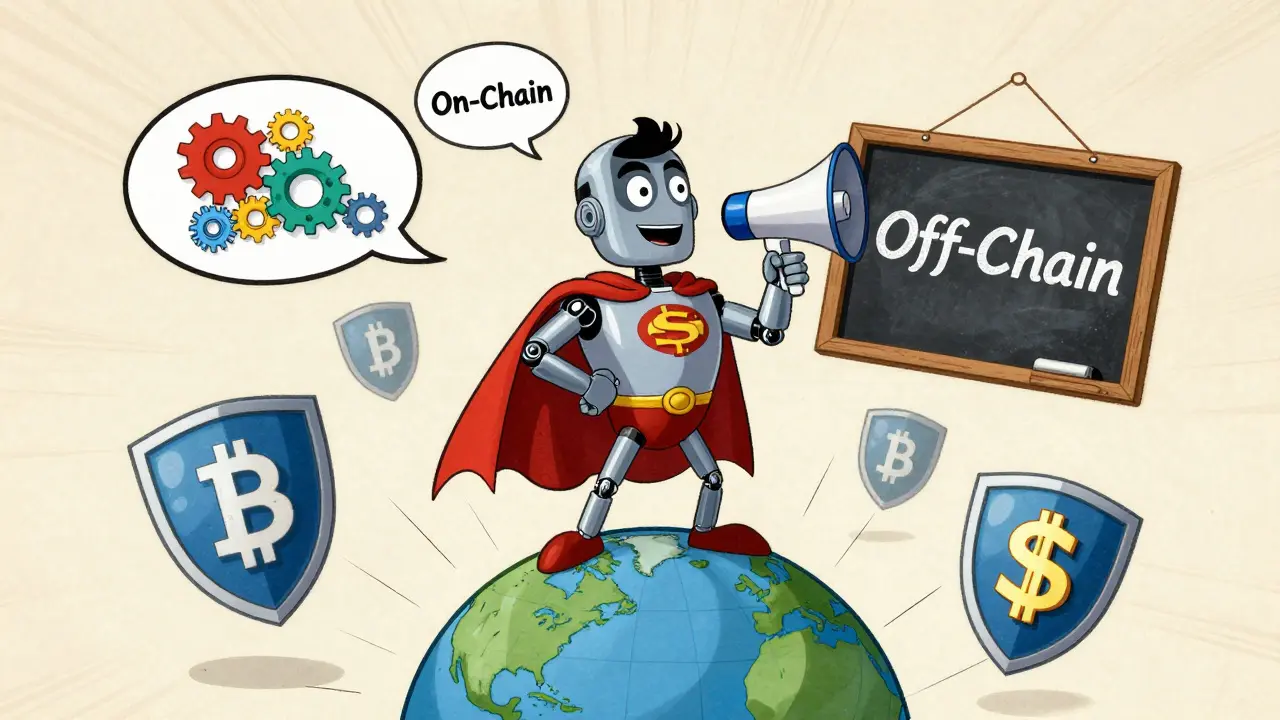
The pattern is clear: the most successful projects don’t pick one side. They use off-chain for discussion, feedback, and refinement. They use on-chain for final, binding decisions.
Which One Should You Care About?
If you’re holding tokens in a DAO, you need to understand how decisions are made. If you’re building a blockchain project, you need to choose wisely.
Use on-chain governance when:
- You’re managing large sums of money (like a DeFi protocol)
- You need absolute transparency and auditability
- You want to eliminate trust in any single party
- You’re okay with slower, more expensive decision-making
Use off-chain governance when:
- You need fast, frequent updates
- You’re dealing with sensitive or private matters
- Your community is large and diverse
- You want to reduce costs and avoid gas fees
Most teams today choose a hybrid model. It’s not about picking the ‘better’ system. It’s about matching the tool to the task.
The Future: Hybrid Governance Is the Standard
The debate between on-chain and off-chain governance isn’t going away. But it’s evolving. The next generation of blockchain systems won’t force you to choose. They’ll let you use both - smartly.
Layer 2 solutions like zkSync and StarkNet are reducing on-chain costs dramatically. That means more voting can happen on-chain without breaking the bank. Meanwhile, off-chain tools are getting more secure. Zero-knowledge proofs, decentralized identity, and verifiable voting are making off-chain systems more trustworthy.
What’s clear is this: blockchain governance isn’t about technology alone. It’s about people. It’s about culture. It’s about how a community makes decisions together. The best systems don’t just automate votes - they foster trust, encourage participation, and protect privacy.
In 2025, the winners won’t be the blockchains with the most on-chain voting. They’ll be the ones that understand when to let the code decide - and when to let the community talk.
What’s the main difference between on-chain and off-chain governance?
On-chain governance means decisions are made and executed directly on the blockchain using smart contracts and token-based voting. Off-chain governance happens outside the blockchain - through forums, polls, and discussions - with only the final decision recorded on-chain. On-chain is transparent and secure but expensive. Off-chain is fast and cheap but relies on trust.
Can off-chain governance be manipulated?
Yes. Since off-chain systems don’t have built-in enforcement, a small group of large token holders (whales) or core developers can dominate discussions and push proposals through without real community support. Without on-chain enforcement, a vote on Snapshot or Discord is just a suggestion - not a rule.
Why do some projects use both on-chain and off-chain governance?
Because each has strengths and weaknesses. Off-chain is great for discussion, feedback, and testing ideas without paying gas fees. On-chain is essential for final, binding decisions - especially when money or security is at stake. Hybrid models let communities debate freely, then lock in consensus securely.
Is on-chain governance more secure than off-chain?
Yes, for final decisions. On-chain governance uses smart contracts and blockchain validation to prevent tampering. Off-chain systems rely on external platforms that can be hacked, censored, or ignored. But on-chain isn’t foolproof - bad proposals can still pass and become permanent.
Do I need to vote on every proposal in a DAO?
No. Many DAOs allow token holders to delegate their voting power to trusted representatives. This keeps governance efficient without forcing everyone to vote on every small change. But if you don’t vote or delegate, you’re giving up your voice - and letting others decide for you.
What happens if a bad proposal passes on-chain?
It’s extremely hard to reverse. On-chain decisions are immutable by design. You’d need a hard fork - which requires near-unanimous community support. In practice, that’s rare. That’s why most DAOs use off-chain polling first - to catch bad ideas before they go on-chain.
Heath OBrien
December 11, 2025 AT 04:52Sarah Luttrell
December 11, 2025 AT 07:56Patricia Whitaker
December 13, 2025 AT 06:16Vidhi Kotak
December 14, 2025 AT 12:17Kim Throne
December 15, 2025 AT 07:47Toni Marucco
December 15, 2025 AT 17:28Kathryn Flanagan
December 16, 2025 AT 05:09Alex Warren
December 17, 2025 AT 19:27Steven Ellis
December 18, 2025 AT 01:28Jessica Eacker
December 18, 2025 AT 12:10Bridget Suhr
December 19, 2025 AT 20:26Madison Surface
December 21, 2025 AT 06:37Nicholas Ethan
December 21, 2025 AT 17:30Kelly Burn
December 22, 2025 AT 19:57Andy Walton
December 24, 2025 AT 08:55Scot Sorenson
December 24, 2025 AT 22:32Lloyd Cooke
December 24, 2025 AT 23:54Kurt Chambers
December 26, 2025 AT 22:03Kathleen Sudborough
December 27, 2025 AT 15:07Joey Cacace
December 28, 2025 AT 16:12Taylor Fallon
December 30, 2025 AT 02:43Jeremy Eugene
December 31, 2025 AT 22:58Jessica Petry
January 2, 2026 AT 06:33Taylor Farano
January 3, 2026 AT 15:40