
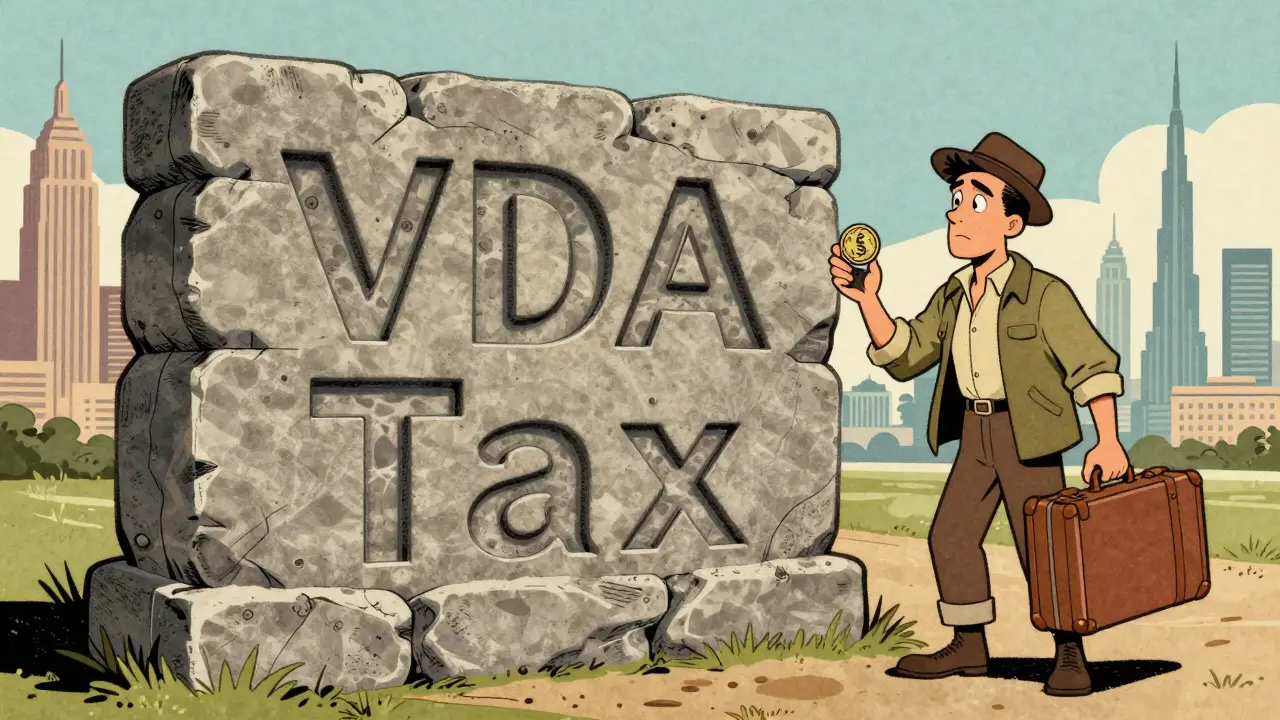
If you're a Non-Resident Indian (NRI) looking for a loophole to avoid the steep crypto taxes in India, I have some tough news: there aren't any. Unlike traditional investments where you can play around with exemptions and reinvestment schemes, the Indian government has built a very tight wall around Cryptocurrency taxation. Whether you're living in Dubai, New York, or London, the rules for Virtual Digital Assets (VDAs) are designed to be rigid and universal.
The core problem is that the tax office doesn't distinguish between a resident and an NRI when it comes to the tax rate. If you make a profit, they want their cut, and they want a large chunk of it. But as we move into 2026, the rules about who counts as a "resident" are changing, which could accidentally drag your entire global crypto portfolio into the Indian tax net. Let's break down how this actually works and where the traps are hidden.
The Flat Tax Reality: No Long-Term Benefits
In the world of stocks or real estate, you usually get a break if you hold an asset for a long time. Not here. For NRIs, all gains from the sale of Virtual Digital Assets (VDAs)-which include everything from Bitcoin and Ethereum to NFTs and Matic-are taxed at a flat 30% rate.
Here is the part that really stings: you can't deduct your expenses. If you spent money on trading bots, exchange fees, or secure storage, you're out of luck. The only thing the government allows you to subtract from your sale price is the original cost of buying the asset. If you bought 1 BTC for $40,000 and sold it for $60,000, you pay 30% on that $20,000 difference, period.
Even worse? You cannot offset losses. If you made a huge profit on Solana but lost everything on a meme coin, you can't use that loss to lower your tax bill. You pay the 30% on the winner, and the loser just stays a loss. This makes Crypto Trading in India a high-risk game compared to traditional equity markets.
TDS and the 1% Friction
If you're using an Indian exchange, you'll notice a small slice of your transaction disappearing instantly. This is the Tax Deducted at Source, or TDS, under Section 194S.
Currently, a 1% TDS is levied on the total sale value if the transaction exceeds ₹50,000 (and in some cases, as low as ₹10,000). While 1% sounds small, it's not a tax on your profit-it's a tax on the total amount. If you sell ₹10 lakhs worth of crypto, the exchange automatically sends ₹10,000 to the government. You can claim this back or offset it against your final tax liability, but it creates an immediate cash-flow drag on your portfolio.
The Big Trap: The 120-Day Residency Shift
This is where things get dangerous for NRIs. Historically, you were generally considered a non-resident if you spent less than 182 days in India. However, starting April 1, 2026, the rules are shifting. There is now a 120-day rule.
If you are an Indian citizen or a person of Indian origin (PIO) and you spend 120 days or more in India during a financial year, and your Indian-sourced income exceeds ₹15 lakhs, you could be classified as a resident. Why does this matter for your crypto? Because once you're a resident, the scope of your taxable income expands. Instead of just paying tax on "Indian-sourced" gains, your NRI cryptocurrency tax obligations could potentially extend to your global earnings, depending on your specific residency sub-category.
| Feature | Traditional Assets (Shares/Bonds) | Cryptocurrencies (VDAs) |
|---|---|---|
| Tax Rate | Slab rate or LTCG/STCG rates | Flat 30% |
| Holding Period Benefit | Yes (Lower tax for long-term) | No (Same rate regardless) |
| Expense Deductions | Many allowed | Only cost of acquisition |
| Loss Offsetting | Allowed against similar gains | Not allowed |
| Section 115F Exemption | Available for specific reinvestments | Explicitly Excluded |
Mining, Airdrops, and Gifts
Not every crypto gain is a "sale." What if you mined some coins or got a lucky airdrop? This is where the taxation changes. Acquisitions without a purchase price-like Mining Rewards or gifts-aren't hit with the flat 30% rate immediately. Instead, they are taxed at your applicable income tax slab rates.
Depending on your total income, this could actually be a benefit or a nightmare. If you're in a lower bracket, you might pay less than 30%. But if you're a high earner, the slab rate could potentially be higher. The key is that these are treated as "income" upon receipt, and then if you sell those coins later, you'll still hit that 30% tax on any further price increase.
The Section 115F Disappointment
Many NRIs are familiar with Section 115F, which lets you avoid paying tax on long-term capital gains if you reinvest the money into specific Indian assets like government bonds or shares of Indian companies. It's a great way to move money back into India tax-efficiently.
However, you cannot use this for crypto. The government has explicitly excluded VDAs from the list of approved reinvestment options. You can't sell your Bitcoin and buy Indian stocks to save on tax; the 30% hit happens the moment you realize the gain, regardless of where you put the money next.
Managing Your "Indian Source" Ambiguity
For those maintaining a strict non-resident status, only income "accruing or arising" in India is taxable. But here's the million-dollar question: what counts as an Indian source for a decentralized asset?
If you use a foreign exchange like Binance or Coinbase, and your bank account is in Singapore, does that count as Indian income? Generally, no. But if you use an Indian exchange (where the platform is based in India and your KYC is linked to Indian documents), the government has a much stronger claim. The line is blurry, and as the Income Tax Act evolves, the definition of "source" for digital assets is becoming a primary target for audits. If you're unsure, the safest bet is to keep your NRI and resident portfolios strictly separated.
Can I offset my crypto losses against other income?
No. Under current Indian tax laws, losses from Virtual Digital Assets (VDAs) cannot be set off against any other income. Furthermore, you cannot even offset a loss from one cryptocurrency (like Ethereum) against a gain from another (like Bitcoin) within the same year.
Is the 30% tax applicable to NRIs on global crypto gains?
If you are a true Non-Resident, you generally only pay Indian tax on gains sourced within India. However, if your status changes to "Resident" due to the new 120-day rule starting in 2026, your global income could become taxable in India.
What happens to the 1% TDS deducted by exchanges?
The TDS is not a final tax; it's a prepayment. When you file your annual income tax return in India, you can claim the total TDS amount as a credit to reduce the final 30% tax liability you owe on your gains.
Do airdrops count as taxable income for NRIs?
Yes. Airdrops and mining rewards are treated as income and are taxed at your applicable slab rates at the time of receipt, rather than the flat 30% capital gains rate.
Can I use Section 115F to avoid crypto tax by buying Indian bonds?
No. Cryptocurrency is explicitly excluded from the reinvestment options under Section 115F. This exemption only applies to specific traditional assets like shares of Indian companies or notified bonds.
Next Steps for NRI Investors
If you're navigating this mess, the first thing you need to do is an audit of your days spent in India. With the new 120-day threshold for 2026, a few extra trips home for weddings or family visits could accidentally flip your tax status. Keep a precise log of your entry and exit stamps.
Second, stop assuming that "offshore" means "invisible." Indian tax authorities are increasingly using data-sharing agreements with other countries. If you're using an Indian-linked PAN for any part of your crypto journey, expect the 1% TDS to leave a paper trail. The best way to handle this is through meticulous record-keeping-save every trade confirmation and cost-basis screenshot, because the government will only accept the purchase price, and the burden of proof is on you.
Saurav Bhattarai
April 18, 2026 AT 08:24Oh, look, another guide telling NRIs how to stay poor by following the law. Typical. Why would anyone actually invest in India when the government treats crypto like a criminal enterprise? The 30% tax is just a way for the state to admit they can't innovate, so they just loot the innovators instead. Absolutely pathetic. 🙄
Abhinav Chaubey
April 19, 2026 AT 23:58The logic here is sound because the Indian state has every right to regulate assets that can be used for money laundering. If you enjoy the benefits of Indian citizenship or origin, you should be more than happy to contribute to the nation's growth via these taxes. Those whining about the 30% rate are simply too greedy to understand national interest.
Joshua Salwen
April 21, 2026 AT 16:23OMGGG this is literally the most horrifying thing I've ever read!! 😱 Like, 120 days? They're basically tracking us with GPS at this point! This is a total nightmare and honestly, it's just a giant scam to steal our money. I can't even deal with the stress of calculating my days anymore, it's just too much!!
John and Lauren Busch
April 22, 2026 AT 05:33Classic government. 🙃
Shannon Kelly Smith
April 23, 2026 AT 19:16Listen up everyone! 🚀 The key here is to be proactive. Don't let these rules scare you into paralysis. Just start a detailed spreadsheet today-track every flight, every hotel stay, and every single trade. If you're organized, you can handle the 30% hit without it ruining your life. Let's all help each other navigate this mess! 📈💪
Michelle Stanish
April 23, 2026 AT 19:19I think the taxes are fine.
Jeff Barlett
April 24, 2026 AT 22:09Actually, the 120-day rule is probably just a distraction from the real issue. Why are we even talking about residency when the entire VDA framework is designed to fail? It's a complete joke. I've seen better tax policies in a lemonade stand. The inconsistency is just wild.
Adedamola Oyebo
April 25, 2026 AT 00:47TDS is a huge drag!! Keep records!!
Kim Smith
April 26, 2026 AT 20:00it's just so fascinatin how we try to put these digital boundaries on somethin that's basically designed to be borderless, right? like the very essence of crypto is to escape these kinds of rigid state structures but here we are, counting days on a calendar and worrying about timestamps of our existence in a specific geo-location... it's almost poetic in a sad way how the analog world tries to eat the digital one and usually just ends up making everything more complicated for the average person who just wants to save for retirement without feeling like they're committing a crime by existing in two places at once.
Mark Pfeifer
April 28, 2026 AT 01:06I'm not okay with the lack of clarity on what defines an 'Indian source' for decentralized wallets. We need a concrete definition, not just 'the line is blurry.' It's unacceptable to leave investors in a position where they could be audited years later because of an ambiguous definition.
Kaitlyn Wu
April 28, 2026 AT 07:40Stop looking for loopholes and just set aside 30% of your gains in a high-yield savings account so you aren't scrambling during tax season. It's the only way to maintain your peace of mind while staying compliant.
nikki krinkin
April 29, 2026 AT 20:28I feel for anyone trying to balance family visits with these new rules. It's a tough spot to be in.
Keri Pommerenk
April 30, 2026 AT 16:57just keep your spreadsheets updated and you will be fine no one likes this but we can manage it
siddharth narula
May 2, 2026 AT 03:37It is a moral imperative to support the state that provided the infrastructure for one's ancestry. Complaining about a 30% tax on speculative digital tokens is simply gauche. 🧐
Sandeep Bhoir
May 3, 2026 AT 12:07Sure, because the government is famously known for being 'helpful' and 'fair' with their tax brackets. 🙄
Yuhan Mo
May 5, 2026 AT 03:31The liquidity friction caused by the 1% TDS is quite significant for high-frequency traders, even if it's eventually reclaimable. The opportunity cost of that capital is often ignored in these discussions.
Sean Mitchell
May 5, 2026 AT 22:10This is an absolute tragedy. The sheer audacity of a 30% flat tax with no loss offsetting is nothing short of financial terrorism! I am genuinely appalled that this is the standard now!
Thomas Jewett
May 7, 2026 AT 18:43America handles things way better than this honestly because at least we have some sense of consistency in our capital gains and not this weird 120 day rule that basically treats you like a prisioner in your own home country if you visit too often!! its just totaly insane how they operate over there
Luke George
May 9, 2026 AT 12:12They're just using the 120-day rule to map out exactly who has assets offshore so they can implement a global wealth tax later. It's all connected. The TDS is just the tracking beacon.
Michael Harms
May 10, 2026 AT 03:56Keep your heads up! Just keep documenting everything and you'll get through it. We've all had to deal with weird tax laws at some point in our lives, this is just the 21st century version!
Anna Grealis
May 10, 2026 AT 11:45probs just a way for them to launder their own money through the tax system while we pay 30% lol
Karen Mogollon Gutierrez
May 11, 2026 AT 08:31The level of administrative incompetence required to create such a rigid system is truly staggering. One must wonder if the architects of this policy have ever actually attempted to execute a single trade in their lives. It is an affront to financial intelligence!
Gillian Kent
May 13, 2026 AT 01:38im sure there is a way to make this work if we just talk to the rigt people in the tax office. maybe we can find a peacful solusion for everyone involvd