
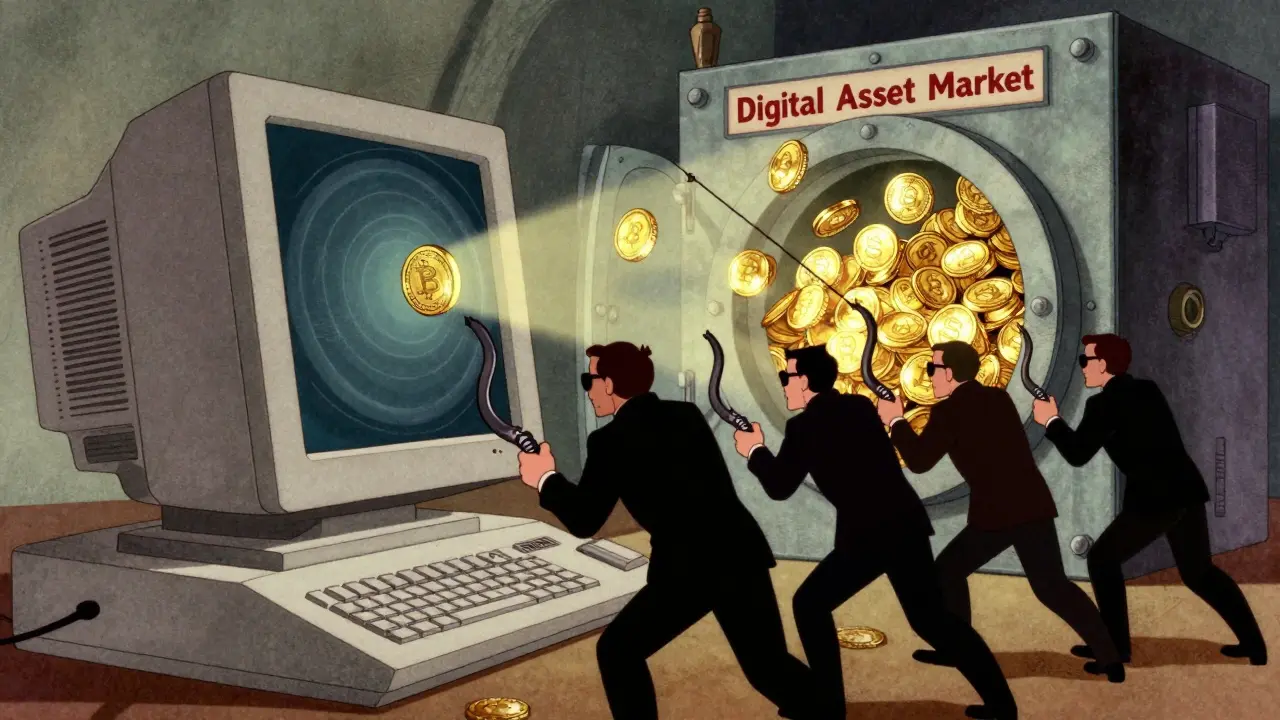
The battle is fought in the same place the thefts occur: the blockchain. While crypto is often touted for its anonymity, it's actually a permanent, public ledger. This transparency is the primary weapon used by international agencies and private firms to identify sanctioned wallet addresses and cut off the regime's funding streams.
The Scale of the Digital Heist
To understand why sanctions are so aggressive, you have to look at the numbers. In 2025 alone, North Korean-linked hacking groups stole over $2.03 billion in cryptocurrency. To put that in perspective, that's nearly triple the $712 million stolen in 2024. When you add it all up, the cumulative value of stolen assets has soared past $6 billion since tracking first began.These aren't just random robberies. We're talking about massive, coordinated strikes. For instance, the February 2025 breach of the Bybit exchange saw a staggering $1.46 billion vanish. Other platforms like LND.fi, WOO X, and Seedify also fell victim to these actors. The money isn't just sitting in a digital vault; reports from the Multilateral Sanctions Monitoring Team (MSMT) indicate that approximately $2.8 billion of these stolen funds were specifically funneled into nuclear arms development.
Who is Tracking the Money?
Tracking these funds requires a mix of government authority and private-sector tech. The Office of Foreign Assets Control (or OFAC), a division of the U.S. Treasury, is the primary entity that designates specific addresses as "sanctioned." Once OFAC puts a wallet on its list, any person or business that interacts with that address risks severe legal penalties.However, OFAC doesn't work in a vacuum. They rely heavily on blockchain analytics firms like Elliptic, a company specializing in tracking illicit crypto flows through transaction pattern recognition and cluster analysis. These firms use a few key techniques to find the bad actors:
- Cluster Analysis: Grouping multiple addresses together based on spending patterns, proving they are controlled by the same entity.
- Heuristic Analysis: Identifying "fingerprints" in how the hackers move money, such as specific amounts or timing.
- Intelligence Sourcing: Combining on-chain data with real-world intelligence from government agencies.
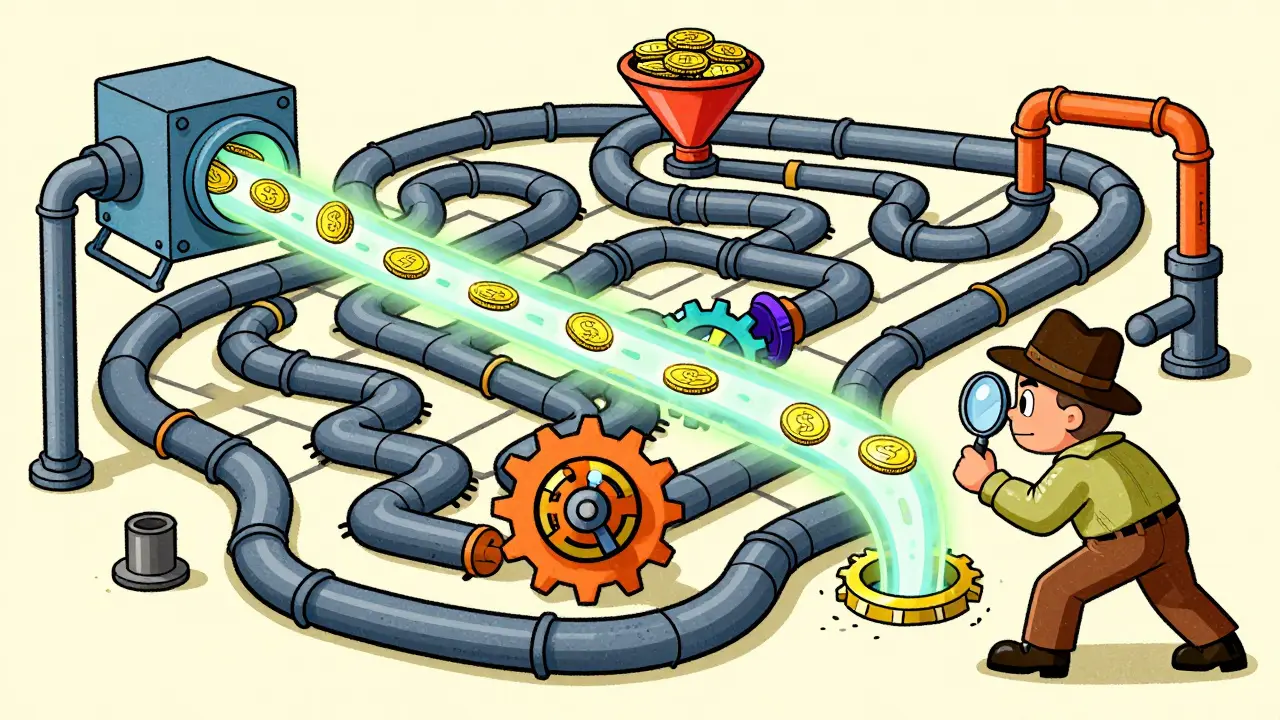
The Laundering Maze: How They Hide
If the blockchain is public, why is it so hard to catch them? Because North Korean actors are masters of obfuscation. They don't just send stolen funds from Point A to Point B. Instead, they use a "laundering maze" to break the trail.First, they often use Mixing Services, which blend illicit funds with clean ones to hide the source. Next, they perform cross-chain swaps-moving assets from Ethereum to Bitcoin or other chains-to confuse trackers. They also lean heavily on privacy coins, which hide the sender and receiver's identities. Finally, they attempt to convert these assets into fiat currency through "over-the-counter" (OTC) brokers who don't ask questions.
| Tracking Method | Laundering Countermeasure | Effectiveness |
|---|---|---|
| Cluster Analysis | Chain Hopping | Moderate (Requires cross-chain tools) |
| Address Screening | Mixing Services | High (If the mixer is sanctioned) |
| Transaction Mapping | Privacy Coins | Low (Unless using specialized analytics) |
The Human Element: Fraudulent IT Workers
It's not all about hacking exchanges. North Korea also runs a massive human-capital scam. The regime deploys IT workers globally who pose as freelancers or employees from other countries. They get hired by American and international companies, but while they're "working," they're actually stealing data and demanding ransoms.In July 2025, the U.S. Treasury targeted individuals and companies like Vitaliy Sergeyevich Andreyev and the Shenyang Geumpungri Network Technology Co., Ltd. These entities weren't necessarily hackers; they were part of the infrastructure that helped the DPRK recruit and manage these fraudulent workers. This "full-spectrum" cyber program is now considered so sophisticated that it rivals the capabilities of major powers like Russia and China.
How to Protect Your Business and Portfolio
For most people, this feels like a geopolitical game, but it has real implications for anyone using crypto. If you accidentally send funds to a sanctioned address, or receive funds that passed through a sanctioned wallet, your own account on a major exchange could be frozen.Here is a practical checklist for businesses and high-volume traders to avoid the "sanction trap":
- Use Real-Time Screening: Don't rely on manual checks. Integrate APIs from blockchain analytics providers that flag high-risk addresses instantly.
- Audit Your Counterparties: If you're doing a large OTC deal, use a tool to trace the origin of the funds. If the coins spent time in a known mixer, walk away.
- Monitor DeFi Bridges: Be cautious with new cross-chain bridges. Since these are prime targets for North Korean theft, they are often the first place sanctioned funds appear.
- Stay Updated on OFAC Lists: The SDN (Specially Designated Nationals) list is updated frequently. Ensure your compliance software is synced in real-time.
What Happens Next?
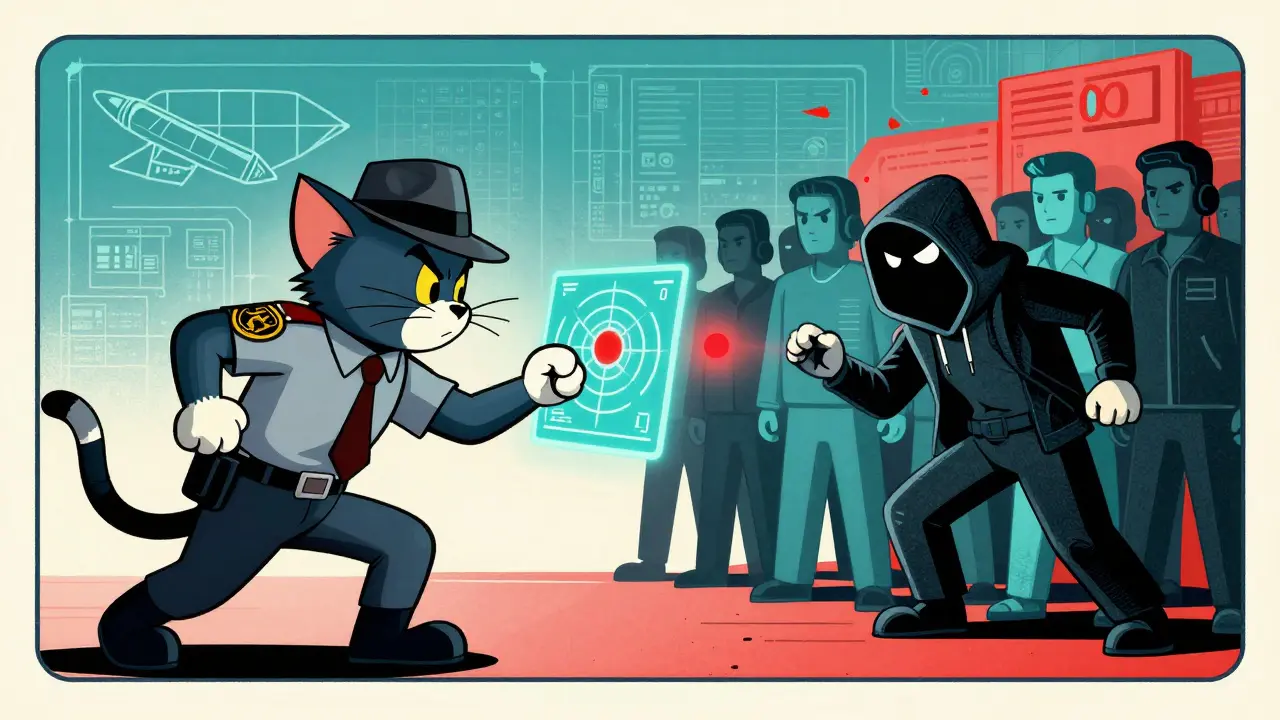
As we move deeper into 2026, the cat-and-mouse game is intensifying. The U.S. Department of State has even offered rewards up to $15 million for information that disrupts these revenue schemes. This shows that the government isn't just playing defense; they are actively trying to flip insiders and disrupt the network from within.We can expect North Korea to move further into Decentralized Finance (or DeFi) protocols. Because DeFi doesn't have a central authority to freeze accounts, it's an attractive playground for laundering. However, as analytics tools get better at mapping the "hops" between different protocols, the walls are closing in. The regime is adaptable, but the transparency of the blockchain is an enemy they can never fully defeat.
What happens if my wallet interacts with a sanctioned North Korean address?
If you send or receive funds from a sanctioned address, your account at a centralized exchange (CEX) will likely be flagged and frozen. In serious cases, you could be investigated for sanctions evasion by agencies like OFAC. It is critical to use screening tools before accepting large transfers from unknown sources.
Can North Korea really fund nuclear weapons with Bitcoin?
Yes. While Bitcoin is volatile, the regime converts stolen crypto into hard currencies (fiat) through a network of brokers and shell companies. This cash is then used to purchase prohibited components and materials on the black market for their weapons programs.
How does the MSMT differ from the UN Panel of Experts?
The Multilateral Sanctions Monitoring Team (MSMT) was established as a coordinated effort among 11 nations, including the U.S., Japan, and South Korea, to maintain sanctions monitoring after the UN Panel of Experts was disbanded. It focuses specifically on reporting and ensuring the effectiveness of UN Security Council Resolutions.
Which cryptocurrency exchanges are most at risk?
Exchanges with weaker KYC (Know Your Customer) and AML (Anti-Money Laundering) protocols are the most vulnerable. However, even large exchanges like Bybit have been targeted through sophisticated technical breaches rather than simple account fraud.
What are "cross-chain swaps" in the context of laundering?
Cross-chain swaps involve exchanging a token on one blockchain (e.g., Ethereum) for a token on another (e.g., Solana). By jumping between different ledgers, hackers attempt to break the linear trail that blockchain analysts follow, making it harder to prove that the final coins came from the original theft.
Eric Raines
April 22, 2026 AT 05:12Everyone keeps acting like this is some big surprise when the public nature of the blockchain basically makes it a giant neon sign for anyone with a basic understanding of graph theory. It is honestly exhausting how many people still think they can hide behind a wallet address without realizing that once you hit a centralized exchange for an off-ramp, you are basically handing over your ID to the government. The whole 'anonymity' argument is just a fairy tale for people who don't actually understand how heuristics and cluster analysis work in the real world.
Yvette P
April 22, 2026 AT 19:48Oh, absolutely, because relying on a few 'cluster analysis' tools is just so foolproof in a world where advanced obfuscation techniques like zero-knowledge proofs and sophisticated coin-mixing protocols are basically the industry standard for anyone with a functioning brain. It is just precious that we think the OFAC list is some kind of impenetrable digital wall when the liquidity in DeFi is fragmented across a dozen different L2s and sidechains, making the actual process of attribution a complete nightmare of cross-chain slippage and liquidity pool gymnastics. I mean, sure, if you're just sending a bunch of ETH to a known mixer, you're practically begging for a freeze, but the real players are using complex atomic swaps and synthetic assets to create a level of noise that makes standard heuristic mapping look like a child's drawing. We are talking about state-level actors who treat the blockchain as a playground for social engineering and algorithmic camouflage, while the 'experts' are still playing catch-up with basic address tagging. It is almost poetic how the transparency of the ledger is touted as a weapon while the actual perpetrators are operating in the shadows of non-custodial bridges that basically act as black holes for attribution. Just imagine the sheer volume of data scrubbing required to actually prove a link between a specific DPRK operative and a final fiat off-ramp in a jurisdiction that doesn't even recognize US sanctions. It is a glorious mess of technical hubris and geopolitical desperation.
Larry Yang
April 24, 2026 AT 01:35imagine thinking the US treasury actually has a handle on this lol. they just ban the most obvious addresses and call it a win while the actual money moves through channels they can't even see.
Jagdish Sutar
April 24, 2026 AT 06:34It is quite eye-opening to see how global this issue has become. We should all be mindful of the tools we use for our transactions to ensure we aren't accidentally supporting these activities.
Kyle Bush
April 24, 2026 AT 08:00USA needs to just nuke their servers and be done with it! 🇺🇸💪 Why are we playing games with these thieves? Just shut the whole thing down! 💥💥
Benjamin Forg
April 25, 2026 AT 14:20the blockchain is just another tool for the surveillance state to track us all while the real money is moved by the elite in ways we can't even imagine
Paige Raulerson
April 27, 2026 AT 03:05This is all so basic. Anyone who actually understands the architecture of a distributed ledger knows that 'transparency' is a relative term.
debashish sahu
April 27, 2026 AT 03:38The impact on global security is quite significant.
Doc Coyle
April 29, 2026 AT 00:24It is simply wrong to use technology for theft. We should all follow the rules regardless of the country.
Findlay Duncan Lyon
April 29, 2026 AT 18:57Spot on analysis.
jill huyo-a
April 30, 2026 AT 07:23I wonder how the apathetic side of the market feels about this, maybe we can find a way to make the screening tools more accessible for everyone.
Ellie Drews
April 30, 2026 AT 13:07It is really scary for new users to think their accounts could be frozen just for interacting with a bad address. Stay safe everyone!
Hannah Rubia
May 1, 2026 AT 16:45The coordination between the MSMT and national agencies is an essential component of maintaining international law in the digital age.
Matthew Morse
May 2, 2026 AT 23:47who actually reads the whole list of sanctioned addresses though
Guy Bianco
May 3, 2026 AT 10:47It is a complex situation, but utilizing the tools mentioned in the checklist is a prudent move for any serious investor. 😊