

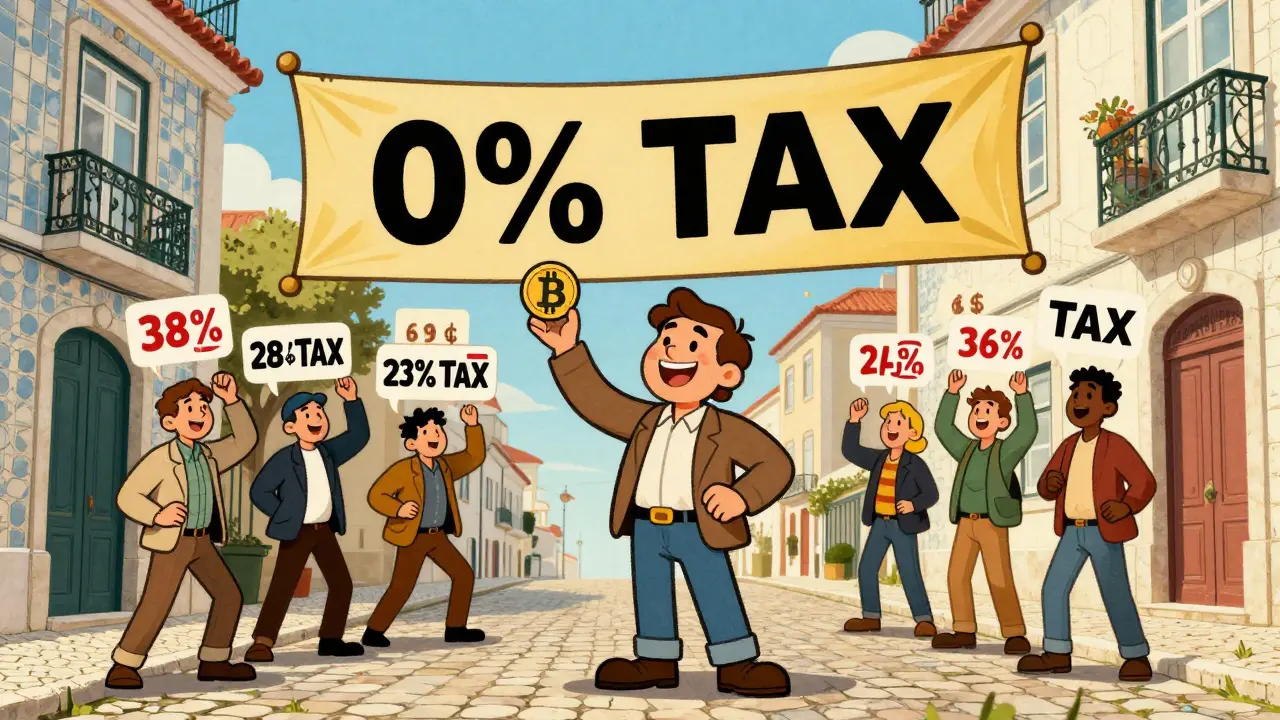
Portugal used to be the go-to country for crypto investors looking to cut their taxes. If you held Bitcoin for over a year, you paid zero capital gains tax. If you earned staking rewards or airdrops, you didn’t owe a cent. And if you moved there under the Non-Habitual Resident (NHR) program, your foreign income - including crypto profits - was completely tax-free. That was the reality until early 2024. Now, things have changed. The old NHR program is gone. And if you’re thinking about relocating to Portugal for crypto tax advantages, you need to know exactly what’s left - and what’s not.
What happened to the NHR program?
The Non-Habitual Resident (NHR) program started in 2009. It was created to lure foreign professionals, retirees, and investors to Portugal after the financial crisis. For ten years, qualifying residents paid a flat 20% tax on Portuguese-sourced income and zero tax on most foreign income. That included dividends, pensions, royalties, and - crucially - cryptocurrency gains from trading or holding assets outside Portugal. The government announced in October 2023 that NHR would close to new applicants. The final deadline to apply was March 31, 2025. After that, no new applications were accepted. If you didn’t submit your paperwork by then, you missed the window. Today, the original NHR program no longer exists. It’s been replaced by the Tax Incentive for Scientific Research and Innovation (IFICI), also called NHR 2.0. The new regime doesn’t offer the same broad benefits. It’s not for digital nomads or full-time traders. It’s for scientists, engineers, doctors, and tech professionals working in approved fields. If your main income comes from trading Ethereum or running a crypto startup without a formal R&D license, you likely won’t qualify. The flat 20% rate still exists under IFICI - but only for qualifying professional income. Foreign-sourced crypto gains? No automatic exemption anymore.Portugal’s current crypto tax rules (2026)
Even without NHR, Portugal still has one of the most straightforward crypto tax systems in Europe. Here’s how it works today:- Long-term holdings (over 365 days): If you buy Bitcoin and hold it for more than a year, you pay 0% tax when you sell - even if you cash out to euros. This rule still applies to everyone, regardless of residency status.
- Short-term holdings (under 365 days): Any profit from selling crypto you held less than a year is taxed at 28% under Category G (capital gains).
- Crypto-to-crypto trades: These are not taxable events in Portugal. You can swap BTC for ETH, then ETH for SOL, and never trigger a tax liability - as long as you don’t convert to fiat.
- Staking, lending, airdrops: These are treated as income and taxed at 28%. The Portuguese tax authority (AT) considers them earnings, not capital gains.
- Gifts and transfers between wallets: No tax if you’re moving crypto from your own wallet to another. Tax only applies when you sell or convert to fiat.
Who still benefits under IFICI?
IFICI is not a replacement for NHR. It’s a completely different program. To qualify, you must:- Work in a field approved by the Portuguese government - like AI, quantum computing, biotech, or renewable energy tech.
- Have a formal employment contract or be self-employed in a qualifying profession.
- Be able to prove your work contributes to scientific or technological innovation.
What about existing NHR holders?
If you got NHR status before March 31, 2025, you’re fine. Your 10-year clock continues ticking. You’ll keep:- 0% tax on foreign-sourced crypto gains
- 20% flat rate on Portuguese income
- No wealth tax
- No dividend tax on foreign income
How to stay compliant
Tax rules are only useful if you follow them. Here’s what you need to do:- Track every transaction. Use crypto tax software like Koinly or CoinLedger. Record timestamps, wallet addresses, and fiat values at time of trade. The tax office can ask for this.
- Don’t assume crypto-to-crypto trades are free. They’re not taxable in Portugal - but if you’re a U.S. citizen, the IRS still taxes them. Double-check your obligations.
- File your annual IRS return. Everyone in Portugal - even non-residents - must declare worldwide income if they’re tax residents. Missing this can trigger penalties.
- Get a NIF (tax ID). You need this to open a bank account, sign a lease, or apply for any tax benefit. Apply through a fiscal representative if you’re not in Portugal yet.

Is Portugal still worth it for crypto investors?
Yes - but only if you adjust your expectations. If you’re a long-term holder who plans to buy Bitcoin now and sell in 2030? Portugal is still one of the best places to do it. The 365-day rule is rock solid. The 28% short-term rate is low compared to Spain (26-45%) or France (30-45%). And you still get EU residency, access to healthcare, and a high quality of life. But if you’re hoping to move in, trade daily, and pay zero tax? That’s over. The days of easy tax avoidance are gone. The government closed the loophole. The real winners now are:- People who got NHR before March 2025
- Long-term crypto holders who hold assets for over a year
- Developers and engineers working in blockchain infrastructure
What’s next? Predictions for 2026
The Portuguese tax authority hasn’t updated IFICI’s crypto rules yet. But signs point to change:- The EU’s MiCA regulations are in full force. All member states must standardize crypto reporting.
- Deloitte Portugal predicts the holding period could stretch from 365 to 730 days by late 2026 to align with EU norms.
- There’s growing pressure to tax staking income differently - possibly as capital gains instead of ordinary income.
- Portugal may introduce a minimum income threshold for IFICI applicants - possibly €70k/year - to filter out low-income applicants.
Can I still get NHR status in Portugal in 2026?
No. The original NHR program closed to new applicants on March 31, 2025. Only those who applied and were approved before that date continue to benefit. No exceptions or extensions are being made.
Do I have to pay tax on crypto gains if I hold for over a year in Portugal?
No. Portugal taxes long-term capital gains (assets held over 365 days) at 0%. This applies to everyone - regardless of residency status - as long as you’re not classified as a professional trader. If you’re just buying and holding, you pay nothing.
Is staking crypto taxable in Portugal?
Yes. Staking rewards, lending interest, and airdrops are treated as income and taxed at 28%. This applies to all residents, including those under IFICI or former NHR holders. The tax is triggered when you receive the reward, not when you sell it.
Can I use crypto-to-crypto trades to avoid tax in Portugal?
Yes - but only if you’re not converting to fiat. Swapping BTC for ETH or ETH for SOL doesn’t trigger tax in Portugal. The tax event only happens when you sell crypto for euros or another fiat currency. This makes portfolio rebalancing very tax-efficient.
Do U.S. citizens still owe taxes on crypto in Portugal?
Yes. Portugal’s tax rules don’t override U.S. tax law. The IRS taxes crypto gains regardless of where you live or how long you hold. Even if you pay 0% in Portugal, you still owe taxes to the IRS. FATCA reporting means your Portuguese bank may share your data with the U.S. government.
What’s the difference between NHR and IFICI?
NHR gave broad tax breaks to almost any foreign resident - including traders and retirees. IFICI is only for people in approved scientific, technological, or highly skilled professions. The flat 20% rate still exists under IFICI, but only for qualifying income. Foreign crypto gains are no longer automatically exempt.
Do I need to live in Portugal full-time to get tax benefits?
Yes. To qualify for any Portuguese tax residency benefit, you must be a tax resident. That means spending at least 183 days per year in Portugal, or having clear ties like property ownership, a local bank account, or family living there. Short visits won’t cut it.
How much does it cost to apply for IFICI or NHR?
Professional fees for applying for IFICI or NHR typically range from €1,200 to €2,500, depending on complexity. This includes help with your NIF, tax filings, and legal representation. DIY applications are risky - mistakes can lead to denial or audits.
Bruce Doucette
March 19, 2026 AT 05:09Marie Vernon
March 21, 2026 AT 00:41Ross McLeod
March 22, 2026 AT 00:18rajan gupta
March 23, 2026 AT 17:19Billy Karna
March 24, 2026 AT 19:30Gene Inoue
March 25, 2026 AT 16:55Ricky Fairlamb
March 26, 2026 AT 00:14Arlene Miles
March 27, 2026 AT 12:19Jessica Beadle
March 28, 2026 AT 12:33Tony Weaver
March 30, 2026 AT 04:24Patty Atima
April 1, 2026 AT 03:19Lucy de Gruchy
April 1, 2026 AT 18:09Lauren J. Walter
April 3, 2026 AT 16:20Carol Lueneburg
April 4, 2026 AT 08:11Brenda White
April 6, 2026 AT 03:49Tobias Wriedt
April 7, 2026 AT 17:31Ernestine La Baronne Orange
April 8, 2026 AT 13:27