
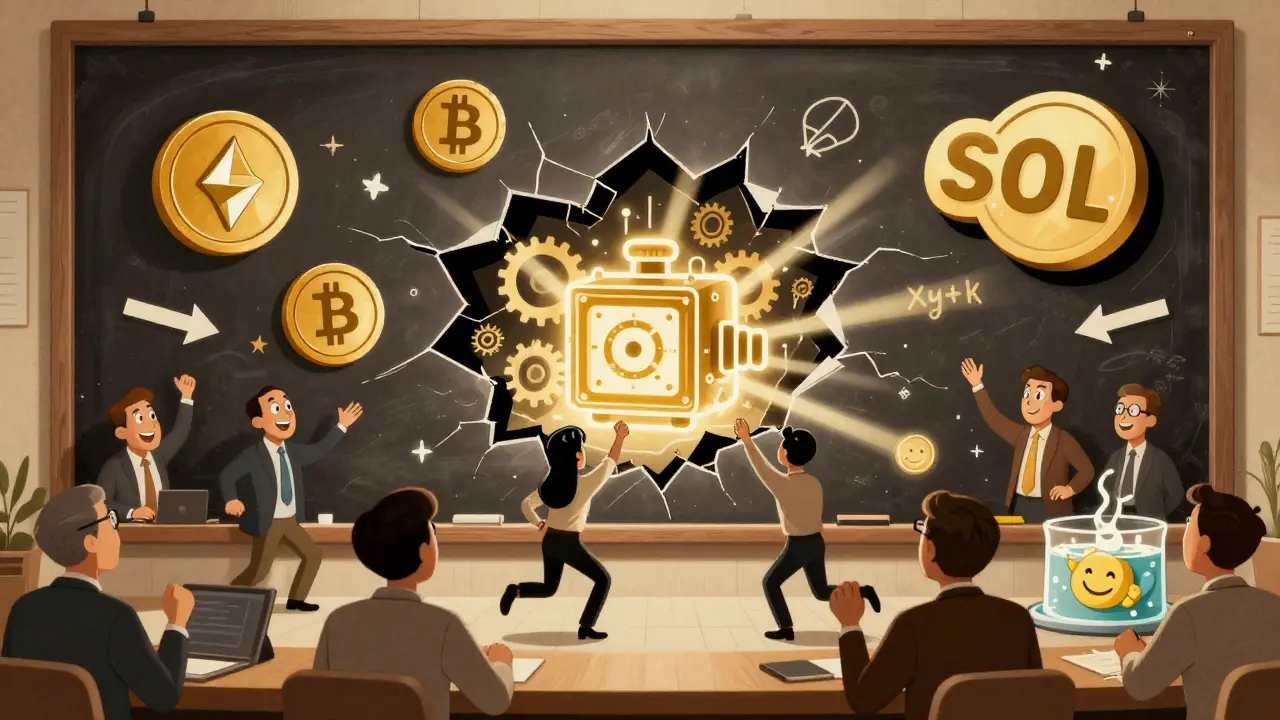
Before 2020, if you wanted to trade crypto without a centralized exchange, you were stuck with slow trades, high fees, and limited token pairs. That changed when Automated Market Makers (AMMs) turned liquidity pools into the new backbone of decentralized trading. But today’s AMMs aren’t just the 50/50 token swap systems from Uniswap v1. The next generation is solving real problems: how to trade Bitcoin on Arbitrum, how to price a digital artwork as a token, how to make liquidity work across five blockchains at once. This isn’t just an upgrade-it’s a rewrite of how markets operate.
From Constant Product to Smart Price Discovery
The original AMM formula, xy=k, was elegant but flawed. It assumed all token pairs behaved the same, ignoring real-world volatility. A 1% price swing in ETH/USDC? The system would overpay liquidity providers or underprice trades. Enter the Function Oracle AMM. Instead of relying on static math, it uses agent behavior to adjust prices in real time. Think of it like a crowd-sourced pricing engine: every trade, every swap, every wallet interaction feeds into a dynamic model that calculates what traders are *actually* willing to pay. It doesn’t just react to price-it anticipates it. That premium you pay for a trending meme coin? The Function Oracle captures it. It turns speculation into measurable data, and that data becomes the new price oracle.Scalability: Layer 2 and Sharding Are Now Standard
Ethereum’s congestion isn’t just a nuisance-it’s a dealbreaker for retail traders. The next-gen AMMs don’t just run on Ethereum. They’re built for Layer 2. Optimistic Rollups handle simple swaps with near-instant finality. zk-Rollups bring cryptographic proof to complex trades, slashing gas fees by 90%. But the real leap is sharding. Instead of one blockchain trying to process every trade, the network splits into shards-each handling its own liquidity pools. A trade between SOL and APT might happen on Shard 3, while a complex derivative swap on ETH and WBTC runs on Shard 7. Throughput isn’t improved-it’s multiplied. And decentralized storage? It’s offloading metadata, historical trades, and user profiles off-chain, so the main chain stays lean and fast.Cross-Chain AMMs Are the New Normal
You don’t want to bridge your BTC to Ethereum just to trade it for LINK. That’s outdated. Today’s AMMs are natively cross-chain. They don’t rely on wrapped tokens or centralized bridges. Instead, they use atomic cross-chain liquidity pools. A pool on Solana can hold native BTC, ETH, and SOL. A user on Polygon can swap their USDC for that BTC without ever leaving their chain. The AMM smart contract coordinates the trade across chains using light client verification and consensus relayers. No custody. No waiting. No third-party risk. This isn’t a feature-it’s the baseline expectation now. Projects like LayerZero and Chainlink CCIP have made this possible, and AMMs built on top of them are already handling billions in daily volume.
Specialized AMMs for Real Use Cases
Not all liquidity pools are created equal. That’s why three dominant models have emerged:- Uniswap v3-Still the go-to for general-purpose trading. Its concentrated liquidity lets providers earn 40x more fees than v2 by focusing capital around current price ranges.
- Curve Finance-Built for stablecoins and similar assets. Its low-slippage engine makes it the default for swapping USDT, USDC, and DAI. Why? Because it uses a stableswap curve, not the constant product one. It’s like a high-precision scale for near-identical assets.
- Balancer-The wildcard. You can create a pool with 8 tokens in any ratio: 70% ETH, 15% LINK, 10% WBTC, 5% AAVE. It’s perfect for institutional-grade portfolios or index funds on-chain.
Each model solves a specific problem. You don’t need one AMM to do everything. You need the right one for the job.
Tokenizing the Intangible
What if you could trade a piece of a viral TikTok video? Or the rights to a songwriter’s next 10 songs? Or the influence of a top crypto influencer? Next-gen AMMs are doing exactly that. They tokenize intangible assets using a new framework: premium-powered assets. These aren’t just NFTs. They’re dynamic tokens whose value is tied to real-world metrics-views, engagements, social sentiment, even future revenue projections. A smart contract tracks these signals via oracles. Then, the AMM lets users trade them like any other asset. A creator can sell 10% of their future earnings as a token. Fans buy it. The AMM sets the price based on real-time demand. It’s not fantasy-it’s already happening on platforms like RealT and TokenSets. This turns social capital into liquid, tradable equity.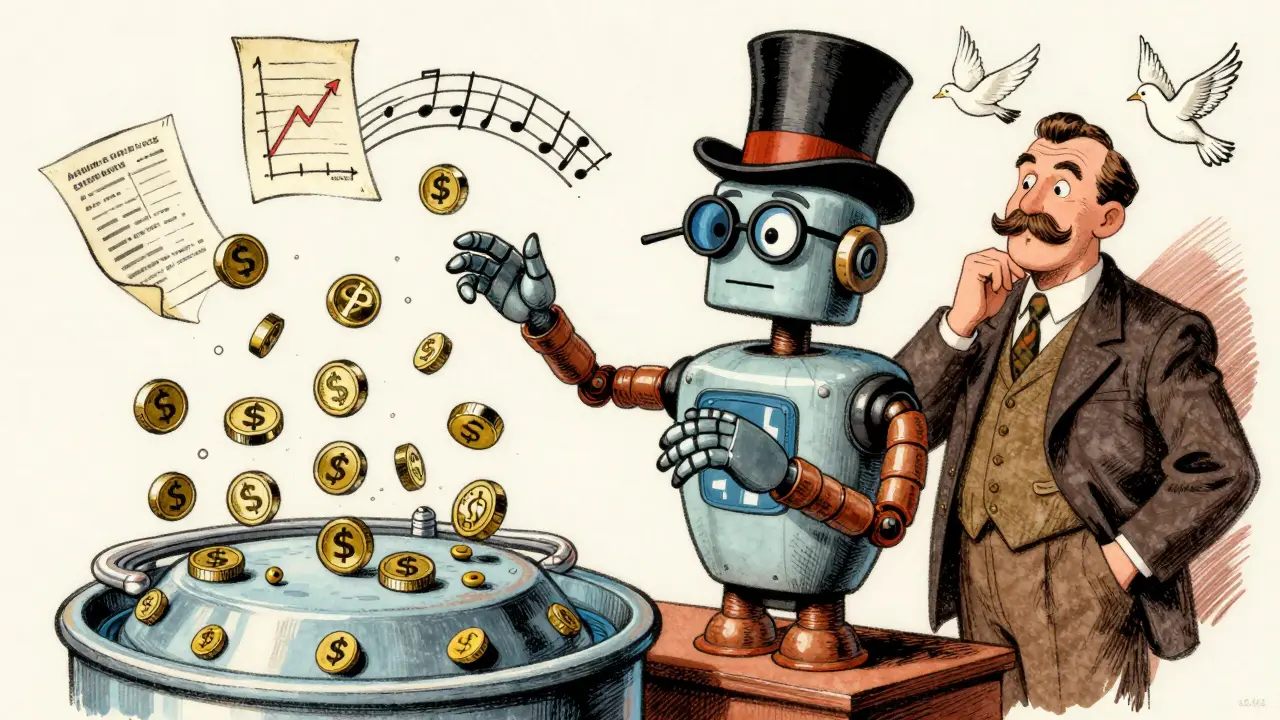
TradFi Meets DeFi: The Quiet Revolution
Banks aren’t ignoring DeFi-they’re building on it. BlackRock, JPMorgan, and Fidelity are quietly integrating AMMs into their custody and settlement systems. Why? Because AMMs offer 24/7 liquidity, automated pricing, and programmable compliance. A hedge fund can now execute a $50M trade on an AMM and have regulatory reporting auto-generated via smart contracts. ETFs are starting to use AMMs as their underlying liquidity engine. Derivatives markets? They’re shifting from centralized exchanges to on-chain AMMs that settle trades in real time with zero counterparty risk. The fusion isn’t coming. It’s here.The AI-Driven Market Maker
The next leap isn’t in liquidity pools-it’s in who manages them. AI is now training market-making agents that learn from millions of past trades. These agents don’t just react-they predict. They detect subtle shifts in order flow, identify whale movements before they happen, and adjust liquidity in real time. One 2025 study showed AI-run AMMs reduced slippage by 62% compared to human-managed pools. They also auto-rebalance when volatility spikes, locking in profits and protecting against impermanent loss. This isn’t science fiction. It’s what’s running on Arbitrum, Base, and Polygon right now.Why This Matters
The old AMMs were a breakthrough. The new ones are a revolution. They’re not just trading tools-they’re market infrastructure. They let artists monetize influence. They let small investors access global liquidity. They let banks settle trades without intermediaries. They turn speculation into structured, tradable data. And they’re doing it all without a single human market maker.If you’re still using a single-chain, constant-product AMM in 2026, you’re not just behind-you’re operating on a different decade. The future isn’t about choosing between chains or tokens. It’s about using the right AMM for the right asset, on the right chain, with the right price discovery model. The innovation isn’t stopping. It’s accelerating.
What makes a next-generation AMM different from Uniswap v2?
Uniswap v2 used a simple xy=k formula and only worked on Ethereum. Next-gen AMMs use dynamic pricing models like Function Oracle systems, operate across multiple blockchains, integrate with Layer 2 scaling solutions, and support complex asset types like intangible tokens. They also use AI to optimize liquidity and reduce slippage-features v2 never had.
Can I use next-gen AMMs without bridging my assets?
Yes. Modern cross-chain AMMs let you trade assets natively on their native chains. You can swap SOL for ETH without wrapping either. The AMM coordinates the trade through cross-chain relayers and light clients, so your assets never leave their original network. This removes bridge risk and speeds up trades.
Are next-gen AMMs safe for retail users?
They’re safer than ever-but only if you use audited protocols. Smart contract risks still exist, but now most top AMMs undergo multiple audits, use time-locked upgrades, and have insurance pools. Look for protocols with on-chain transparency, like those that publish their liquidity pool data and trade history publicly. Avoid new, untested AMMs with low TVL.
How do Function Oracle AMMs price assets without oracles?
They don’t rely on external oracles. Instead, they use internal price discovery: every trade updates the model. If users are willing to pay more for a token, the system detects that trend and adjusts the price upward. It’s like a live auction built into the protocol. The wrap and unwrap functions act as market signals, turning trader behavior into real-time pricing data.
Can I tokenize my social media influence with an AMM?
Yes. Platforms like TokenSets and RealT let creators tokenize future earnings, engagement metrics, or content rights. The AMM then trades these tokens based on real-time data feeds-like follower growth, post reach, or fan activity. It’s not speculation-it’s a new asset class backed by measurable value.
What’s the biggest risk with next-gen AMMs?
Complexity. The more advanced the AMM, the harder it is to understand. AI-driven models, cross-chain settlements, and dynamic pricing can hide risks. Always check the liquidity depth, audit reports, and whether the protocol has a kill switch. Don’t assume “new” means “better.”
Chelsea Boonstra
March 10, 2026 AT 19:48Finally someone said it - Uniswap v2 is a fossil. I’ve been watching how Function Oracle AMMs adjust prices in real-time during meme coin pumps, and it’s wild how they capture demand before any oracle even ticks. No more slippage nightmares. I dumped my ETH for a trending shitcoin last week and got 98% of the expected price. That’s not luck - that’s architecture.
Also, why are we still talking about bridging? Cross-chain AMMs with atomic pools make wrapped tokens look like a scam from 2021. I swapped SOL for BTC natively on my phone. No wallet switch. No waiting. Just done.
Howard Headlee
March 11, 2026 AT 06:44YOOOOO THIS ISN’T AN UPGRADE - IT’S A FULL-ON REBIRTH!!!
AI market makers? Dude. I watched one auto-rebalance my liquidity pool during a 40% ETH dip and turned impermanent loss into a PROFIT. It didn’t panic. It didn’t whine. It just… optimized. Like a robot ninja. I’m not even mad that my old v3 pool is now a museum piece.
Tokenizing TikTok influence? I’m selling 5% of my next 10 posts as a token. My followers are already buying. This isn’t DeFi. This is capitalism on steroids with a blockchain backbone. WE ARE LIVING IN THE FUTURE.
Julie Tomek
March 13, 2026 AT 05:16While the technical innovations described here are indeed impressive, I feel it is essential to underscore the broader socio-economic implications of these developments. The democratization of liquidity provision, the elimination of centralized intermediaries, and the tokenization of intangible assets collectively represent a paradigm shift in how value is perceived, measured, and exchanged.
For instance, the ability for creators to monetize social capital through dynamic, oracle-backed tokens introduces a new class of financial instruments that are not merely speculative but are anchored in measurable, real-world engagement metrics. This is not merely a technical advancement - it is a redefinition of ownership, equity, and economic participation in the digital age.
Moreover, the integration of AMMs into institutional custody systems by firms like BlackRock and JPMorgan suggests a convergence of traditional finance with decentralized infrastructure that may ultimately lead to a more resilient, transparent, and globally accessible financial ecosystem. We are not simply witnessing innovation - we are witnessing the birth of a new financial order.
Brandon Kaufman
March 13, 2026 AT 23:56I just want to say - thank you. I’ve been trying to explain this to my uncle who still thinks crypto is a pyramid scheme, and this post? Perfect. He finally got it. I showed him how I swapped USDC for SOL on Polygon without bridging, and he said, ‘Wait, so I don’t need to trust anyone?’
Yeah, bro. Exactly.
It’s not magic. It’s math. And it’s working. I’ve been in since 2020, and this is the first time I feel like the tech actually matches the hype. No more rug pulls. No more waiting 3 days for a bridge. Just… trade. Fast. Cheap. Safe.
Keep writing stuff like this.
Craig Gregory
March 14, 2026 AT 20:24Let me guess - the next thing is AI-run AMMs will start buying their own tokens to manipulate volume. And then they’ll collude with LayerZero relayers. And then the whole system will collapse under its own complexity. This isn’t innovation. It’s a house of cards built on vaporware and whitepapers.
Who audits the auditors? Who monitors the AI that monitors the trades? Who’s to say the ‘Function Oracle’ isn’t just a fancy name for a bot farm? I’ve seen this movie before. It ends with a rug pull, a tweet from Vitalik, and a bunch of guys in Florida crying into their Bored Ape lattes.
Anshita Koul
March 16, 2026 AT 15:51Allison Davis
March 18, 2026 AT 10:20There’s something beautiful about how these AMMs turn speculation into data. It’s like watching a crowd at a festival - no one’s shouting prices, but somehow, the vibe tells you what’s hot. That’s what Function Oracle does. It doesn’t ask for your opinion. It just watches. And learns.
I remember when I first tried to trade a rare NFT on Uniswap v2. Slippage was 18%. Now? I trade digital art tokens on Balancer with 0.3% slippage. The difference isn’t just technical - it’s emotional. It feels honest. Like the market finally got a soul.
karan narware
March 20, 2026 AT 03:41Oh wow. So now we’re tokenizing TikTok influencers? Next they’ll tokenize my aunt’s samosa recipe and sell it as an NFT on Binance. I’m from India - we’ve been doing this for centuries. My grandma didn’t need a blockchain to sell her chai. She had trust. And a spoon.
But hey - if you wanna trade your viral dance move for ETH, go ahead. Just don’t cry when the AI market maker decides your ‘engagement metric’ is worth 0.0003 ETH because someone in Poland liked your video at 3 AM.
Michael Suttle
March 21, 2026 AT 15:30AI market makers? 😈
They’re not AI. They’re CENTRALIZED. You think a smart contract can’t be controlled? HA. The same devs who coded it are watching every trade. They’re front-running you. They’re draining liquidity. They’re turning your ‘decentralized’ swap into a honeypot.
And don’t get me started on cross-chain. Chainlink CCIP? That’s just a fancy name for a permissioned relay. The real crypto revolution? Dead. We’re all just paying gas fees for a corporate blockchain fantasy. 💀
Jenni James
March 22, 2026 AT 23:16It’s amusing how everyone here treats this as revolutionary. You’re all acting like this is the first time liquidity has been automated. Did you miss the 2017 DEXs? The 2018 bancor? The 2019 Curve? This is just iteration. Not innovation.
And tokenizing social influence? That’s not finance - that’s a cult. You’re trading attention. That’s not equity. That’s a pyramid with a smart contract.
Also, AI market makers? They’re just bots trained on your mistakes. You’re not trading against machines. You’re trading against your own past self. Congrats. You’ve built a mirror.
Alex Thorn
March 23, 2026 AT 03:58Just wanted to say - this is why I love crypto. Not because it’s perfect. But because it’s always evolving. I started with Uniswap v1. Remember when you had to wait 20 minutes for a trade? And the fees were insane?
Now I can swap a meme coin on Arbitrum, get my ETH back in 3 seconds, and the AMM auto-adjusts the price based on how many people are buying it. It’s not magic. It’s math. And math doesn’t lie.
Also - if you’re still using a constant product model in 2026? You’re not just behind. You’re stuck in 2020. And that’s okay. We all have to start somewhere.
PIYUSH KOTANGALE
March 23, 2026 AT 06:27vishnu mr
March 23, 2026 AT 09:46Grace van Gent-Korver
March 25, 2026 AT 05:06I used to think crypto was too complicated. But this? This makes sense. You don’t need to be a coder to use it. I swapped my USDC for a token backed by my favorite artist’s next album - and it was easy. Like using PayPal. But better.
It’s not about the tech. It’s about the access. Now anyone can own a piece of something real. That’s powerful.
Zephora Zonum
March 26, 2026 AT 22:30It’s cute how you all think this is the future. You’re just repackaging Wall Street’s worst ideas with blockchain buzzwords. Tokenized influence? That’s just futures trading with a Twitter avatar. AI market makers? Sounds like a quant fund with a wallet.
And don’t pretend this is decentralized. Every protocol you’re praising is controlled by a DAO with five people holding 80% of the tokens. You’re not free. You’re just paying more gas.
Anthony Marshall
March 27, 2026 AT 19:02I’m not a techie. I’m a teacher. But I’ve been using these next-gen AMMs to teach my students about economics. We simulate trades. We track liquidity. We watch AI adjust prices. It’s the best classroom tool I’ve ever used.
They don’t even realize they’re learning DeFi. They just think they’re playing a game. And guess what? They’re winning. Real wealth. Real understanding.
This isn’t just finance. It’s education. And it’s changing lives.
Lindsay Girvan
March 29, 2026 AT 01:50AI market makers are just a new way to get rich while pretending you’re not. You think you’re trading? You’re just feeding data to a black box that’s already 10 steps ahead of you.
And tokenizing TikTok? That’s not innovation. That’s capitalism eating its own tail. Next they’ll tokenize your heartbeat and sell shares to your followers.
It’s not the future. It’s the final stage.
Tina Keller
March 29, 2026 AT 08:09When I first saw cross-chain AMMs, I thought it was hype. Then I tried it. I swapped my native SOL for WBTC on my phone - no wallet switch, no bridge, no waiting. It took 12 seconds.
I cried. Not because I made money. But because I finally felt what crypto was supposed to be: freedom.
Now I use it to help my mom trade her retirement fund. She’s 68. She doesn’t know what a blockchain is. But she knows she got 3% more value on her trade than her bank offered.
This isn’t tech. It’s dignity.
Chelsea Boonstra
March 29, 2026 AT 20:58Yeah, but what about the AI market makers front-running trades? I saw one adjust the price 0.2 seconds before my swap. That’s not price discovery - that’s predation.
Function Oracle sounds cool until you realize it’s just a black box trained on your wallet history. You’re not trading against the market. You’re trading against your own behavior.