

You hold Bitcoin or Ethereum, and you want to move it to an exchange in Singapore or the US. It sounds simple enough-just click 'withdraw' and enter the address. But if you are an Indian resident, that click triggers a complex web of legal checks, tax liabilities, and banking regulations that can freeze your assets overnight.
As of mid-2026, moving Virtual Digital Assets (VDAs) abroad from India is not just a technical task; it is a regulatory minefield. The government treats these assets as taxable property, not currency, and has tightened the screws on cross-border flows significantly since early 2025. One wrong move regarding documentation or tax disclosure can lead to frozen bank accounts, heavy penalties, or even criminal prosecution under anti-money laundering laws.
The Current Legal Status of Crypto in India
First, let’s clear up the confusion about legality. Cryptocurrencies are legal to own and trade in India. They are not banned. However, they are not recognized as legal tender either. You cannot use Bitcoin to pay for groceries, nor does the Reserve Bank of India (RBI) back its value.
The current framework classifies these assets as Virtual Digital Assets (VDAs). This classification matters because it dictates how you report them. Under the Income Tax Act, VDAs are treated as assets for capital gains purposes. This means every time you sell, swap, or transfer crypto across borders, you are potentially triggering a taxable event. The regulatory oversight is shared among multiple agencies: the Ministry of Finance handles taxation, the RBI monitors financial stability, and the Securities Exchange Board of India (SEBI) watches over securities-like tokens.
This multi-agency approach creates a unique challenge. Unlike traditional stock transfers, there is no single "crypto regulator" to call with questions. Instead, you must comply with overlapping rules from tax authorities, banking regulators, and foreign exchange controllers simultaneously.
FEMA Regulations and Cross-Border Transfers
If you are moving money out of India, the Foreign Exchange Management Act (FEMA) is your primary hurdle. FEMA governs all external commercial transactions. For years, the status of crypto under FEMA was ambiguous. That ambiguity ended in June 2025.
The Finance Ministry issued Notification No. 56/2025, which explicitly classified VDAs as 'intangible movable property.' This classification brings crypto transfers under the purview of current account transactions. Here is what this means for you:
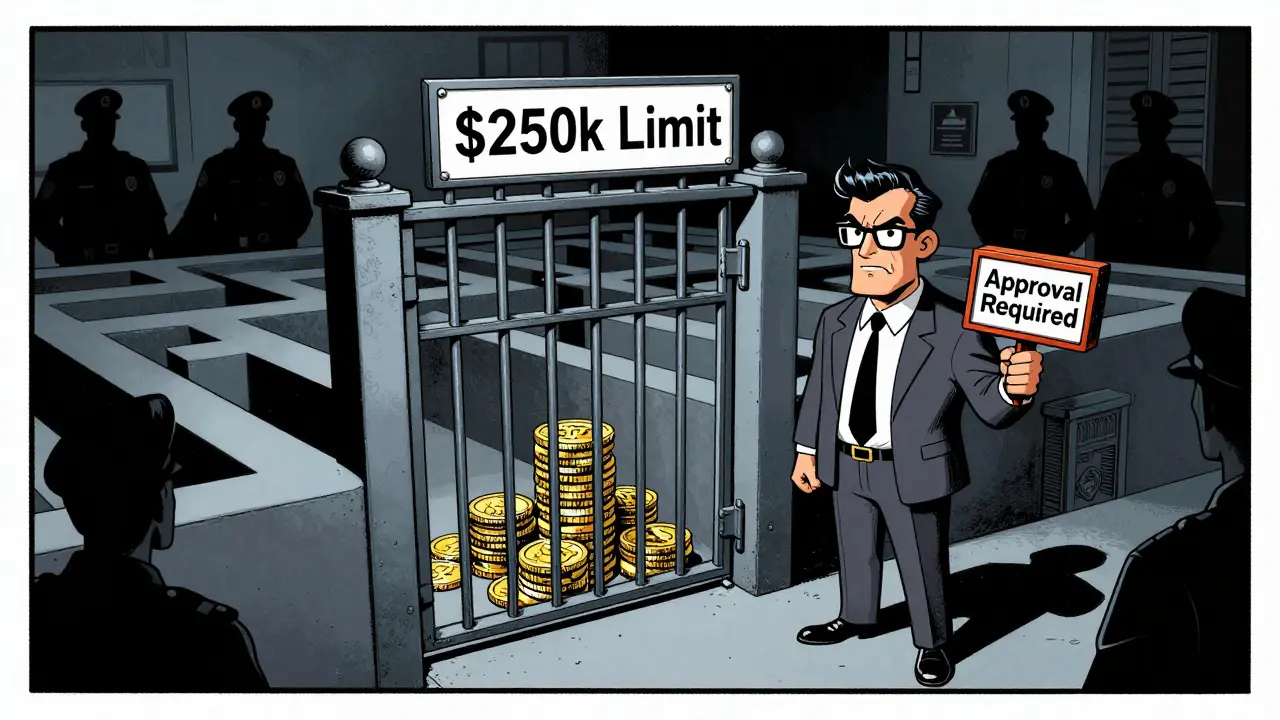
- Threshold Limits: If you plan to transfer more than $250,000 worth of crypto annually, you must obtain prior approval from your Authorized Dealer Bank (your domestic bank). Without this approval, the transaction is illegal.
- Reporting Requirements: All cross-border transactions must be reported. Your domestic exchange is required to share details with the Financial Intelligence Unit-India (FIU-IND).
- Banking Channel Restrictions: While direct P2P transfers via blockchain bypass banks initially, the fiat entry and exit points are strictly monitored. Banks are instructed to flag any suspicious crypto-related activity.
Many users assume that because blockchain is decentralized, FEMA doesn't apply. This is a dangerous misconception. The moment you convert INR to crypto or vice versa through a regulated entity in India, you are subject to FEMA rules. Even if you hold stablecoins, the underlying value movement is tracked.
The FATF Travel Rule: No More Anonymous Transfers
Gone are the days when you could send crypto anonymously across borders. India implemented the Financial Action Task Force (FATF) Travel Rule with zero minimum threshold. This is stricter than most other jurisdictions, which often exempt small transactions.
Under this rule, every crypto service provider (CSP) in India-including exchanges like WazirX, CoinDCX, or international platforms registered with FIU-IND-must collect and transmit specific data for every cross-border transfer. This includes:
- Your full legal name
- Your account number or wallet ID
- Your physical address or date of birth
- Your national identification number (like PAN or Aadhaar)
This information is sent to the receiving institution abroad. If the receiving exchange in Singapore or the US cannot verify this data against their own KYC records, they will reject the transfer. In many cases, Indian exchanges have started freezing outgoing requests until they receive confirmation that the recipient's identity has been verified by the foreign counterpart.
This process adds significant friction. Transactions that used to take minutes can now take days due to manual verification checks. According to user surveys from mid-2025, nearly 70% of Indian users experienced delays exceeding seven business days when attempting cross-border transfers due to these compliance checks.
Tax Implications: The Heavy Cost of Moving Assets
Perhaps the biggest deterrent to moving crypto abroad is the tax burden. India’s tax regime for VDAs is among the strictest globally. When you move assets abroad, you may trigger capital gains tax depending on how the transfer is structured.
Here is the breakdown of costs you need to factor in:
| Tax Component | Rate / Requirement | Notes |
|---|---|---|
| Capital Gains Tax | 30% | Flat rate on profits. No indexation benefit. Losses cannot be offset against gains. |
| TDS (Tax Deducted at Source) | 1% | Deducted on every transaction above ₹50,000 per year. Applies to sales and certain transfers. |
| GST (Goods and Services Tax) | 18% | Applied on trading fees and services provided by exchanges. |
| Penalty for Non-Disclosure | 60% | Under Section 158B, undisclosed VDAs held abroad attract a massive penalty plus potential jail time. |
Note that the 30% capital gains tax applies to the profit made. If you bought Bitcoin at ₹10 lakh and sold it for ₹15 lakh, you pay 30% on the ₹5 lakh gain. You cannot claim losses from other crypto trades to reduce this bill. Furthermore, the 1% TDS is deducted at the source, meaning less liquidity is available for your transfer.
Crucially, the Central Board of Direct Taxes (CBDT) clarified in Circular No. 18/2025 that when transferring crypto abroad, you must value the asset in Indian Rupees at the exact time of transfer using the RBI-published exchange rate. This prevents arbitrage opportunities where users might try to undervalue assets to lower tax bills.
Compliance Checklist Before You Transfer
To avoid having your funds frozen or facing legal action, follow this checklist before initiating any cross-border crypto transfer:
- Link PAN and Aadhaar: Ensure your Permanent Account Number (PAN) and Aadhaar card are linked to your bank account and all exchange accounts. Unlinked accounts face immediate suspension.
- Verify Exchange Registration: Only use exchanges registered with the Financial Intelligence Unit-India (FIU-IND). Many offshore platforms like Binance and KuCoin faced enforcement notices in 2025. Using non-compliant platforms risks permanent loss of access to your funds.
- Document Transaction Purpose: Keep detailed records of why you are moving the assets. Is it for investment? Personal use? Be prepared to provide this documentation to your bank if queried.
- Calculate Tax Liability: Determine if the transfer constitutes a sale. If so, set aside 30% + 1% + GST for taxes. Paying advance tax may be necessary to avoid interest charges.
- Check FEMA Limits: If the amount exceeds $250,000 USD equivalent, get written approval from your bank before proceeding.
- Disclose in ITR: You must disclose all foreign crypto holdings in Schedule VDA of your Income Tax Return (ITR-2 or ITR-3). Failure to do so invites a 60% penalty under Section 158B.

Enforcement Actions and Real-World Risks
Theoretical rules become real problems when enforcement kicks in. In 2025, the Enforcement Directorate (ED) issued notices to 25 offshore crypto platforms, demanding they comply with Indian KYC norms. Platforms that failed to cooperate faced IP blocking within India.
Users have reported instances where their domestic exchange accounts were frozen pending FEMA compliance documents. For example, a user attempting to move 2 BTC to a US-based exchange received a warning from their Indian exchange that failure to produce bank certification within 72 hours would result in account closure. These timelines are tight and often unrealistic for individuals without professional legal support.
Additionally, the Indian Computer Emergency Response Team (CERT-In) mandated cybersecurity audits for all digital asset exchanges in May 2025. While this improves security, it also means exchanges are more cautious about approving unusual large withdrawals to prevent fraud accusations.
Future Outlook: What to Expect in Late 2026
The regulatory landscape is still evolving. India is preparing for a Financial Stability Board (FSB) peer review in late 2025 and early 2026, which pushes for greater alignment with global standards like the Crypto-Asset Reporting Framework (CARF). This means automatic exchange of tax information between India and other countries will likely expand.
If you are considering moving assets abroad, expect tighter scrutiny rather than relaxation. The government’s stance remains clear: crypto is not currency, and it will be taxed heavily to discourage speculative hoarding. Peer-to-peer (P2P) channels are seeing increased usage, but these carry higher risks of fraud and lack the protection of regulated exchanges.
For now, the safest path is transparency. Comply with every reporting requirement, pay your taxes upfront, and keep meticulous records. The cost of non-compliance far outweighs the hassle of paperwork.
Is it illegal to move crypto abroad from India?
No, it is not illegal to move crypto abroad from India, provided you comply with FEMA regulations, pay applicable taxes, and use FIU-IND registered exchanges. However, transfers exceeding $250,000 require prior bank approval, and all transactions must be reported to tax authorities.
What is the tax rate on crypto transfers in India?
India imposes a flat 30% capital gains tax on crypto profits, plus a 1% TDS on transactions above ₹50,000. Additionally, an 18% GST applies to exchange fees. There is no provision to offset losses against gains.
Do I need to declare foreign crypto holdings in my ITR?
Yes, you must declare all Virtual Digital Assets (VDAs) held abroad in Schedule VDA of your Income Tax Return (ITR-2 or ITR-3). Failure to disclose attracts a 60% penalty under Section 158B and potential criminal prosecution.
Can I use Binance or KuCoin for cross-border transfers from India?
Using offshore exchanges like Binance or KuCoin carries significant risk. The Enforcement Directorate has issued compliance notices to these platforms. If they are blocked in India, you may lose access to your funds. It is safer to use FIU-IND registered domestic exchanges or ensure the offshore platform fully complies with Indian KYC norms.
What is the FATF Travel Rule impact on crypto transfers?
The FATF Travel Rule requires Indian crypto exchanges to share sender and receiver details (name, address, ID) for every cross-border transaction, regardless of amount. This eliminates anonymity and can cause delays if the receiving exchange cannot verify the recipient's identity quickly.