Kraken Jurisdiction Checker
Check Your Trading Status
Select your country or U.S. state to see Kraken restrictions
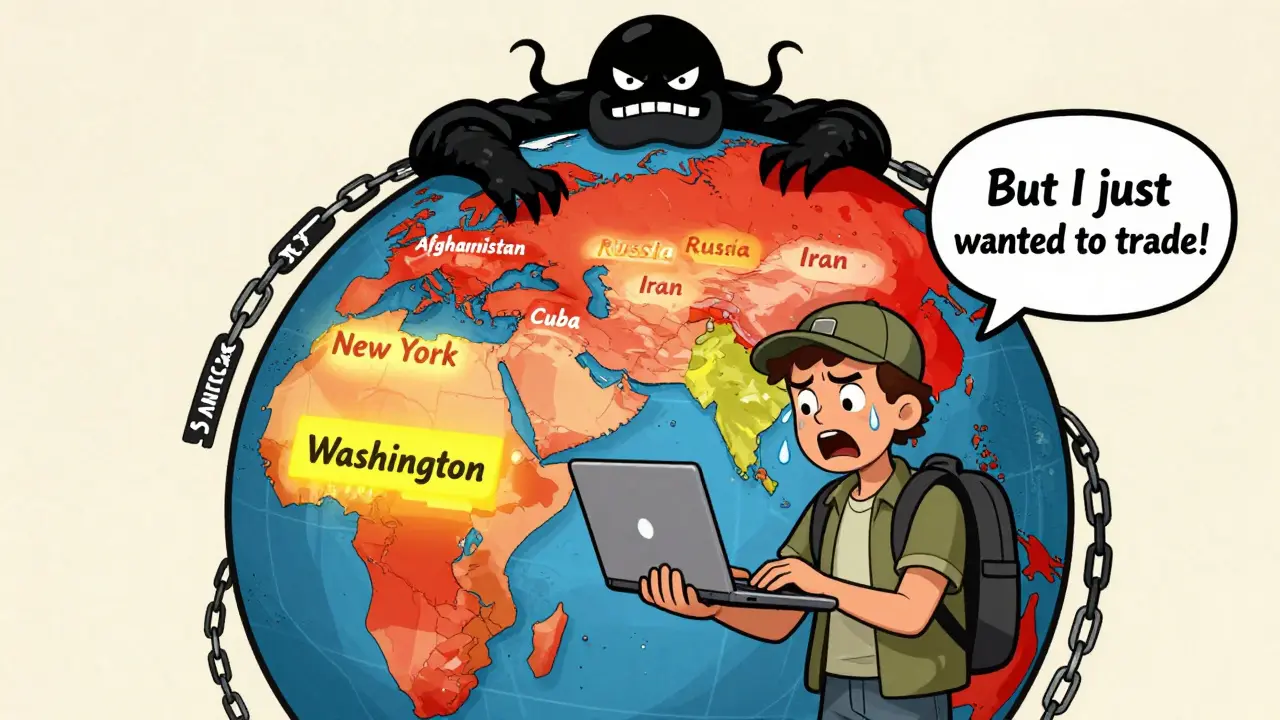
If you’re trying to trade crypto on Kraken and got blocked, you’re not alone. Thousands of users hit walls every week-not because of account issues, but because of where they live. As of 2025, Kraken enforces some of the most detailed geographic restrictions in the crypto industry. It’s not about trust or security alone. It’s about legal compliance. And if you’re in one of the restricted zones, you won’t be able to trade, deposit, or even hold certain assets-no matter how hard you try.
Which Countries Are Fully Blocked by Kraken?
Kraken doesn’t operate in 14 countries where international sanctions are in full force. These include:
- Afghanistan
- Belarus
- Russia (including Crimea, Donetsk, and Luhansk)
- Iran
- Iraq
- North Korea
- Syria
- Libya
- Sudan
- South Sudan
- Democratic Republic of the Congo
- Cuba
That’s not all. Additional countries face partial or full service blocks, including Central African Republic, Eritrea, Lebanon, Mali, Somalia, Tajikistan, Yemen, and several others in Africa and the Middle East. These restrictions aren’t random. They follow sanctions lists from the U.S. Treasury, the UN, and the EU. If a country is under U.S. or international sanctions, Kraken shuts down access entirely.
Trying to bypass these blocks with a VPN? Don’t. Kraken uses advanced IP tracking, device fingerprinting, and transaction monitoring. If you’re caught spoofing your location, your account gets frozen-and you could lose access to your funds permanently.
U.S. Residents: It’s Not Just a Country, It’s a State-by-State Maze
If you’re in the U.S., you’re not just dealing with federal rules. You’re dealing with 50 different state regulations. Kraken treats each state like its own country.
Here’s what you can’t do as a U.S. resident:
- No XRP trading-anywhere in the U.S. This has been true since the SEC’s 2020 lawsuit against Ripple. Kraken removed XRP from all U.S. trading pairs and still hasn’t restored it.
- New York and Washington State-residents can’t trade at all unless they go through pre-verification. Even then, access is limited and subject to regulatory approval.
- New Hampshire and Texas-you can’t fund, trade, or hold EUR (Euro) on Kraken. This is because of how these states classify foreign currency trading under their money transmission laws.
- Trading limits-U.S. users can only hold margin positions for 28 days. In Europe or Asia, you can hold them for up to a year.
- Token bans-EWT, GRT, and FLOW tokens are blocked for U.S. and Canadian users. ETH2.S can only be staked, not traded directly.
Why such strict rules? Because U.S. regulators like the SEC and CFTC treat crypto like securities or commodities-and they’re watching every move. Kraken chose to lock down U.S. access rather than risk another $100 million fine, which it paid in 2022 for sanctions violations.
Australia, Canada, and Japan: Hidden Restrictions You Might Not Know
Even in countries where Kraken is fully licensed, there are sneaky limits.
Australian users can’t trade or hold privacy coins. That means no Monero (XMR), no Zcash (ZEC), and no Dash. These coins are banned because AUSTRAC-Australia’s financial intelligence unit-considers them high-risk for money laundering. Kraken complies fully, even though these coins are legal elsewhere.
Canadian users face the same token bans as Americans: no FLOW, no EWT, no GRT. They also can’t use margin trading beyond 28 days. But unlike the U.S., Canadians can trade most major coins like BTC and ETH without issue.
Japanese residents must jump through extra hoops. Kraken requires additional ID verification for JPY deposits. And because Japan’s Financial Services Agency (FSA) has strict rules on stablecoins, Japanese users can’t trade certain tokens that are available elsewhere.

Europe’s Big Shake-Up: Stablecoin Delisting in 2025
One of the biggest changes in 2025 happened in Europe. Kraken removed five major stablecoins from its platform under the new MiCA (Markets in Crypto-Assets) regulation.
The delisted stablecoins:
- Tether (USDT)
- PayPal USD (PYUSD)
- TrueUSD (TUSD)
- Tether EURt (EURt)
- TerraClassic USD (LUNC)
The timeline was brutal:
- February 13, 2025: Reduce-only mode (you could only sell, not buy)
- February 27, 2025: Sell-only mode (no new positions)
- March 17, 2025: Margin positions closed
- March 24, 2025: Spot trading ended
- March 31, 2025: Final conversion to other assets
This wasn’t a surprise to regulators-but it shocked users. USDT is the most traded stablecoin in the world. Kraken’s decision forced thousands of European traders to move their holdings to other platforms. Mark Greenberg, Kraken’s Global Head of Asset Management, admitted this was a "necessary step to maintain regulatory standing," even though he previously said Kraken had no plans to delist USDT.
Over 30 European countries were affected, including Austria, Spain, Sweden, Portugal, and the Czech Republic. The move shows how MiCA is reshaping the crypto landscape-not by banning crypto, but by forcing exchanges to choose between compliance and convenience.
Why Kraken Blocks So Much-And Why It’s Still Trusted
You might wonder: Why not just let people trade? Why block entire countries?
The answer is simple: Kraken needs to keep its licenses. It’s one of the few crypto exchanges with a U.S. banking charter (a Special Purpose Depository Institution license from Wyoming). It’s also regulated by the FCA in the UK, AUSTRAC in Australia, and FINTRAC in Canada. Lose one license, and the whole operation collapses.
It’s not just about avoiding fines. It’s about institutional trust. Hedge funds, pension funds, and even banks use Kraken for crypto exposure. They won’t touch an exchange that’s been fined by the Treasury or sued by the SEC. Kraken’s restrictions are a trade-off: fewer users, but more credibility.
In 2023, the SEC sued Kraken for operating as an unregistered exchange. The case was dropped-but the damage was done. Since then, Kraken has gone even further to prove it’s compliant. That’s why you see these restrictions now. It’s not about control. It’s about survival.

What Happens If You’re Blocked?
If you’re blocked, Kraken won’t give you a workaround. No exceptions. No appeals. Your account will show a message like: "Service unavailable in your jurisdiction."
You can still withdraw your funds, but you can’t deposit, trade, or stake. Kraken doesn’t lock your assets-you just can’t use the platform anymore.
If you’re in a restricted state like New York or Washington, you can apply for pre-verification. But approval isn’t guaranteed. It can take months. And even then, your access might be limited to only a few assets.
Don’t try to trick the system. Kraken’s detection tools are built by former intelligence analysts. They track browser fingerprints, device IDs, and even typing patterns. A VPN might work for a day-but not for long.
What’s Next for Kraken’s Restrictions?
Expect more changes in 2025 and 2026. Here’s what’s coming:
- Possible restoration of XRP trading in the U.S. if the SEC drops its case against Ripple permanently.
- Expansion into New York and Washington State-if regulators give the green light.
- More stablecoin delistings in Europe as MiCA rules tighten.
- Possible expansion of staking options for ETH2.S and other tokens if SEC guidance becomes clearer.
One thing’s certain: Kraken won’t relax restrictions anytime soon. The global trend is toward stricter regulation, not less. Exchanges that play it safe are the ones that survive.
If you’re outside the U.S. and Europe, your access might be smoother. But if you’re in a sanctioned country or a U.S. state with tight rules, Kraken isn’t the platform for you. There are alternatives-but they come with higher risk. And in crypto, risk isn’t just financial. It’s legal too.
Can I still use Kraken if I travel to a blocked country?
No. Kraken checks your location in real time based on your IP address and device data. Even if you’re just visiting, your account will be restricted. You can still withdraw funds, but you won’t be able to trade or deposit while in a blocked jurisdiction.
Why can’t I trade XRP on Kraken in the U.S.?
Because the SEC sued Ripple Labs in 2020, claiming XRP is an unregistered security. Kraken removed XRP from U.S. trading pairs to avoid legal risk. Even though the case is still ongoing, Kraken has not restored trading for U.S. users. This is a legal precaution, not a technical issue.
Are privacy coins like Monero banned everywhere on Kraken?
No. Only users in Australia, the U.S., and Canada are blocked from trading privacy coins like Monero, Zcash, and Dash. In most other countries, you can still buy and hold them. The ban is based on local financial regulations, not Kraken’s own policy.
Can I use Kraken if I’m a U.S. citizen living abroad?
Yes-if you can prove you’re a resident of a permitted country. Kraken requires proof of address and government-issued ID. If you’re a U.S. citizen but live in Germany or Singapore and can verify your residency, you can trade normally. But if you’re just traveling, you’re still treated as a U.S. user.
What happens to my funds if Kraken blocks my country?
You can still withdraw your crypto or fiat to an external wallet or bank account. Kraken doesn’t seize your assets. But you won’t be able to trade, deposit, or stake until you move to a permitted jurisdiction. If you don’t withdraw, your funds stay locked in your account indefinitely.
Josh Rivera
December 8, 2025 AT 14:17Neal Schechter
December 10, 2025 AT 07:11Madison Agado
December 11, 2025 AT 03:51Tisha Berg
December 13, 2025 AT 01:50Billye Nipper
December 13, 2025 AT 15:12Roseline Stephen
December 15, 2025 AT 04:35Isha Kaur
December 16, 2025 AT 04:09Tara Marshall
December 16, 2025 AT 08:29Nelson Issangya
December 17, 2025 AT 14:53Richard T
December 17, 2025 AT 22:00jonathan dunlow
December 17, 2025 AT 22:25rita linda
December 18, 2025 AT 08:56Frank Cronin
December 18, 2025 AT 22:28miriam gionfriddo
December 19, 2025 AT 16:06Nicole Parker
December 21, 2025 AT 09:01Kenneth Ljungström
December 21, 2025 AT 17:44Chris Jenny
December 22, 2025 AT 12:12Annette LeRoux
December 23, 2025 AT 01:50Jerry Perisho
December 24, 2025 AT 09:13Manish Yadav
December 25, 2025 AT 10:16Vincent Cameron
December 25, 2025 AT 22:42Krista Hewes
December 27, 2025 AT 20:14Mairead Stiùbhart
December 28, 2025 AT 03:28ronald dayrit
December 29, 2025 AT 16:40Doreen Ochodo
December 30, 2025 AT 12:06Yzak victor
January 1, 2026 AT 07:30Holly Cute
January 2, 2026 AT 04:35Jon Visotzky
January 3, 2026 AT 22:24Glenn Jones
January 5, 2026 AT 04:32Josh Rivera
January 5, 2026 AT 06:47Nelson Issangya
January 5, 2026 AT 10:11