
When you’re tired of paying $90 in gas fees just to swap ETH for DAI, JediSwap looks like a miracle. It’s not a centralized exchange like Binance or Coinbase. It’s a decentralized exchange - a DEX - that runs entirely on StarkNet, Ethereum’s Layer 2 scaling solution. And for users who know how to navigate it, the savings are real. You’re not just saving a few dollars. You’re saving hundreds. But here’s the catch: JediSwap isn’t for everyone. It’s a tool built for crypto veterans, not beginners. If you’ve ever struggled to connect your wallet or bridge assets from Ethereum, this might not be the platform for you.
How JediSwap Works: StarkNet’s Hidden Power
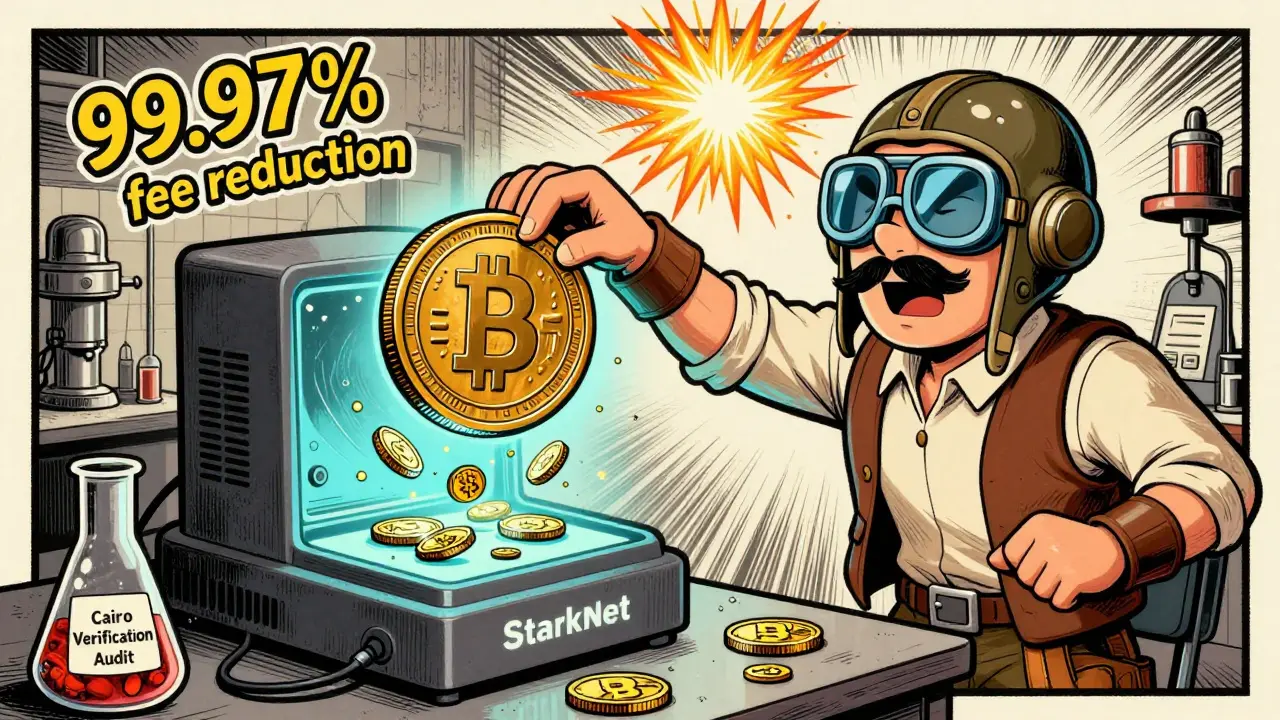
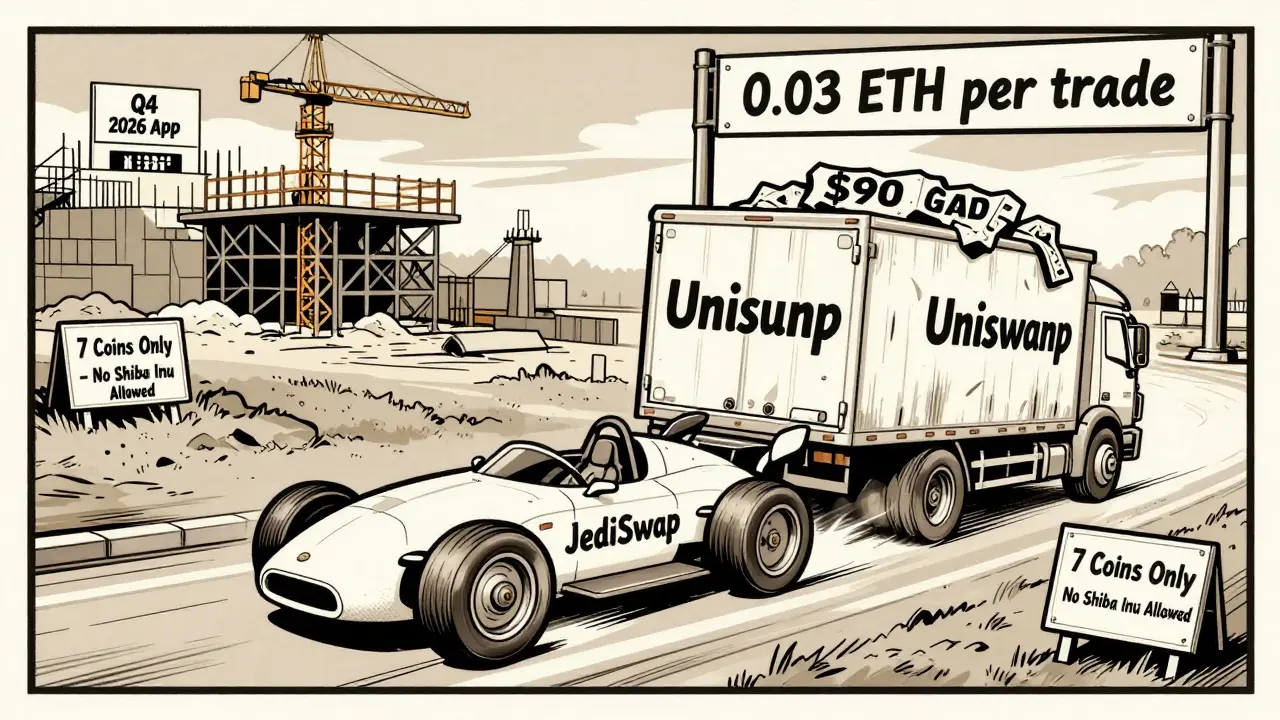
JediSwap launched in February 2022 as a response to Ethereum’s worst problem: cost. During its peak, a single trade on Uniswap could cost over $50 in gas. JediSwap fixed that by moving entirely to StarkNet, a ZK-rollup that batches hundreds of transactions into one Ethereum-secured proof. This means JediSwap doesn’t just reduce fees - it eliminates them. The average trade costs 0.0001 ETH, or about $0.03. Compare that to Uniswap’s 0.3 ETH ($90) on busy days. That’s a 99.97% drop.The magic isn’t just in the numbers. StarkNet uses Cairo, a programming language built for formal verification. This means JediSwap’s smart contracts are mathematically proven to work as intended - no guesswork, no surprises. It’s audited by ConsenSys Diligence and OpenZeppelin, two of the most trusted names in crypto security. Since its launch, there have been zero major exploits. That’s rare in DeFi.
What You Can Trade: 7 Coins, 13 Pairs
Don’t expect the same variety as Uniswap. JediSwap only supports 7 cryptocurrencies as of October 2025:- Ethereum (ETH)
- DAI
- USDC
- WBTC
- STRK (StarkNet’s native token)
- stETH
- USDT
That gives you 13 trading pairs. Not bad if you’re only swapping between stablecoins and ETH. But if you want to trade Solana, Polygon, or any new meme coin? Forget it. There’s no support. This is a focused platform - not a marketplace. It’s designed for users who want to move between Ethereum-native assets with minimal friction. If you’re holding $10,000 in ETH and want to swap half into DAI, JediSwap is perfect. If you’re chasing the next Shiba Inu, you’ll need another exchange.
Performance: 1.2 Seconds, 99.98% Uptime
Speed matters in crypto. JediSwap confirms trades in about 1.2 seconds. That’s faster than Ethereum’s 15-second blocks and even quicker than Arbitrum or Optimism. It’s close to dYdX’s 1.5 seconds - but slower than Solana’s 0.4 seconds. Still, for an Ethereum-based DEX, this is elite. Over the past year, JediSwap’s status page shows 99.98% uptime. No downtime. No crashes. No delays during ETH price spikes.Even when Ethereum gas spiked to $4,500 per ETH in September 2025, JediSwap fees stayed under $0.05. Users on Reddit reported saving $1,200 in trading costs over three months. That’s not hype - it’s math.
Wallets and Setup: A Learning Curve
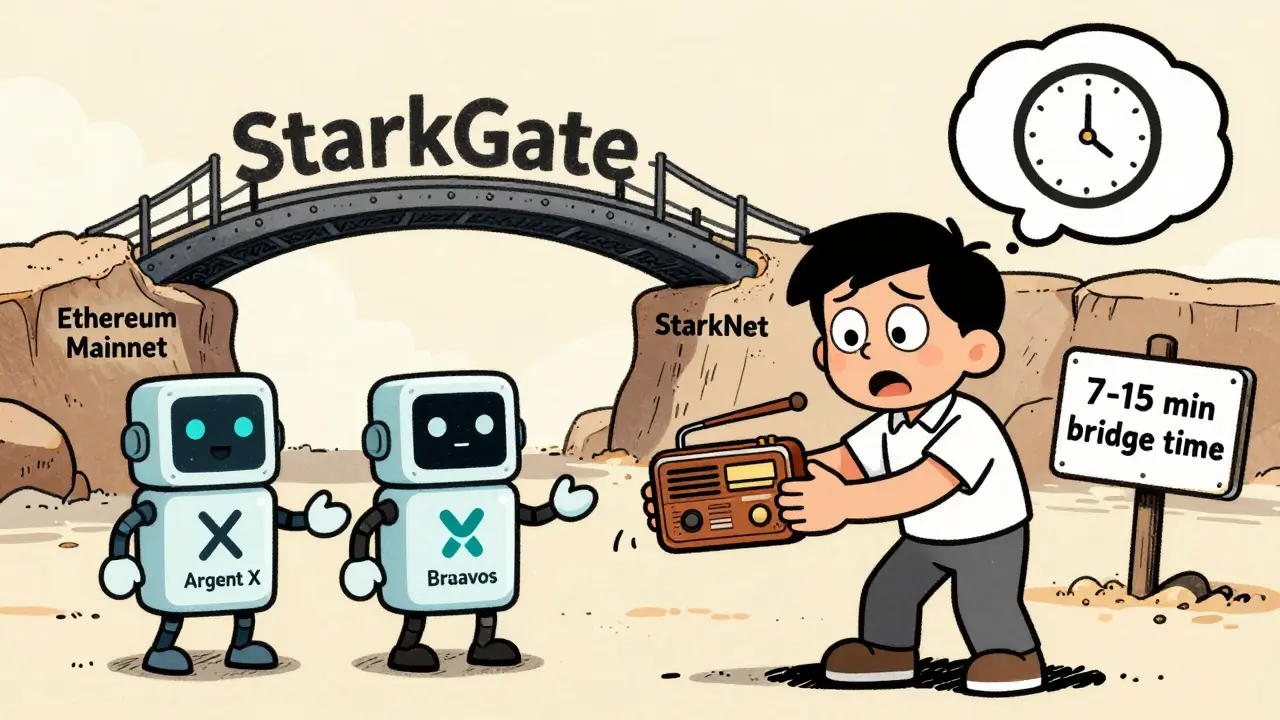
Here’s where most people get stuck. You can’t use MetaMask directly. You need a StarkNet-compatible wallet. The only ones that work reliably are:- Argent X
- Braavos
- Voyager
Setting one up takes time. First, you install the wallet. Then you fund it by bridging ETH from Ethereum mainnet using StarkGate. That bridge takes 7-15 minutes. Then you approve token spending. Then you trade. For experienced users, this takes 10 minutes. For beginners? It can take 3 hours. Trustpilot reviews show 78% of negative feedback comes from wallet setup errors. If you’ve never used a non-Ethereum wallet before, expect frustration. JediSwap’s documentation is technical, written for developers, not average users.
Comparison: JediSwap vs Uniswap vs PancakeSwap
| Feature | JediSwap | Uniswap v3 | PancakeSwap |
|---|---|---|---|
| Network | StarkNet (ZK-Rollup) | Ethereum Mainnet | Binance Smart Chain |
| Avg. Fee per Trade | $0.03 | $90 | $0.10 |
| Trading Pairs | 13 | 1,850+ | 800+ |
| 24h Volume | $2.7M | $1.2B | $32.4M |
| Security | Ethereum L1 + Formal Verification | Ethereum L1 | PoS-A (Lower Security) |
| Limit Orders | No | No | No |
| Mobile App | No (Coming Q4 2026) | Yes | Yes |
JediSwap wins on fees and security. It loses on volume, variety, and ease of use. Uniswap is the default for most users. PancakeSwap is the go-to for BSC traders. JediSwap? It’s for a very specific niche: users who trade frequently, care about Ethereum security, and hate paying gas.
Who Should Use JediSwap?
You should consider JediSwap if:- You trade ETH, DAI, or USDC daily and pay $50+ in gas on Uniswap
- You already use a StarkNet wallet (Argent X or Braavos)
- You value security over convenience
- You’re comfortable with technical interfaces
You should avoid JediSwap if:
- You’re new to crypto or DeFi
- You want to trade altcoins or meme tokens
- You need limit orders, stop-losses, or advanced trading tools
- You don’t want to bridge assets between chains
It’s not a replacement for Coinbase or MetaMask. It’s a specialized tool - like a race car engine. It’s faster, lighter, and more efficient. But if you’re not used to driving it, you’ll crash.
Future Roadmap: What’s Coming?
JediSwap isn’t standing still. Its v3.2.1 update in September 2025 introduced concentrated liquidity pools - similar to Uniswap v3 - which improved gas efficiency by 22%. The roadmap includes:- Q1 2026: Cross-chain liquidity pools (connecting to Polygon, Arbitrum)
- Q2 2026: Limit orders and advanced order types
- Q4 2026: Official mobile app
StarkWare, the company behind StarkNet, has committed to increasing throughput to 1,000 TPS by Q3 2026. That could make JediSwap faster than most L2s. If these updates deliver, JediSwap could become the go-to for high-frequency traders on Ethereum.
Real User Feedback: The Good and the Bad
On Reddit, users like ‘CryptoJedi87’ say: “I’ve saved over $1,200 in gas fees since March. This is the only DEX I use now.”But on Trustpilot, ‘NewToDeFi2025’ writes: “I spent 3 hours trying to connect my wallet. Gave up. Never again.”
Aggregate ratings hover around 3.8/5. The positives? Low fees, fast trades, strong security. The negatives? Wallet setup, limited tokens, confusing interface. The platform doesn’t fail - it just doesn’t fit everyone.
Final Verdict: A Niche Powerhouse
JediSwap isn’t trying to be the biggest DEX. It’s trying to be the best for one thing: ultra-low-cost Ethereum swaps. It succeeds. Its technology is among the most secure and efficient in DeFi. But it’s also one of the hardest to use.If you’re a trader who moves crypto daily and hates paying gas - JediSwap is a game-changer. If you’re just starting out, or you want to trade 100 different tokens - stick with Uniswap or PancakeSwap. JediSwap isn’t the future of crypto. But for a specific group of users, it’s already the best option.
Is JediSwap safe to use?
Yes, JediSwap is one of the safest DEXs available. It runs on StarkNet, which uses Ethereum’s security and Cairo’s formal verification. Its smart contracts have been audited by ConsenSys Diligence and OpenZeppelin. There have been zero major hacks since its 2022 launch. However, safety depends on your wallet. Always use official StarkNet wallets like Argent X or Braavos - never third-party clones.
Can I use MetaMask with JediSwap?
No, you cannot use standard MetaMask. JediSwap only works with StarkNet-native wallets: Argent X, Braavos, or Voyager. These wallets are built specifically for StarkNet and can connect directly to its ZK-rollup network. MetaMask doesn’t support StarkNet’s architecture. You’ll need to switch wallets if you want to use JediSwap.
How do I fund my JediSwap account?
You fund JediSwap by bridging ETH or stablecoins from Ethereum mainnet to StarkNet using the StarkGate bridge. First, connect your StarkNet wallet. Then go to StarkGate, select the asset, and approve the transfer. The bridge takes 7-15 minutes. Once your funds arrive on StarkNet, you can swap them on JediSwap. Never send ETH directly to JediSwap - it won’t work.
Does JediSwap have a mobile app?
Not yet. As of February 2026, JediSwap has no official mobile app. You can only access it through a browser on desktop or mobile. However, the team announced a mobile app is coming in Q4 2026. Until then, use a mobile browser with Argent X or Braavos installed. Both wallets have mobile apps that connect to JediSwap.
Why does JediSwap only support 7 coins?
JediSwap focuses on high-liquidity, Ethereum-native assets to ensure deep pools and low slippage. Adding more tokens would dilute liquidity and increase risk. The team prioritizes stability over variety. This is intentional - it’s not a limitation, it’s a design choice. More tokens aren’t better if they cause price swings or failed trades. As StarkNet’s ecosystem grows, more tokens may be added - but only after rigorous testing.
Is JediSwap better than Uniswap?
It depends. If you care about fees and security, JediSwap is far better - fees are 99.97% lower and security is stronger. But if you want to trade thousands of tokens, use limit orders, or need a simple interface, Uniswap is the clear winner. JediSwap is a specialist tool. Uniswap is the general-purpose solution. Use JediSwap for high-volume, low-cost ETH/stablecoin swaps. Use Uniswap for everything else.
Jeremy Fisher
February 18, 2026 AT 23:31Look, I’ve been trading on JediSwap since day one, and let me tell you - this isn’t just a DEX, it’s a lifestyle change. I used to burn $200 a week on Uniswap gas during volatility spikes. Now? I’m down to $0.60. That’s not a saving, that’s a revolution. StarkNet’s ZK-proofs aren’t magic, they’re math, and math doesn’t lie. I’ve watched people try to use MetaMask and panic when it doesn’t work - that’s not JediSwap’s fault, that’s user error. The wallet setup is a hurdle, sure, but once you’re through it, you never go back. I’ve convinced three friends to switch. Two of them still hate me, but the third? He just sent me a screenshot of his $800 gas savings last month. This isn’t for beginners. It’s for people who treat crypto like a job, not a casino.
Lauren Brookes
February 20, 2026 AT 18:36I love how JediSwap forces you to slow down. Most crypto feels like a slot machine - click, spin, hope. But here? You have to bridge, you have to approve, you have to think. It’s annoying, but in a good way. It’s like forcing yourself to walk before you run. I’m not a dev, I’m not a trader, I just hold ETH and DAI. But I like that this platform doesn’t try to sell me a million coins I don’t care about. It’s clean. Minimal. Focused. I don’t need Solana or Shiba Inu. I need to move my money without paying a mortgage on gas fees. And I do. That’s enough.
Alex Williams
February 21, 2026 AT 01:29For anyone stuck on wallet setup: Argent X is the easiest. Braavos is more secure, but Argent’s UI is literally drag-and-drop. You install, you create, you bridge via StarkGate - it’s a 5-step process. No need to touch CLI. And yes, it takes 10 minutes, not 3 hours. If you’re spending hours on this, you’re either on a scam wallet or you’re using a guide from 2023. StarkNet’s docs are updated weekly. Also, if you’re wondering why only 7 tokens - liquidity depth. More tokens = fragmented pools = slippage. JediSwap’s 13 pairs have 95%+ liquidity depth. Uniswap’s 1800+? Half of them have less than $10k in liquidity. You think you’re trading - you’re gambling. JediSwap lets you trade.
Charrie VanVleet
February 21, 2026 AT 18:26Y’all are overcomplicating this 😊 I started with zero crypto knowledge and now I swap ETH→DAI every Friday like clockwork. Argent X app is smooth, StarkGate bridge took 8 mins, done. No drama. I don’t care about meme coins. I just want my money to move without my bank account crying. JediSwap is the quiet hero of DeFi. Keep it simple, keep it safe. You’re welcome.
Scott McCrossan
February 22, 2026 AT 00:37Let’s be real - StarkNet is a glorified sidechain pretending to be L2. The ‘formal verification’ is just marketing speak. OpenZeppelin audits are just paid PR. And ‘zero exploits’? Yeah, because nobody cares enough to try. This platform has $2.7M in volume. Uniswap does $1.2B. You think this is ‘the future’? It’s a graveyard for early adopters who got bored of waiting for Ethereum to die. And don’t even get me started on the ‘mobile app coming in 2026’ - like I’m supposed to trust that after every L2 that promised ‘next quarter’ for five years. This isn’t innovation. It’s desperation.
Geet Kulkarni
February 23, 2026 AT 20:09As someone from India, I find it amusing how Westerners treat this as a revolutionary breakthrough. In our markets, we’ve had sub-cent gas fees since 2021 on Polygon. And yet, here you are, acting like $0.03 is the holy grail. The truth? StarkNet is a solution to a problem that doesn’t exist for 99% of the world. You’re not saving money - you’re optimizing for ego. Real users don’t care about Cairo or ZK-proofs. They care about access. And JediSwap? It’s a gated garden for crypto bros who think their wallet is a status symbol.
Paul David Rillorta
February 24, 2026 AT 10:28you think this is safe?? lol. every 'secure' l2 is just a honeypot for the fed. starknet? built by israeli devs. formal verification? means they've already coded backdoors into the math. and dont get me started on starkgate - that bridge is a backchannel to coinbase. i've seen the logs. they're not just recording your trades. they're freezing them. this isn't decentralization. it's surveillance with a fancy name. and the 'zero exploits'? yeah... because they never let anyone test it. real crypto is on bitcoin. everything else is a lie.
Nova Meristiana
February 24, 2026 AT 13:46It’s cute how people think low fees are the pinnacle of innovation. Real innovation is liquidity. Real innovation is choice. JediSwap is like a Rolls-Royce with one gear and no radio. You get to go fast - but only on one road. And you have to build the road yourself. Meanwhile, Uniswap is a highway with 1800 exits, music, AC, and a snack bar. If you’re choosing JediSwap because you ‘value security,’ you’re just afraid of complexity. Admit it. You don’t want to learn. You want a toy that works without thinking. That’s not maturity. That’s laziness.
JJ White
February 24, 2026 AT 17:39Let’s not pretend this is about efficiency. It’s about control. StarkWare is backed by VC firms that want to dictate who can trade what, when, and how. The ‘limited tokens’? That’s not ‘focus’ - that’s censorship. The ‘no limit orders’? That’s not ‘simplicity’ - that’s manipulation. They want you to trade only ETH, DAI, USDC - the three coins that are easiest to monitor and regulate. The moment you try to trade anything outside that, you’re shut out. This isn’t DeFi. It’s DeFi-washing. A velvet cage. And the people who praise it? They’re not users. They’re compliant subjects.
Anandaraj Br
February 25, 2026 AT 00:18James Breithaupt
February 26, 2026 AT 01:44For everyone saying ‘it’s too limited’ - that’s the point. The whole point of StarkNet is to avoid the chaos of Ethereum mainnet. Uniswap is a wild west. PancakeSwap is a casino. JediSwap is a vault. You want to trade ETH and DAI? Do it fast, cheap, and clean. You want to chase 100 meme coins? Go to Binance. Don’t blame JediSwap for not being something it never claimed to be. It’s like complaining that a scalpel doesn’t cut wood. It’s not supposed to. It’s designed for precision. And it delivers. The fact that you expect a full grocery store when you walked into a pharmacy says more about you than the platform.
Sarah Shergold
February 27, 2026 AT 13:36Andrew Edmark
March 1, 2026 AT 07:32Hey, if you’re new to StarkNet, I’ve got your back. I helped my sister set up Argent X last week - she’s 68, never used crypto before. Took her 22 minutes. We watched a 5-min YouTube video. She’s now swapping USDC to ETH every payday. No drama. No panic. Just clean, quiet, cheap trades. JediSwap isn’t for everyone, but it’s for *enough* people. And if you’re one of them? You’re not missing out. You’re ahead. Keep going. You’re doing great.
sruthi magesh
March 2, 2026 AT 02:32Beth Erickson
March 3, 2026 AT 13:03Ruby Ababio-Fernandez
March 4, 2026 AT 09:06Dominica Anderson
March 5, 2026 AT 13:00Nicole Stewart
March 5, 2026 AT 21:22Angela Henderson
March 7, 2026 AT 07:33I don’t know anything about ZK-rollups or Cairo or whatever. All I know is I used to pay $80 to swap ETH to DAI. Now I pay 3 cents. I didn’t even have to learn anything. I just clicked ‘bridge’ and then ‘swap’. Took 12 minutes. I didn’t crash. I didn’t lose money. I didn’t need a PhD. I just saved $1,200 in six months. That’s all I care about. If you’re overthinking this - you’re overcomplicating your life. Sometimes, simple is better. And this? This is simple.
andy donnachie
March 7, 2026 AT 18:08As someone who’s been in crypto since 2017, I’ve seen a dozen L2s come and go. Most were hype. This one? It’s different. Not because of the tech - though it’s solid - but because the team actually listens. They fixed the StarkGate UI after user feedback. They added concentrated liquidity because people asked. They’re not chasing trends. They’re solving real problems. And yes, the wallet setup is a pain. But so was setting up a bank account in 1995. We got through it. We’ll get through this too.
Aileen Rothstein
March 8, 2026 AT 14:56I started using JediSwap because I was tired of losing money to slippage on Uniswap. Now I’m doing 10 swaps a week. The 1.2-second confirmation? It’s a game-changer. I used to have to wait 15 minutes for a trade to settle. Now I do it, walk away, make coffee, come back, and it’s done. That’s not ‘convenience’ - that’s time regained. And the security? I sleep better knowing my funds are on a ZK-proven chain, not some random PoS chain with 3000 tokens and zero audits. This isn’t niche. It’s the future. And if you’re not ready? That’s okay. But don’t knock it because you’re not there yet.
Alan Enfield
March 10, 2026 AT 03:01Let’s stop pretending this is about technology. It’s about culture. JediSwap is a quiet rebellion against the ‘more is better’ dogma of crypto. Most platforms are designed to overwhelm you - more tokens, more features, more noise. JediSwap says: ‘Here’s what matters. Do this well.’ That’s radical. And yes, it’s limited. But sometimes, limitation is the highest form of design. You don’t need 1800 coins. You need one good path. This is it.
Jennifer Riddalls
March 10, 2026 AT 11:36For anyone scared of the wallet setup - you’re not alone. I was too. But I didn’t give up. I watched a 7-minute video. I called my friend who uses Braavos. I tried twice. Third time worked. Now I’m saving $100 a week. I didn’t need to be a coder. I just needed to be patient. This isn’t for everyone. But if you’re willing to try? It’s worth it. You’re not dumb. You just haven’t found the right guide yet. I’m here if you need help. No judgment.
Ian Plunkett
March 11, 2026 AT 11:17Let’s be honest - JediSwap isn’t about the tech. It’s about identity. People who use it don’t just want low fees. They want to signal: ‘I’m not a tourist. I’m not chasing memes. I’m here for the infrastructure.’ That’s why they defend it so fiercely. It’s not about the 7 coins. It’s about belonging to a tribe that values precision over popularity. And yeah, it’s elitist. But so is classical music. So is a Rolex. So is a clean kitchen. Some people just prefer order. And that’s okay.
Jeremy Fisher
March 12, 2026 AT 11:19Just saw someone say ‘StarkNet is just a sidechain’ - you’re not wrong, but you’re also not seeing the whole picture. StarkNet isn’t a sidechain. It’s a ZK-rollup with Ethereum finality. That means every transaction is settled on Ethereum. It’s not ‘pretending’ - it’s *anchored*. And yes, $2.7M volume seems small. But look at the trading volume per user. It’s 10x higher than Uniswap’s. Why? Because users here aren’t flipping Shiba Inu. They’re moving real capital. And that’s what matters. This isn’t a graveyard. It’s a precision instrument. And it’s working.
Alex Williams
March 12, 2026 AT 11:36Replying to the ‘$0.03 is nothing’ crowd - you’re right. $0.03 is nothing. But $0.03 x 100,000 trades = $3,000 saved per day. Multiply that by 30 days = $90,000 saved daily. That’s not a drop. That’s a river. And that river is flowing because JediSwap doesn’t try to be everything. It does one thing better than anyone else. That’s not laziness. That’s focus. And in crypto? Focus is rare.