

It sounds like a contradiction that doesn’t make sense. How can a country with some of the toughest cryptocurrency taxes in the world also be number one in global adoption? The answer lies in the sheer size and hunger of the Indian market for digital assets. Even as the government piles on restrictions, people keep buying, trading, and holding crypto. This isn't just about rebellion; it's about opportunity. As of May 2026, India is the leading nation in global cryptocurrency adoption metrics, despite facing what many experts call a punitive regulatory environment.
To understand this paradox, you have to look at the numbers and the rules. The Indian government treats crypto not as money, but as a specific type of asset called a Virtual Digital Asset (VDA). This classification matters because it dictates how you pay taxes. If you are trading Bitcoin or Ethereum here, you aren't just dealing with market volatility; you are navigating a complex web of income tax, withholding taxes, and goods and services tax that makes every trade expensive.
The Heavy Cost of Trading: Understanding VDA Taxes
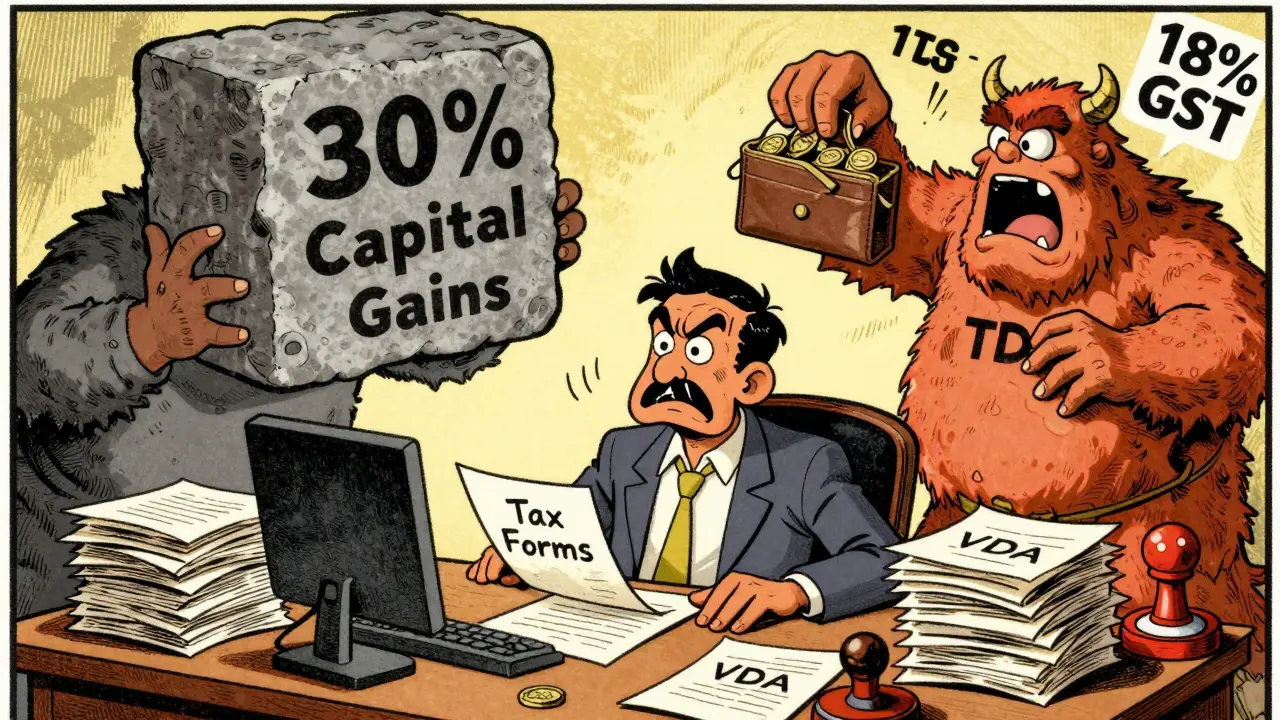
The core of the issue is the taxation framework introduced in the 2022 fiscal year and still active today. The government decided to treat profits from cryptocurrencies similarly to lottery winnings. Why does this matter? Because lottery winnings don't get breaks for expenses. When you sell a coin for a profit, you pay a flat 30% tax rate on all gains derived from Virtual Digital Assets including cryptocurrencies and NFTs. There are no deductions for your electricity bills if you mined the coins, no write-offs for software costs, and crucially, no ability to offset losses.
Imagine you buy a token for $1,000 and it crashes to $500. Then you buy another token for $1,000 and it goes up to $1,500. In most countries, you could use the $500 loss to reduce your taxable gain. In India, that loss disappears. You pay the full 30% on the $500 profit. For active traders who experience daily ups and downs, this structure is brutal. It creates a scenario where your net tax bill can sometimes exceed your actual economic profit, especially when you factor in transaction fees.
But the 30% isn't the only hit. Every time you trade more than ₹50,000 (roughly $600), the exchange automatically deducts 1% TDS on Tax Deducted at Source applied to crypto transactions exceeding ₹50,000. This money leaves your wallet immediately. It’s not gone forever-you claim it back during annual tax filing-but it ties up your capital. For high-frequency traders, this liquidity drain is significant. You need more cash on hand just to keep trading because 1% of every move is held hostage by the system until April next year.
The July 2025 GST Shock
If the income tax was heavy, the changes starting in July 2025 added another layer of friction. The government reclassified crypto platforms as "Online Service Providers" under Section 2(102) of the CGST Act. What did this mean for you? An additional 18% GST on Goods and Services Tax applied to all crypto platform services including trading fees, deposits, withdrawals, and staking rewards.
Previously, some services might have slipped through cracks or had lower rates. Now, everything is taxed. Spot trading fees? 18% GST on top of the fee. Margin trading interest? 18% GST. Staking rewards? Yes, even the passive income you earn from holding coins has GST implications on the service charges. Exchanges had to scramble to update their systems to ensure they were registered for GST regardless of their turnover threshold. This increased the administrative burden on platforms, which often passed these compliance costs onto users in the form of slightly higher spreads or fees.
| Cost Component | Rate / Amount | Impact on Trader |
|---|---|---|
| Capital Gains Tax | 30% Flat | Applied to all profits; no loss offsets allowed. |
| TDS (Withholding) | 1% | Deducted per trade >₹50k; reduces immediate liquidity. |
| GST on Fees | 18% | Added to trading fees, staking costs, and withdrawal charges. |
| Expense Deductions | None | Cannot deduct mining costs, internet, or software fees. |
Why Adoption Is Still #1
So, with a 30% tax, 1% withholding, and 18% GST on fees, why is India still the leader? The short answer is demographics and financial exclusion. India has a massive young population that is digitally savvy but often underserved by traditional banking systems. For millions, crypto isn't just a speculative bet; it's a way to participate in the global economy without relying solely on local banks.
The desire for yield is strong. With inflation affecting savings, many Indians look to stablecoins or yield-bearing assets to preserve purchasing power. Even with the taxes, the potential returns in volatile markets often outweigh the regulatory costs. Furthermore, the cultural shift toward digital-first finance is irreversible. Once people learn how to use wallets and exchanges, they don't stop. They just adapt.
There is also the element of defiance and innovation. The community has found ways to navigate the restrictions. While direct fiat-to-crypto ramps face strict KYC (Know Your Customer) and AML (Anti-Money Laundering) checks enforced by the Financial Intelligence Unit-India (FIU-IND), peer-to-peer (P2P) networks remain vibrant. These networks allow users to trade directly with each other, bypassing some of the centralized exchange controls, though they come with their own risks of fraud and lack of recourse.
The Exodus of Liquidity and Local Firms
The harsh rules haven't been without consequence. One major side effect has been the migration of trading volume overseas. Many large Indian traders moved their operations to offshore exchanges that offer better leverage, lower fees, and no automatic TDS. This created a brain drain and a capital drain. Local exchanges struggled to compete because they had to comply with every rule, while offshore players operated in a gray area.
Several prominent crypto firms relocated their headquarters or operational hubs outside India to avoid the administrative nightmare. This hurt the domestic ecosystem, reducing job creation and local innovation in blockchain technology. The Reserve Bank of India (RBI) continues to monitor these flows closely, worried about systemic risks and capital flight. However, the RBI cannot easily block individuals from accessing foreign websites, making enforcement difficult.

Signs of Change: The CBDT Consultation
By August 2025, the reality became too hard to ignore. The Central Board of Direct Taxes (CBDT) launched comprehensive consultations with crypto companies and stakeholders. This was a pivotal moment. For the first time since the 2022 laws were enacted, the government admitted the current model might be broken.
The CBDT sent out detailed questionnaires asking tough questions. They wanted to know if the 1% TDS on every trade was killing market liquidity. They asked if the flat 30% tax had driven too much volume offshore. They even questioned whether India needed comprehensive crypto legislation rather than just patchwork tax rules. Industry reports showed that local trading volumes had stagnated while global adoption metrics for Indian residents continued to climb via offshore channels.
This consultation signals a potential shift. Regulators are realizing that punishing users doesn't stop adoption; it just pushes it underground or abroad. The goal now seems to be finding a balance-maintaining tax revenue and preventing money laundering while creating a sustainable environment for innovation. We may see proposals for lower tax rates for long-term holders, allowances for loss offsets, or clearer guidelines for institutional investment.
Navigating Compliance Today
Until new laws are passed, you must operate within the current framework. Ignorance is not a defense in tax audits. Here is what you need to do to stay safe:
- Maintain Detailed Records: Track every trade. You need dates, amounts, and values in INR at the time of transaction. Software tools can help automate this, but verify them manually.
- File Schedule VDA: When you file your Income Tax Return, you must disclose all crypto holdings and trades in Schedule VDA. Failure to report can lead to penalties far worse than the tax itself.
- Manage TDS Claims: Keep track of the 1% TDS deducted by exchanges. You will need Form 26AS statements to claim these credits against your final tax liability. Don't let this money sit unclaimed.
- Understand GST Implications: If you run a business involving crypto, ensure your GST registration is correct. For individual traders, the GST applies to the fees you pay, not your personal income, but it affects your cost basis.
The learning curve is steep, but necessary. The intersection of income tax, TDS, and GST requires precision. Mistakes here trigger notices from the Income Tax Department, which can freeze bank accounts or demand hefty penalties. Treat your crypto accounting with the same seriousness as your main salary.
Is crypto legal in India in 2026?
Yes, owning and trading cryptocurrencies is legal in India. They are classified as Virtual Digital Assets (VDAs). However, they are not recognized as legal tender, meaning businesses cannot accept them as payment for goods and services in the same way they accept Rupees.
Can I offset crypto losses against gains in India?
No. Under the current tax regime, you cannot set off losses from one crypto asset against gains from another. You also cannot carry forward losses to future years. Each gain is taxed independently at a flat 30% rate.
What is the 1% TDS on crypto?
TDS stands for Tax Deducted at Source. If you sell or transfer crypto worth more than ₹50,000 in a single transaction, the exchange must deduct 1% of the transaction value and remit it to the government. You can claim this amount back when filing your annual income tax return.
How does the 18% GST affect crypto traders?
Since July 2025, crypto platforms are treated as Online Service Providers. This means an 18% Goods and Services Tax is applied to all service fees, including trading commissions, margin interest, and staking fees. It increases the overall cost of trading but does not apply directly to the value of the crypto itself.
Will the crypto tax rules change soon?
The Central Board of Direct Taxes (CBDT) initiated consultations in late 2025 to review the impact of current rules. While no new law has been passed yet, there is growing pressure to create a more balanced framework that encourages innovation while ensuring tax compliance. Changes could emerge in subsequent budget sessions.