

Have you seen ads for HUA Exchange? You are not alone. A quick search reveals zero credible information about this platform. That silence is deafening in the crypto world. Legitimate exchanges like Binance or Coinbase dominate headlines, regulatory filings, and user reviews. HUA Exchange has none of that. This article cuts through the noise to tell you exactly what we know-or rather, what we don’t-about this mysterious entity.
The short answer? Treat HUA Exchange as a high-risk operation until proven otherwise. The complete lack of verifiable data, security audits, and user feedback raises major red flags. Before you risk even a dollar, let’s break down why this platform should be on your radar for all the wrong reasons.
The Silence Speaks Volumes
In the cryptocurrency industry, visibility equals credibility. Major platforms publish their fee structures, supported assets, and security protocols openly. For example, Kraken clearly lists its fees ranging from 0% to 0.4% and supports over 350 cryptocurrencies. Coinbase details its support for 235 coins with transparent fee tiers. These specifics allow users to make informed decisions.
HUA Exchange offers nothing comparable. There are no API specifications, no published security whitepapers, and no clear fee schedules. This absence of documentation is not just inconvenient; it is a critical warning sign. Legitimate businesses operate in the open because transparency builds trust. When a platform hides its operational details, it usually means there is something to hide.
We checked major review aggregators, including Trustpilot, Reddit, and CryptoSlate. The results were empty. No user experiences, no complaints, and surprisingly, no scam warnings either. This paradox suggests two possibilities: either the platform is so new it hasn’t attracted users yet, or it is a non-interactive site designed solely to harvest credentials without ever processing trades.
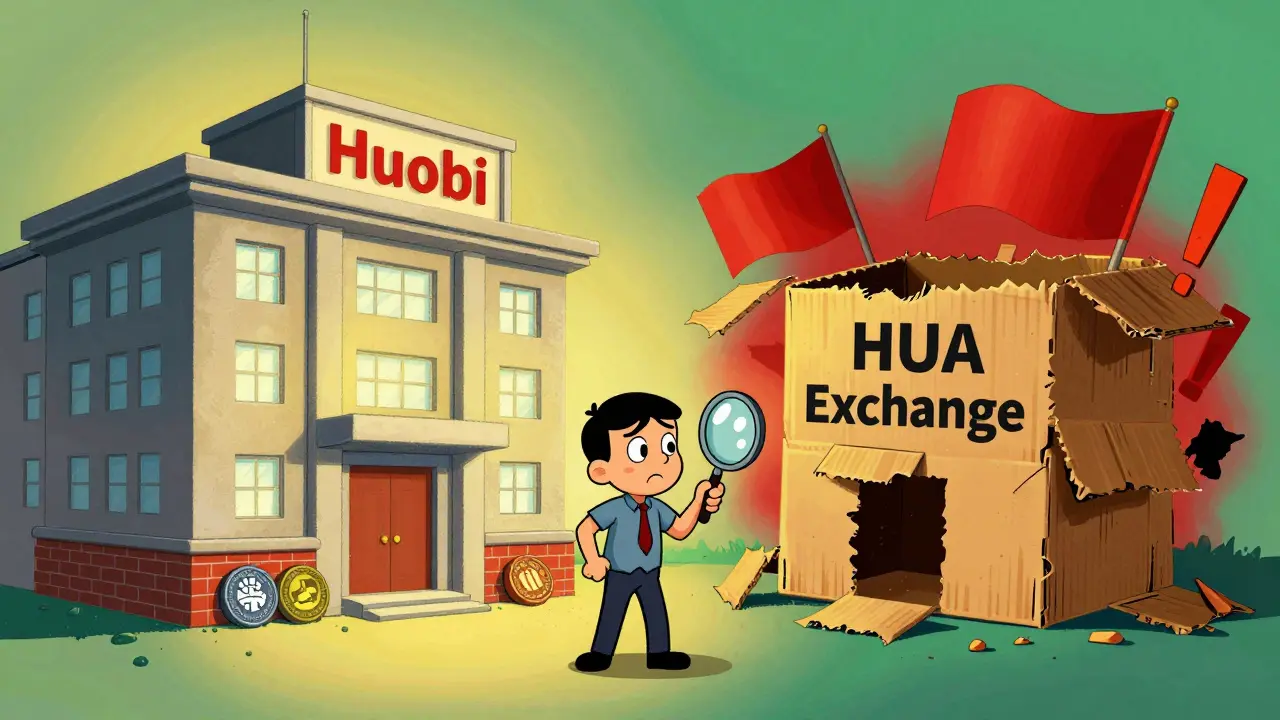
Is It a Misspelling of Huobi?
A common confusion arises between HUA Exchange and Huobi Global. Founded in 2013 by Leon Li, Huobi is one of the oldest and most established exchanges in the market. It is often abbreviated as 'HB' but never 'HUA.' If you intended to find Huobi, ensure you visit their official domain. Do not assume they are the same entity. HUA Exchange has no verified connection to Huobi Global.
This distinction matters because Huobi operates under strict regulatory frameworks and undergoes regular security audits. HUA Exchange lacks these safeguards. Confusing the two could lead you to deposit funds into a fraudulent clone site that mimics the branding of a legitimate exchange. Always double-check URLs and verify company registration details before connecting any wallet.
Regulatory Red Flags
Regulation is the backbone of consumer protection in crypto. In the United States, the SEC requires exchanges to comply with Know Your Customer (KYC) rules. Platforms like Gemini and Coinbase adhere to these standards, processing nearly 100 million verified users safely. They are listed in regulatory databases and subject to periodic inspections.
HUA Exchange appears in none of these records. We searched the IOSCO International Securities & Commodities Alerts Network, which monitors unauthorized investment firms. As of late 2025, HUA Exchange was not listed. While this might seem positive, it actually indicates the platform operates entirely outside regulated channels. It is too insignificant to warrant a formal warning or too obscure to have filed any licenses. Operating without regulatory oversight means you have no recourse if your funds disappear.
Security and Technical Gaps
Security is not optional; it is essential. Top-tier exchanges employ advanced measures like multi-party computation (MPC). For instance, OKX splits seed phrases into multiple shares, requiring only two of three to sign transactions. This method prevents single points of failure and protects user assets from internal theft or external hacks.
There is zero evidence that HUA Exchange uses such technology. Without documented security protocols, your private keys and funds are vulnerable. Legitimate platforms also provide clear withdrawal procedures. Margex, for example, processes withdrawals once daily at scheduled times, offering predictability and transparency. HUA Exchange provides no such clarity. If you cannot find how to withdraw your money, you likely won’t be able to.
Comparison: Legitimate Alternatives
| Feature | Coinbase | Kraken | HUA Exchange |
|---|---|---|---|
| Supported Assets | 235+ | 350+ | Unknown |
| Fees | 0%-3.99% | 0%-0.4% | Not Published |
| Regulatory Status | US Compliant | Global Licenses | None Found |
| User Reviews | Extensive | Extensive | Zero |
| Security Tech | MPC/Cold Storage | Cold Storage | Undocumented |
The table above highlights the stark contrast between established platforms and unknown entities. Every metric for HUA Exchange is missing or unverifiable. In contrast, competitors offer detailed data that allows users to assess risk accurately. Never trade on a platform that refuses to disclose basic operational details.
How to Spot Fake Exchanges
Scammers create convincing websites to trick inexperienced traders. Here is how to identify them:
- No Social Media Presence: Legitimate exchanges engage with communities on Twitter, Telegram, and Discord. HUA Exchange has no verified social footprint.
- Generic Content: Scam sites often copy text from Wikipedia or other exchanges. Check for unique, specific information about their team and technology.
- Pressure Tactics: If a site promises guaranteed returns or urges immediate deposits, walk away. Real investing carries risk.
- Missing Contact Info: Look for a physical address and customer support channels. Uphold, for instance, notes its lack of live phone support but still provides email assistance. Total anonymity is a bad sign.
If you encounter HUA Exchange, apply these checks rigorously. The absence of answers is an answer in itself.
What Should You Do Instead?
Your safety comes first. Stick to platforms with proven track records. Uphold earned a 4.8/5 rating from NerdWallet for its extensive staking offerings and thousands of trading pairs. Binance US handles 158 assets with low spreads. These platforms invest heavily in compliance and security because they rely on long-term user trust.
If you are new to crypto, start small. Use reputable exchanges to buy stablecoins or major assets like Bitcoin and Ethereum. Enable two-factor authentication (2FA) immediately. Withdraw large amounts to hardware wallets like Ledger or Trezor for added security. Avoid platforms that promise easy riches with little effort. There is no such thing in finance.
Is HUA Exchange a scam?
While we cannot definitively label it a scam without direct evidence of fraud, all indicators suggest high risk. The lack of regulatory registration, security documentation, and user reviews makes it unsafe to use. Treat it as a potential scam until verified by independent authorities.
Is HUA Exchange related to Huobi?
No. Huobi Global is a well-established exchange founded in 2013. HUA Exchange has no verified connection to Huobi. Do not confuse the two. Always verify the official website of Huobi if you intend to trade on that platform.
Why can't I find reviews for HUA Exchange?
Legitimate exchanges generate thousands of user reviews. The complete absence of reviews for HUA Exchange indicates it either has no real users or is a newly created shell site designed to steal credentials. Both scenarios are dangerous.
Are my funds safe on HUA Exchange?
Without published security protocols, insurance policies, or regulatory oversight, your funds are not safe. We strongly advise against depositing any money into this platform. Use verified exchanges like Coinbase or Kraken instead.
What are the safest crypto exchanges in 2026?
Top-rated exchanges include Coinbase, Kraken, Binance US, and Uphold. These platforms offer transparent fees, robust security features like MPC and cold storage, and full regulatory compliance. They are widely reviewed and trusted by millions of users globally.
Jimmy vasquez
May 5, 2026 AT 01:03Hey folks, just wanted to chime in on this because I see a lot of newbies getting confused by these clone sites. The key thing here is that silence really does speak volumes in the crypto space. Legit exchanges like Coinbase or Kraken have thousands of reviews and clear fee structures. If you can't find basic info like supported assets or security protocols, it's usually a red flag. Always double-check the URL before connecting your wallet.
Ryan Nakielny
May 5, 2026 AT 16:09Oh great, another 'mystery' exchange that nobody has heard of.
I guess we're supposed to be impressed by the mystery? Because nothing screams 'trust me with your life savings' like a website with zero reviews and no regulatory filings. It's not a bug, it's a feature for the scammers. They don't need marketing when they have desperate people looking for quick riches. Stay away from HUA unless you enjoy watching your money vanish into the digital ether.
Sri Astuti
May 5, 2026 AT 18:51:) Well isn't this just a delightful little exposé on the absolute trash fire that is the current state of unregulated crypto platforms?? :D You see, what is truly fascinating about this entire situation is how the complete and total lack of any verifiable data serves as a screaming warning sign that should be ignored at one's own peril!! The fact that there are no API specifications or published security whitepapers is not merely an inconvenience but rather a critical indicator of malicious intent!!! One must consider that legitimate businesses operate in the open because transparency builds trust, whereas shady entities hide their operational details because they have something to hide!!! It is almost poetic in its simplicity really!!
Elle Kharitou
May 7, 2026 AT 13:10G'day everyone! 🌏✨ I think it's so important to remember that our financial safety is deeply connected to our personal responsibility and community awareness. 🙏 When we choose to support platforms that prioritize transparency and ethical practices, we are not just protecting our own funds, but also contributing to a healthier ecosystem for everyone involved. 💖 The absence of user reviews for HUA Exchange is a significant gap in the social fabric of trust that holds the crypto world together. Let's lift each other up by sharing knowledge about verified exchanges like Uphold or Binance US instead! 🚀💫
Nitin Gupta
May 8, 2026 AT 18:28I agree with the points raised here. It is always better to be safe than sorry when dealing with digital assets. The comparison table provided in the post is quite helpful for visualizing the differences between established platforms and unknown entities. I would suggest that users start with smaller amounts on reputable exchanges to build confidence. Thank you for sharing this information.
AP Fisher
May 9, 2026 AT 18:51I was looking for Huobi and got confused for a second. Good thing I read this. So HUA is not Huobi. Got it. I will stick to Coinbase then. Thanks for the heads up.
Wayne Gillis
May 11, 2026 AT 17:18Yo @Jimmy vasquez you nailed it! 🔥🔥🔥 This is exactly why I love this community! We look out for each other! 👊 Don't let these sketchy sites fool you! They want your keys! 🗝️🚫 Keep it real and keep it safe! 💪💰 #CryptoLife #StaySafe
Noel Mandotah
May 13, 2026 AT 04:31Silence is golden. Or in this case, suspicious.
No audits. No fees listed. No users. Just a blank canvas for fraud.
It’s not ‘high risk.’ It’s a guaranteed loss if you touch it.
Wake up sheeple. Use Coinbase. Go home.
edie rosa
May 14, 2026 AT 13:02I just feel so drained reading about all these scams. It makes me wonder if anyone actually cares about doing things right anymore. It’s just greed and deception everywhere. I suppose I’m too tired to fight the tide, but I do hope people learn from this. Honestly, it’s exhausting trying to stay vigilant against every new threat that pops up. I just want to rest my mind.
Michael Repak
May 15, 2026 AT 02:50Great article!!! It is very important to check the regulatory status of any exchange before depositing funds!!! Please remember to enable two-factor authentication on all your accounts!!! Safety first!!!
Livvy Cooper
May 15, 2026 AT 07:34Whatever. Everyone says everything is a scam now. I bet HUA is fine. People just complain too much. I don’t care about reviews. I’ll try it myself. Who cares?
Rain Richardsson
May 16, 2026 AT 06:24I hear you Livvy. It is scary. But I think we should listen to the experts here. Better safe than sorry.
Iestyn Lloyd
May 16, 2026 AT 14:26From a UK perspective, the FCA has warned about several unauthorised firms recently. While HUA isn't specifically listed in the alerts I've seen, the principle remains the same: if it's not authorised, you have no protection. It's worth checking the Financial Conduct Authority's register before engaging with any platform. Transparency is key in our industry.
April D Thompson
May 17, 2026 AT 21:02Oh wow! This is such a dramatic reminder of how fragile trust can be in the digital age! 😱 It’s almost poetic, isn’t it? How a simple lack of information can unravel the entire foundation of a financial platform! We must embrace the chaos and learn from it! 💃
Kara Spadone
May 18, 2026 AT 02:20:) The universe often tests our discernment through such mysterious entities. One must ask: what is the nature of truth in a void of information? Perhaps the silence is a mirror reflecting our own desires for easy gains. Proceed with caution, dear seeker. :)
Arun Prabhu
May 19, 2026 AT 16:04It is quite amusing how the masses flock to these digital mirages, blind to the obvious signs of deceit. The pretentiousness of claiming legitimacy without substance is truly laughable. I suppose some prefer the comfort of ignorance over the harsh light of verification. A pity, really.
Jehan ZA
May 21, 2026 AT 03:17It is imperative to adhere to strict due diligence protocols when evaluating cryptocurrency exchanges. The absence of regulatory compliance and transparent operational details constitutes a significant risk factor. Investors are advised to utilize only verified platforms with established reputations. Caution is warranted in all transactions involving unverified entities.
debra hoskins
May 21, 2026 AT 03:54I suppose the silence is deafening, but I find the whole 'scam' narrative a bit overblown. Maybe they’re just private. Not everyone wants to shout from the rooftops. But sure, keep panicking. It’s cute.
Pramendra Singh
May 23, 2026 AT 00:47Let's stay positive! There are many great options out there. Just take your time and research well. You got this!