
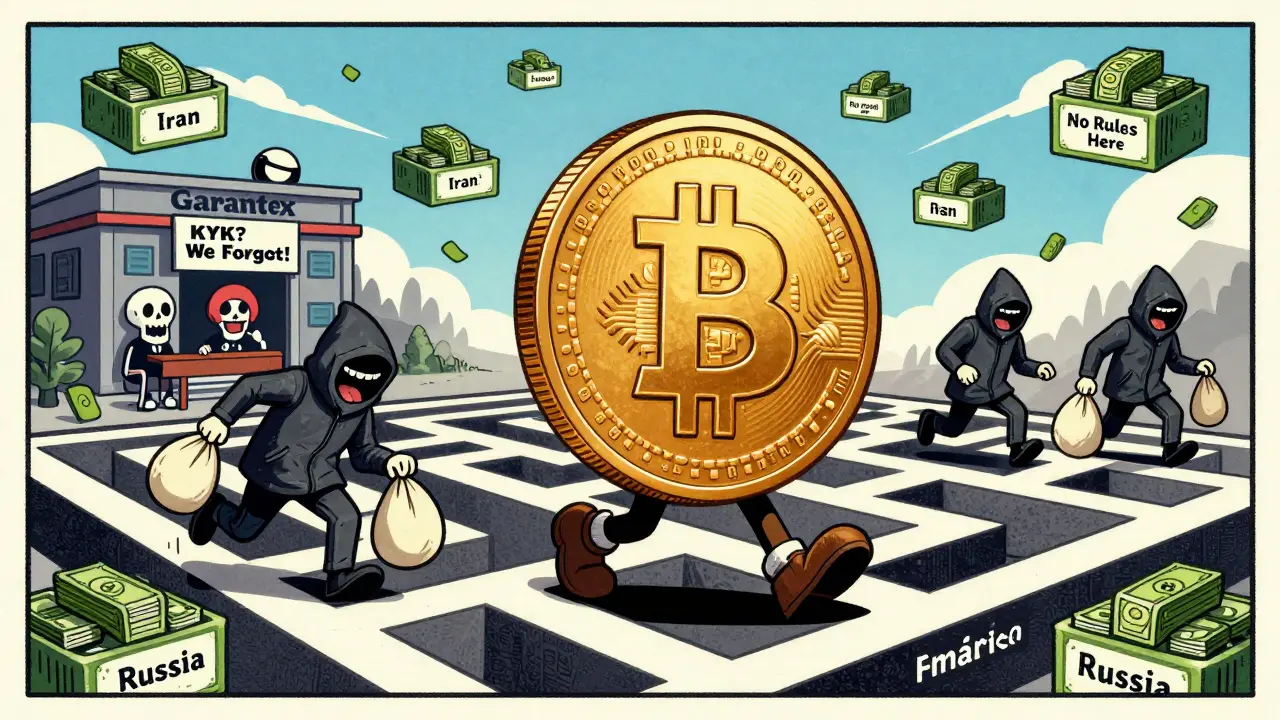
For the first time, over $15.8 billion in cryptocurrency flowed into wallets tied to sanctioned countries and groups in 2024. That’s not just a number - it’s a warning sign. This money didn’t vanish into thin air. It moved through exchanges, crossed blockchains, hid in DeFi pools, and slipped past tools built to catch it. And it wasn’t random. Every dollar had a destination, a purpose, and a method. The real question isn’t how much moved - it’s how it moved, who let it through, and what’s next.
Who Got the Money?
The bulk of this $15.8 billion didn’t go to lone hackers or shady traders. It went to entire countries under U.S. sanctions - mainly Iran and Russia. Iran’s centralized exchanges saw a massive spike in inflows. People there weren’t just trading crypto. They were using it to move money out of the country, bypassing banking restrictions. Russia’s role was even more direct: $800 million in ransomware payments flowed through sanctioned wallets. That’s not just crime - it’s state-tolerated cyber warfare. And it’s getting worse. Ransomware payments to Russian-linked wallets rose 22% from 2023. Darknet markets added another $1.1 billion, mostly from Russia-based operations. These weren’t small-time sellers. These were organized networks using crypto to move drugs, stolen data, and hacking tools. And they knew exactly how to hide: using mixers, privacy coins, and cross-chain bridges to confuse trackers.How Did the Money Move?
Bitcoin was the workhorse. It made up 68% of all sanctioned crypto transactions in 2024. Why? Because it’s the most tracked, but also the most trusted. It’s hard to fake, easy to verify, and widely accepted. Ethereum followed at 20%, mostly because of stablecoins like USDT. Tether alone moved over $2 million in funds linked to money launderer Ekaterina Zhdanova - a name OFAC flagged in late 2023. She didn’t just use one exchange. She used Garantex, which became the main pipeline for Russian ransomware cash. Garantex and Nobitex together handled over 85% of all inflows to sanctioned entities. These weren’t anonymous platforms. They were registered exchanges with KYC systems that clearly failed. OFAC didn’t just warn about them - they sanctioned Garantex outright. The exchange had been processing payments from Conti, LockBit, Black Basta, and other ransomware gangs for years. It wasn’t ignorance. It was complicity. Cross-chain bridges were used in nearly one in five transactions. That’s a game-changer. Instead of moving money on one blockchain, bad actors split it, sent parts through different chains, then reassembled it elsewhere. This made tracking nearly impossible without real-time coordination between networks - something most blockchains don’t do.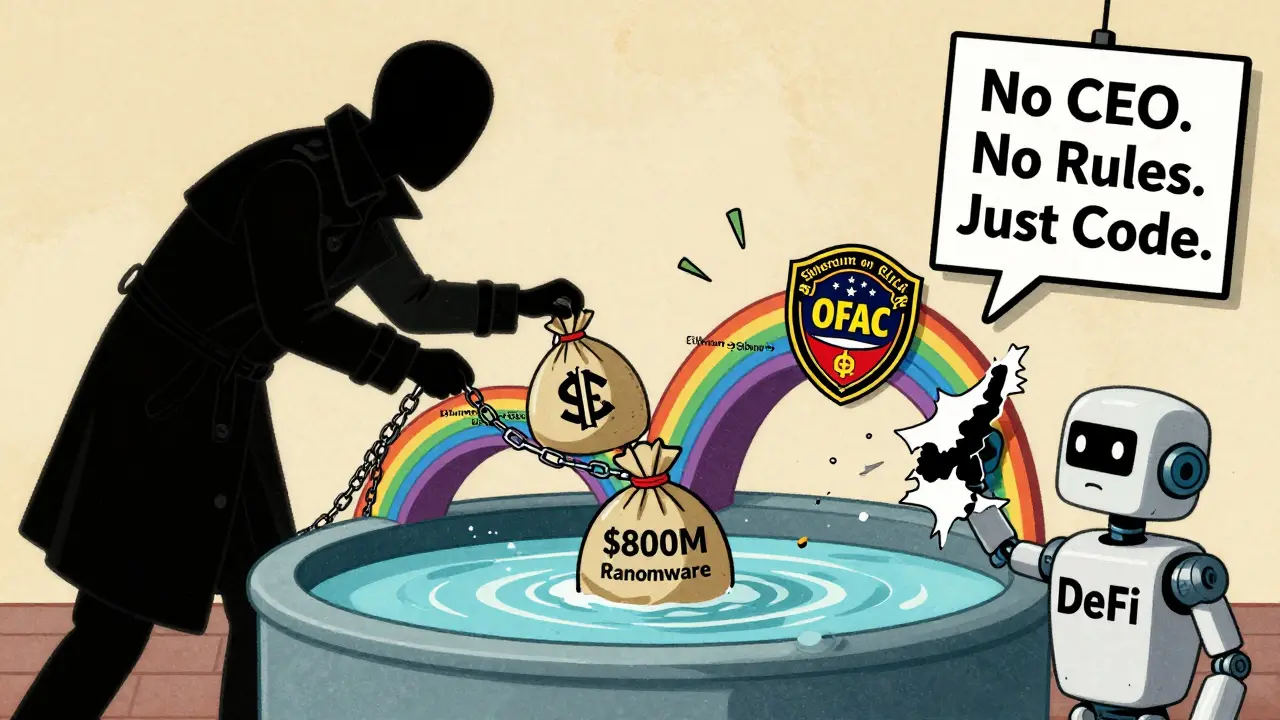
DeFi: The Wild West of Sanctions Evasion
One of the biggest surprises in 2024? DeFi platforms. Thirty-three percent of all illicit crypto funds passed through decentralized finance protocols. No CEO. No support desk. No account freeze button. Just code. And code doesn’t ask questions. Liquidity pools, automated market makers, and token swaps became the new money laundromats. OFAC flagged 150 DeFi pools in 2024, but that’s just the tip. Most DeFi apps don’t even know who’s using them. And that’s the problem. The shift from centralized exchanges to DeFi didn’t happen overnight. It was a slow escape. As regulators cracked down on platforms like Garantex, bad actors moved to Uniswap, SushiSwap, and other decentralized protocols. The tools to track them exist - but they’re slower, less precise, and often blocked by privacy layers.Why the Numbers Don’t Add Up
You’ll see different numbers depending on who you ask. Chainalysis says $15.8 billion. TRM Labs says $14.8 billion. CoinLaw.io says $2.7 billion. Why the gap? Because no one agrees on what counts as a “sanctioned entity.” Some firms track every wallet that ever touched a sanctioned address. Others only count wallets directly listed by OFAC. Some include wallets that received funds from a darknet market. Others ignore them. Chainalysis includes all indirect flows - meaning if a hacker sent ransomware money to Wallet A, and Wallet A sent $100 to Wallet B, Wallet B gets counted. TRM Labs is stricter. CoinLaw.io only tracks direct OFAC-designated addresses. That’s why their numbers are so much lower. This isn’t just a technical disagreement. It’s a policy problem. If regulators can’t agree on what to measure, how can they fix it?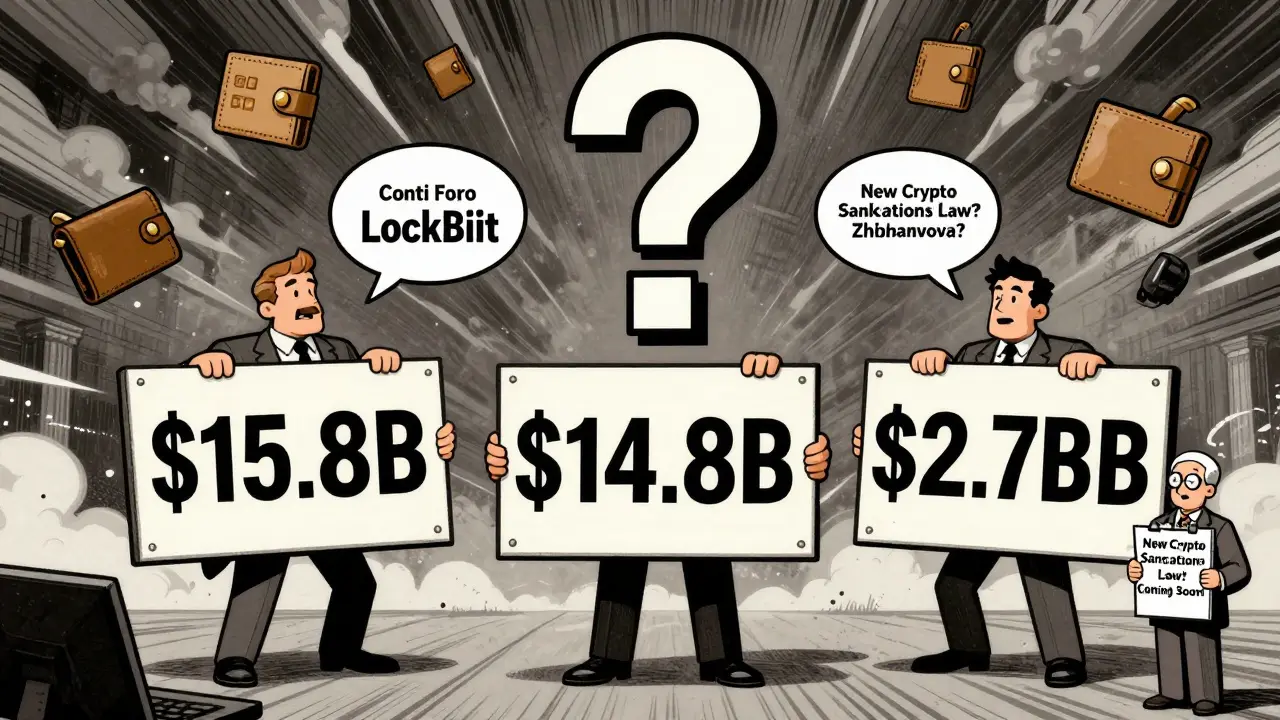
What Changed in 2024?
The big shift? Jurisdictions took over from individuals. In past years, most illicit crypto money went to individual hackers or fraud rings. In 2024, nearly 60% of the value went to country-level sanctions - Iran, Russia, North Korea. That’s a new level of scale. It’s no longer just crime. It’s economic warfare. The number of OFAC designations that included crypto addresses dropped slightly - 13 in 2024 versus 15 in 2023. But that’s misleading. The value per designation went up. A single sanctioned wallet could now move millions. And 55% of those wallets handled over $500,000 each. This wasn’t scattered activity. It was concentrated, high-volume, and well-organized. Meanwhile, fraud scams like “pig butchering” dropped 58%. Why? Because bad actors realized crypto sanctions offered a bigger, safer, and more profitable target. Why scam one person for $50,000 when you can move $100 million through a state-backed exchange?What’s Next?
The arms race is accelerating. On one side, blockchain analytics firms are using AI to detect patterns across millions of transactions. They’re mapping wallet networks, identifying clustering behavior, and flagging suspicious liquidity pools. On the other side, sanctioned entities are building new tools: privacy coins with zero-knowledge proofs, automated cross-chain routers, and decentralized mixers that don’t log anything. Regulators are responding. The U.S. Treasury is pushing for global cooperation. Countries are starting to share wallet data. The EU is drafting new crypto compliance rules. But enforcement still lags behind innovation. Blockchain volume hit $10.6 trillion in 2024 - up 56% from 2023. Monitoring that is like trying to track every drop of rain in a hurricane. The next big move? Legal frameworks specifically for crypto sanctions. Right now, OFAC uses old banking rules. That doesn’t work for DeFi. We need new laws that treat decentralized protocols like financial institutions - even if they have no headquarters. Until then, the $15.8 billion isn’t just a statistic. It’s a blueprint. And it’s being copied.Why is Bitcoin the main currency in sanctioned crypto transactions?
Bitcoin is the most widely adopted and tracked cryptocurrency, making it the default choice for large-scale illicit transfers. Its network is mature, liquidity is high, and it’s accepted by most exchanges - even those under sanctions. Unlike privacy coins, Bitcoin transactions are transparent, which helps bad actors avoid suspicion. They know regulators monitor it closely, but they also know it’s harder to fake. This paradox makes it ideal for moving large sums without drawing attention to the method - just the volume.
How do cross-chain bridges help evade sanctions?
Cross-chain bridges let users move crypto from one blockchain to another - say, from Ethereum to Solana. Sanctioned entities use these to break the trail. If a wallet is flagged on Ethereum, they send funds to a bridge, swap them on a different chain, then withdraw elsewhere. Since most blockchain analytics tools focus on single chains, this fragmentation makes tracking nearly impossible without real-time global coordination - which doesn’t exist yet.
Why did DeFi become a major tool for sanctions evasion?
DeFi platforms have no central authority. You don’t need an ID, a bank account, or permission to use them. This makes them perfect for hiding money. In 2024, 33% of illicit crypto funds passed through DeFi liquidity pools, automated swaps, or lending protocols. Regulators can’t shut them down. They can only flag them - and even then, the code keeps running. That’s why DeFi is now the frontline of sanctions evasion.
Why do different firms report such different figures for sanctioned crypto?
It comes down to methodology. Chainalysis counts indirect flows - if money touches a sanctioned wallet even once, it’s included. TRM Labs is more selective, focusing on direct transfers. CoinLaw.io only tracks wallets explicitly named by OFAC. So one firm might count $15 billion, another $14 billion, and another just $2.7 billion - all because they’re measuring different things. Without a global standard, these numbers can’t be trusted.
Is the $15.8 billion figure the total illicit crypto volume?
No. The $15.8 billion is only the portion tied to sanctioned jurisdictions and entities. Total illicit crypto activity in 2024 was closer to $40-45 billion, according to Chainalysis and TRM Labs. That includes fraud, ransomware, darknet markets, and theft. Sanctioned transactions made up about 39% of all illicit activity - the largest single category, but not the whole picture.
Austin King
March 4, 2026 AT 16:20Bryanna Barnett
March 5, 2026 AT 06:33Rachel Rowland
March 6, 2026 AT 22:52Bonnie Jenkins-Hodges
March 7, 2026 AT 13:50Cerissa Kimball
March 8, 2026 AT 02:26Melissa Ritz
March 9, 2026 AT 08:01Shawn Warren
March 10, 2026 AT 02:00Emily Pegg
March 12, 2026 AT 00:56Jeffrey Dean
March 13, 2026 AT 15:12Jane Darrah
March 14, 2026 AT 23:18Eva Gupta
March 15, 2026 AT 23:30Nancy Jewer
March 16, 2026 AT 15:26Julie Potter
March 17, 2026 AT 16:34Leah Dallaire
March 18, 2026 AT 13:40prasanna tripathy
March 20, 2026 AT 03:20James Burke
March 20, 2026 AT 03:42Olivia Parsons
March 21, 2026 AT 02:42Nick Greening
March 21, 2026 AT 19:28Issack Vaid
March 23, 2026 AT 08:54Jackson Dambz
March 24, 2026 AT 22:48Megan Lutz
March 24, 2026 AT 23:07Jesse VanDerPol
March 25, 2026 AT 21:52jonathan swift
March 27, 2026 AT 11:47Datta Yadav
March 29, 2026 AT 08:34Lydia Meier
March 31, 2026 AT 05:17jay baravkar
April 1, 2026 AT 00:32Ian Thomas
April 2, 2026 AT 22:57Josh Moorcroft-Jones
April 4, 2026 AT 19:53Basil Bacor
April 6, 2026 AT 10:05Ethan Grace
April 7, 2026 AT 01:34