

Trading cryptocurrency in a country that restricts or bans digital assets isn’t about finding loopholes-it’s about working within the rules, even when they’re unclear. If you’re in a place like Nigeria, Bangladesh, or even parts of China, you’re not alone. Millions of people still trade crypto despite legal gray zones. But doing it safely means one thing: compliance-first.
Understand What’s Actually Banned
Not every restricted country bans the same things. In Bangladesh, the central bank prohibits all cryptocurrency activity-buying, selling, holding, even receiving it as payment. Violations can lead to criminal charges under anti-money laundering laws. In China, it’s different. You can’t trade on local exchanges, you can’t mine, and banks won’t touch crypto. But if you hold Bitcoin in your own wallet? That’s not illegal. The ban targets intermediaries, not individuals.Indonesia takes a middle path. Crypto isn’t legal tender, so you can’t use it to pay for coffee. But the government classifies it as a commodity, not a currency. That means you can buy and sell it on licensed exchanges like Bappebti-approved platforms. It’s not a free-for-all, but it’s not a total ban either.
Knowing the exact scope of the ban changes everything. If possession is allowed, you can use self-custody wallets. If trading is banned but holding isn’t, peer-to-peer (P2P) platforms become your lifeline. If everything is banned, even holding, then you’re playing with fire-and that’s not worth the risk.
Self-Custody Is Your Best Friend
When banks won’t help you buy Bitcoin, and exchanges are shut down, the only way to hold crypto legally in restricted countries is through self-custody. That means using a non-custodial wallet-like Exodus, Trust Wallet, or a hardware wallet like Ledger-where you control the private keys. No third party. No bank account link. No traceable transaction history through local financial systems.This isn’t a workaround-it’s the only compliant path in places like China and Nigeria. The People’s Bank of China doesn’t care if you hold crypto privately. They care if you use a local exchange or convert crypto to fiat through a bank. Stay off those systems, and you stay under the radar legally.
But here’s the catch: self-custody means you’re fully responsible. Lose your seed phrase? Your coins are gone. Get hacked? No one’s coming to help. That’s why learning basic security-two-factor authentication, offline storage, avoiding phishing sites-isn’t optional. It’s the foundation of compliance-first trading.
Use P2P Platforms, But Choose Wisely
In countries like Nigeria and Vietnam, where banks block crypto transactions, peer-to-peer trading is the dominant method. Platforms like LocalBitcoins, Paxful, and Binance P2P let you buy crypto directly from other users using bank transfers, mobile money, or even cash.But not all P2P trades are safe. Some sellers are scammers. Some buyers are laundering money. That’s why you must stick to platforms with strong dispute resolution and verified sellers. Look for traders with high ratings, long histories, and clear communication. Avoid deals that ask you to send money to a third party or use untraceable methods like gift cards.
Also, keep records. Even if your country doesn’t require it, having proof of purchase-screenshots of chat logs, transaction IDs, payment receipts-can protect you if authorities ever ask questions. Compliance isn’t just about avoiding bans; it’s about being able to prove you’re playing by the rules.

Don’t Use Crypto for Payments
In many restricted countries, the real red flag isn’t holding crypto-it’s spending it. Indonesia explicitly bans using digital assets as payment. Nigeria’s central bank forbids financial institutions from processing crypto payments. Even in places like Argentina, where crypto adoption is high, the government warns businesses against accepting it for goods and services.Why? Because payments are traceable, reversible, and tied to real-world commerce. That’s what regulators fear most: crypto becoming a parallel financial system. If you’re trading crypto as an investment, you’re in a gray zone. If you’re using it to pay your rent or buy groceries, you’re in the crosshairs.
Stick to holding. Stick to trading. Avoid spending. That’s the simplest rule to stay compliant.
Watch for Regulatory Shifts-They’re Happening Fast
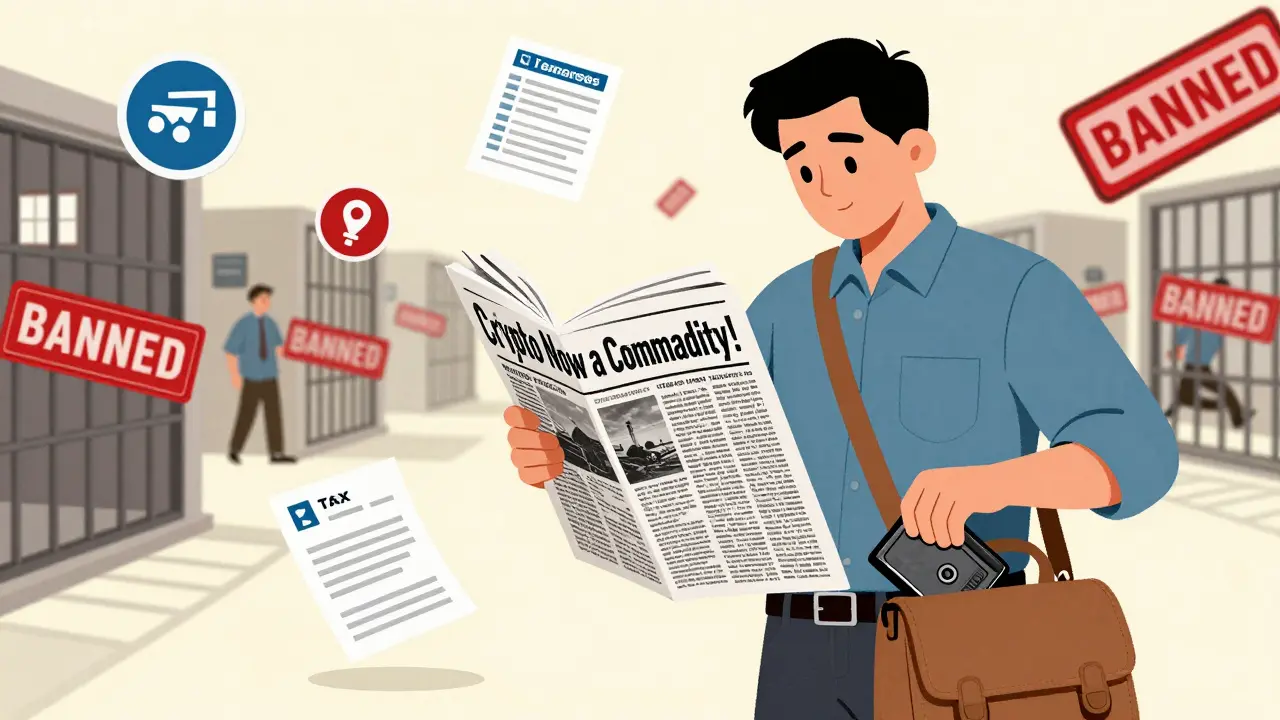
The idea that crypto bans are permanent is outdated. In 2025, 99 countries are actively updating their crypto laws, according to the Financial Action Task Force. Indonesia moved from warning traders to creating a regulated commodity market. Hong Kong launched its first stablecoin licensing regime in August 2025, allowing retail access to major cryptocurrencies under strict oversight. Singapore expanded its authority to monitor unlicensed crypto-derivative traders.That means today’s restriction could be tomorrow’s license. In 2021, Nigeria banned crypto banking. By 2025, its central bank was forming committees to explore blockchain integration. That’s not a sign of weakness-it’s a sign of adaptation.
If you’re in a restricted country, don’t just follow the rules. Follow the news. Subscribe to your central bank’s official announcements. Track changes in tax policy. Watch for new licensing frameworks. Compliance isn’t a one-time setup-it’s an ongoing practice.
Learn From Countries That Got It Right
Some places didn’t ban crypto-they built rules around it. Australia requires exchanges to register with ASIC and follow AML/KYC rules. Brazil classifies crypto as a security, so exchanges must be licensed and report transactions. Panama has no capital gains tax on crypto and clear AML guidelines.These countries didn’t stop innovation. They channeled it. They gave businesses clarity. They protected consumers. And they kept crypto out of the shadows.
That’s the goal for restricted countries too. If you’re trading crypto legally, you’re not just protecting yourself-you’re helping build a future where regulation replaces prohibition. Every compliant trade, every verified P2P deal, every tax record kept adds pressure on governments to move from fear to framework.
When to Walk Away
There are limits. If your country bans everything-including personal ownership, like in Algeria or Nepal-then trading crypto isn’t just risky. It’s illegal. No amount of self-custody or P2P trading changes that. The penalties aren’t fines. They’re jail time.And if you’re being pressured by authorities, or your bank is monitoring your transactions, don’t dig in. Pull back. Wait. Document everything. Talk to a lawyer who understands financial law in your country. Don’t rely on Reddit advice or Telegram groups. Real compliance comes from legal expertise, not online rumors.
Compliance Isn’t Boring-It’s Powerful
Most people think compliance means giving up freedom. But in restricted countries, it’s the only way to keep your freedom intact. You can’t fight a ban with a hack. You can’t outsmart a regulator with a VPN. But you can trade legally, safely, and quietly-by following the rules that exist, not the ones you wish were there.Compliance-first doesn’t mean you’re surrendering. It means you’re playing the long game. It means you’re building a future where crypto isn’t hidden-it’s understood. And that future starts with one simple choice: follow the law, even when it’s hard.
Don Grissett
January 5, 2026 AT 11:36bro i just bought btc on p2p with my uncle’s bank account and now the feds are knocking. you think compliance is cool until your name’s on a subpoena. lol.
Katrina Recto
January 6, 2026 AT 08:39Self-custody isn’t optional. It’s survival. Lose your keys, lose everything. No second chances.
Veronica Mead
January 8, 2026 AT 07:52It is profoundly irresponsible to suggest that individuals in jurisdictions with explicit prohibitions should engage in any form of cryptocurrency activity, regardless of the method employed. The rule of law exists for a reason, and circumvention-even under the guise of "compliance-first"-is an affront to civil order and regulatory integrity.
Mollie Williams
January 10, 2026 AT 01:07There’s something quietly revolutionary about holding your own keys in a world that wants to track every movement. It’s not about rebellion-it’s about reclaiming the quiet autonomy that financial systems have slowly erased. We think we’re buying crypto, but really, we’re buying back the right to be invisible when we choose to be.
Surendra Chopde
January 11, 2026 AT 07:45India is watching. Soon we will have our own regulated exchange. Until then, P2P is the only way. Use Binance P2P. Avoid gift cards. Always screenshot chat. Stay safe.
Tiffani Frey
January 11, 2026 AT 21:47Just a quick note: if you’re in a country where crypto is banned as a payment method, please don’t use it to buy groceries. I’ve seen people get arrested for that. It’s not worth it. Hold. Trade. Don’t spend. Simple.
Tre Smith
January 13, 2026 AT 10:46Everyone thinks they’re "compliance-first" until they get caught. You think self-custody makes you safe? Please. The government doesn’t care if you hold it in a Ledger-they care if you ever converted it to fiat. And they track fiat. Always. You’re not a hacker. You’re just a guy with a seed phrase and a death wish.
Ritu Singh
January 13, 2026 AT 18:05They want you to think this is about law… but it’s about control. The same people who banned crypto are the ones printing endless money. They don’t want you to have an alternative. They want you dependent. Self-custody? It’s not legal. It’s liberation. And they know it.
kris serafin
January 15, 2026 AT 02:23Use Trust Wallet. Enable biometrics. Never share your seed. Use a burner phone for P2P. And always, ALWAYS verify the seller’s history. 🛡️💰
Jordan Leon
January 15, 2026 AT 21:02There’s a difference between legality and morality. The state may ban crypto, but that doesn’t mean it’s unjust. And if you’re holding it quietly, not harming anyone, not laundering, not evading taxes-you’re not breaking the spirit of the law. You’re preserving the spirit of freedom.
Rahul Sharma
January 15, 2026 AT 22:25For beginners: Use only licensed P2P platforms. Check seller rating. Never use UPI for crypto. Use bank transfer. Save screenshots. If you are in India, wait for RBI rules. It is coming.
Gideon Kavali
January 17, 2026 AT 13:17Let me be crystal clear: if you’re trading crypto in a country that bans it, you’re not a savvy investor-you’re a traitor to your own nation’s sovereignty. America doesn’t let China control its financial system, and you shouldn’t let some anonymous blockchain dev control yours. This isn’t finance. It’s digital colonialism.
Allen Dometita
January 19, 2026 AT 11:44Compliance-first = smart-first. You don’t have to be a hero. Just be smart. Use P2P. Hold your keys. Don’t spend. Watch the news. You got this. 💪
Brittany Slick
January 20, 2026 AT 12:00There’s beauty in doing something quietly right. No fanfare. No brags. Just holding your keys, watching the market, and knowing you’re doing it the way that keeps you free-not just rich.
greg greg
January 21, 2026 AT 07:03It’s interesting to consider the broader epistemological implications of regulatory arbitrage in decentralized systems-particularly when one examines the tension between sovereign state authority and the emergent ontological reality of blockchain as a non-hierarchical, permissionless ledger architecture. If compliance is framed not as obedience to legal codification but as alignment with the intrinsic properties of cryptographic trust, then self-custody becomes not merely a technical choice but a metaphysical stance against centralized epistemic control. Furthermore, the notion of "gray zones" as legal liminal spaces suggests that the state’s inability to fully regulate decentralized networks reveals not a failure of enforcement but a failure of conceptual framework-a paradigm mismatch between analog governance and digital ontology.
LeeAnn Herker
January 21, 2026 AT 15:29Oh wow, "compliance-first"-right after you use a VPN to buy crypto on Binance P2P with a stolen credit card? Lmao. You’re not being smart. You’re being a hypocrite. The government bans it because it’s dangerous. You’re just mad you can’t gamble without consequences.
Sherry Giles
January 23, 2026 AT 11:26Canada’s about to ban crypto too. They’re watching the US. You think you’re safe? You’re just one audit away from losing everything. They’re coming for your wallet. And they’ll call you a criminal while they take it.
Andy Schichter
January 23, 2026 AT 20:49Wow. So much effort to say "don’t get caught." I’m impressed. Truly. The art of being a criminal with a PowerPoint.
Caitlin Colwell
January 24, 2026 AT 21:34My cousin in Nigeria uses P2P. She’s fine. Just doesn’t talk about it. And never uses her real name. Simple.
Natalie Kershaw
January 26, 2026 AT 13:35You’re not just trading crypto-you’re building the future of finance. Every P2P trade, every self-custody wallet, every tax record you keep? That’s how change happens. Keep going. We see you. 💫
Jacob Clark
January 26, 2026 AT 18:38Wait-so if I hold Bitcoin in a Ledger and never convert it, I’m "compliant"? But if I buy a pizza with it, I’m a criminal? That makes NO SENSE. Who decided this? Some guy in a suit who doesn’t even know what a private key is? This isn’t law. It’s chaos dressed in a suit.
Jon Martín
January 28, 2026 AT 18:28Compliance isn’t surrender. It’s strategy. You don’t fight the system-you outlast it. Stay quiet. Stay smart. Stay in the game. The world is changing. You’re not behind. You’re ahead.
Mujibur Rahman
January 29, 2026 AT 03:25In the UK, HMRC treats crypto as property. Even if you’re trading in Nigeria, if you’re a UK tax resident, you owe capital gains. Don’t assume anonymity means exemption. Tax authorities share data globally now. Be prepared.
Danyelle Ostrye
January 31, 2026 AT 01:15I’ve seen people lose everything trying to be clever. Don’t be the one who thought "I’m just holding" and ended up in court. Stay low. Stay smart. It’s not worth the risk.
Jennah Grant
February 1, 2026 AT 00:28Regulatory frameworks are evolving faster than most realize. What’s illegal today may be licensed tomorrow. The key is documentation. Keep records. Know your jurisdiction. Don’t assume. Verify. Compliance is a discipline, not a loophole.
Dennis Mbuthia
February 1, 2026 AT 12:55China banned mining? Good. They’re smart. Crypto is a Western scam to drain capital. You think you’re free? You’re just a pawn in a game where the house always wins. Stick to the yuan. Stay loyal. Don’t let Silicon Valley rob your future.
Dave Lite
February 2, 2026 AT 15:31Just did my first P2P trade in Nigeria. Used Binance. Seller had 12k+ trades. Paid via bank transfer. Got BTC in 8 mins. No drama. 🤝 You can do this safely. Just be smart.
Becky Chenier
February 4, 2026 AT 12:18Compliance-first doesn’t mean you’re weak. It means you’re patient. And patience is the only thing that outlasts bans.
Don Grissett
February 5, 2026 AT 17:16you’re all acting like this is a game. my cousin got arrested in Nigeria for holding btc. they took his house. he’s in jail. you think "self-custody" means safety? it means you’re the only one who knows you’re dead.
Tiffani Frey
February 6, 2026 AT 13:12That’s why documentation matters. Even if you’re not required to keep records, having proof you didn’t use it for payments or laundering could save you. Screenshots. Receipts. Dates. It’s not paranoia. It’s protection.