

Imagine you have some crypto sitting in your wallet. You want it to work for you, not just sit there. That’s where Automated Market Maker (AMM) pools come in. By providing liquidity to these pools, you help traders swap tokens and earn fees in return. It sounds like a dream, but it’s actually a complex financial activity with real risks. If you don’t understand how the math works, you could end up losing money even if the price of your tokens goes up.
In this guide, we’ll break down exactly what happens when you deposit funds into an AMM pool. We’ll look at the mechanics, the hidden costs like impermanent loss, and the strategies that experienced providers use to stay profitable in 2026. Whether you’re looking at Ethereum mainnet or faster Layer 2 solutions, knowing the ins and outs is critical before you click “approve.”
What Is an AMM Pool and How Does It Work?
Traditional exchanges use an order book. Buyers place bids, sellers place asks, and trades happen when prices match. AMMs ditch this model entirely. Instead, they use smart contracts to hold reserves of two different tokens. When you trade, you interact directly with this pool, not another person.
The most famous formula behind this is the constant product market maker model, often written as x * y = k. Here, x and y are the amounts of the two tokens in the pool, and k is a constant number that shouldn’t change during a trade. If someone buys Token A from the pool, the amount of Token A decreases. To keep k constant, the price of Token A must rise, and the amount of Token B in the pool must increase. This automatic pricing mechanism ensures there’s always liquidity available, regardless of market conditions.
Uniswap pioneered this approach. Today, it remains the dominant player in decentralized finance (DeFi). However, the landscape has evolved. Newer protocols introduce different formulas or incentives to attract specific types of assets. Understanding the basic mechanic is step one; understanding the evolution is step two.
The Role of Liquidity Providers (LPs)
You become a Liquidity Provider (LP) when you deposit paired tokens into a pool. Most pools require equal value in both assets. For example, if you want to provide $1,000 worth of liquidity to a WETH-USDC pool, you’d deposit $500 worth of Wrapped Ether (WETH) and $500 worth of USD Coin (USDC).
In return, you receive LP tokens. These aren’t spending money. They represent your share of the pool. As long as you hold them, you earn a portion of the trading fees generated by swaps in that pool. When you’re ready to exit, you burn these LP tokens to withdraw your original assets plus any accrued fees.
This system creates a symbiotic relationship. Traders get instant execution without waiting for a counterparty. LPs get continuous fee income. But this income isn’t guaranteed profit. It’s compensation for taking on inventory risk. The more volatile the pair, the higher the fees should be to justify the risk.
Understanding Impermanent Loss: The Hidden Risk
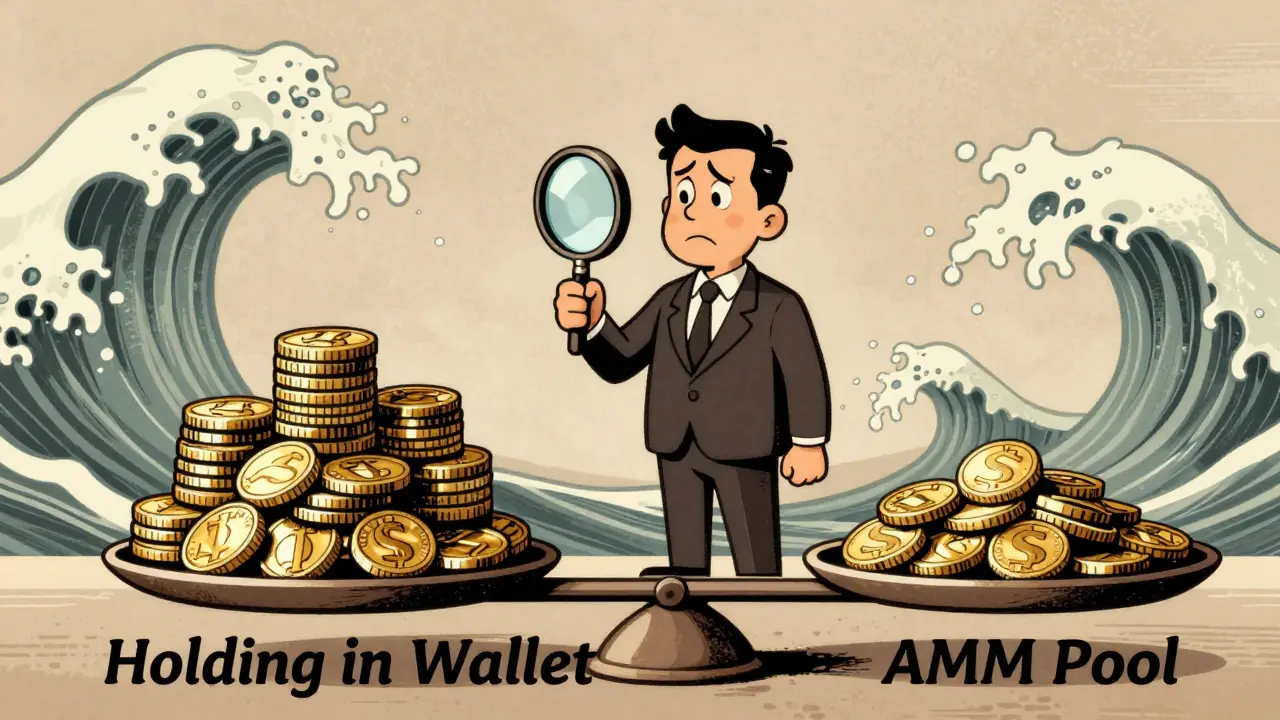
If you’ve heard warnings about AMMs, they likely revolved around impermanent loss. This term sounds scary because it implies permanent damage, but it’s actually a comparison metric. It measures how much less wealth you have in the pool compared to simply holding the same tokens in your wallet.
Here’s why it happens. When the price of one token changes significantly relative to the other, the AMM rebalances the pool. It sells the appreciating asset and buys the depreciating one to maintain the constant product ratio. If the price eventually reverts to its original level, your position recovers. If it doesn’t, you’re left with more of the loser and less of the winner than you started with.
Recent academic research from 2025 highlights a sobering statistic. On average, realized impermanent loss leads to a 3.8% loss per position compared to a simple buy-and-hold strategy. This means that unless the trading fees you earn exceed this 3.8% drag, you’re better off just holding the tokens. Volatility is the enemy of passive liquidity provision.
Concentrated Liquidity: The Game Changer
Early AMMs spread liquidity across the entire price range, from zero to infinity. This was inefficient. Most of your capital sat idle, earning no fees, because trades rarely happened at extreme prices. Enter concentrated liquidity, popularized by Uniswap V3.
With concentrated liquidity, you choose a specific price range where your capital will be active. If you believe ETH will trade between $3,000 and $3,500, you allocate your funds only within that band. Inside this range, your capital efficiency skyrockets. You earn significantly higher fees because your liquidity is dense where the action is.
However, this comes with a catch. If the price moves outside your chosen range, your position stops earning fees. Worse, it may convert entirely into the underperforming asset, maximizing your exposure to impermanent loss. Managing these ranges requires active monitoring or automated tools. It’s no longer a “set and forget” strategy.
Choosing the Right Pool and Platform
Not all pools are created equal. Your choice of platform and token pair drastically impacts your risk and reward profile. In 2026, several key players dominate the space, each with distinct advantages.
| Platform | Best For | Risk Profile | Key Feature |
|---|---|---|---|
| Uniswap | High volume pairs, general purpose | Medium to High | Concentrated liquidity, deep ecosystem |
| Curve Finance | Stablecoins and pegged assets | Low | Minimal impermanent loss, low slippage |
| Balancer | Customizable multi-asset portfolios | Variable | Weighted pools, diversification |
| PancakeSwap | Binance Smart Chain users | Medium | Lower gas fees, competitive yields |
| Raydium | Solana ecosystem | High | Ultra-fast transactions, Serum integration |
Curve Finance specializes in stablecoins. Since these assets are pegged to similar values, their correlation is high. This minimizes impermanent loss, making Curve ideal for conservative providers seeking steady, albeit lower, returns. On the other hand, Balancer allows you to create pools with three or more assets and custom weightings. This opens up sophisticated portfolio strategies beyond simple two-token pairs.
Layer 2 solutions like Arbitrum and Optimism offer lower transaction costs, which is crucial for frequent adjustments. However, research shows that established L2s sometimes suffer from negative elasticity between Total Value Locked (TVL) and trading volume. In simpler terms, adding more liquidity doesn’t always generate more fees. Emerging chains like Base and ZKsync show positive elasticity, meaning new liquidity can drive actual trading activity. Always check the volume-to-TVL ratio before committing capital.

Strategies for Profitable Liquidity Provision
To beat the odds and overcome impermanent loss, you need a strategy. Passive depositing rarely wins in the long run. Here are four proven approaches based on recent industry analysis:
- Correlated Tokens: Stick to pairs that move together. Stablecoin pairs or wrapped versions of the same asset (like wBTC and renBTC) have near-zero impermanent loss risk. You’re essentially earning yield on a stable position.
- Wide Ranges: If you’re using concentrated liquidity, setting a wider price range reduces the chance of your position going out of bounds. It sacrifices some capital efficiency for greater stability and peace of mind.
- Long Duration: Frequent entry and exit incur gas fees and potential slippage. Holding positions longer allows fee accumulation to outweigh temporary price fluctuations. Time is your friend in low-volatility environments.
- Active Management: Monitor your positions daily. Adjust your price ranges as the market moves. Use bots or algorithmic tools to rebalance automatically. This requires technical skill but maximizes returns.
Avoid “liquidity mining” traps. Some projects offer massive token rewards to attract liquidity. While the APY looks attractive, the reward token might crash in value. Always calculate the sustainable yield from trading fees alone. If the base yield is too low, the incentive structure is fragile.
Practical Steps to Get Started
Ready to dip your toes in? Here’s a practical checklist to ensure you don’t make costly mistakes.
- Start Small: Begin with a small amount you can afford to lose. Treat it as tuition for learning the interface and mechanics.
- Use Wallet Connectors Carefully: Only connect reputable wallets like MetaMask or Rabby. Never approve unlimited spending permissions unless necessary. Revoke approvals regularly using tools like Revoke.cash.
- Check Gas Fees: On Ethereum mainnet, gas fees can eat into profits. Consider using Layer 2 networks for testing or smaller positions.
- Analyze Historical Data: Use platforms like DefiLlama or Dune Analytics to check historical volatility and fee generation for your chosen pool.
- Understand Tax Implications: In many jurisdictions, LP rewards and fee income are taxable events. Keep detailed records of every transaction.
Implementation complexity varies. Basic liquidity provision takes a few hours to learn. Advanced strategies involving concentrated liquidity and cross-chain deployment require significant study. Don’t rush. Read the documentation. Test with minimal funds.
Future Trends in AMM Liquidity
The landscape is shifting. Future developments focus on reducing impermanent loss through novel mathematical models. Hybrid AMMs that combine order books with liquidity pools are emerging to capture the best of both worlds. Cross-chain interoperability is improving, allowing seamless liquidity movement between networks.
Algorithmic trading strategies are becoming standard for professional LPs. These bots adjust positions in real-time based on market conditions, optimizing for maximum fee capture while minimizing risk. For retail investors, managed liquidity products may offer a safer entry point, where experts handle the heavy lifting.
Regulatory scrutiny is increasing. Expect clearer guidelines on tax treatment and consumer protection. Stay informed. Adapt quickly. The DeFi space rewards those who understand the underlying technology and manage risk proactively.
What is the biggest risk of providing liquidity to an AMM pool?
The biggest risk is impermanent loss. This occurs when the price of the deposited tokens changes significantly relative to each other. The AMM rebalances the pool, causing you to hold more of the depreciating asset and less of the appreciating one. If the price doesn't revert, you lose value compared to simply holding the tokens in your wallet.
How do I minimize impermanent loss?
You can minimize impermanent loss by providing liquidity to correlated token pairs, such as stablecoins or wrapped versions of the same asset. Using wider price ranges in concentrated liquidity pools also helps, as does actively managing your position to adjust to market movements. Avoid highly volatile pairs unless the fee yield is exceptionally high.
Is providing liquidity to Uniswap V3 better than V2?
Uniswap V3 offers higher capital efficiency through concentrated liquidity, allowing you to earn more fees on the same amount of capital. However, it requires active management and carries higher risk if the price moves out of your selected range. V2 is simpler and more passive but less efficient. Choose based on your expertise and time commitment.
Can I lose my entire investment in an AMM pool?
While impermanent loss is recoverable if prices revert, you can lose value permanently if one of the tokens in the pair goes to zero due to a hack, rug pull, or project failure. Always vet the projects and smart contracts before providing liquidity. Smart contract bugs also pose a risk, though major platforms undergo rigorous audits.
What are LP tokens?
LP tokens are receipts that represent your share of the liquidity pool. They are not tradable currency. You hold them to prove ownership of your deposited assets and accrued fees. To withdraw your funds, you must burn these LP tokens back into the protocol. They can also be used in other DeFi applications as collateral.