
Imagine turning your audience into actual stakeholders. That is the promise of social tokens, which are digital assets that let creators monetize their personal brand directly without relying on middlemen like Patreon or YouTube. Unlike traditional stocks or even standard cryptocurrencies, the value here isn't just about speculation-it's tied to your social capital, your content, and the access you provide. If you have been thinking about making the jump in 2026, you are not alone. The market has exploded, with Coinbase reporting a massive 217% year-over-year increase in social token transactions leading up to late 2024. But launching one isn't as simple as hitting a "publish" button. It requires strategy, technical know-how, and a clear understanding of what you are actually selling.
What Exactly Is a Social Token?
To get this right, you first need to know what you are building. A social token is a type of cryptocurrency issued by an individual, group, or community. Its primary function is to create a direct economic relationship between the creator and their fans. When someone buys your token, they aren't just buying a piece of digital paper; they are buying access. This could mean entry to exclusive Discord channels, voting rights on your next project, or even physical perks like meet-and-greets.
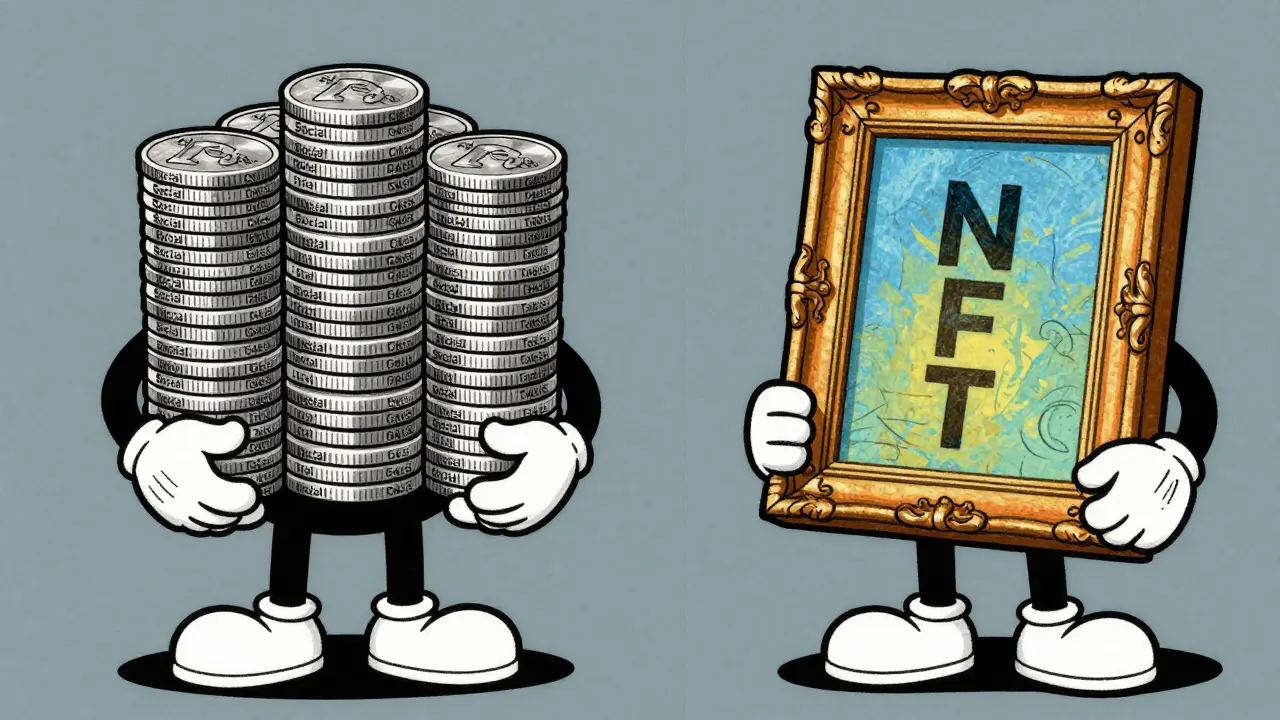
There is often confusion between social tokens and NFTs (Non-Fungible Tokens). Here is the difference: an NFT is unique-like a specific painting or a single ticket. You can sell only one version of it. A social token is fungible, meaning every token is identical to the next, similar to how every dollar bill is worth the same. This makes social tokens better for recurring revenue and ongoing community engagement, while NFTs are better for one-off collectibles. According to a 2024 survey by TokenMinds, creators using social tokens generated 3.2 times more recurring revenue than those relying solely on NFTs.
| Feature | Social Token | NFT |
|---|---|---|
| Fungibility | Fungible (interchangeable) | Non-fungible (unique) |
| Primary Use | Access, governance, recurring revenue | Collectibles, proof of ownership |
| Revenue Model | Recurring via utility & trading volume | One-time sales & secondary royalties |
| Best For | Communities & subscriptions | Art, music files, limited editions |
Choosing Your Blockchain: Ethereum vs. Solana
The foundation of your token is the blockchain it lives on. In 2026, the choice largely comes down to cost versus security. Most social tokens start as ERC-20 tokens on Ethereum, which is the most established blockchain network known for its robust security and large developer ecosystem. However, Ethereum can be expensive. During peak times in late 2024, gas fees sometimes exceeded $50 per transaction. While the Dencun upgrade in March 2024 reduced Layer 2 fees significantly, mainnet costs remain a barrier for smaller communities.
On the other hand, Solana offers a high-performance blockchain capable of processing thousands of transactions per second with minimal fees. Solana handles around 65,000 transactions per second compared to Ethereum's 15-30, and the average transaction cost is about $0.01. For a new creator whose fans might only want to spend $10 on tokens, Ethereum fees make no sense. Solana is becoming the go-to for micro-transactions and high-volume community interactions. Just remember: Ethereum still holds the majority of institutional trust and liquidity, so if you aim for long-term holding by serious investors, Ethereum (or its Layer 2 solutions like Polygon) might still be the safer bet.
Designing Your Tokenomics: The Blueprint
This is where most projects fail. You cannot just mint 1 million tokens and hope for the best. You need a plan called tokenomics-the economics of your token supply. Start by asking: What is the total supply? Who gets the tokens? And what do they do with them?
A common mistake is allocating too much to yourself. Successful projects typically cap team allocations at 20% or less, with a vesting period of 6 to 12 months. Vesting means you don't get all your tokens at once; they unlock over time. This shows your community you are committed to the long haul and prevents you from dumping all your tokens on day one, which would crash the price. According to data from OSL Academy, projects with transparent token distribution saw 44% higher trust scores in community surveys.
You also need to define utility. Why should someone hold your token instead of spending that money on coffee? Utility examples include:
- Tiered Access: Holding 10 tokens unlocks a basic Discord role; 100 tokens unlocks monthly Q&A sessions.
- Governance: Token holders vote on your next album cover, podcast topic, or charity donation.
- Discounts: Using tokens to buy merchandise gives a 15% discount.
Without clear utility, your token is just a speculative asset. As Nic Carter of Castle Island Ventures warned in early 2025, many social tokens lack intrinsic utility and end up functioning merely as gambling chips. Make sure your token solves a problem or provides a tangible benefit.
The Technical Launch Process
If you are not a coder, do not panic. You do not need to write smart contracts from scratch, but you do need to understand the steps. Here is the typical workflow for launching a social token in 2026:
- Choose a Platform: Services like Rally, TokenMinds, or Mighty Networks allow you to launch tokens without deep coding knowledge. Rally processed $142 million in transactions in Q4 2024, showing it is a mature option for non-technical creators.
- Set Up Wallets: You will need a crypto wallet like MetaMask (for Ethereum/Polygon) or Phantom (for Solana). Never share your private keys with anyone.
- Deploy the Contract: On platforms like Rally, this is a click-through process. If doing it manually on Ethereum, expect to pay $220-$1,100 in gas fees depending on network congestion. On Solana, it costs pennies.
- Add Liquidity: For people to buy your token on exchanges, there needs to be a pool of funds. You usually pair your token with ETH or SOL on a decentralized exchange (DEX) like Uniswap or Raydium. This initial liquidity is crucial-if there is no pool, no one can trade.
- List on Exchanges: Start with DEXs. Centralized exchanges like Coinbase or Binance have strict requirements and are harder to get into initially.
Security is paramount. Before going live, consider hiring a firm like CertiK to audit your smart contract. Costs range from $5,000 to $15,000. It sounds steep, but in 2024, 18% of social tokens had critical vulnerabilities, and breaches cost projects millions. An audit protects your reputation and your community's funds.
Legal and Regulatory Realities in 2026
We cannot ignore the law. The regulatory landscape for social tokens is still evolving, especially in the US. The SEC’s 2024 enforcement actions against several token projects created uncertainty, placing 41% of social tokens in legal gray areas. The key question regulators ask is: Is your token a security?
If investors are buying your token primarily because they expect profits from your efforts, it might be classified as a security. To mitigate this risk, focus heavily on utility. The EU’s MiCA framework provides clearer guidelines, which is why many European creators feel more comfortable launching there. In the US, the proposed 'Creator Token Framework' suggests exemptions for tokens under $10 million in market cap if they demonstrate clear utility. Always consult with a lawyer specializing in digital assets before launching. Do not rely on generic advice found online.

Building the Community First
Here is the hard truth: You should not launch a token until you have a dedicated community. Harvard Business Review analyzed 317 token launches and found that projects starting with fewer than 10,000 highly engaged followers had an 82% failure rate. Engagement matters more than raw follower count. One thousand super-fans who interact daily are worth more than one hundred thousand passive scrollers.
Spend 3-6 months building this base before you even think about code. Talk to them. Ask what they want. Create a whitelist of early supporters who will buy in during the private sale phase. This initial group provides the liquidity and social proof needed to attract broader interest. Remember, the value of your token is intrinsically tied to your ability to deliver value. If you stop creating content, your token price will drop. As one Reddit user noted after their influencer’s token crashed 70% due to a controversy, "The value proposition is fragile." Consistency is your best defense.
Cost Breakdown and Budgeting
Launching a social token is an investment. Here is a realistic budget estimate for a professional launch in 2026:
- Smart Contract Deployment: $0.01 (Solana) to $1,100 (Ethereum)
- Security Audit: $5,000 - $15,000 (highly recommended)
- Liquidity Provision: $10,000 - $50,000+ (depends on desired depth)
- Marketing & Legal: $5,000 - $20,000
- Total Estimated Cost: $20,000 - $85,000+
If these numbers scare you, consider starting small on a low-cost chain like Solana or using a no-code platform that handles the heavy lifting. You can always migrate or expand later as revenue grows.
Do I need coding skills to launch a social token?
No, you do not need to be a programmer. Platforms like Rally, TokenMinds, and Mint.fun offer no-code interfaces that handle smart contract deployment for you. However, having a basic understanding of blockchain concepts helps you manage risks and communicate effectively with developers if you hire them.
How much does it cost to launch a social token on Ethereum?
The direct gas fee for deploying a basic ERC-20 token on Ethereum mainnet ranges from $220 to $1,100 depending on network congestion. However, you must also budget for liquidity provision, security audits ($5k-$15k), and marketing, bringing the total professional launch cost to $20,000 or more.
Are social tokens legal in the United States?
The legality is complex. The SEC views some social tokens as unregistered securities if investors expect profits from the creator's efforts. To reduce risk, focus on utility (access, voting) rather than financial returns, and consult a legal expert. The EU’s MiCA regulation offers clearer guidelines, making Europe a potentially safer jurisdiction for now.
What is the difference between a social token and an NFT?
Social tokens are fungible, meaning each token is identical and interchangeable, making them ideal for recurring access and community membership. NFTs are unique, non-interchangeable digital items, better suited for collectibles, art, or one-time purchases. Creators often use both together.
When is the right time to launch a social token?
You should launch when you have at least 10,000 highly engaged followers and a clear utility model. Studies show projects with smaller or less engaged audiences have an 82% failure rate. Spend 3-6 months building community trust and testing demand before investing in development.
Drew M
July 13, 2026 AT 20:37Oh, absolutely darling. 🌟 The sheer audacity of thinking one can simply 'monetize their personal brand' without understanding the nuanced socio-economic fabric of digital scarcity is breathtakingly naive. I mean, truly. One must approach this with the grace of a swan gliding over murky waters. 💅✨
Deep Rahman
July 14, 2026 AT 18:43I have been contemplating the nature of value in the digital realm for quite some time now and it seems to me that what we are calling social tokens is merely a reflection of our collective desire for connection in an increasingly isolated world where we seek tangible proof of our existence through these digital artifacts that represent not just currency but a piece of our shared humanity and trust in one another which is a profound thing indeed.
Melissa Beckwith
July 16, 2026 AT 08:24Let us be clear about the technical implications here because most people glossing over this article clearly do not understand the fundamental differences between Layer 1 scalability issues on Ethereum versus the Proof of History mechanism on Solana which fundamentally alters the transaction finality and thus the user experience for micro-transactions which is why any serious creator should be looking at Solana or Polygon rather than mainnet Ethereum unless they want to bleed gas fees into oblivion while their community chafes at the high entry barrier.
Josephine Finlayson
July 18, 2026 AT 07:53It is so lovely to see such a comprehensive guide; I hope everyone takes the time to consider the ethical implications as well! 😊 It is important to remember that behind every token is a person, and treating them with kindness and respect is paramount. Let us all strive to build communities that are inclusive and supportive! ✨🌸
Tuan Nguyen
July 18, 2026 AT 10:09The entire premise of 'social capital' being convertible to financial capital is a grotesque distortion of human interaction. You are essentially commodifying friendship. It is pathetic how desperate creators are to squeeze every last cent from their audience. This isn't innovation; it is parasitism disguised as empowerment. Disgusting.
Hazel Fruitman
July 18, 2026 AT 22:26its really sad that weve come to a point where ppl need crypto to support art. its not fair to fans who cant afford it. the system is broken and its wrong to exploit people like this. we need change not more scams.
Autumn Story
July 18, 2026 AT 23:41I think this is such a wonderful opportunity for creators!! 😊 I know it might seem scary at first, but if you take it slow and ask your community what they want, it can be really positive! Just make sure you are honest and kind! ❤️✨
Mark Tuason
July 20, 2026 AT 10:37I appreciate the detailed breakdown of costs. It is important to acknowledge that while the potential for direct monetization exists, the regulatory landscape remains precarious. Creators would be wise to consult legal counsel before proceeding, as the distinction between a utility token and a security is often blurred in practice.
Ella Collinson
July 20, 2026 AT 14:38The inefficiency of ERC-20 standards for high-frequency micro-interactions is glaring. If you are not utilizing a high-throughput L1 like Solana or a sophisticated L2 rollup solution with optimistic fraud proofs, you are architecturally doomed to fail due to latency and cost constraints. The tokenomics section ignores the liquidity fragmentation inherent in DEX models.
Ray Arney
July 20, 2026 AT 20:19I guess it depends on what you want out of it. For me, I just want to support my favorite streamers without going through Patreon's cut. Seems fair enough.
Anuj Kashyap
July 21, 2026 AT 03:16Oh, look at you, trying to tokenize love. How quaint. 🙄 As if buying a JPEG or a fungible blob makes you part of the 'inner circle.' Spoiler alert: it doesn't. You're still just a wallet address to the algorithm. But hey, keep spending your rent money on 'access' to a Discord channel. 🤡💸
Tracy Marshall
July 21, 2026 AT 20:02this is clearly part of the great reset plan to track all our spending habits and control our thoughts through blockchain surveillance they dont want you to know that the SEC is in on it and its all a trap to steal your identity and your soul (:(
Guy Davis
July 22, 2026 AT 04:29Its greedy. Stop asking for money.
KEITH WONG
July 23, 2026 AT 06:34You guys are missing the big picture. It’s about freedom from Big Tech. 🚀💪 If you’re scared of losing a few bucks, you’re not ready for the future. Wake up sheeple!
John Harman
July 24, 2026 AT 05:06Actually, the comparison to NFTs is flawed because NFTs have proven to be a far superior model for establishing verifiable ownership of unique creative works, whereas social tokens suffer from infinite dilution risks and lack the scarcity premium that drives true collector value, which is why smart money is moving away from fungible social assets back to PFP projects.
Antony Lopez
July 24, 2026 AT 21:45This whole crypto space is dominated by foreign entities trying to undermine our local economy. We need American-led blockchain solutions that respect our laws and values. Don't let these globalists trick you into using offshore chains. Keep it domestic and secure.
Erika Pozzetto
July 25, 2026 AT 23:44It is imperative that we consider the long-term sustainability of such models. While the initial excitement may drive adoption, the retention rates are notoriously low. Therefore, a robust community management strategy is essential to ensure that the perceived value of the token does not depreciate rapidly after the initial launch phase.
Winston Lacewing
July 27, 2026 AT 09:43Wait, did you say you need 10k followers? What if I only have 5k but they are MY friends?? 😭😭😭 This is so exclusive and hurtful! Why can't I have access too?? 🥺💔 Tell me I'm special!!
Kristine Lawson
July 28, 2026 AT 12:49On the contrary, the entire concept is fundamentally flawed. The idea that 'utility' can justify a speculative asset is a legal fiction designed to evade securities regulations. Furthermore, the environmental impact of even 'green' blockchains is negligible compared to the energy wasted on mining Bitcoin, yet we pretend otherwise. It is dishonest.