

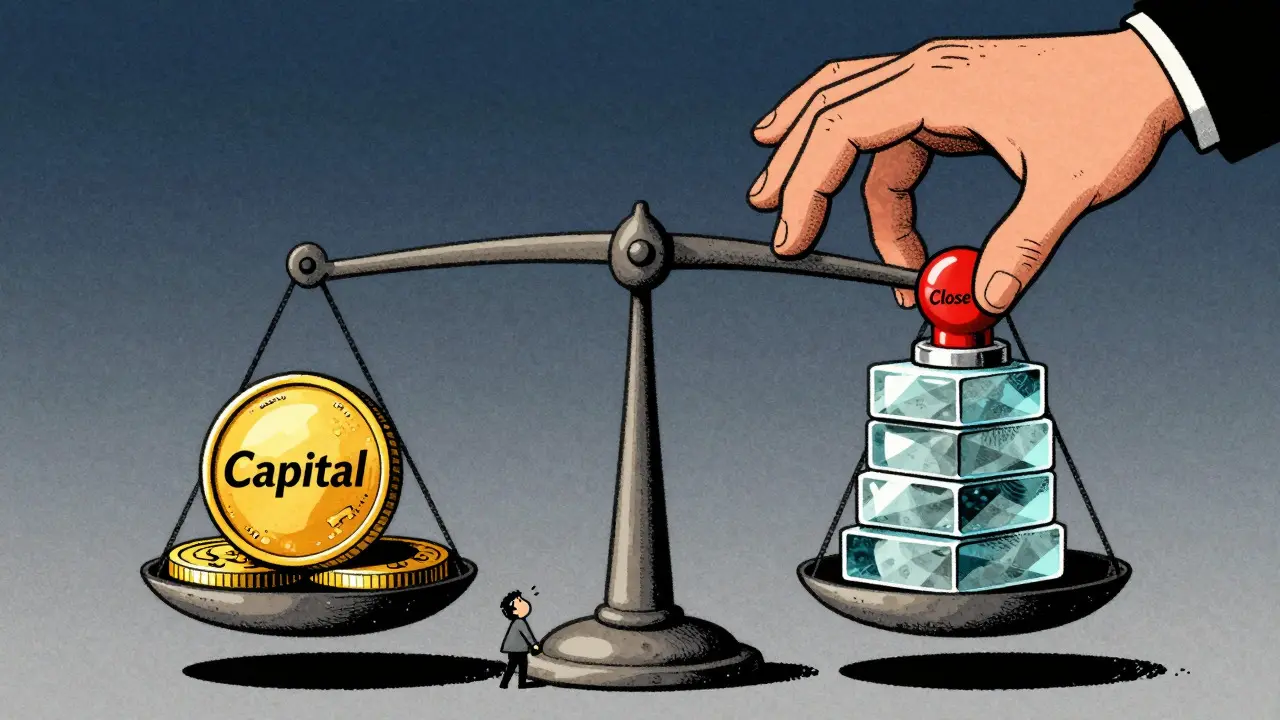
Imagine watching your screen as the price of Bitcoin dips just 5% against your position. If you are trading with 20x leverage, that small move doesn't just reduce your profit-it wipes out your entire account balance in seconds. This is Liquidation, a mechanism that forces the automatic closure of your trade when your collateral runs too low. It is the safety net for exchanges and the nightmare scenario for traders who underestimate how fast leverage works against them.
Understanding this process isn't just about avoiding losses; it's about knowing exactly where your exit door is before you walk into the room. Whether you are using centralized platforms like Binance or DeFi protocols like Aave, the core logic remains similar: if your equity falls below a specific threshold, the system takes control. Let's break down the mechanics, the math, and the strategies that keep experienced traders alive in volatile markets.
The Core Mechanics: Initial vs. Maintenance Margin
To grasp liquidation, you first need to understand the two types of margin involved in any leveraged position. Think of Initial Margin as the deposit you make to open a trade. If you want to buy $10,000 worth of Bitcoin with 10x leverage, you only need to put up $1,000 (10%) as initial margin. The exchange lends you the remaining $9,000.
Maintenance Margin is different. This is the absolute minimum amount of capital you must keep in your account to stay in the game. It acts as a buffer. If your account equity drops below this maintenance requirement, the position becomes "under-collateralized." Most major exchanges set this between 0.5% and 1% of the position value. For example, on a $10,000 position, your maintenance margin might be just $50 to $100. If your total funds (initial margin + unrealized profits - unrealized losses) fall below that $50-$100 mark, liquidation triggers.
This distinction is critical because many beginners confuse the entry cost with the survival threshold. You don't get liquidated when you lose your initial margin; you get liquidated when you lose almost all of it, leaving only enough to cover the maintenance fee.
Calculating Your Liquidation Price
Your liquidation price is not a static number etched in stone. It moves dynamically based on market conditions, funding rates, and the specific formula used by your exchange. However, the basic calculation follows a predictable pattern depending on whether you are long or short.
For a long position (betting the price will go up), the liquidation price is calculated as:
- Liquidation Price = Entry Price × (1 - Initial Margin Rate + Maintenance Margin Rate)
For a short position (betting the price will go down), the formula flips:
- Liquidation Price = Entry Price × (1 + Initial Margin Rate - Maintenance Margin Rate)
Let's apply real numbers. Suppose you enter a long position on Bitcoin at $60,000 with 10x leverage. Your initial margin rate is 10% (0.10). Assuming a standard maintenance margin rate of 0.5% (0.005), your liquidation price would be roughly $60,000 × (1 - 0.10 + 0.005) = $54,300. That means if Bitcoin drops from $60,000 to $54,300, you are out. Now, imagine you used 20x leverage instead. The initial margin rate drops to 5% (0.05). The new liquidation price becomes $60,000 × (1 - 0.05 + 0.005) = $57,300. Notice how doubling the leverage cut your safety buffer in half. At 50x leverage, a mere 2% adverse move could wipe you out.
Centralized Exchanges vs. DeFi Protocols
Not all liquidations happen the same way. The environment you trade in dictates the speed, fairness, and cost of the process.
| Feature | Centralized Exchanges (Binance, Bybit) | DeFi Protocols (Aave, Compound) |
|---|---|---|
| Trigger Method | Automated engine uses mark price oracles | Third-party liquidators compete to close positions |
| Execution Speed | Near-instantaneous (milliseconds) | Depends on block time and gas fees (seconds to minutes) |
| Cost to Trader | Often built into slippage or small fee (0-0.5%) | Discounted collateral sale (5-15% discount to liquidator) |
| Price Source | Weighted average of multiple exchanges | On-chain price feeds (e.g., Chainlink) |
| Risk of Wicks | High during flash crashes | Moderate, but higher due to execution lag |
In centralized environments, the exchange acts as both the house and the dealer. They use complex algorithms to determine the "mark price," which is an index price derived from several spot and futures markets. This prevents a single wick on one exchange from triggering mass liquidations. In DeFi, however, there is no central authority. Instead, anyone can become a liquidator. If your health factor drops below 1, a bot can step in, pay off your debt, and take your collateral at a discount. This creates a competitive market for liquidations, which generally keeps prices efficient but introduces execution risks if the network is congested.
The Role of Funding Rates and Mark Price
One of the most misunderstood aspects of liquidation is that your displayed price isn't always the price used for calculations. Exchanges use a Mark Price rather than the last traded price. Why? Because the last traded price can be manipulated by a single large order. The mark price is a smoothed, weighted average that reflects the true market sentiment.
Additionally, perpetual swaps involve Funding Rates. These are periodic payments exchanged between longs and shorts to keep the perpetual contract price aligned with the spot price. If the market is bullish, longs pay shorts. If bearish, shorts pay longs. While funding rates don't directly change your liquidation price formula, they affect your account equity over time. A high positive funding rate can slowly erode your margin balance even if the price stays flat, effectively moving your liquidation point closer. Traders often forget this "slow bleed" effect, leading to unexpected liquidations during stagnant markets.
Common Pitfalls and How to Avoid Them
Most retail traders don't get liquidated because they were wrong about the direction of the market; they get liquidated because they managed their risk poorly. Here are the top traps to avoid:
- Ignoring Cross-Margin Risks: In cross-margin mode, all your free balance supports the position. This seems safer, but if you have other open trades, a loss in one can drain the collateral needed for another, causing a cascade of liquidations across your portfolio.
- Underestimating Volatility Clusters: Research shows that 78% of liquidations occur near major technical support or resistance levels. Prices often dip slightly past these levels to trigger stop-losses and liquidations before reversing. If you place your stop-loss right at a round number, you are likely to get stopped out at the worst possible moment.
- Over-Leveraging for Small Moves: Using 50x or 100x leverage assumes perfect timing. In reality, even a 1-2% noise move can kill your position. Professional traders typically stick to 2-5x leverage, allowing for significant drawdowns without risking total ruin.
Practical Risk Management Strategies
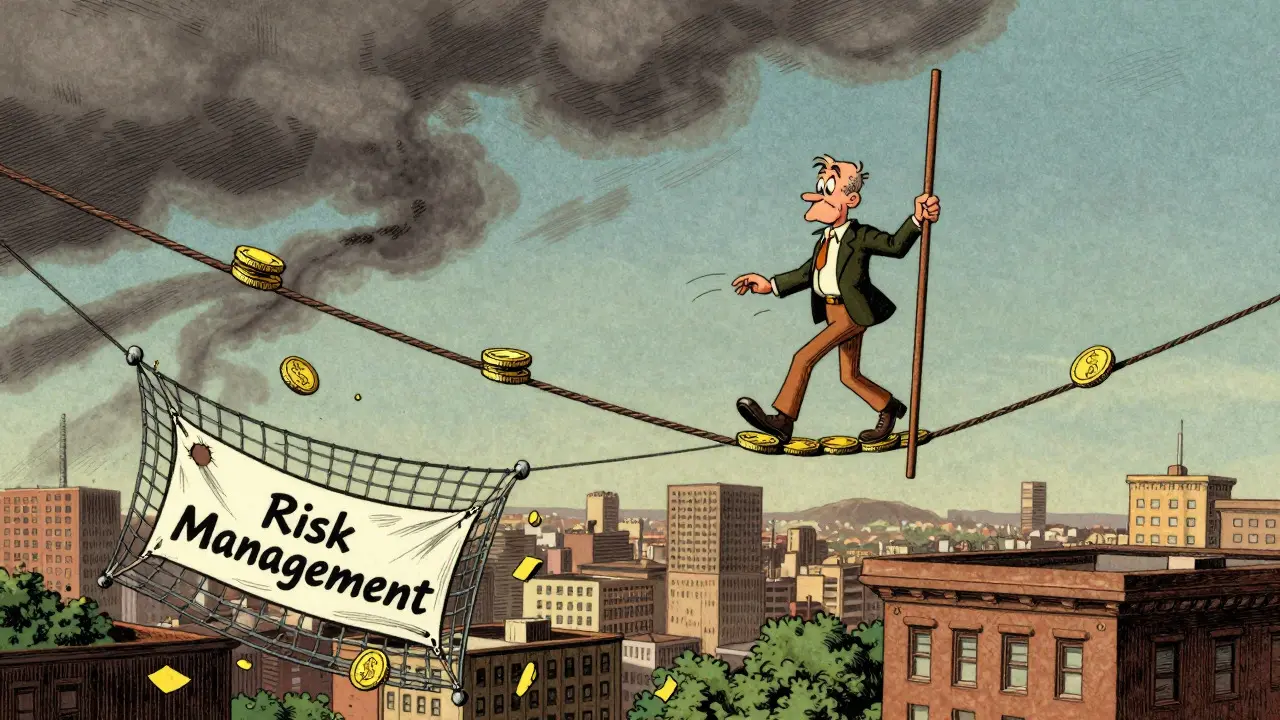
You cannot eliminate the risk of liquidation, but you can significantly lower the probability of it happening. Experienced traders use a few key tactics to stay in control.
First, calculate your exact liquidation price before entering any trade. Use the exchange's built-in calculator or a third-party tool. Never guess. Second, set your stop-loss order at 70-80% of the distance to your liquidation price. This ensures you exit voluntarily before the system forces you out. Third, maintain excess collateral. Keeping 20-30% more capital in your margin account than the minimum required provides a buffer against sudden spikes in volatility or funding rate changes.
Finally, consider using isolated margin for speculative trades. This limits your potential loss to just the margin allocated to that specific position, protecting the rest of your portfolio from a single bad trade. For larger, higher-conviction positions, cross-margin might be appropriate, but only if you monitor your overall account health closely.
Frequently Asked Questions
What happens to my funds after liquidation?
When a position is liquidated, the exchange closes the trade and deducts any fees and losses from your margin balance. If you had excess funds, they remain in your account. If the loss exceeds your margin (which can happen in extreme gaps), you may owe the exchange a small amount, though most modern platforms cap this liability. In DeFi, your collateral is sold to pay off the debt, and any remaining assets return to your wallet.
Is liquidation the same as a stop-loss?
No. A stop-loss is an order you place to close your position at a specific price. Liquidation is a forced closure by the exchange when your margin falls below the maintenance requirement. Ideally, your stop-loss should trigger before liquidation does. If your stop-loss is set too close to your liquidation price, or if the market moves faster than your order can execute, you may still face partial liquidation.
Why did I get liquidated even though the price didn't hit my liquidation level?
This usually happens due to the difference between the last traded price and the mark price. During high volatility, the mark price can spike briefly above or below the actual traded price. If the mark price crosses your liquidation threshold, the system triggers liquidation, even if the final closing price ends up back within your safe zone. Additionally, funding rate changes can shift your effective liquidation point over time.
Which leverage is safest for beginners?
Most experts recommend starting with 2x to 5x leverage. At 5x, you can withstand a 20% adverse price movement before facing serious margin calls. This allows for normal market fluctuations without immediate risk of ruin. As you gain experience and develop better entry/exit strategies, you can gradually increase leverage, but never exceed 10x unless you have strict stop-losses in place.
Do liquidation fees vary by exchange?
Yes. Some exchanges like BitMEX charge an explicit liquidation fee (e.g., 0.5%). Others like Binance and Bybit have removed explicit fees but incorporate the cost through less favorable execution prices or slippage. In DeFi, the "fee" is the discount given to the liquidator, typically ranging from 5% to 15% of the collateral value. Always check the specific fee schedule of your platform before trading.
Susan Kiley
August 18, 2026 AT 00:10Oh, how delightfully pedestrian this exposition is. One assumes that by the time one has read this, the market has already moved on to something more intellectually stimulating, like perhaps a new algorithmic arbitrage strategy that doesn't require a PhD in stochastic calculus to understand. It is almost offensive how basic this is for those of us who actually trade for a living rather than just watching the numbers go up and down with wide-eyed wonder. The concept of maintenance margin is not rocket science, yet here we are, dissecting it like it's the Rosetta Stone. I suppose for the common man, knowing that 20x leverage is a death sentence is a revelation, but for the elite trader, it is merely a Tuesday afternoon fact. Let us hope this post serves its purpose for the masses, though I doubt many will retain the information long enough to apply it correctly before their next impulsive entry. The drama of liquidation is best appreciated from a safe distance, preferably with a large buffer of capital that ensures you never have to worry about such trivialities as 'wiping out' your account. It is a charmingly naive guide, really.
Darren Moon
August 18, 2026 AT 13:37It is, without question, a rather tedious enumeration of the obvious. The distinction between initial and maintenance margin is a fundamental tenet of derivative trading that should be ingrained in any individual possessing even a modicum of financial literacy. To present it in such a verbose manner suggests a lack of confidence in the reader's cognitive abilities. Furthermore, the comparison between centralized exchanges and DeFi protocols is superficial at best; it ignores the systemic risks inherent in smart contract vulnerabilities which are far more significant than the mere execution speed of a liquidation event. The jargon used is adequate, if not slightly archaic in its application to modern high-frequency trading environments. One must appreciate the effort, however, for attempting to codify what is essentially a mechanical process into a readable format. The inclusion of funding rates is a necessary addition, given their impact on equity erosion over time, yet it feels tacked on rather than integrated into the core narrative. A competent trader does not need a guide to tell them where the exit door is; they calculate it before entering the room. Nevertheless, for the uninitiated, it serves its function, albeit with a heavy hand of redundancy.
Quang Thai Tran
August 19, 2026 AT 05:50The authorities have been feeding us this sanitized version of liquidation mechanics for decades. They want you to believe that the mark price is a fair representation of the market, when in reality, it is a weighted average designed to trigger mass capitulation at specific psychological levels. Notice how the article mentions that 78% of liquidations occur near support or resistance? That is no coincidence. It is a coordinated effort by the whales to shake out the retail investors who lack the computational power to see the true order flow. The DeFi section is particularly suspicious; why would anyone trust an on-chain oracle like Chainlink when the entire infrastructure is controlled by a few key entities? The 'competitive market for liquidations' is simply a euphemism for a predatory system where bots hunt down under-collateralized positions for profit. You must always assume that the exchange is the house, and the house always wins, regardless of what the user interface displays. Do not fall for the trap of thinking that isolated margin protects you from the broader conspiracy of volatility clustering. The real risk is not the math; it is the manipulation of the data feed itself. Stay vigilant, for the next flash crash is likely being orchestrated right now.
Dianne Ritter
August 19, 2026 AT 15:19I found the section on cross-margin risks particularly helpful. It’s easy to overlook how interconnected our positions can be until a single bad trade starts dragging everything else down with it. Thanks for breaking it down so clearly.
Calliope Clio
August 20, 2026 AT 10:15Ugh, another generic crypto explainer 🙄✨. I’ve read better guides on Wikipedia, honestly. But I guess for the casuals, it’s fine? 😬
Abigail Sparks
August 21, 2026 AT 08:09You got this! 💪 Stop letting fear drive your trades. Calculate that liquidation price NOW and set your stops. Don’t wait for the crash, take control! The market rewards the prepared, not the passive. Go out there and manage your risk like a pro! 🚀📈
Mike Baca
August 21, 2026 AT 20:52honestly i think the whole thing about mark price vs last traded price is where most people get burned. i got liq’d once because the mark spiked for like two seconds during a news drop and then came back down. felt like a ghost touch. the math is all well and good but the execution lag is the real killer. also stop using 50x leverage unless you enjoy gambling. its not trading. its a coin flip with extra steps. i stick to 3x max now. peace of mind is worth more than the extra profit. anyway great writeup for the basics tho. needed a refresher after my last loss. lol. life goes on. 🤷♂️
Leah Humphrey
August 23, 2026 AT 08:35The discussion on funding rate erosion is pertinent, yet often overlooked in standard risk management protocols. It acts as a silent drain on equity, effectively shifting the effective liquidation threshold closer to the entry point over extended holding periods. This dynamic necessitates a recalibration of position sizing strategies for traders maintaining perpetual swaps across multiple funding intervals. Ignoring this variable leads to a false sense of security regarding margin buffers.
Jennifer Ulmer
August 23, 2026 AT 09:26I agree with the point about isolated margin. It keeps things simple. If you lose, you only lose what you put in. No surprises later. Good advice for beginners.
Jade Brown
August 24, 2026 AT 12:23Let’s cut through the fluff, shall we? This isn’t just a 'guide,' it’s a autopsy report for the dead accounts of thousands of retail bagholders. The 'safety net' is actually a noose tightened by the very exchanges claiming to protect you. Look at the table: CEXs use 'mark price' oracles? Sure, because they want to ensure you’re liquidated based on a phantom price that exists only in their server rooms, not the actual spot market you’re looking at. It’s a beautiful little theater of control. And don’t get me started on DeFi 'liquidators.' They aren’t heroes; they’re vultures waiting for your health factor to dip below 1 so they can feast on your collateral at a 15% discount. The 'competitive market' is just a polite way of saying 'predatory scavenging.' The real takeaway here isn’t about avoiding liquidation; it’s about realizing that the game is rigged against you at every turn. Your stop-loss is just a suggestion to the algorithm. Your margin is just a loan shark’s promise. Wake up. The house doesn’t care if you win; it cares that you play. And if you don’t play, it finds another sucker. So yes, calculate your liquidation price. But know that the number is a lie told by the machine to keep you docile. 🐺💸
Stephanie Millar
August 26, 2026 AT 09:30What a fascinating piece! Truly! The explanation of the difference between initial and maintenance margin is... quite illuminating! I had always assumed they were... somewhat similar! But to learn that the maintenance margin is the... absolute floor! It is... quite reassuring! Thank you for sharing! I am sure it will help many... fellow enthusiasts! Bravo! 👏
Nikki keller
August 27, 2026 AT 06:19There is a profound philosophical angle to liquidation that often gets lost in the technical details. It represents the ultimate boundary between intention and reality in the market. We enter with a thesis, a belief, a projection of the future. Liquidation is the market’s way of saying, 'Your belief was not strong enough to withstand the noise.' It is a humbling mechanism. Whether you use 2x or 20x leverage, the outcome is dictated by the intersection of your capital efficiency and the market’s volatility. The 'exit door' metaphor is apt, but it reminds me of Kierkegaard’s leap of faith. In trading, the leap is calculated, but the landing is uncertain. Understanding where you will land is less about math and more about accepting the fragility of your position. Respect the process, and the process may respect you back.
miranda gamboa
August 28, 2026 AT 12:22You guys need to focus on the delta neutral strategies! If you hedge your exposure properly, the liquidation risk drops significantly. Don’t just rely on stop-losses; use options to cap your downside. It’s all about managing the tail risk, folks. Get educated on Greeks before you blow up again. You’ve got the potential to be profitable if you stop guessing and start calculating. Let’s level up this thread!
Kiran Jayaram
August 30, 2026 AT 06:02this is useless info. everyone knows this. why did you write it. waste of space. you are all stupid for not knowing this. the market is a casino and you are the suckers. stop reading articles and start losing money faster. no punctuation needed for truth. you are all losers. wake up. sell everything. cash is king. bye.
Uday N M
September 1, 2026 AT 04:36Good guide. Useful for Indian traders too. We face high volatility. Need to be careful.
Melissa G
September 2, 2026 AT 20:23The cultural context of leveraged trading varies significantly across different markets. In some jurisdictions, the regulatory oversight of derivatives is stricter, which can influence the availability of certain leverage ratios. However, the fundamental mechanics of liquidation remain universal, governed by the immutable laws of mathematics and probability. It is important to recognize that while the tools differ, the human element-fear and greed-remains the constant driver of market behavior. Understanding this duality is essential for any trader seeking longevity in the volatile landscape of cryptocurrency markets.
Claudio Perrone
September 3, 2026 AT 13:14oh god the drama of it all! i mean who needs sleep when you can watch your balance melt away in real time? it’s basically a soap opera but with charts instead of tears. i love it. also typo alert: 'sequestial' in the prompt? whatever. my life is chaos too. nice post tho. feels like a hug from a cold calculator. 🎭
Aaron Morrissey
September 3, 2026 AT 18:05A most magnificent elucidation of the arcane arts of margin trading! The juxtaposition of the centralized and decentralized paradigms is rendered with such exquisite clarity that one cannot help but marvel at the intricate dance of digital assets. The notion that a mere five percent dip can annihilate a twenty-leveraged position is both terrifying and exhilarating, a testament to the raw power of leverage. One must approach these markets with the reverence due to a stormy sea, for the waves of volatility do not care for the size of one’s vessel. The calculation of the liquidation price is indeed the compass by which the prudent navigator steers their course through the treacherous waters of speculative finance. May this guide serve as a beacon for those who seek to master the tides of the market.
Sarah Campbell
September 4, 2026 AT 11:37Finally someone explains it without making it sound like a fairy tale! 🇺🇸 Real talk: if you’re not ready to lose it all, don’t touch 20x. It’s brutal out here. Love the honesty. 🔥
Ami Elizabeth
September 4, 2026 AT 23:02nice read. took me a bit to get through the table but the formulas helped. i usually just use the calculator on the app but good to know the math behind it. chill vibes. 🧘♂️
michelle aguilar
September 6, 2026 AT 17:51One might argue that the complexity of these mechanisms is intentionally obscured to maintain the status quo! Isn’t it ironic that the 'safety net' is actually a tool of control?! The elitist nature of high-leverage trading is quite evident here! Perhaps we should all just stick to savings accounts! After all, stability is... desirable! 😒
Lance Konig
September 7, 2026 AT 14:59Let me clarify a few points for the unenlightened. First, the mark price is not arbitrary; it is a robust statistical construct. Second, the idea that DeFi liquidations are 'unfair' is a misconception born of ignorance regarding incentive alignment. The liquidator provides a service: clearing insolvent debt. Without them, the protocol would collapse. Third, the recommendation to use 2-5x leverage is conservative to a fault for those with high conviction and low drawdown tolerance. Risk is not to be avoided; it is to be priced. Those who cannot handle the variance are not suited for this arena. Read the whitepapers. Understand the code. Then judge. Until then, speak with caution.
Dina Lazarova
September 8, 2026 AT 04:42While the article attempts to demystify the process, it remains somewhat superficial in its treatment of the microstructure of order books during liquidation cascades. The assumption that execution is instantaneous in CEXs is a simplification that ignores queue dynamics and latency arbitrage opportunities. For the serious practitioner, understanding the depth of the book at the liquidation price is paramount. Otherwise, one is merely engaging in a form of sophisticated roulette. The tone is acceptable, if slightly condescending towards the novice audience. Nonetheless, a competent overview.