

Imagine a country with some of the harshest cryptocurrency taxes in the world sitting at the very top of global adoption charts. That is exactly where India stands in mid-2026. It sounds contradictory, doesn't it? You would expect strict rules to crush interest. Instead, they seem to have fueled a fire that no one else can match.
According to the Chainalysis 2025 Global Crypto Adoption Index, India isn't just leading; it is dominating every single category. Retail trading, centralized finance (CeFi), decentralized finance (DeFi), and even institutional adoption all point to one winner: India. This isn't a fluke. It is the result of a unique mix of digital infrastructure, grassroots hunger for financial freedom, and a tech-savvy population that refuses to be sidelined by red tape.
The Numbers Behind the Boom
To understand why India is number one, you have to look at the raw data. Between July 2024 and June 2025, the Asia-Pacific region saw on-chain transaction volume jump by 69%. That growth went from $1.4 trillion to $2.36 trillion. While North America grew by 49% and Europe by 42%, India was the engine driving this surge.
Bitcoin remains the gateway drug for most new users. In that same period, Bitcoin attracted $4.6 trillion in fiat on-ramps globally-more than double any other asset. But in India, the story goes deeper. Users aren't just buying Bitcoin and holding it. They are engaging with stablecoins like USDT and USDC, and increasingly experimenting with newer tokens like Circle's EURC and PayPal's PYUSD. This diversity shows a mature market, not just a speculative frenzy.
| Rank | Country | Key Driver | Adoption Style |
|---|---|---|---|
| 1 | India | Digital Infrastructure & Grassroots Use | Comprehensive (Retail + Institutional) |
| 2 | United States | Institutional ETFs | Institutional Heavy |
| 3 | Pakistan | Currency Instability | Retail / Hedge Against Inflation |
| 4 | Vietnam | Gaming & DeFi | Retail / Tech-Savvy |
| 5 | Brazil | Financial Inclusion | Retail / Payments |
Notice how the US ranks second, but its leadership is driven largely by institutional money flowing into spot Bitcoin ETFs. India’s victory is different. It is a total package win. From the student coding smart contracts to the small business owner accepting crypto for services, the participation is broad and deep.
Why India Works: The Digital Foundation
You cannot build a skyscraper on sand. India’s crypto success sits on a rock-solid foundation of digital payments. If you have ever used the Unified Payments Interface (UPI), you know how seamless it is. UPI has normalized instant, mobile-first money transfers for hundreds of millions of people.
This creates a perfect bridge to crypto. When your population is already comfortable sending money via smartphone QR codes, adding a cryptocurrency wallet feels like a natural next step, not a foreign concept. Innovations like eRupi further prove that India can scale complex digital value transfer systems quickly. The Bharat Web3 Association has played a key role here, working to normalize crypto as a secure method of value transfer rather than just a gambling tool.
Think about it. In many countries, banking is still slow and paper-heavy. In India, if you have a smartphone, you are financially active. This "mobile-first" mentality lowers the barrier to entry for crypto. You don't need a fancy computer or a high-speed desktop connection. You just need an app and a data plan.

Grassroots vs. Institutional Power
Most crypto markets are either retail-driven (like Vietnam) or institutional-driven (like the US). India is both. This dual engine is rare.
On the grassroots level, you see students experimenting with blockchain code and communities using crypto for small-scale income opportunities. It is bottom-up adoption. People are finding ways to earn and save outside the traditional system because they see real utility. Small businesses are leveraging crypto to reach global customers without expensive intermediary fees.
Simultaneously, institutional adoption is accelerating. Banks, fintech firms, and larger corporations are recognizing that ignoring crypto is no longer an option. Regulators and law enforcement are collaborating to create oversight mechanisms. This doesn't mean the government loves crypto yet, but it means they are taking it seriously enough to build frameworks around it. That seriousness gives big players the confidence to enter the market.
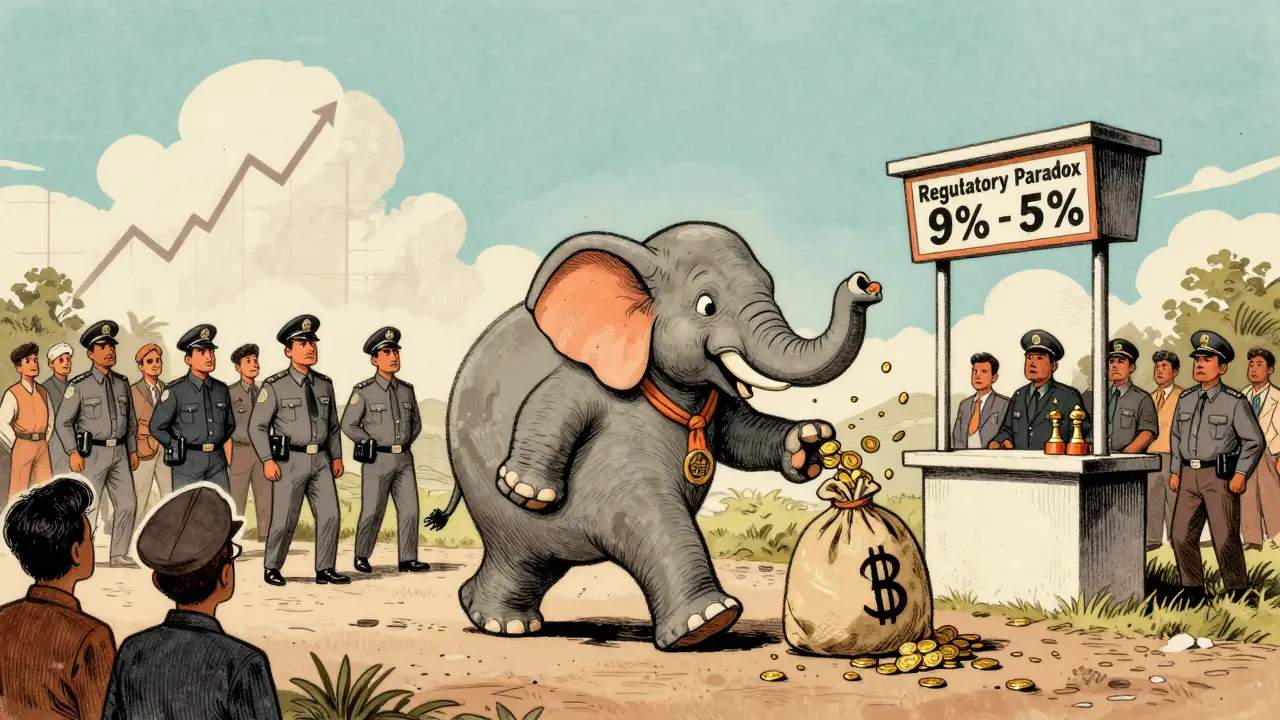
The Regulatory Paradox: High Taxes, Higher Interest
Here is the elephant in the room. India has implemented some of the toughest digital asset tax regulations in the world. A 30% tax on profits and a 1% Tax Deducted at Source (TDS) on transactions makes trading expensive. Logically, this should kill demand. Yet, adoption keeps growing.
Why? Because the push factors are stronger than the pull factors of regulation. For many Indians, crypto offers a hedge against inflation, access to global DeFi yields, and financial inclusion that traditional banks haven't provided. The friction of taxes is annoying, but it isn't a wall. It is more like a toll booth. People are willing to pay the toll because the destination is valuable.
However, the wind may be changing. There are credible reports suggesting India is considering creating a Bitcoin reserve. If true, this would be a seismic shift. It would signal that the government sees strategic value in holding digital assets, potentially softening the hostile regulatory stance. Even the rumor of such a move boosts confidence among investors.
What This Means for the Future
India’s position as the #1 crypto adopter is not a temporary blip. It is structural. The combination of a young, tech-literate population, robust digital infrastructure like UPI, and a resilient entrepreneurial spirit creates a self-sustaining ecosystem.
As the Asia-Pacific region continues to outgrow North America and Europe in percentage terms, India will likely remain the bellwether for global trends. If something works in India, it often works everywhere. The sophistication of Indian users-from basic Bitcoin buys to complex DeFi protocols-means they are early adopters of new technologies.
For anyone watching the crypto space, India is the place to watch. It proves that regulation alone cannot stop innovation if the underlying demand is strong enough. It also shows that digital public infrastructure is the secret sauce for mass adoption.
Is crypto legal in India in 2026?
Yes, cryptocurrency is legal in India, but it is heavily regulated. There is no ban on owning or trading crypto, but the government imposes strict taxes. Profits are taxed at 30%, and there is a 1% TDS on transactions. However, recent discussions about a potential Bitcoin reserve suggest the regulatory environment may become more nuanced in the future.
Why does India rank #1 in crypto adoption despite high taxes?
India ranks first because of its massive digital infrastructure, particularly UPI, which makes digital transactions easy. Additionally, there is strong grassroots demand for financial inclusion and hedging against inflation. The cultural acceptance of technology and a large youth population drive adoption regardless of tax burdens.
How does India's crypto adoption compare to the USA?
The USA ranks second, primarily driven by institutional investment through Bitcoin ETFs. India leads in overall comprehensive adoption, including retail, DeFi, and CeFi. While the US market is bigger in absolute dollar terms, India shows higher growth rates and broader demographic engagement across all sectors.
What role does UPI play in crypto adoption?
UPI (Unified Payments Interface) has normalized instant digital payments for millions of Indians. This familiarity with mobile-first finance lowers the barrier to entry for cryptocurrencies. Users who are comfortable with UPI find it easier to transition to crypto wallets and exchanges, creating a smooth path for adoption.
Is India considering a Bitcoin reserve?
There are credible reports and industry analyses suggesting that India is exploring the creation of a Bitcoin reserve. If implemented, this would mark a significant shift in government policy, moving from purely restrictive taxation toward strategic recognition of Bitcoin as a valuable asset class.
Which crypto assets are most popular in India?
Bitcoin remains the primary entry point for most users due to its brand recognition and store-of-value narrative. Stablecoins like USDT and USDC are widely used for trading pairs and remittances. There is also growing interest in Ethereum and various DeFi tokens as users become more sophisticated.
Mekz Wheoki
June 12, 2026 AT 07:11India is #1 because everyone else is asleep at the wheel while Indians are actually trying to survive on less than a dollar a day. The 'strict regulations' are just a speed bump for people who have no other option but to innovate their way out of poverty. Meanwhile, you lot in the West are arguing about ETF fees.
Manish Prajapat
June 12, 2026 AT 17:46The correlation between UPI infrastructure and crypto adoption is undeniable. It is not just about the technology itself, but the cultural shift towards digital-first financial interactions that has taken place over the last decade. When an entire population is already comfortable with instant, low-cost digital transactions, the transition to decentralized finance becomes a matter of convenience rather than education. We see this clearly in how stablecoins are being used for remittances and small business payments, bypassing traditional banking delays entirely.
Skm Shubham
June 14, 2026 AT 06:57Let's be real, the tax structure is a joke designed to bleed retail investors dry while institutions figure out loopholes. The 30% tax plus 1% TDS is punitive, yet people still flock to it because the traditional banking system offers zero real yield against inflation. It is not 'adoption' driven by innovation; it is desperation driven by economic necessity. The government knows this, which is why they haven't banned it outright, but they certainly aren't making it easy either.
John Doe
June 14, 2026 AT 17:35I am genuinely shocked by these numbers. I always assumed the heavy taxation would crush any semblance of a healthy market. To see India leading in both retail and institutional sectors despite the regulatory hostility is mind-boggling. It really highlights how much potential energy is stored in emerging markets when given even a sliver of opportunity. The US might have the ETFs, but India has the hunger.
Rob Aronson
June 15, 2026 AT 14:50From a DeFi protocol perspective, the volume metrics from APAC are staggering. 📊 The integration of UPI-like rails into crypto wallets is creating a seamless UX that Western exchanges can only dream of. Most US users still struggle with KYC friction and bank transfer delays, whereas Indian users are executing complex swaps and staking operations with the ease of sending a WhatsApp message. This infrastructural advantage is a massive moat. 🚀
Danna Charris
June 17, 2026 AT 03:23It is amusing how the narrative shifts every few months. First, it was Vietnam, then Nigeria, now India. But let us look past the hype. The 'grassroots' adoption often masks significant security risks and lack of financial literacy among the masses. Just because people are buying Bitcoin does not mean they understand the underlying technology or the risks involved. It is speculation dressed up as revolution.
Fede Faith
June 17, 2026 AT 11:21Actually, the security aspect is evolving rapidly. With organizations like the Bharat Web3 Association pushing for better standards, we are seeing a maturation in user behavior. It is not just blind speculation anymore; there is a growing community of developers and educators working to bridge the knowledge gap. The resilience of the market despite taxes proves that the utility value is recognized by the users themselves.
Josh Dodson
June 18, 2026 AT 17:25totally agree! its crazy how fast things are moving. i remember when upi first launched and people thought it was too good to be true. now its everywhere. same thing happening with crypto here. young folks are coding smart contracts in their dorm rooms while the rest of the world argues about regulation. kudos to the innovators!
Suman Patil
June 18, 2026 AT 20:22The synergy between fintech and blockchain in India is unmatched. We are seeing hybrid models where traditional payment gateways are integrating crypto options subtly. It is not a bang, but a steady hum of growth. The key is accessibility. If you can buy $10 worth of BTC using your daily grocery budget via a familiar app, you have won the war for mass adoption. The jargon-heavy discourse misses this simple truth.
Kumaran sowkarpet
June 19, 2026 AT 11:35As someone living in Tier-2 cities, i can confirm this trend. My cousins use crypto for freelance payments from overseas clients because banks take weeks to process SWIFT transfers. Crypto is instant. Yes, taxes are high, but time is money. Also, the community support is strong, lots of local meetups and online groups helping newbies avoid scams. :)
Mauricio Contreras Loredo
June 20, 2026 AT 22:53Oh sure, because nothing says 'financial freedom' like paying 30% tax to a government that barely provides basic services. But hey, if it makes the GDP numbers look pretty, who cares? The irony is palpable. They hate crypto, they tax crypto, but they love the revenue crypto generates. Classic.
Abby Sivertsen
June 21, 2026 AT 09:24You are missing the bigger picture. It is not about hating the government; it is about survival. Inflation eats away savings faster than any tax can. Crypto is a lifeboat, not a luxury yacht. People are smart enough to know that holding fiat long-term is a losing strategy. The aggression in your tone suggests you don't understand the ground reality.
Benjamin Eisen
June 21, 2026 AT 20:26i think the rumor about the bitcoin reserve is huge. if india actually starts holding btc on its balance sheet, it changes everything. it legitimizes the asset class overnight. imagine the signal that sends to global markets. maybe the strict taxes were just a test run to see how resilient the ecosystem is before going all in?
Kenneth Riley
June 23, 2026 AT 20:14stop dreaming. the government will never hold bitcoin. they want control. they want surveillance. every transaction tracked. the 'reserve' talk is just smoke and mirrors to keep the retail sheep happy while they tighten the leash. you guys are so naive thinking tech will save you from authoritarianism. it wont. wake up.
Kwon Bill
June 24, 2026 AT 06:00The comparative analysis with the US is crucial here. While Wall Street treats Bitcoin as a tradable commodity akin to gold or oil, Indian retail treats it as a tool for empowerment. This fundamental difference in mindset drives the diverse adoption patterns seen in DeFi and CeFi. The US model is top-down; India's is bottom-up. Historically, bottom-up movements are harder to suppress and more sustainable in the long run.