
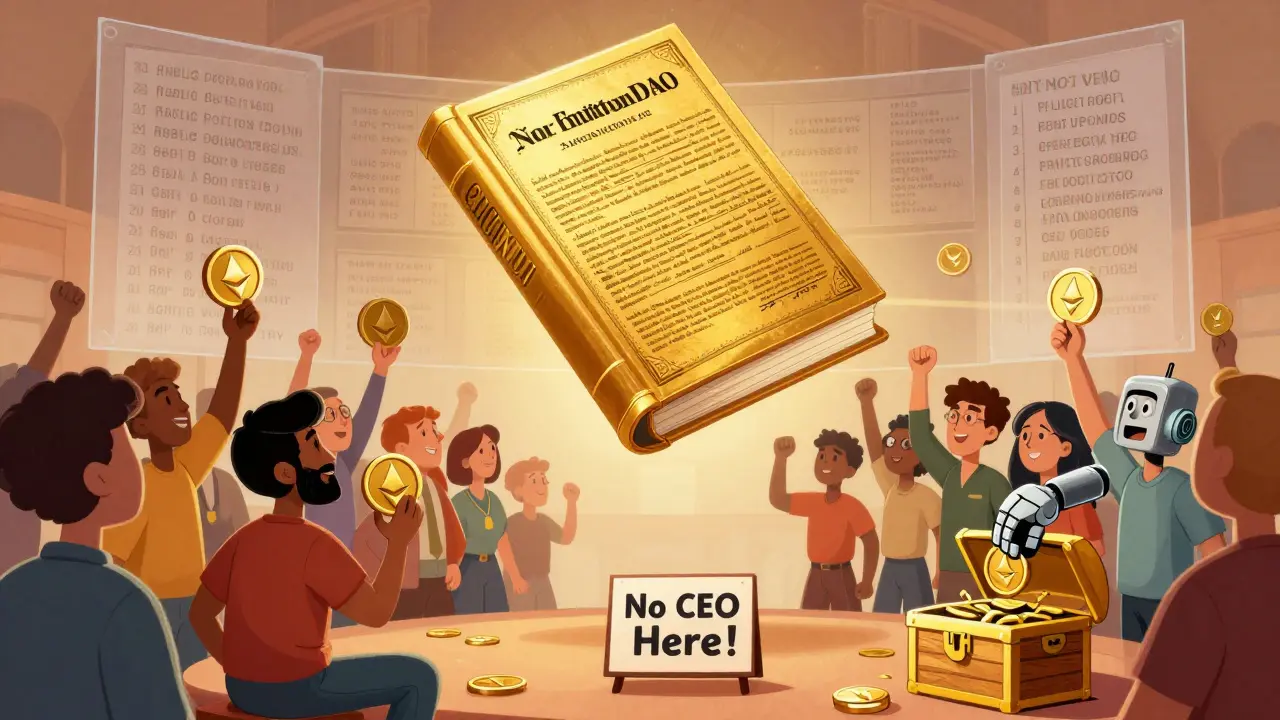
When you hear the word "organization," you probably picture a company with a CEO, a board, and a hierarchy of managers. But what if that organization had no CEO? No office. No employees. Just code. And thousands of people voting on every decision with tokens in their wallets? That’s what a DAO is - a decentralized autonomous organization that runs on blockchain technology, where rules are written in code and decisions are made by its members. Unlike traditional companies, a DAO doesn’t rely on people to approve budgets or hire staff. It relies on votes. And those votes? They’re recorded forever on a public ledger.
How DAOs Are Built
Every DAO starts with a smart contract. Think of it like a digital rulebook written in code and stored on a blockchain - usually Ethereum, Solana, or NEAR. This contract defines everything: who can vote, how many tokens you need to propose a change, how votes are counted, and what happens when a proposal passes. Once deployed, the code can’t be changed unless the community votes to change it. That’s the whole point. No single person can sneak in and alter the rules. The system is transparent. Anyone can read the code. Anyone can verify what’s happening.
After the smart contract is live, the DAO issues governance tokens. These aren’t like Bitcoin or Ethereum. They don’t have value because they’re scarce. They have value because they give you power. The more tokens you hold, the more voting weight you have. These tokens are distributed through sales, rewards, or grants. Once people own them, they become stakeholders. They’re not investors in the old sense. They’re co-owners. And they get to vote on everything - from how treasury money is spent to whether the DAO should partner with another project.
The Four Pillars of DAO Governance
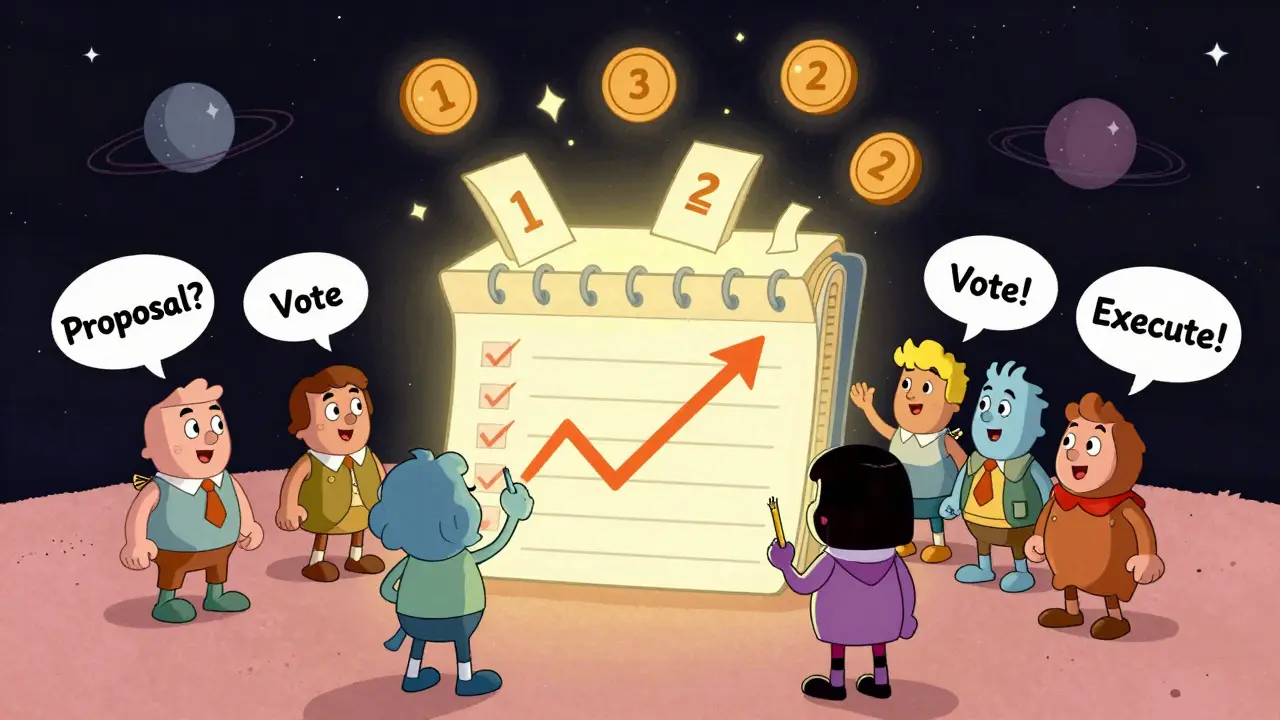
DAO governance isn’t random. It follows a clear, repeatable process with four key parts:
- Proposals - Any member can submit a suggestion. It could be "Fund a new marketing campaign," "Change the voting threshold," or "Buy $50,000 worth of NFTs." Proposals are posted on forums like Discord or specialized platforms like Snapshot.
- Voting - Token holders cast their votes. Each token usually equals one vote. So if you own 100 tokens, you get 100 votes. Voting periods last from a few days to weeks, depending on the DAO’s rules.
- Consensus - The proposal passes if it meets the required threshold. Some DAOs need 50%+1. Others require 60%, 70%, or even 80%. Some even require a minimum number of voters to make the vote valid.
- Execution - Once approved, a smart contract automatically carries out the decision. No human needs to click "approve." No treasurer signs a check. The code executes. Money moves. Contracts update. Changes happen.
This entire process happens on-chain. That means every vote, every transaction, every rule change is public and permanent. You can go back months or years and see exactly how a decision was made.
How Voting Works: Different Models
Not all DAOs vote the same way. Different models solve different problems.
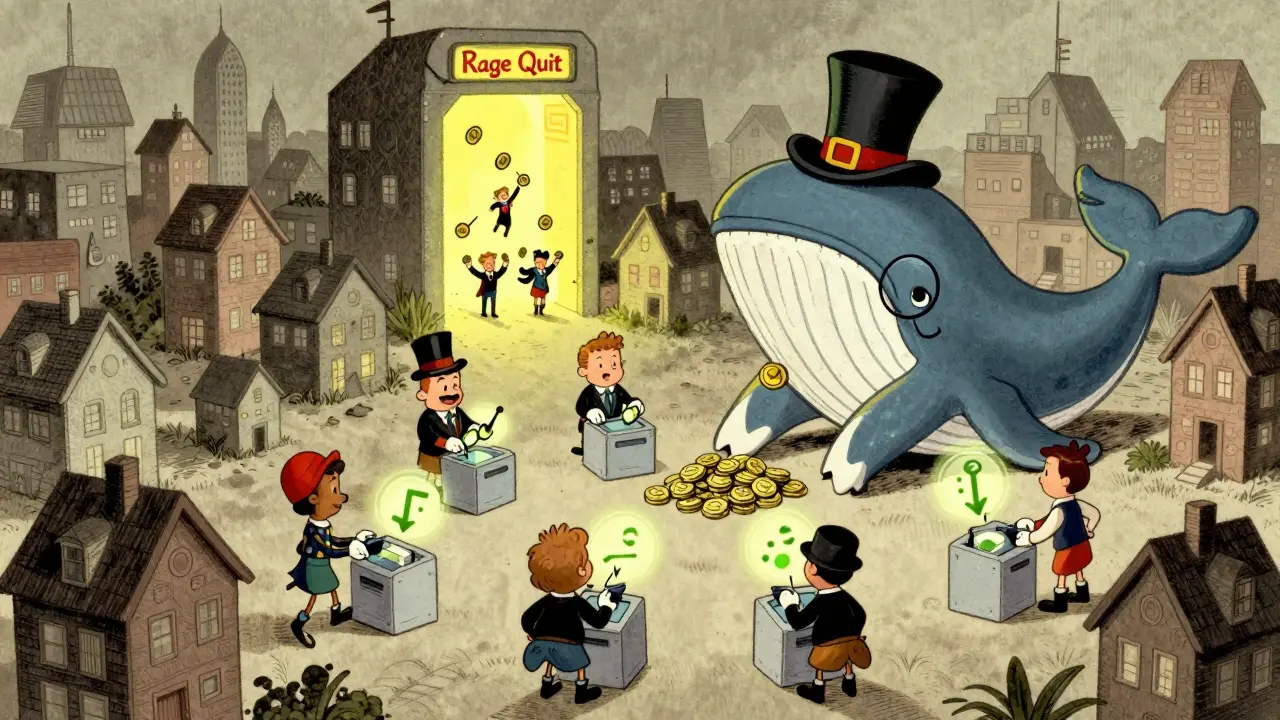
Permissioned Relative Majority is the simplest. You vote. The majority wins. No minimum turnout required. A single person with enough tokens could pass a proposal. Sounds fair? It’s not. This model is vulnerable to "whales" - people who hold huge amounts of tokens. If one wallet owns 40% of all governance tokens, they can control the DAO. Many early DAOs failed because of this.
Rage Quit was designed to fix that. Here’s how it works: Before a proposal goes to vote, it must be sponsored by at least one member. Once it passes, there’s a grace period - say, 7 days. During that time, anyone who voted "yes" can change their mind. If they do, they can "rage quit" - meaning they withdraw their tokens and leave the DAO. If enough people leave, the proposal fails. It’s a way to force people to think twice. It also protects minorities. If a proposal threatens your interests, you can walk away with your money. But it’s slow. And slow doesn’t work when you need to fix a security flaw in 48 hours.
Quadratic Voting is another model. Instead of one token = one vote, it uses math to reduce the power of big holders. If you have 100 tokens, you don’t get 100 votes. You get √100 = 10 votes. If someone else has 10,000 tokens, they get √10,000 = 100 votes. It’s not perfect, but it makes it harder for whales to dominate. It’s used by DAOs like Gitcoin and MakerDAO.
Real-World DAOs and Their Rules
DAOs aren’t theoretical. They’re real - and they’re doing real things.
- Ethereum Name Service (ENS) DAO manages the .eth domain names. It’s like DNS for blockchain. ENS DAO members vote on upgrades, pricing, and partnerships. In 2023, they approved a proposal to allocate $10 million to developers building tools on ENS.
- Friends With Benefits (FWB) DAO is a social DAO. You don’t just vote on money. You vote on who gets invited into their Discord, which events they host, and what art they buy. Membership requires owning FWB tokens - and proving you’re an active community member.
- ConstitutionDAO tried to buy a rare copy of the U.S. Constitution in 2021. Over 17,000 people pooled $47 million in Ethereum to bid. They didn’t win, but the experiment showed how fast a global community can mobilize.
- JuiceboxDAO helps other DAOs manage their treasuries. It doesn’t just vote - it provides the tools. Its governance lets members decide how to fund new projects, cut fees, or change payout rules.
Each DAO is different. Some are focused on finance. Others on culture. Some on tech. But they all share one thing: power is distributed. No one owns the DAO. Everyone who holds a token has a say.
Big Problems With DAO Governance
It sounds ideal. But real life gets messy.
Whale dominance is the biggest threat. If 10 people hold 70% of the tokens, they control the DAO. That’s not decentralization - that’s oligarchy with blockchain branding. Some DAOs try to fix this by capping vote weight per wallet. Others require proof of identity or time-based voting rights. But there’s no perfect solution yet.
Low participation is another issue. Most DAOs have voter turnout under 5%. Why? Because voting is hard. You need to understand the proposal. You need to find the right platform. You need to pay gas fees. And if you’re not a whale, your vote feels meaningless. Many people just don’t bother.
Legal gray zones are real too. If a DAO votes to send money to a developer in another country, who’s responsible if it’s illegal? Who gets sued? Governments are starting to pay attention. Some countries are trying to classify DAOs as legal entities. Others say they’re just unregulated pools of money.
And then there’s code risk. If a smart contract has a bug, and a proposal passes to fix it - but the fix breaks something else - who’s accountable? The code executed. No one meant for it to happen. But the damage is done.
Why DAO Governance Matters
DAOs aren’t just about money. They’re about control. In traditional companies, shareholders vote once a year. CEOs make the big calls. Employees follow orders. But in a DAO, you’re not just a user - you’re a co-owner. You decide where the money goes. You vote on who gets hired. You shape the future.
This model is changing how digital communities work. Open-source projects are now funded by their users. Online collectives are managing multimillion-dollar treasuries. Artists are forming collectives that pay each other directly. And none of it needs banks, lawyers, or middlemen.
DAO governance is still young. It’s messy. It’s slow. Sometimes it fails. But it’s also the first time in history that a global group of strangers could build something together - without a boss - and actually make it work.
The future of online collaboration might not be in Silicon Valley boardrooms. It might be in a blockchain, where every vote counts - and every rule is open for anyone to see.
Can anyone create a DAO?
Yes. Anyone with basic coding knowledge and access to a blockchain network can deploy a DAO using tools like Aragon, DAOstack, or Snapshot. You don’t need permission. But creating a successful DAO requires more than code - it needs clear rules, active members, and a reason for people to care.
Do you need to buy tokens to join a DAO?
Not always. Some DAOs let you join for free and earn governance tokens by contributing - like writing code, translating docs, or moderating forums. Others require you to buy tokens upfront. It depends on the DAO’s goals. Social DAOs like FWB often reward participation. Treasury DAOs usually require token ownership to vote.
What happens if a DAO votes to steal money?
If a proposal passes to send funds to an address, the smart contract executes it. There’s no way to reverse it. That’s why proposals are debated publicly before voting. Still, scams happen. Some DAOs have multi-sig emergency stops or time locks to delay large transfers. But ultimately, if the community votes to do something - even foolish or unethical - the code follows through. That’s the trade-off of decentralization.
Are DAOs legal?
Legality varies by country. Some places, like Wyoming in the U.S., have passed laws recognizing DAOs as legal entities. Others treat them as unregulated partnerships. The IRS and SEC are still figuring out how to classify them. For now, most DAOs operate in a gray zone - which makes them powerful, but also risky.
Can DAOs replace traditional companies?
They already are - in some areas. Open-source software, NFT collectives, and decentralized finance (DeFi) protocols are increasingly run by DAOs. But for complex tasks like hiring, legal contracts, or physical operations, traditional companies still have the edge. DAOs work best when the work is digital, transparent, and community-driven. They’re not a replacement for every business - but they’re a better fit for many Web3 projects.
Phillip Marson
February 25, 2026 AT 18:47aaron marp
February 27, 2026 AT 16:04Tracy Whetsel
February 28, 2026 AT 00:45Ifeanyi Uche
February 28, 2026 AT 08:49Jeff French
March 1, 2026 AT 12:30Elana Vorspan
March 2, 2026 AT 19:23Kenneth Genodiala
March 4, 2026 AT 09:26Michael Rozputniy
March 5, 2026 AT 01:17Cathy Sunshine
March 6, 2026 AT 05:49Shannon Black
March 7, 2026 AT 02:02Richard Cooper
March 7, 2026 AT 17:13Dee Resin
March 8, 2026 AT 20:18Tanvi Atal
March 10, 2026 AT 18:03Sony Sebastian
March 10, 2026 AT 21:16Brian Lemke
March 12, 2026 AT 07:03Megan Lavery
March 13, 2026 AT 03:02Reggie Fifty
March 15, 2026 AT 01:18Kristi Emens
March 16, 2026 AT 00:54Deborah Robinson
March 16, 2026 AT 20:36Michelle Mitchell
March 17, 2026 AT 16:37aaron marp
March 18, 2026 AT 17:12