
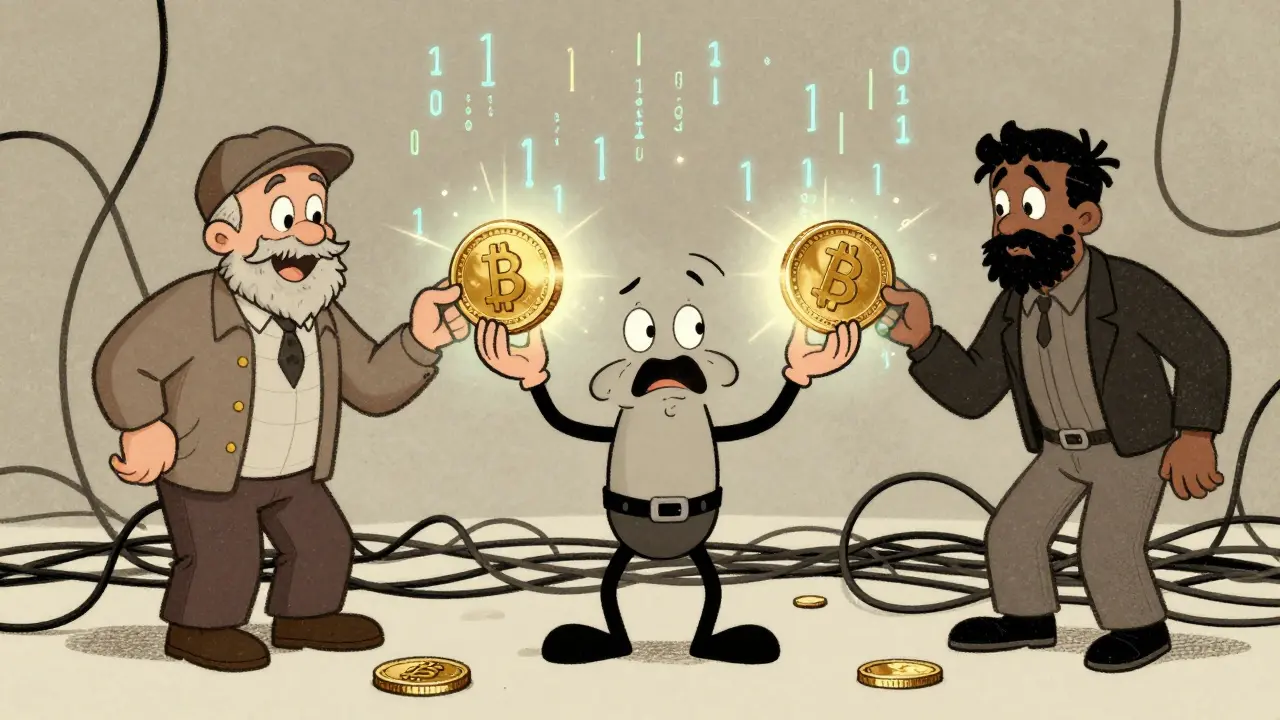
Imagine handing over a $20 bill to buy coffee. You walk away with your drink, and the barista puts the bill in their register. That same physical bill cannot suddenly appear in your pocket again. It’s gone. But now imagine that bill is digital-a string of code on a computer screen. If I copy that code and send it to two different people at the exact same time, who gets the money? In the world of traditional banking, a central authority (the bank) checks its ledger and says, "Nope, you only have enough for one transaction." But in a decentralized network like blockchain, where there is no single boss or central server, how do we stop someone from spending the same digital token twice?
This problem is known as double-spending. It is the fundamental threat to any digital currency system. Without a solution, trust collapses. The answer lies in something called consensus mechanisms. These are the rules and protocols that allow thousands of independent computers to agree on the truth without needing to trust each other. Let’s break down exactly how these systems work to keep your digital assets safe.
The Core Problem: Why Digital Money Needs Rules
To understand the solution, you first need to grasp why the problem exists. Physical cash has a natural limit: scarcity. There is only one physical note. Digital files, however, are infinitely replicable. If I email you a photo, I still have the original. If I could replicate value instead of transferring it, inflation would be instant and total.
In centralized systems, databases are controlled by one entity. They maintain a single source of truth. When you spend money, they update their record. In a decentralized network, every participant (node) keeps a copy of the ledger. If Node A sees a transaction sending 5 coins to Bob, and Node B sees a conflicting transaction sending those same 5 coins to Alice, who is right? This is the Byzantine Generals’ Problem simplified: how do distributed parties agree on a single state when some might be lying or acting maliciously?
Consensus mechanisms solve this by creating a shared reality. They force the network to choose one version of events and discard the others. Once the network agrees, that history becomes immutable-extremely difficult to change. This agreement process is what prevents double-spending.
Proof of Work: Security Through Energy
The most famous consensus mechanism is Proof of Work (PoW), pioneered by Bitcoin. Think of PoW like a global lottery where buying tickets requires solving complex mathematical puzzles. Miners compete to find a specific number (a hash) that meets certain criteria. This process requires massive amounts of computational power and electricity.
Here is how PoW stops double-spending:
- Costly Validation: To add a block of transactions to the chain, a miner must prove they did the work. This isn’t just checking boxes; it’s burning energy.
- Economic Barrier: If an attacker wants to double-spend, they can’t just lie. They have to redo the work for the block containing their fraudulent transaction AND all subsequent blocks faster than the rest of the honest network combined.
- The 51% Rule: To successfully rewrite history, an attacker needs more than 50% of the network’s total computing power. For a large network like Bitcoin, this would require billions of dollars in hardware and electricity costs, making the attack economically irrational.
PoW makes cheating expensive. The cost of attacking the network far exceeds the potential gain from stealing a few coins. It’s like trying to rob a bank by building a bigger vault than the government-you’d go bankrupt before you opened the door.

Proof of Stake: Security Through Skin in the Game
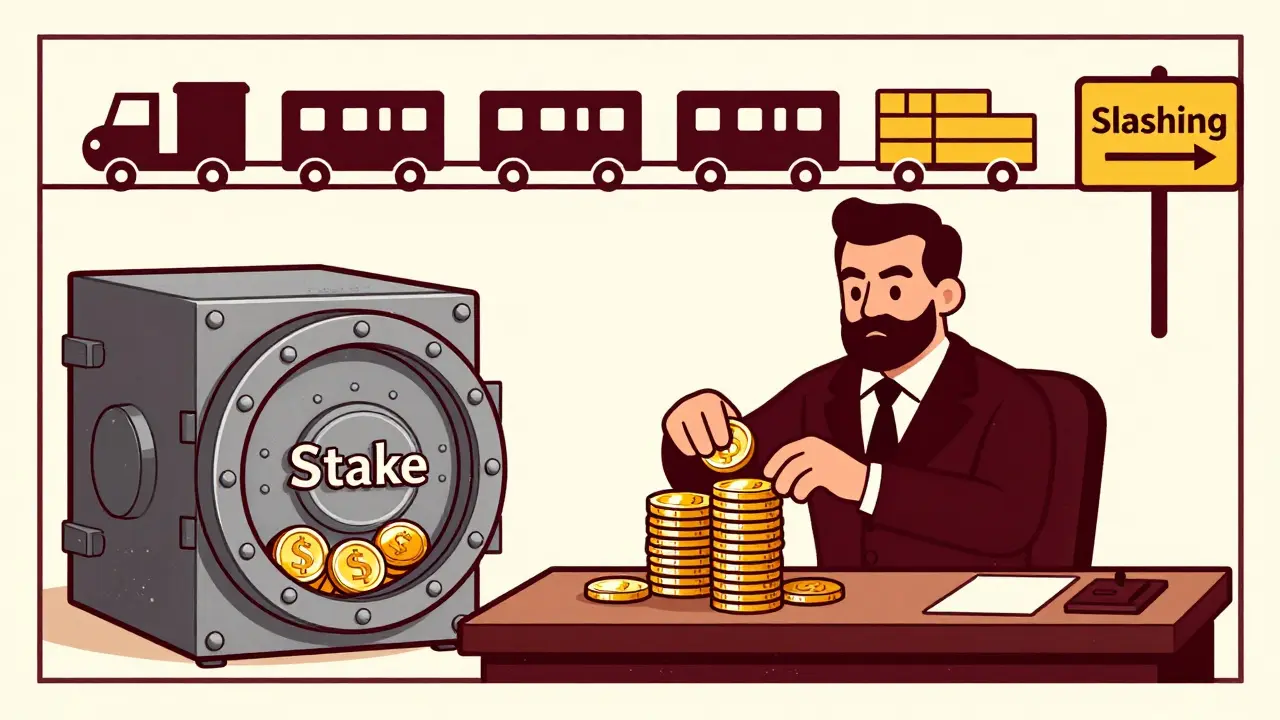
While PoW relies on energy, Proof of Stake (PoS) relies on economic collateral. Instead of miners, we have validators. To become a validator, you must lock up (stake) a significant amount of the cryptocurrency. Ethereum, for example, transitioned from PoW to PoS in 2022, reducing its energy consumption by roughly 99.9%.
In PoS, the protocol randomly selects validators to propose new blocks based on the size of their stake. How does this prevent double-spending?
- Slashing Penalties: If a validator tries to validate a fraudulent transaction or acts dishonestly, the protocol automatically detects it. Their staked funds are "slashed"-destroyed or confiscated. This is a direct financial penalty.
- Opportunity Cost: Validators earn rewards for honest behavior. By acting maliciously, they lose their stake and their future income. It’s a rational choice to stay honest.
- No Energy Waste: Since there is no mining race, the barrier to entry is capital, not computation. This makes the network more efficient but shifts the risk from energy costs to wealth concentration.
Double-spending in a PoS network is harder because the attacker must own a huge portion of the total supply. If they succeed in double-spending, the value of the coin likely crashes, wiping out their remaining holdings. It’s a self-defeating strategy.
| Feature | Proof of Work (PoW) | Proof of Stake (PoS) |
|---|---|---|
| Security Basis | Computational Power & Energy | Economic Collateral (Stake) |
| Attack Cost | Hardware + Electricity (Billions for large chains) | Acquiring >51% of Token Supply |
| Penalty for Cheating | Wasted resources; invalid blocks rejected | Slashing (loss of staked funds) |
| Energy Usage | High | Very Low |
| Centralization Risk | Mining Pools | Wealth Concentration |
The Role of Confirmations and Finality
Even with strong consensus mechanisms, networks don’t consider a transaction "final" immediately. This is where the concept of confirmations comes in. When a transaction is included in a block, it has one confirmation. When the next block is added on top of it, it has two. And so on.
Why wait? Because in early stages, a fork might occur. Two miners might find a block at the same time, creating two temporary versions of the blockchain. The network follows the longest chain. If an attacker tries to double-spend, they create a private chain that excludes the victim’s payment. They release this private chain only after the victim has delivered goods or services.
Each additional confirmation makes it exponentially harder for the attacker to catch up. For high-value Bitcoin transactions, merchants often wait for six confirmations. At that point, the probability of a successful double-spend is statistically near zero. It’s like waiting for the tide to go out before declaring the beach safe-the longer you wait, the more certain you are.
Delegated Proof of Stake and Hybrid Models
Some networks use variations to balance speed and security. Delegated Proof of Stake (DPoS) allows token holders to vote for delegates who validate transactions. This speeds up consensus significantly because fewer nodes are involved in validation. However, it introduces a democratic element where voters must monitor delegate behavior closely. If a delegate attempts to double-spend, voters can vote them out and slash their stake.
Hybrid models, such as those used by Decred or Horizen, combine PoW and PoS. Miners produce blocks using PoW, but stakeholders vote on governance and security parameters. This dual-layer approach aims to mitigate the weaknesses of either system alone. For double-spending prevention, it means an attacker would need to compromise both the computational layer and the economic stake layer simultaneously, raising the barrier even higher.
Real-World Risks and Edge Cases
Are consensus mechanisms perfect? No. They rely on assumptions about human behavior and economics. One major risk is the 51% attack on smaller chains. If a small blockchain has low participation, a wealthy actor might rent enough hashing power (for PoW) or buy enough tokens (for PoS) to control the network temporarily. We’ve seen this happen on minor altcoins, leading to lost funds.
Another issue is network latency. In rare cases, if a user broadcasts a transaction to only part of the network, another node might accept a conflicting transaction first. This is why wallets always broadcast to multiple peers. Users must also be aware that "instant" payments often rely on probabilistic finality, not absolute certainty. For everyday coffee purchases, one confirmation might suffice. For buying a house, you want many.
Looking ahead, Layer 2 solutions and sharding aim to scale these networks without sacrificing security. They handle transactions off the main chain but settle back onto it, inheriting the base layer’s security guarantees against double-spending. As quantum computing advances, researchers are also developing post-quantum cryptographic methods to ensure these consensus rules remain unbreakable in the future.
What happens if a double-spend attempt is detected?
If a double-spend attempt is detected, the network rejects the conflicting transaction. In Proof of Work, the block containing the fraud is orphaned and ignored by the majority of nodes. In Proof of Stake, the validator responsible may face slashing, losing their staked funds as a penalty. The legitimate transaction remains valid.
Can double-spending happen on Bitcoin?
Theoretically, yes, but practically it is nearly impossible. It would require controlling more than 51% of Bitcoin's total hashing power, which costs billions of dollars. Any successful attack would likely crash Bitcoin's value, destroying the attacker's investment. For all intents and purposes, Bitcoin is secure against double-spending.
Why do I need to wait for confirmations?
Confirmations ensure that the transaction is buried deep enough in the blockchain that it would take immense effort to reverse. Each new block added on top of your transaction makes it harder for an attacker to create a longer, alternative chain. Waiting reduces the risk of accepting a fraudulent payment.
Is Proof of Stake safer than Proof of Work?
Both are highly secure but in different ways. PoW is secured by physical energy costs, making attacks expensive in terms of hardware and electricity. PoS is secured by economic stakes, making attacks costly in terms of capital loss. Neither is inherently "safer," but PoS is more energy-efficient. The safety depends on the specific implementation and network size.
What is a 51% attack?
A 51% attack occurs when a single entity or group controls more than half of the network's consensus power (hashing power in PoW or stake in PoS). This allows them to reorder transactions, prevent new blocks from being confirmed, and potentially double-spend their own coins. It is rare on large networks due to the high cost of acquiring such power.