
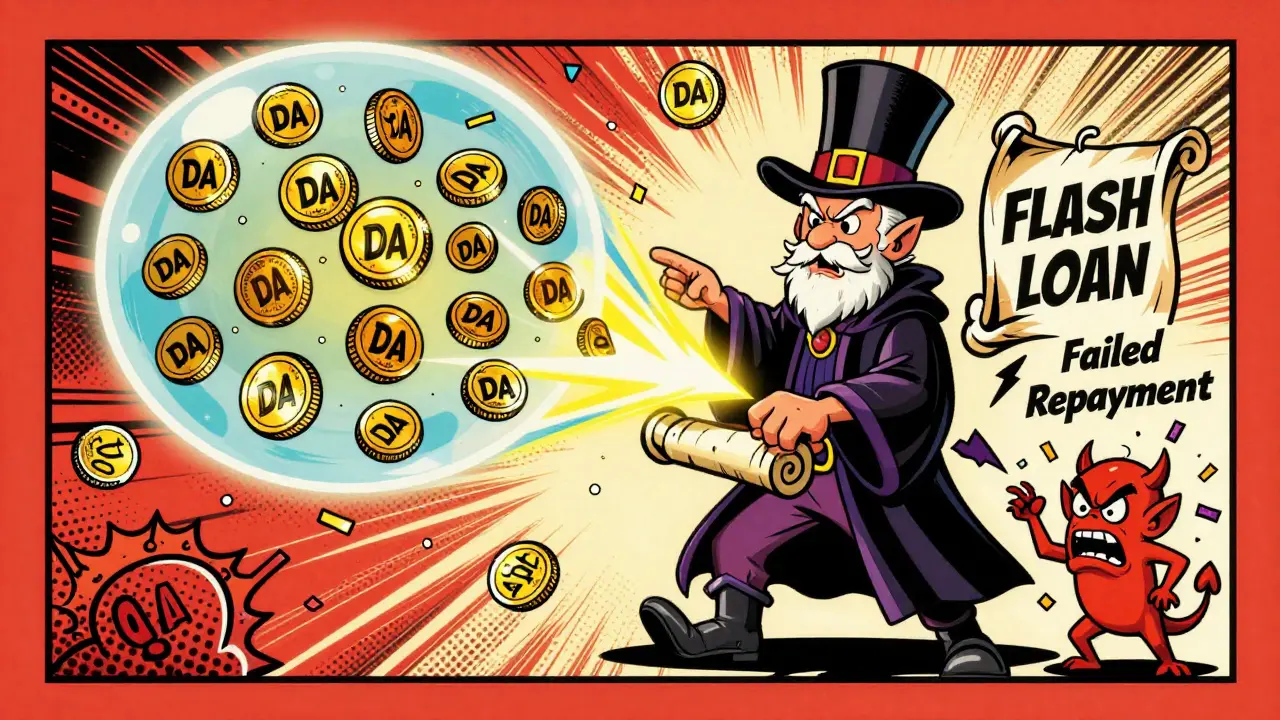
Flash loans sound like magic. You borrow millions of dollars in cryptocurrency - no collateral, no credit check, no waiting - and pay it back all in the same transaction. If you fail? The whole thing cancels out like it never happened. This isn’t sci-fi. It’s real, and it’s happening right now on blockchains like Ethereum. But here’s the catch: flash loans aren’t for casual users. They’re a tool for developers and traders who know exactly what they’re doing. If you’re wondering how these loans work, who offers them, and why they matter, you’re in the right place.
How Flash Loans Actually Work
Traditional loans need collateral. A bank wants your house or car as security. Flash loans? They need nothing. Not even a signature. Instead, they rely on something far more powerful: smart contracts.
Here’s the step-by-step breakdown:
- You request a loan from a flash loan provider - say, $10 million in DAI.
- The smart contract instantly sends that money to your custom-built smart contract.
- Your contract does something with it: buys low on one exchange, sells high on another, or swaps collateral in a lending protocol.
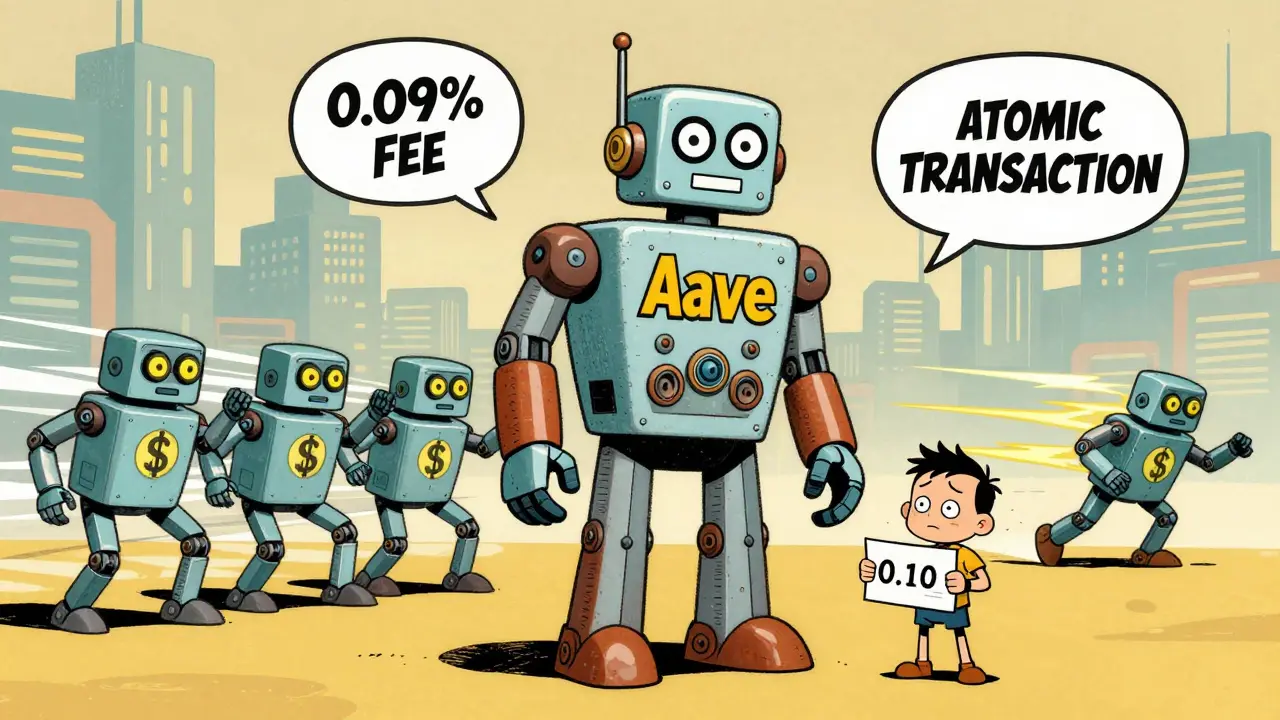
- Within the same blockchain transaction, you repay the loan plus a small fee - usually 0.09%.
- If you didn’t repay? The entire transaction is reversed. No money changes hands. The loan never existed.
This is called an atomic transaction. Either everything succeeds, or everything fails. There’s no middle ground. That’s what makes flash loans possible. No one would lend you $10 million without collateral - unless they knew you couldn’t keep it if you didn’t pay back.
Why Flash Loans Exist
Flash loans aren’t meant for buying a car or paying rent. They’re financial tools built for one thing: efficiency. They let traders and developers move capital around the DeFi world in seconds.
Here are the most common uses:
- Arbitrage: Buy ETH for $2,800 on Uniswap, sell it for $2,820 on Coinbase. Profit? $20 per ETH. With a $10M flash loan, that’s $71,428 in one transaction.
- Liquidation: If someone’s collateralized loan is under-collateralized, you can use a flash loan to buy their position, repay the debt, and claim the collateral as your own.
- Collateral swaps: Swap your ETH for WBTC inside a lending protocol without selling on an exchange. Flash loans let you borrow the ETH needed to trigger the swap, then repay it immediately.
- Liquidity provision: Deposit assets into a liquidity pool, earn fees, then repay the flash loan. This lets you earn yield without locking up your own funds.
These aren’t theoretical. In 2024, one trader used a flash loan to execute a $300 million arbitrage across three DeFi protocols in under 15 seconds. That’s the power of flash loans.

Top Flash Loan Providers and Platforms
Not all platforms are created equal. Some have deep liquidity, better security, and more documentation. Here are the main players right now:
| Platform | Supported Chains | Fee Structure | Liquidity Pool Size | Best For |
|---|---|---|---|---|
| Aave | Ethereum, Polygon, Arbitrum | 0.09% per loan | Over $2 billion | General use, reliability |
| Uniswap | Ethereum | 0.01% (via V3) | $1.5 billion | Arbitrage between DEXs |
| dYdX | Ethereum | 0.09% | $800 million | Margin trading integration |
| Equalizer Finance | Ethereum, Blast, Base | 0.05% - 0.1% | $300 million | Newer chains, lower fees |
| Port Finance | Ethereum, Polygon | 0.09% | $250 million | Multi-asset lending pools |
Aave is the most widely used. It’s been around since 2020, has the largest liquidity, and supports multiple chains. Uniswap’s flash loan feature is simpler but limited to Ethereum. dYdX integrates with its lending market, making it ideal for leveraged strategies. Equalizer and Port Finance are newer, offering lower fees and support for emerging networks.
Then there’s Furucombo - not a lender, but a builder. It lets you chain together multiple DeFi actions (like flash loans, swaps, and deposits) in one click. You don’t write code. You drag and drop. It’s like a flash loan GUI for non-developers.
Who Can Use Flash Loans?
If you’re thinking, "I’ll just log in and borrow $500,000," think again.
Flash loans require:
- A smart contract you’ve coded or deployed
- Deep knowledge of DeFi protocols (Uniswap, Aave, Compound, etc.)
- Access to a wallet with gas funds (you pay for execution)
- A profitable strategy ready to execute in under 15 seconds
Most retail users can’t do this. Even experienced traders struggle. A 2025 report from Chainlink showed that over 90% of flash loan volume comes from fewer than 500 unique addresses. These aren’t hobbyists. They’re automated bots, hedge funds, and professional arbitrageurs.
That doesn’t mean you can’t learn. Many developers use flash loans to test strategies on testnets first. You can borrow 100 DAI on Goerli and simulate an arbitrage without risking real money.
Risks and Downsides
Flash loans aren’t risk-free. In fact, they’re one of the most dangerous tools in DeFi.
- Exploits: Hackers use flash loans to manipulate prices. In 2022, a $600 million exploit on Venus used a flash loan to crash a token’s price, then bought it cheap. The protocol lost millions.
- Slippage: If the market moves too fast during your trade, you might not get the price you expected. You lose money - and still have to repay the loan.
- Gas wars: During high congestion, transaction fees spike. If your profit is $100 but gas costs $300, you’re in the red.
- Protocol risk: If the smart contract you’re interacting with has a bug, your entire strategy can fail - and you still owe the loan.
Platforms have responded with better security audits, price oracles, and transaction limits. But the risk remains. Flash loans are a double-edged sword: they unlock massive opportunities - and massive losses.
The Future of Flash Loans
Flash loans are evolving. New platforms are popping up on Solana, Base, and Blast, where transaction speeds are faster and fees are lower. Cross-chain flash loans are becoming possible, letting you borrow on Ethereum and repay on Polygon.
Some teams are building tools to make flash loans accessible. Imagine a mobile app that says: "Here are 3 live arbitrage opportunities. Pick one, and we’ll execute the flash loan for you." That’s the next step.
Regulators are watching too. The SEC and EU’s MiCA framework are starting to look at DeFi lending. If flash loans are classified as financial instruments, platforms may need licenses - which could slow innovation.
One thing’s certain: flash loans aren’t going away. They’re too efficient, too powerful, and too deeply woven into DeFi’s DNA. Whether they become a mainstream tool or stay a niche weapon for experts depends on how well the ecosystem can simplify them - without losing their core advantage: speed.
Can I use a flash loan to buy crypto without putting up collateral?
Technically yes, but not practically. Flash loans require repayment within the same transaction. You can’t borrow $10,000 in ETH, hold it for a week, then sell it. You’d need to buy ETH, sell it for profit, and repay the loan - all in under 15 seconds. Without a pre-planned arbitrage or trading strategy, you’ll lose money and the transaction will fail.
Do I need to code to use flash loans?
Yes, unless you’re using a tool like Furucombo or DeFi Saver. These platforms let you combine flash loans with swaps and deposits without writing code. But even then, you need to understand how the underlying protocols work. If you don’t know what Uniswap or Aave does, you’re likely to lose money.
What’s the minimum amount I can flash loan?
There’s no official minimum. Some platforms allow loans as small as 0.1 ETH. But gas fees and fees on the loan make tiny loans impractical. Most users borrow at least $10,000 worth of assets to make the math work. Smaller loans rarely cover their own costs.
Are flash loans legal?
Currently, yes - but the legal landscape is unclear. Flash loans operate on permissionless blockchains. No government regulates them directly. However, if you use them to manipulate markets or exploit vulnerabilities, you could face legal consequences under securities or fraud laws. Regulators are starting to monitor DeFi activity closely.
Can I lose money even if I repay the loan?
Absolutely. Repaying the loan only means the transaction succeeds. It doesn’t mean you made money. If your arbitrage failed due to slippage, or if you swapped tokens at a bad rate, you could lose money - even though the flash loan itself was repaid. The loan isn’t the risk. Your strategy is.
Anna Lee
March 23, 2026 AT 10:21Just wish more people understood how risky they are. Not for the faint of heart!
Justin Credible
March 24, 2026 AT 15:39Mike Yobra
March 26, 2026 AT 02:58How is this not just a glorified loophole? The fact that this is considered innovation instead of a security flaw says more about our priorities than about blockchain.
Anand Makawana
March 27, 2026 AT 16:12Furthermore, the fee structure-typically 0.09%-is economically optimal, as it aligns with the marginal cost of transaction validation across major EVM chains. The liquidity depth of Aave, exceeding $2B, is a testament to network effects in permissionless lending.
Mohammed Tahseen Shaikh
March 28, 2026 AT 00:21And guess what? The cops ain’t coming. The bank’s made of code. And the guy who built it? He’s probably sipping coconut water on a beach in Bali while his bot makes $500k in 12 seconds.
Chaos is the feature, not the bug.
Sarah Terry
March 29, 2026 AT 19:14One thing to emphasize: even pros get burned. Slippage, gas spikes, contract bugs-it all adds up. Always test on testnets first. No exceptions.
John Alde
March 30, 2026 AT 00:41There are days when I make $200. There are days when I lose $1,200 because a liquidity pool got drained mid-trade.
It’s not trading. It’s a full-time job with no benefits. And you don’t even get paid in dollars-you get paid in ETH, and then you have to figure out how to cash out without getting taxed into oblivion.
But hey, if you’re into high-stakes puzzle-solving with real money on the line? It’s kind of beautiful.
Also, Furucombo is a lifesaver. I used to write custom contracts. Now I drag and drop like a wizard. Still need to understand the underlying mechanics, though. Don’t be fooled by GUIs.
manoj kumar
March 31, 2026 AT 17:32Every time one of these things gets used for arbitrage, it’s just moving money around while the real users pay gas fees and get rug-pulled.
And don’t get me started on ‘profitable strategies.’ Most of these ‘traders’ are just bots running the same 3 scripts since 2021. It’s not innovation. It’s automation of greed.
vu phung
April 2, 2026 AT 16:18What’s wild is how these protocols have basically created a market for temporary capital. You’re not borrowing money-you’re borrowing *timing*.
And that’s why institutions are quietly building infrastructure around it. Not for retail. Not for ‘decentralization.’ But because it’s the most efficient way to move liquidity across fragmented markets.
It’s financial plumbing. And most people don’t even realize the pipes exist.
Lorna Gornik
April 3, 2026 AT 09:40"hey bank, lend me $10M to buy a house, then sell it for $10.1M and pay you back in 10 secs"
they’d lock you in a room forever.
crypto is the wild west and i love it 💫
Joshua T Berglan
April 5, 2026 AT 05:23Flash loans? They’re not magic. They’re math. And math doesn’t care who you are.
Anyone with a brain and a gas wallet can participate. That’s power. That’s freedom.
Keep learning. Keep building. The future’s not waiting.
Kevin Da silva
April 7, 2026 AT 00:00Bottom line: pick your chain. Know your risks. Don’t over-leverage.
Andrew Midwood
April 8, 2026 AT 11:01For devs on a budget? Totally worth exploring. Less liquidity, but way more accessible.
Kayla Thompson
April 9, 2026 AT 02:12And you’re seriously recommending Furucombo? That’s like giving a toddler a nuclear launch code and calling it ‘user-friendly.’
People are going to lose everything because they clicked ‘execute’ without understanding what it does.
Ananya Sharma
April 11, 2026 AT 00:15Alicia Speas
April 11, 2026 AT 13:30While the risks are substantial, the potential for financial inclusion in underserved economies is profound.
Perhaps the greatest value of flash loans lies not in their profitability, but in their demonstration of what is possible when trust is encoded rather than institutionalized.
Kevion Daley
April 13, 2026 AT 04:52The traders? They’re just the guys doing the heavy lifting.
The devs? They’re the ones getting the 0.01% cut on every transaction.
And you? You’re just the sucker who thinks you’re the genius.
Anna Lee
April 14, 2026 AT 09:51Turns out they lost $80k in gas and got liquidated.
Don’t be that guy.