
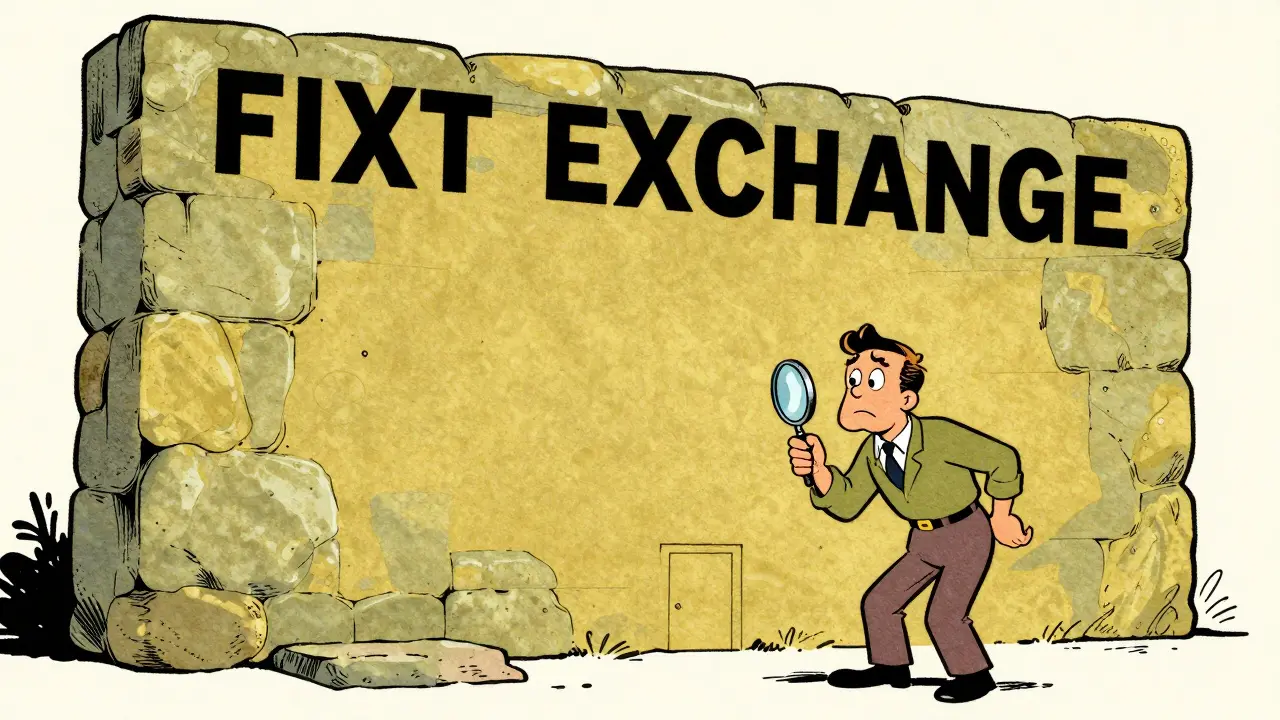
Picking a place to trade your digital assets usually comes down to two things: can you actually get your money out, and does the platform hide its fees in the fine print? When you look at FIXT is a global cryptocurrency platform established in 2023 and headquartered in Panama , you quickly realize that finding straight answers is harder than predicting a meme coin's price spike. In an era where transparency is the only currency that matters, this platform is surprisingly quiet.
The Red Flags of a "Ghost" Exchange
If you've spent any time in the crypto world, you know that a lack of information is often a loud warning signal. Most reputable platforms brag about their liquidity, their security audits, and their user growth. FIXT, however, operates more like a secret society than a financial service. While it launched in 2023, there is a glaring absence of public documentation regarding its technical architecture or its trading engine.
Why does this matter? Because when you deposit funds, you're trusting the exchange's Security Protocols the set of rules and technical measures used to protect digital assets from unauthorized access . If a company won't tell you how they secure your keys or whether they use cold storage, you're essentially flying blind. Compare this to giants like Coinbase a publicly traded US-based cryptocurrency exchange known for its regulatory compliance or Kraken a long-standing exchange focused on security and proof-of-reserves , which publish detailed reports on where user funds are held.
Comparing the Unknown with the Known
To understand where FIXT sits in the market, it helps to look at how it stacks up against other services. Some users confuse it with FixedFloat a non-custodial cryptocurrency exchange service providing fixed and float rate swaps , but they are entirely different entities. FixedFloat is transparent about its costs, charging 1% plus network fees for fixed rates. FIXT, on the other hand, keeps its fee structure undisclosed. This is a massive hurdle for any serious trader who needs to calculate their margins.
| Feature | FIXT | Top-Tier Exchanges (e.g., Binance) |
|---|---|---|
| Fee Transparency | Undisclosed | Public / Tiered |
| Regulatory Clarity | Vague (Panama based) | Strict / Multi-jurisdictional |
| User Community | Minimal/Invisible | Millions of active users |
| Security Audits | Not Publicized | Regular Third-Party Audits |

The Panama Connection and Regulatory Risk
The platform is headquartered in Panama. While many companies choose Panama for its tax advantages and flexible corporate laws, in the crypto world, this can be a double-edged sword. When an exchange is based in a jurisdiction with loose oversight, users have very little recourse if their funds vanish. We saw the absolute worst-case scenario of this with the FTX a former top-three crypto exchange that collapsed in 2022 due to fraud and misappropriation of customer funds bankruptcy. FTX's fall revealed that billions in customer funds were diverted to Alameda Research, proving that a fancy interface can hide a hollow core.
Does FIXT follow AML (Anti-Money Laundering) laws and regulations designed to stop the practice of generating income through illegal actions protocols? Are they compliant with the laws of the countries they serve? There is no public record to confirm these details. In a post-FTX world, "trust me" is not a valid security strategy.

User Experience: The Silence of the Crowd
One of the fastest ways to vet a crypto platform is to head over to Reddit or Trustpilot. For most exchanges, these pages are battlegrounds of complaints and praise. For FIXT, the silence is deafening. There are almost no real-world reviews regarding order execution speed, the ease of the KYC (Know Your Customer) the mandatory process of identifying and verifying the identity of clients process, or the speed of withdrawals.
When you can't find a community of users talking about a platform, it usually means one of two things: the platform is incredibly new and hasn't gained traction, or it's intentionally keeping a low profile to avoid scrutiny. Neither is particularly comforting when you're deciding where to store your life savings. If you're looking for an intuitive interface or a robust mobile app, you'll find that FIXT doesn't offer the comprehensive onboarding guides that modern users expect.
The Verdict: Should You Use FIXT?
If you enjoy high-stakes gambling with your financial security, then by all means, go ahead. But for anyone else, the lack of transparency makes FIXT a high-risk option. A legitimate exchange provides a roadmap, a clear fee schedule, and proof of its security measures. FIXT provides none of these.
Instead of risking your assets on an undocumented platform, it's smarter to stick with exchanges that have a proven track record and clear regulatory standing. The crypto market is volatile enough without adding "exchange failure" to your list of worries. Always remember the golden rule: not your keys, not your coins. If you must use an exchange, use one that is an open book.
Is FIXT a legitimate crypto exchange?
While FIXT is a registered entity in Panama, its legitimacy in terms of safety and transparency is questionable. There is very little public information regarding its security audits, fee structures, or user base, which are standard for reputable exchanges.
What are the fees on the FIXT platform?
Currently, FIXT does not publish a clear fee schedule. This lack of transparency makes it difficult for traders to calculate the cost of transactions compared to other platforms.
Does FIXT require KYC verification?
The specific KYC (Know Your Customer) requirements and verification timeframes for FIXT are not well-documented in public sources, making it unclear how they handle user identity verification.
Where is FIXT headquartered?
FIXT is headquartered in Panama, a jurisdiction known for flexible corporate laws but which can offer less regulatory protection for international users.
How does FIXT compare to FixedFloat?
They are entirely different services. FixedFloat is a known non-custodial exchange with transparent fees (e.g., 1% for fixed rates), whereas FIXT is a global platform with far less public information about its operations.
Iestyn Lloyd
April 29, 2026 AT 03:52The Panama registration is a classic red flag for these kinds of platforms. If you're looking for a safe bet, sticking to exchanges with proof-of-reserves is the only way to go these days. Most a-list platforms provide aMerkle tree or similar audit tools so you can verify your funds are actually there. Without that, you're basically trusting a promise from a company in a tax haven.
Alex Mazonowicz
April 30, 2026 AT 04:33Stay safe everyone!!! Always do your own research!!!
debra hoskins
May 2, 2026 AT 03:55Oh please, acting like Panama is the only problem here. The whole industry is a circus of clowns juggling our money while they pretend to be the next big thing in finance. It is all just a shiny veneer over a pit of desperation and greed.
Lex Harley
May 3, 2026 AT 18:00I wonder if they're using a custodial wallet or maybe some weird multi-sig setup that's not documented? If the API is just a wrapper for some other liquidity provider, that would explain why the fees are ghosted. Total lack of transparency on the order book is a huge L for any scalper trying to find actual depth in the market.
Jehan ZA
May 4, 2026 AT 08:29It is indeed prudent to exercise extreme caution when the corporate structure remains opaque. One must prioritize the security of their capital over the allure of a new platform.
Robert Smith
May 6, 2026 AT 04:18Hard pass 🚩🚩🚩
Kristi Swartz
May 6, 2026 AT 05:24people really need to stop being so naive about where they put their money it is basic common sense that a company with no public fees is a scam and anyone who uses it deserves to lose their funds
Rushell Perry
May 6, 2026 AT 06:28Just a friendly reminder to use a hardware wallet for the bulk of your holdings. Keep only what you're actively trading on any exchange regardless of their reputation. It takes the stress out of these reviews because your main stack is safe regardless of which platform goes bust next
Ryan Nakielny
May 6, 2026 AT 13:22Wow, imagine actually thinking a Panama-based exchange with no fee list is a 'legitimate' choice. Truly an inspiration to us all.
Tracy McBurney
May 7, 2026 AT 19:05The lack of technical documentation is a fundamental failure of a financial service. It is not merely a 'red flag' but a definitive indicator of incompetence or malice. Only an amateur would consider this a viable trading venue given the current regulatory climate in the G20 countries.
Arti Jain
May 8, 2026 AT 02:27Pathetic attempt at a platform. Indian traders deserve better than these offshore jokes.
VIVEK SINGH
May 9, 2026 AT 05:23Oh look, another 'revolutionary' exchange that forgot to mention how it actually makes money. I'm sure their 'secret' fee structure is just a very efficient way to transfer your balance to the CEO's yacht fund. Truly a masterclass in financial innovation.
Sri Astuti
May 10, 2026 AT 06:38I honestly cannot believe some people are still falling for these things in 2024 when the warnings are literally everywhere across the internet 🙄 the level of negligence required to deposit money here is actually impressive in a depressing way, and the fact that they can even operate without a shred of public audit is a total joke of a system!
Amanda Macy
May 11, 2026 AT 20:21The nature of trust in a decentralized world is paradoxical. We move to crypto to remove the middleman, yet we spend all our time searching for a middleman we can actually trust. Perhaps the true lesson is that the search for a 'safe' exchange is a search for a contradiction.
Elle Kharitou
May 12, 2026 AT 10:42It's so important to remember that our journey in the crypto space is as much about learning how to protect ourselves as it is about the gains we hope to make 🌟 we have to be our own guides and look out for one another by sharing these warnings, because at the end of the day, the community is the only real safety net we have in this wild digital frontier ✨🌈
Nitin Gupta
May 13, 2026 AT 17:29I agree with the points made here. For anyone unsure, using a decentralized exchange (DEX) might be a better alternative if you want to avoid the risks associated with centralized entities in vague jurisdictions.
AP Fisher
May 15, 2026 AT 15:14Is there any way to check if they have a license in other countries too?
Lloyd I
May 16, 2026 AT 17:44Let's keep the conversation helpful! If anyone has found an actual list of their fees, please share it so we can all compare. It would be great to have a community-sourced list of the real costs!
Noel Mandotah
May 18, 2026 AT 00:28Imagine using a Panama exchange. Pure comedy.
Harvey Alford
May 18, 2026 AT 16:37I bet they're just stealing it.
its me
May 20, 2026 AT 03:17We all want to believe in a fair system, but we must accept that the ego of the founder usually outweighs the security of the user. This is just the cycle of greed repeating itself in a new skin.
Ipsita Seal
May 21, 2026 AT 22:00Too long didn't read, but looks like a scam.
Veronica Bago
May 23, 2026 AT 05:01Thanks for the heads up! Definitely staying away from this one.
Pramendra Singh
May 23, 2026 AT 22:08I'm sure they might improve their transparency over time as they grow, but for now, it's best to be careful!