
Have you ever tried to swap a token and felt like you left money on the table? You check one exchange, then another, realizing that each platform offers a slightly different price. By the time you find the best rate, the market has moved, or you’ve paid too much in gas fees just to navigate between sites. That is exactly why decentralized exchange (DEX) aggregators exist. They scan multiple liquidity sources to find you the absolute best deal automatically.
In this crowded space of Firebird Finance, a multi-chain DeFi aggregator, promises to solve this problem. It claims to integrate over 140 decentralized exchanges to optimize your swaps while offering cashback rewards. But does it actually deliver better rates than the giants like 1inch or Matcha? Or is it just another project with flashy marketing and empty tokens? Let’s dig into the mechanics, the risks, and the reality of using Firebird Finance in 2026.
What Exactly Is Firebird Finance?
At its core, Firebird Finance is a decentralized finance platform that acts as an intermediary between users and various liquidity pools. Instead of connecting directly to a single pool, such as Uniswap or Curve, Firebird uses a sophisticated routing algorithm. This algorithm splits your trade across multiple venues to minimize slippage-the difference between the expected price of a trade and the executed price.
The platform operates on a cross-chain mechanism. This means you aren’t locked into just Ethereum or BNB Chain. You can move assets and provide liquidity across several blockchain networks simultaneously. For the average user, this simplifies life. You don’t need to manage wallets on five different chains manually; the interface handles the complexity behind the scenes.
However, being an aggregator doesn’t mean it creates new liquidity. It relies entirely on the existing pools from the 140+ integrated DEXs. If those underlying pools are dry, Firebird can’t magically create depth. Its value lies purely in the efficiency of finding the best available price among those existing options.
How the Swap Technology Works
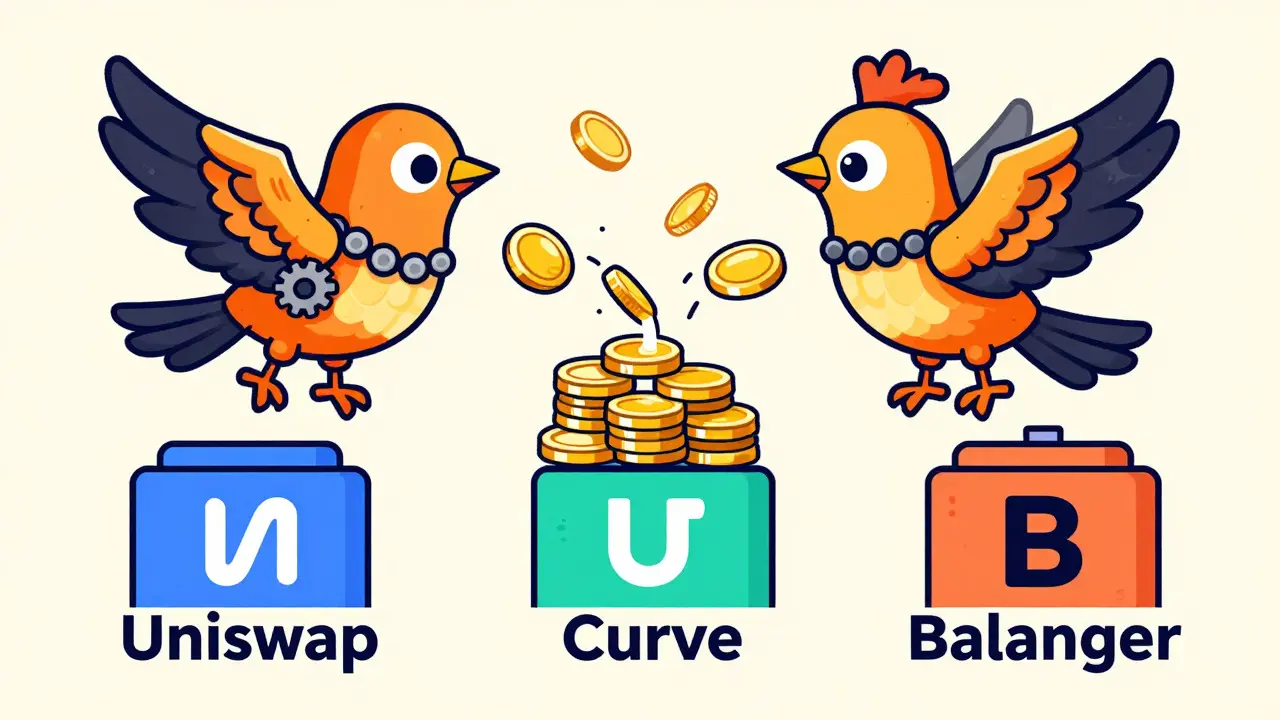
The heart of any aggregator is its engine. Firebird Finance utilizes a feature called OneSwap. Think of this as the brain of the operation. When you enter a swap request, OneScan scans hundreds of potential paths. It might split your transaction so that 40% goes through Uniswap, 30% through Curve, and 30% through Balancer.
Why split it? Because large trades often suffer from high slippage. If you try to sell $10,000 worth of a low-cap token on a small pool, you crash the price. By splitting the order, Firebird minimizes this impact. The result should be a final execution price that is closer to the theoretical mid-market price than if you had traded on a single platform.
Here is what you need to watch out for:
- Gas Fees: Splitting transactions can sometimes increase gas costs because more smart contract interactions occur. On Layer 2 solutions like Arbitrum or Optimism, this is negligible. On mainnet Ethereum, it can add up.
- Execution Time: Complex routing takes milliseconds longer. In a volatile market, that delay matters.
- Success Rate: If one leg of the split transaction fails, the whole swap might revert. You lose gas but keep your tokens. Always check the estimated success rate before confirming.
The Tokenomics: FBA and HOPE Explained
Most DeFi projects use tokens to incentivize usage. Firebird Finance uses a dual-token model involving FBA and HOPE. Understanding these is critical because they dictate whether you actually save money or just earn points that might be worthless.
FBA (Firebird Token): This is the utility token. When you swap on the platform, you receive cashback rewards in FBA. The idea is simple: trade more, get more FBA back. It reduces your net cost of trading. However, the value of that cashback depends entirely on the market price of FBA. If the token price crashes, your "savings" vanish.
HOPE (Governance Token): This token is designed for governance and fee sharing. Here is how it works:
- You lock HOPE tokens for a period ranging from 1 week to 4 years.
- You receive mHOPE tokens in return.
- mHOPE gives you voting rights (1 mHOPE = 1 vote).
- Holders of mHOPE receive a portion of the trading fees generated by the platform.
| Feature | Firebird Finance | 1inch Network | Matcha (By 0x) |
|---|---|---|---|
| Integrated DEXs | 140+ | 150+ | 100+ |
| Cashback Mechanism | FBA Token Rewards | 1inch Token Staking | None (Focus on UX) |
| Governance | mHOPE (Locked) | 1inch DAO | None |
| User Interface | Beginner Friendly | Advanced Options Available | Simple & Clean |
| Token Liquidity Risk | High (Low Volume) | Low (High Volume) | N/A |
Security and Trust: Should You Connect Your Wallet?
In DeFi, security is not a feature; it is a requirement. Firebird Finance markets itself as having "secure vaults" and an intuitive interface. But let’s look at the hard facts. The provided research data does not mention specific security audits from top-tier firms like CertiK, OpenZeppelin, or Trail of Bits.
Without public audit reports, you are trusting the code blindly. Aggregators interact with many other contracts. If one of the 140 integrated DEXs has a vulnerability, or if Firebird’s own router has a bug, your funds could be at risk.
Here is a checklist before you connect your wallet:
- Use a Burner Wallet: Never connect your main wallet holding your life savings. Use a separate wallet with only the amount you intend to swap.
- Check Allowances: After swapping, revoke unnecessary token approvals. Tools like Revoke.cash can help you manage this.
- Verify the URL: Phishing sites are rampant. Bookmark the official site and never click links from Twitter DMs or Telegram groups.
Who Is Firebird Finance For?
Not every tool is for every user. Based on its features and current limitations, here is who fits the profile for using Firebird Finance:
The Yield Farmer: If you are looking to participate in Farms-as-a-Service, Firebird offers automated strategies. This saves you time from manually harvesting yields across different protocols. The cross-chain nature helps you diversify without managing multiple interfaces.
The Casual Swapper: If you hate dealing with complex charts and slippage settings, the "OneSwap" simplicity appeals to you. You just want to trade ETH for USDC quickly. The interface claims to let you start in 5 minutes, which is accurate for basic swaps.
Who Should Avoid It?
- High-Frequency Traders: The potential gas overhead of split transactions might eat into thin margins.
- Risk-Averse Investors: The zero-volume status of the HOPE token suggests early-stage adoption issues. If you rely on stable tokenomics, stick to established players like Uniswap or 1inch.
- Institutional Users: Without transparent audit trails and deep liquidity guarantees, institutional-grade compliance is likely missing.
Community Sentiment and Market Position
Data tells a mixed story. On social media, Firebird Finance has around 11.72K followers on X (formerly Twitter). This is a moderate following, indicating some level of engagement. Community votes show 86% bullish sentiment. People like the idea of cashback and easy cross-chain swaps.
However, market data contradicts the hype. The HOPE token’s zero trading volume is a stark contrast to the bullish community. It suggests that while people talk about the project, few are actively trading its native asset. This disconnect often happens in early-stage DeFi projects where marketing outpaces actual product adoption.
Compared to competitors like Kyber Network, Slingshot, or ParaSwap, Firebird is fighting for attention in a saturated market. Established aggregators have deeper liquidity integrations and proven track records over years of bull and bear markets. Firebird’s advantage is its aggressive incentive structure (cashback), but incentives alone do not sustain a protocol long-term.
Final Verdict: Proceed With Caution
Firebird Finance offers a compelling concept: simplified cross-chain swapping with cashback rewards. The integration of 140+ DEXs provides genuine utility for finding better prices. The OneSwap technology is robust on paper.
Yet, the practical realities raise eyebrows. The lack of visible security audits and the illiquidity of the HOPE governance token are significant hurdles. For small, occasional swaps, it might be a convenient tool. For large capital movements, the risks currently outweigh the benefits compared to more established aggregators.
If you decide to use it, treat it as an experiment. Start small. Monitor your gas costs closely. And always remember that in DeFi, you are your own bank. If the vault breaks, there is no customer support hotline to call.
Is Firebird Finance safe to use?
Safety in DeFi is relative. While Firebird Finance integrates reputable DEXs, the platform itself lacks publicly highlighted security audits from major firms. Always use a burner wallet and limit the amount of funds you expose to any single protocol. The lack of audit transparency increases risk compared to older, audited platforms.
What is the difference between FBA and HOPE tokens?
FBA is a utility token used for cashback rewards when you swap. HOPE is a governance token. You lock HOPE to get mHOPE, which allows you to vote on platform decisions and share in trading fees. Currently, HOPE has very low liquidity, making it harder to trade freely.
Does Firebird Finance work on Ethereum?
Yes, Firebird Finance is a multi-chain aggregator. It supports Ethereum and various other blockchains. It routes trades through DEXs on these networks, including Uniswap on Ethereum. However, gas fees on Ethereum mainnet can be high, so consider using Layer 2 networks if supported for cheaper transactions.
How does the cashback system work?
When you perform a swap using the OneSwap feature, you receive a percentage of the transaction value back in FBA tokens. This effectively lowers your net trading cost. The exact rate may vary based on network conditions and promotional periods.
Why is the HOPE token volume zero?
Market data indicates that the HOPE token currently has negligible trading activity. This could be due to low liquidity, limited exchange listings, or early-stage adoption challenges. It suggests that the token is not yet widely traded or valued by the broader market, posing a risk for holders looking to exit.