
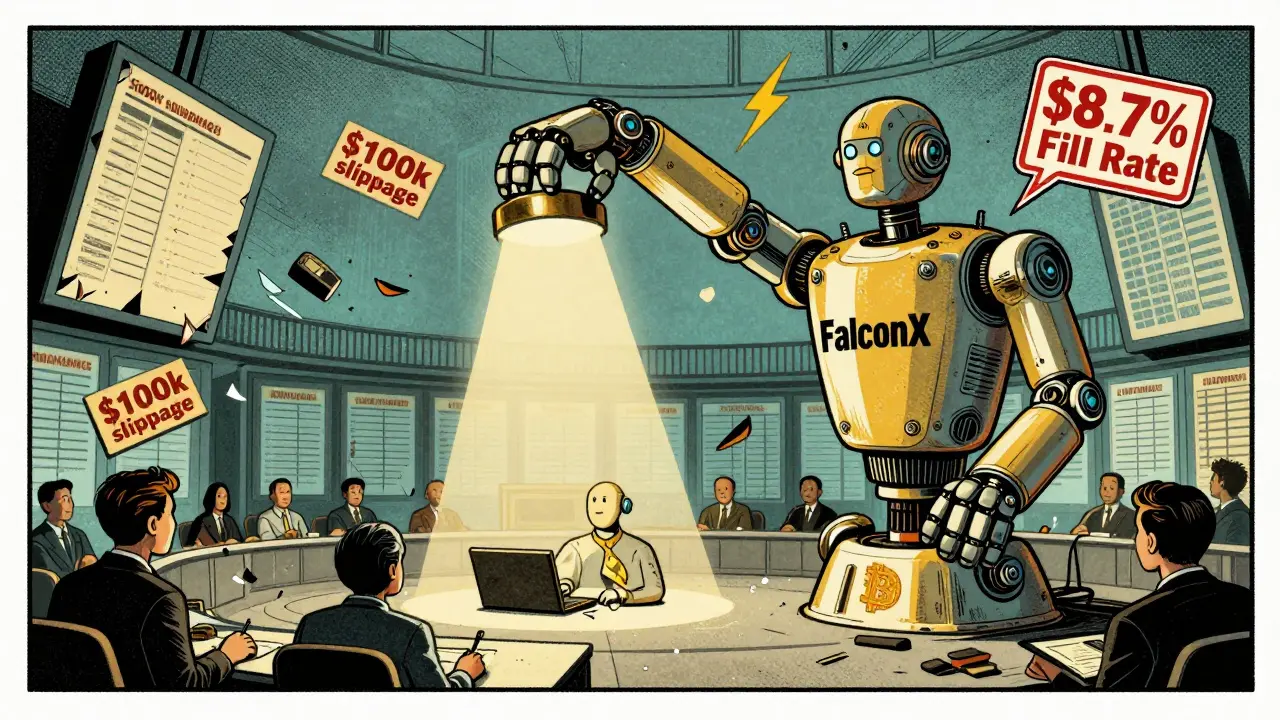
FalconX isn't your everyday crypto exchange. If you're a retail trader looking to buy a few Bitcoin or trade on mobile, you won't find FalconX on your app store. It's built for hedge funds, asset managers, and institutional players who move millions in crypto daily. This isn't about convenience - it's about execution. And in institutional crypto trading, execution is everything.
What Makes FalconX Different?
Most crypto exchanges operate like open markets. You place an order, and the system matches it with whoever's willing to trade at the best price. But for large traders, that system breaks down. A $50 million BTC order on a regular exchange? You'll get slippage - maybe 0.2% or more. That's $100,000 gone before you even start.
FalconX fixes that. Instead of routing orders across dozens of exchanges, it acts as a single counterparty. You quote a price. They accept it. And they guarantee execution - no surprises, no hidden fees, no fragmented liquidity. Their system aggregates depth from over 50 liquidity sources, but delivers it as one clean, executable price. That’s why 98.7% of FalconX orders fill at the quoted rate, according to Finance Magnates’ 2025 benchmark. Compare that to Coinbase Prime’s 95.2% and Kraken Institutional’s 93.8%.
How FalconX Works Under the Hood
Behind the scenes, FalconX runs on a high-frequency engine built for institutional scale. It handles over 100,000 API requests per second with sub-50 millisecond execution latency. That’s faster than most competitors - Coinbase Prime and Galaxy Digital average 120-150ms. Speed alone doesn’t win trades, but when you’re moving $2.5 billion daily, every millisecond matters.
The platform supports both spot and derivatives trading. Its Electronic Options platform, launched in June 2025, lets institutions trade BTC, ETH, SOL, and HYPE options 24/7. Contract sizes range from 0.1 BTC to 100 BTC, giving firms flexibility to hedge large positions without relying on Deribit’s limited weekend hours. And unlike traditional options exchanges, FalconX offers OTC-style flexibility with exchange-like transparency.
Integration is seamless for firms already using trading systems. FalconX supports FIX API (version 5.0 SP2) and REST API, with dedicated engineers helping clients go live in an average of 14 business days. Clients report that integrating with treasury systems like Kyriba or SAP is smoother than with other prime brokers.
Security and Compliance
Institutional clients don’t just care about price - they care about trust. FalconX is registered with multiple global regulators: FalconX Bravo, Inc. is a CFTC-registered swap dealer; FalconX Limited holds a Class 3 VFA license from Malta; and FalconX Delta, Inc. is a FinCEN-registered money services business.
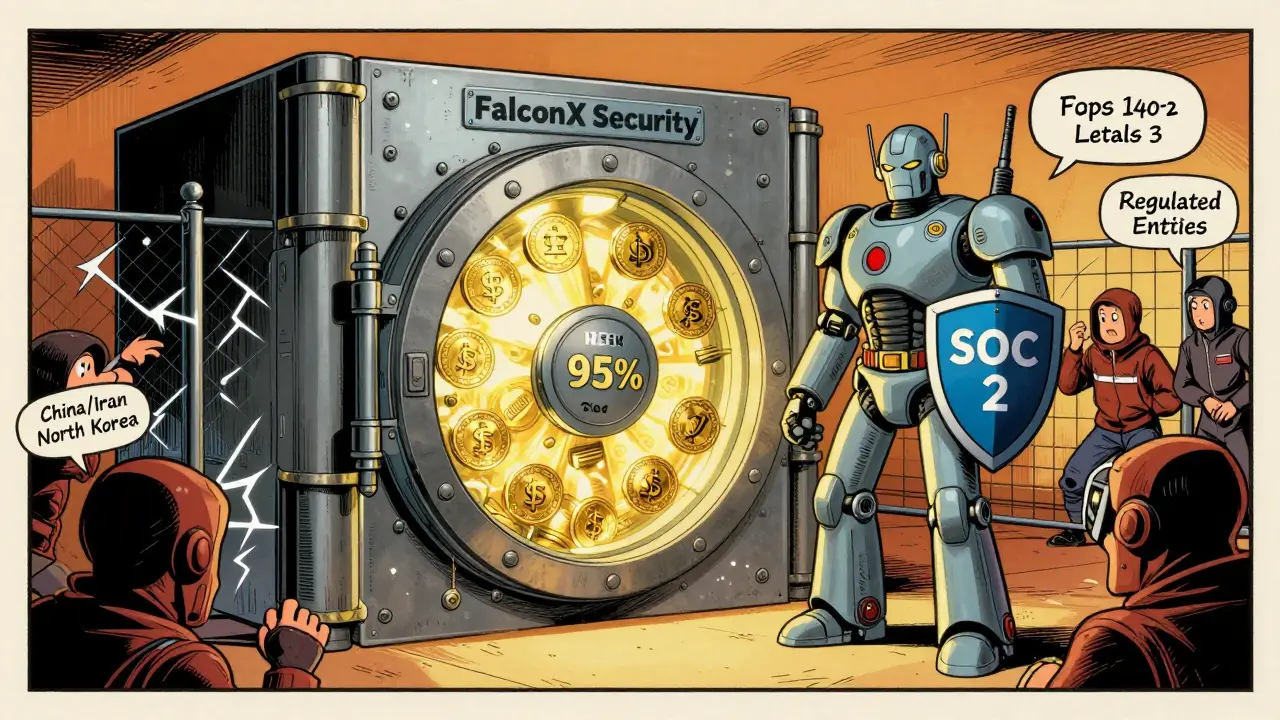
Security is built on institutional-grade standards. 95% of assets are held in cold storage across geographically distributed vaults. Key management uses FIPS 140-2 Level 3 HSMs - the same standard banks use. The platform is SOC 2 Type II compliant, meaning its internal controls are independently audited quarterly.
Settlement is where FalconX really stands out. It offers T+0 settlement for USD and USDC pairs - meaning funds are available the same day. For institutions managing daily cash flows, this isn’t a luxury. It’s essential. According to FalconX’s Q2 2025 client survey, 87% of users said same-day settlement was a top reason they switched from competitors.

Who Can Use FalconX?
This is the catch: FalconX doesn’t serve retail traders. The minimum account size is $1 million. If you’re an individual investor, you won’t get access. That’s intentional. The platform is designed for entities with established compliance frameworks - hedge funds, family offices, crypto-native firms, and institutional asset managers.
As of November 2025, FalconX serves over 1,000 institutional clients globally. The largest user base is in North America (58% of volume), followed by Europe (27%) and Asia (15%). It explicitly blocks clients from restricted jurisdictions like China, Iran, and North Korea.
The acquisition of 21Shares in April 2025 - estimated at $450 million - expanded FalconX’s reach into ETF-related trading. While integration has been slower than expected, it positions FalconX to lead in tokenized asset trading. The company has already announced plans for a Q2 2026 launch of tokenized real-world assets like gold and real estate.
Performance and Real-World Results
Client feedback is overwhelmingly positive. On G2, FalconX holds a 4.6/5 rating from 87 verified reviews, with 92% saying they’d recommend it. One hedge fund manager reported saving $1.2 million in slippage costs over six months on $50M+ trades. Another noted the UI was the best they’d seen in institutional crypto platforms.
Slippage numbers speak volumes. For BTC-USD trades under $500,000, FalconX averages 0.08% slippage. On Binance Institutional, it’s 0.15%. On FTX’s replacement platforms? 0.22%. That difference compounds fast. A $100 million trade on FalconX saves you $160,000 compared to Binance and $220,000 compared to others.
Support is another win. Priority clients get 24/7 multilingual support with an average response time of 47 seconds. But Reddit users report delays during extreme volatility - response times can stretch to 15+ minutes when markets panic. That’s a trade-off for a platform that doesn’t scale its support team for retail spikes.
The Downsides
No platform is perfect. FalconX’s biggest weakness is its lack of transparency. The Block gave it 3.8/5 for transparency, citing limited public disclosure on how orders are routed. Some traders worry about counterparty risk - if FalconX goes down, you’re stuck. Unlike decentralized exchanges, there’s no fallback.
Onboarding is another hurdle. For new institutional clients, the process takes 21-30 business days. You need corporate documents, beneficial ownership disclosures, and proof of regulatory compliance. It’s not quick. But for firms already regulated, it’s predictable. FalconX reports 92% of integration issues are resolved within 30 days.
And while its Electronic Options platform is powerful, it’s still new. Some users report occasional API instability during extreme volatility. But those are edge cases - not the norm.
How FalconX Compares to the Competition
Here’s how FalconX stacks up against key rivals:
| Feature | FalconX | Coinbase Prime | Kraken Institutional | Binance Institutional |
|---|---|---|---|---|
| Minimum Account Size | $1 million | $1 million | $1 million | $1 million |
| Execution Fill Rate | 98.7% | 95.2% | 93.8% | 94.5% |
| Spot Slippage (under $500k) | 0.08% | 0.12% | 0.16% | 0.15% |
| 24/7 Options Trading | Yes | No | No | Yes |
| T+0 Settlement (USD/USDC) | Yes | Yes | No | Yes |
| API Integration Time | 14 days avg | 21 days avg | 25 days avg | 18 days avg |
| Market Share (Institutional Options) | 18.7% | 12.1% | 8.3% | 15.4% |
FalconX leads in execution quality and options volume. Coinbase Prime has broader brand recognition. Binance offers more assets. But if your priority is guaranteed fills, low slippage, and 24/7 options access, FalconX is unmatched.
Final Verdict
FalconX isn’t for everyone. But if you’re an institutional trader moving millions, it’s one of the best tools on the market. It removes the friction that’s plagued crypto trading for years - slippage, fragmented liquidity, unreliable settlement, and opaque pricing.
Its strengths are clear: unmatched execution quality, real-time settlement, institutional-grade security, and a single-counterparty model that cuts operational complexity by 40%. The downsides - onboarding complexity, limited transparency, and retail inaccessibility - are trade-offs for the level of service it delivers.
With $412 million in cash reserves and a projected path to profitability by Q1 2026, FalconX isn’t going anywhere. And with tokenized assets on the horizon, it’s positioning itself to lead the next phase of institutional crypto adoption.
Is FalconX a good crypto exchange for retail traders?
No. FalconX is designed exclusively for institutional clients with a minimum account size of $1 million. Retail traders cannot open accounts, and the platform has no mobile app or web interface for individuals. If you’re trading under $1 million, platforms like Coinbase, Kraken, or Binance are better suited.
How does FalconX make money?
FalconX doesn’t charge trading fees. Instead, it earns revenue through the spread - the difference between the price it quotes to clients and the price it executes at in the broader market. Because it aggregates liquidity from 50+ sources, it can offer tight spreads while still making a profit on volume. Its institutional clients pay for execution quality, not per-trade fees.
Can I trade Bitcoin options on FalconX?
Yes. FalconX launched its Electronic Options platform in June 2025, offering 24/7 trading of BTC, ETH, SOL, and HYPE options. Contract sizes range from 0.1 BTC to 100 BTC, making it ideal for institutional hedging. Unlike Deribit, FalconX offers true round-the-clock access with OTC-like flexibility.
Is FalconX regulated?
Yes. FalconX operates through multiple regulated entities: FalconX Bravo, Inc. is registered with the U.S. CFTC as a swap dealer; FalconX Limited holds a Class 3 VFA license from Malta; and FalconX Delta, Inc. is registered with FinCEN as a money services business. It’s also SOC 2 Type II compliant and uses FIPS 140-2 Level 3 HSMs for security.
How long does it take to get started on FalconX?
Onboarding takes 21-30 business days for regulated institutions. The process requires corporate documents, beneficial ownership disclosures, and proof of regulatory compliance. API integration typically takes 14 days with FalconX’s dedicated engineering team. Most clients complete training and go live within two weeks after integration.
Gene Inoue
March 17, 2026 AT 03:47Graham Smith
March 17, 2026 AT 14:56Konakuze Christopher
March 19, 2026 AT 05:56Angelica Stovall
March 20, 2026 AT 18:24Zachary N
March 21, 2026 AT 20:58Henrique Lyma
March 23, 2026 AT 09:25Carol Lueneburg
March 25, 2026 AT 00:17Manali Sovani
March 26, 2026 AT 19:02Bryan Roth
March 28, 2026 AT 09:07Marc Morgan
March 29, 2026 AT 07:06Brenda White
March 29, 2026 AT 09:01shreya gupta
March 30, 2026 AT 00:08Shreya Baid
March 30, 2026 AT 21:29Prakash Patel
March 31, 2026 AT 05:19Lauren J. Walter
March 31, 2026 AT 22:29Steph Andrews
April 2, 2026 AT 10:09Elizabeth Kurtz
April 2, 2026 AT 12:30Christopher Hoar
April 4, 2026 AT 02:52S F
April 4, 2026 AT 05:18john peter
April 5, 2026 AT 06:45sai nikhil
April 7, 2026 AT 02:41Kira Dreamland
April 8, 2026 AT 12:39Ricky Fairlamb
April 9, 2026 AT 01:41