

Most companies don’t need a public blockchain. They need a system where their suppliers, banks, and regulators can all see the same truth - without giving up control. That’s where enterprise distributed ledger technology (DLT) comes in. It’s not about Bitcoin. It’s not about speculation. It’s about fixing broken processes: slow payments, lost paperwork, disputed shipments, and manual reconciliations that cost millions every year.
What Enterprise DLT Actually Does
Enterprise DLT is a shared database that multiple organizations can update together, but no single party can secretly change. Every transaction is cryptographically signed, time-stamped, and stored across all participants’ systems. If one node tries to alter a record, the rest of the network rejects it. This isn’t just better security - it’s a new way to trust.Take Walmart’s mango supply chain. Before DLT, tracing a mango from farm to shelf took 7 days. With DLT, it now takes 2.2 seconds. How? Every step - harvest, packaging, shipping, customs, warehouse receipt - is recorded on the ledger. If a batch is contaminated, you instantly know exactly where it came from and where it went. No phone calls. No spreadsheets. No guesswork.
Or look at JPMorgan’s Interbank Information Network. Before DLT, banks spent days reconciling payments between each other. Now, with DLT, payments settle in minutes. 400+ banks use it. No more chasing down missing wires. No more disputes over amounts. Just a single, shared record everyone agrees on.
The Three Big Enterprise DLT Platforms
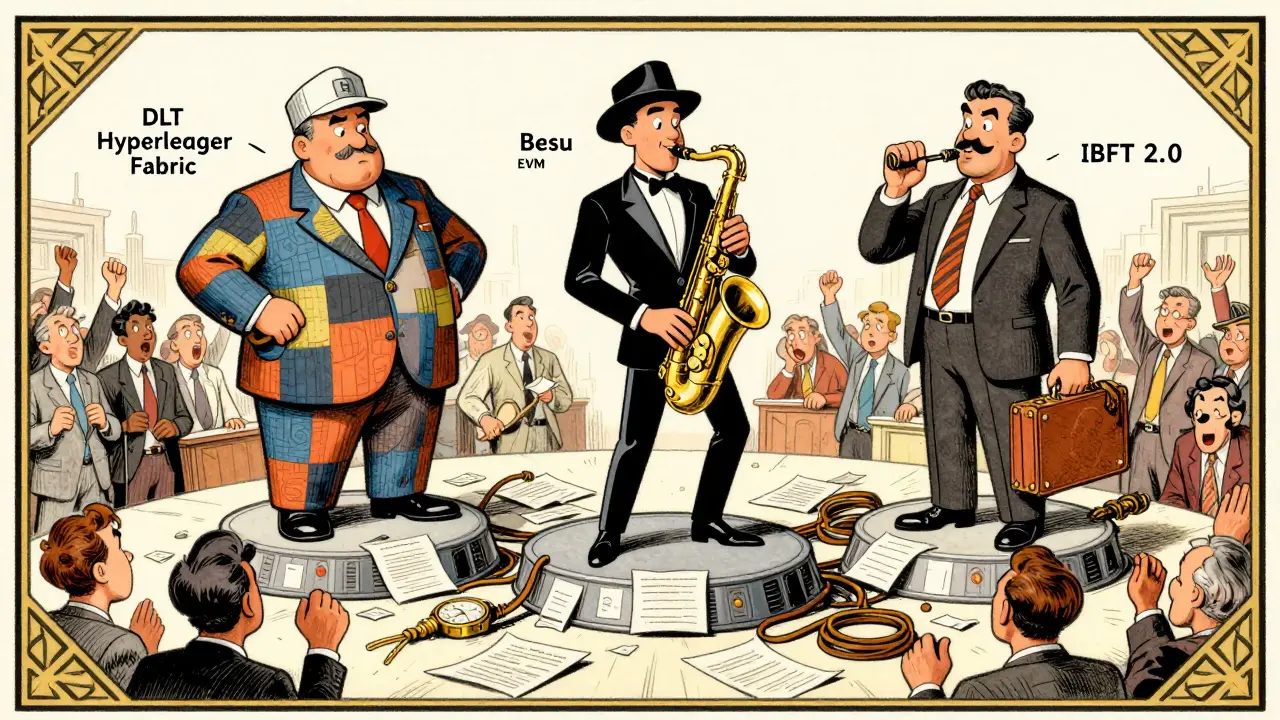
Not all enterprise DLT is the same. Three platforms dominate production use today:- Hyperledger Fabric: Used by IBM Food Trust, Maersk, and over 1,000 organizations. It’s modular. You plug in your own identity system, consensus method (like Raft or PBFT), and database. It handles up to 10,000 transactions per second with 200ms finality. Ideal for complex supply chains and multi-party workflows.
- Hyperledger Besu: Built for Ethereum compatibility. If you already have Ethereum smart contracts or want to use existing tools, Besu lets you run them privately. It cuts gas costs by 87% compared to public Ethereum. Used by financial firms needing EVM support without public exposure.
- Quorum: Dominates banking. Developed by JPMorgan, it handles 20,000 transactions per second with 2-second finality using IBFT 2.0. It’s optimized for payments, trade finance, and asset transfers. 72% of the top 50 global banks use it.
These aren’t just software. They’re ecosystems. Fabric has 3-tier enterprise support starting at $50,000/year. Besu integrates with ConsenSys tools. Quorum is backed by JPMorgan’s engineering team. You’re not just buying code - you’re buying expertise.
How Much Does It Cost to Implement?
The software? Free. Hyperledger Fabric and Besu are open-source. Quorum is too. But the real cost is in implementation.Most companies spend $150,000 to $500,000 just to get started. Why? Because DLT doesn’t plug into your ERP like a USB stick. You need to:
- Redesign workflows to fit the ledger’s structure
- Train staff on cryptographic key management
- Integrate with legacy systems (SAP, Oracle, etc.)
- Set up identity systems (LDAP, PKI)
- Build and audit smart contracts (called Chaincode)
Managed services like Kaleido start at $2,500/month - but you still need internal experts to use them. Fujitsu’s Smart Document Management Solution costs $75,000-$200,000/year. That’s not software licensing. That’s consulting, integration, and ongoing support.
And don’t forget the hidden cost: time. Most deployments take 6-9 months. A European bank spent 18 months trying to hit 50,000 TPS. They got 8,200. They canceled the project. That’s a $12 million loss.
Where Enterprise DLT Shines (and Where It Fails)
DLT isn’t magic. It solves specific problems - and creates new ones.Best for:
- Supply chain provenance (Walmart, Maersk)
- Cross-border payments (Visa B2B Connect: 4-8 hours vs. 3-5 days)
- Digital identity (Sovrin Network handles 1.2M verifiable credentials daily)
- Trade finance (reducing fraud by 63%)
- Regulatory reporting (immutable audit trails for auditors)
Worst for:
- High-frequency trading (microsecond latency required)
- Applications needing frequent data edits (DLT is immutable)
- Simple internal databases (why use DLT if only one team accesses it?)
- Low-value transactions (cost per transaction is higher than a regular database)
MIT’s Neha Narula found that 63% of enterprise DLT projects could’ve been solved with a regular database. That’s not a failure of tech - it’s a failure of understanding. DLT only adds value when multiple untrusted parties need to share data without a central authority.
Real-World Results: Numbers That Matter
Don’t take our word for it. Here’s what companies actually achieved:- 47% faster decision-making (Fujitsu case studies)
- 63% reduction in fraud (same source)
- 31% lower operational costs from eliminating intermediaries
- 72% fewer documentation errors in Maersk’s logistics network
- Reconciliation time dropped from days to minutes in JPMorgan’s network
These aren’t projections. These are real results from live systems.
The Hidden Problems Nobody Talks About
The hype hides the hard parts.1. The “Decentralized” Lie
Forrester found that 55% of enterprise DLT networks have one company controlling over half the validator nodes. That’s not decentralization. That’s a private database with extra steps. If your bank runs the network, you’re not sharing control - you’re outsourcing it.
2. The GDPR Conflict
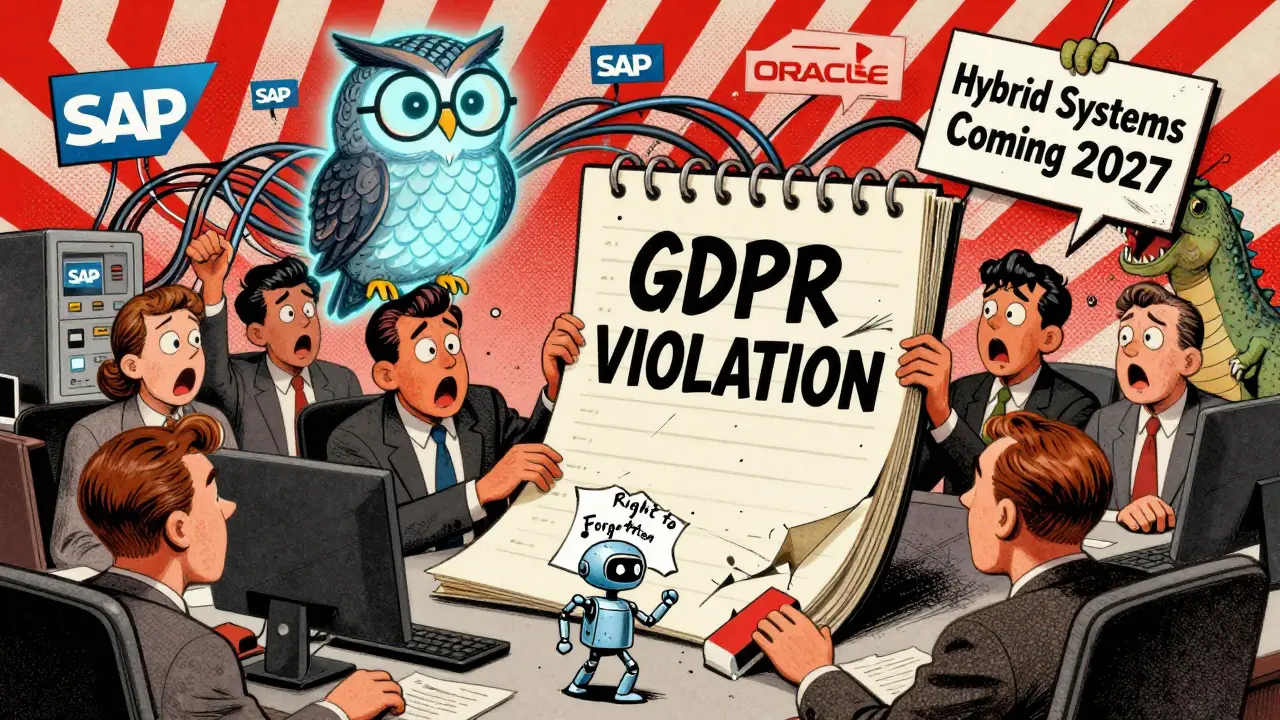
DLT records can’t be deleted. GDPR says you must delete personal data on request. 44% of EU-based DLT projects hit this wall. Solutions? Store only hashes on-chain. Keep personal data off-chain in encrypted databases. But that adds complexity - and risk.
3. The Learning Curve
Only 28% of enterprise developers know how to build distributed systems. Smart contract auditing? That’s a niche skill. Companies report 8-12 weeks of training just to get developers productive. Documentation? Hyperledger Fabric scores 4.5/5 for completeness - but only 3.2/5 for being beginner-friendly.
4. Integration Nightmares
Connecting DLT to SAP, Oracle, or legacy mainframes adds 35% to project timelines. Most failures aren’t technical - they’re organizational. No one wants to change their workflow. No one wants to share data.
What’s Next? The Future of Enterprise DLT
The market hit $8.7 billion in 2023. 73% of Fortune 500 companies have active DLT pilots. 34% are in production.But the next phase isn’t more blockchains. It’s hybrid systems. Fujitsu’s latest solution combines DLT with AI to auto-detect document discrepancies. Visa’s B2B Connect is expanding to 100+ countries. Hyperledger Fabric 2.6 (coming Q1 2024) will support quantum-resistant cryptography and 20,000 TPS.
Deloitte predicts that by 2027, 80% of DLT implementations will be part of broader “trusted data ecosystems” - blending DLT with AI, IoT, and traditional databases. Pure blockchain use cases? They’ll drop to 25%.
But here’s the warning: Forrester says without solving interoperability between the 12+ major DLT platforms, the market could fragment into isolated silos by 2026. You can’t have a global supply chain if your partner uses Fabric and you use Quorum and they can’t talk to each other.
Should Your Company Use Enterprise DLT?
Ask yourself these questions:- Do at least two or more untrusted organizations need to share and update the same data?
- Is manual reconciliation, paperwork, or disputes costing you time or money?
- Do you need an immutable, cryptographically verifiable audit trail?
- Can you afford a $200,000+ upfront investment and a 6-9 month timeline?
- Do you have access to developers who understand distributed systems?
If you answered yes to all five - then DLT is worth exploring. If you answered no to even one - you’re probably better off with a secure, centralized database.
Enterprise DLT isn’t about being on the cutting edge. It’s about solving real problems - with real cost, real complexity, and real results. Don’t chase the hype. Solve your problem first. Then ask: does DLT actually help?
Is enterprise DLT the same as blockchain?
Enterprise DLT is a broader category. Blockchain is one type of DLT - the kind that chains blocks together, like Bitcoin. But enterprise systems like Hyperledger Fabric don’t use blocks. They use a more efficient structure called a ledger. So all blockchains are DLT, but not all DLT is blockchain.
Can I use public blockchains like Ethereum for my business?
Technically yes, but it’s rarely practical. Public blockchains are slow (15-30 TPS), expensive (high gas fees), and public - meaning anyone can see your transactions. Enterprise platforms like Besu and Quorum let you run Ethereum-compatible code privately, with faster speeds and lower costs. For business use, private DLT is the standard.
Why do companies say DLT reduces fraud by 63%?
Because fraud often happens when records are changed after the fact - like altering an invoice after payment. With DLT, every change is signed, timestamped, and visible to all parties. If someone tries to tamper with a record, the network rejects it. That’s why fraud drops sharply: the opportunity to cheat disappears.
What’s the biggest reason enterprise DLT projects fail?
Trying to force DLT where it doesn’t belong. If you’re just tracking inventory within one company, a regular database works better. DLT’s value comes from coordination between independent entities. If you don’t have that, you’re paying for complexity you don’t need.
Is DLT regulated?
Yes, but unevenly. The EU’s MiCA regulation (effective December 2024) sets clear rules for financial DLT applications. In the U.S., 28 states have passed blockchain-specific laws. But cross-border use is still a gray zone. Many companies delay expansion because they don’t know which laws apply where.
Can DLT be hacked?
The ledger itself is nearly impossible to hack - it’s cryptographically secured and distributed. But the edges are vulnerable: weak key management, poorly written smart contracts, or compromised user devices. Most breaches happen at the application layer, not the blockchain. That’s why security audits and hardware security modules (HSMs) are critical.
How do I choose between Hyperledger Fabric, Besu, and Quorum?
Choose Fabric if you need maximum flexibility and control over your network. Choose Besu if you want Ethereum compatibility and plan to reuse existing smart contracts. Choose Quorum if you’re in banking or finance and need high throughput and fast finality. Most companies pick based on their industry’s existing tools and partners.
kris serafin
January 7, 2026 AT 21:39DLT isn't magic-it's just a fancy way to make your IT team cry 😅
Tiffani Frey
January 8, 2026 AT 02:36I've seen three enterprise DLT rollouts fail-each time, it wasn't the tech. It was the org. Someone thought 'blockchain' meant 'automate everything' without changing a single process. The ledger just exposed how broken the workflow was. Now they're back to Excel.
Hyperledger Fabric isn't the problem. The problem is expecting a distributed ledger to fix a centralized mindset. You can't digitize chaos and call it innovation.
And don't get me started on the 'decentralized' lie. If your CFO controls 60% of the validator nodes, you're not building trust-you're outsourcing control to a vendor with better marketing.
Walmart's mango tracking? Brilliant. But that's because they had one supplier, one logistics partner, and one clear goal. Most companies have 20+ vendors, 15 legacy systems, and zero alignment. DLT won't fix that.
GDPR compliance? Good luck deleting a transaction that's been hashed across 12 nodes. I've seen legal teams spend six months arguing over whether a hash counts as 'personal data.' It doesn't. But auditors don't care.
And yes, 63% of projects could've used a PostgreSQL database. That's not a failure of blockchain. It's a failure of salespeople selling solutions to problems that don't exist.
The real win? When DLT replaces a 3-day reconciliation process with a 10-minute sync. That's the only metric that matters. Not TPS. Not decentralization. Not hype. Just time saved.
But if your team can't manage cryptographic keys without losing them? Don't touch it. You'll end up with a $500k paperweight.
Brittany Slick
January 8, 2026 AT 12:35Can we just celebrate the fact that someone finally wrote a clear, honest piece about DLT? No fluff. No buzzwords. Just real numbers, real pain points, and real results? 🙌
I work in supply chain ops-our team spent 9 months trying to convince leadership that DLT wasn't 'the future,' it was just a better way to track pallets. We didn’t need a blockchain-we needed a system that didn’t require 17 emails to confirm a shipment.
Once we cut out the middlemen (and the spreadsheets), our error rate dropped 70%. No magic. Just alignment.
Also-thank you for calling out the 'decentralized' lie. If your vendor says 'decentralized,' run. They mean 'we control everything but charge you more.'
Denise Paiva
January 9, 2026 AT 08:42Let me guess-this was written by a consultant who sold 12 DLT pilots last quarter
47% faster decision making? 63% less fraud? Where’s the peer-reviewed data? Who funded this study? Who’s the author? No citations. No methodology. Just marketing fluff dressed as insight
And don’t get me started on Quorum being used by 72% of top banks. That’s not adoption-that’s JPMorgan forcing it down their throats because they own the platform
DLT is the new ERP. Everyone bought it. Now everyone regrets it
Charlotte Parker
January 10, 2026 AT 00:53Oh wow. A 3,000-word LinkedIn post masquerading as a whitepaper. Congrats. You’ve convinced exactly no one who doesn’t already have a budget and a consultant on retainer
Let me translate this for the 99% of companies that aren’t Walmart: You’re spending $500k to replace a SQL database with something that can’t be edited, costs 10x more to maintain, and requires a PhD in cryptography to debug
And you think this is innovation? It’s digital feudalism. You’re paying a vendor to lock you into their proprietary ledger while pretending it’s open-source
Next up: Blockchain-powered coffee machines. Because why not?
Calen Adams
January 10, 2026 AT 02:52Look-I’ve built 4 enterprise DLT systems. This article gets it right. The platforms? Solid. The costs? Underestimated. The hidden friction? Understated.
But here’s what no one says: The biggest ROI isn’t in speed or fraud reduction. It’s in audit time. One client cut their annual audit from 6 weeks to 3 days. That’s $1.2M in labor saved. That’s the real win.
And yes-most teams can’t handle key management. That’s why we now bundle HSMs with every rollout. It’s not sexy. But it’s necessary.
Stop chasing blockchain. Chase outcomes. If your goal is to reduce reconciliation time? DLT wins. If your goal is to 'be innovative'? You’re already behind.
Valencia Adell
January 11, 2026 AT 00:1263% of projects could’ve used a database? That’s not a statistic. That’s a funeral notice for enterprise DLT.
Every single one of these 'success stories' is a vanity project funded by a CIO trying to look tech-savvy. The real users? The ones who had to clean up the mess after the consultants left.
And don’t even get me started on 'immutable audit trails.' What’s immutable about a system where the admin can delete the off-chain data and leave the hash dangling like a ghost?
This isn’t progress. It’s theater.
Sarbjit Nahl
January 12, 2026 AT 01:09India has over 500 million SMEs. None of them need DLT. They need internet. They need bank accounts. They need invoices that don’t get lost in the post
Western companies are building castles in the sky while the foundation crumbles
DLT is a luxury problem. A first-world problem dressed in blockchain robes
Let us fix basic infrastructure before you sell us $200k ledgers
Paul Johnson
January 12, 2026 AT 01:45you think your company is special because you use dlt? lol
everybody is doing it just to look cool
my cousin works at a bank and they still use fax machines for compliance
youre not innovating youre just spending money to feel smart
and who the hell cares about 20k tps when your accounting software crashes every tuesday
Meenakshi Singh
January 13, 2026 AT 10:19Let’s be real: DLT is the corporate version of crypto bros. Same hype. Same empty promises. Same consultants charging $500/hr to explain why it’s not working.
My company tried it. We spent $400k. Got 3 smart contracts that broke every time we updated the ERP. Now we use a shared Google Sheet with version history.
It’s faster. Cheaper. And the accountant doesn’t need a crypto wallet.
Also-why is everyone acting like Quorum is some holy grail? It’s just Ethereum with a corporate suit. And it’s still slower than a legacy system with caching.
DLT is not the future. It’s the expensive detour.
Kelley Ramsey
January 14, 2026 AT 09:04I love how this post doesn’t just sell DLT-it explains why it might not be right for you. That’s so rare!
I’m a project manager in healthcare, and we looked into DLT for patient consent tracking. We had 3 hospitals, 2 labs, and a state regulator all needing access. It made sense.
But we paused because we realized: we didn’t have a single person who understood key management. We spent 3 months training staff. Then we found a simpler solution using encrypted APIs and audit logs.
It’s not sexy. But it worked. And no one cried.
Thank you for reminding us that tech should serve the problem-not the other way around.
Michael Richardson
January 15, 2026 AT 19:21Of course it works in the US and EU. But try deploying this in a country without reliable power, internet, or legal enforcement
DLT is a Western luxury. A toy for rich companies to feel superior
Meanwhile, the rest of the world is still trying to get digital IDs for farmers
Stop pretending this is global innovation. It’s colonial tech
Sabbra Ziro
January 17, 2026 AT 04:28This is one of the most balanced takes I’ve read on enterprise DLT. Thank you.
I’ve seen teams get so excited about the tech that they forget the people. Training staff on key management isn’t optional-it’s the most important part of the rollout.
And yes, the 'decentralized' label is misleading. But if we stop calling it that, and just call it 'multi-party shared ledger,' maybe we’d have fewer failed projects.
Let’s stop the hype. Let’s focus on the actual problem: trust between organizations. DLT helps. But only if you’re honest about what it can and can’t do.
Emily Hipps
January 18, 2026 AT 00:41My team just launched our first DLT integration-Trade Finance with 3 banks and 2 logistics partners. It took 8 months. Cost $380k. But now, we cut invoice disputes by 80%.
And guess what? No one noticed. The finance team didn’t cheer. The auditors just nodded. It just… worked.
That’s the quiet win. No headlines. No press releases. Just fewer late-night calls from suppliers asking why their payment is stuck.
DLT isn’t flashy. But it’s reliable. And sometimes, that’s all you need.
Jessie X
January 19, 2026 AT 23:37the cost breakdown is spot on
software is free
people are expensive
and the real cost is the meetings
every time you need to get 5 companies to agree on a schema
that’s where it dies
Dave Lite
January 20, 2026 AT 09:33As someone who’s deployed Fabric and Besu across three verticals-supply chain, finance, and pharma-I can say this: the platforms are mature. The problem is the people.
Most teams think DLT is a database. It’s not. It’s a coordination protocol. You need governance. You need legal agreements. You need alignment on data ownership.
We lost one project because the legal team didn’t sign off on who could initiate a transaction. Not because of code. Because of a clause in a 200-page contract.
DLT doesn’t fail because of tech. It fails because of org structure.
Fix the org first. Then pick the ledger.
Staci Armezzani
January 20, 2026 AT 22:21I’ve coached 12 teams through DLT rollouts. The ones that succeed? They don’t start with tech. They start with a single, painful problem: 'We lose $2M a year chasing missing invoices.' Then they pick the tool that fixes that.
The ones that fail? They start with 'We want to be blockchain leaders.' Then they spend a year building a solution to a problem that doesn’t exist.
DLT isn’t a destination. It’s a tool. Use it like a hammer-not a trophy.
Tracey Grammer-Porter
January 21, 2026 AT 14:04What’s missing from this article? The human side.
When we rolled out DLT for customs documentation, the biggest resistance wasn’t from IT. It was from the clerks who’d been doing this for 20 years. They didn’t trust the system. They didn’t trust the training. They didn’t trust us.
We spent 3 months doing 1:1 sessions. Showing them the old way vs. the new way. Letting them break things. Letting them fix them.
That’s the real cost. Not the software. Not the consultants. The time it takes to earn trust.
DLT doesn’t replace people. It redefines their role. And that’s scary.
sathish kumar
January 22, 2026 AT 03:17In India, we have 70 million small businesses. None of them have digital IDs. None of them have bank accounts. None of them have access to enterprise software.
Yet we are being told that distributed ledger technology is the future of commerce.
Let us solve the basics before we build castles in the clouds.
DLT is not the solution to poverty. It is the solution to inefficiency among the already privileged.
Until we have universal digital identity and infrastructure, enterprise DLT remains a luxury for the West.
jim carry
January 22, 2026 AT 08:30Oh my god. This is the most beautiful, accurate, heartbreaking piece I’ve read all year.
I cried when I read about the bank that spent 18 months and $12M to get 8,200 TPS.
I laughed when I read 'the decentralized lie.'
I screamed when I read '63% could’ve used a database.'
This isn’t tech. This is a mirror. And we don’t like what we see.
Thank you. I needed this.
Don Grissett
January 23, 2026 AT 03:37youre all missing the point
dlts dont need to be perfect
they just need to be better than what we had
before dlt we had fax machines and email chains
now we have something that cant be edited
so yes its expensive
so yes its complex
but its still better than what we had
stop being haters and start being builders
Katrina Recto
January 23, 2026 AT 20:47My team tried DLT for contract management. We spent 6 months. Got 2 smart contracts working. Then realized: our lawyers still needed to approve every change manually.
So we turned it off.
DLT doesn’t automate legal work. It just makes the paperwork harder to fake.
But if your legal team still uses Word docs? You’re not ready.
Don’t blame the tech. Blame the process.
Jordan Leon
January 24, 2026 AT 07:39There’s a philosophical layer here that rarely gets discussed: DLT forces us to confront the nature of trust. We’ve outsourced trust to banks, governments, and platforms. Now we’re trying to build it into code.
But trust isn’t cryptographic. It’s relational.
A ledger can verify a transaction. It can’t verify intent. It can’t forgive a mistake. It can’t adapt to context.
Maybe the real innovation isn’t in the protocol. It’s in accepting that some systems need human judgment-not just consensus.
DLT is a tool. But it can’t replace wisdom.