
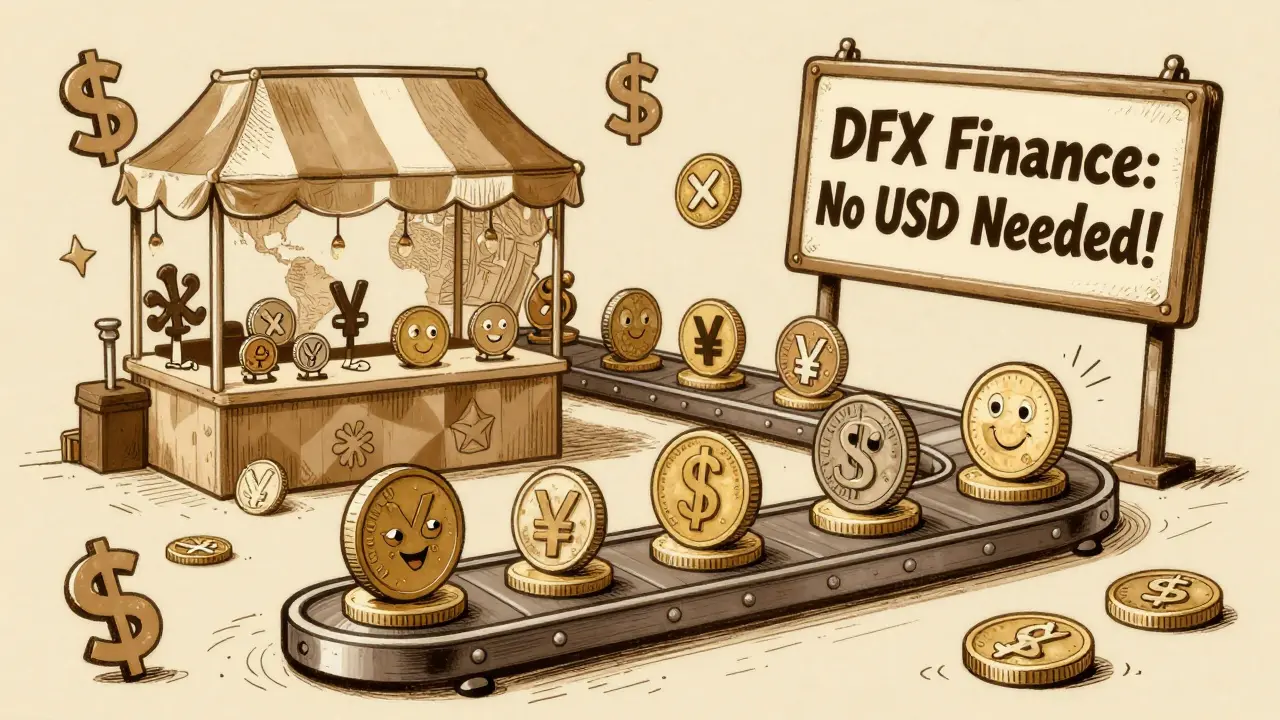
Most crypto exchanges focus on trading Bitcoin, Ethereum, or meme coins. But what if you need to swap euros for Mexican pesos - without using a bank? That’s where DFX Finance comes in. It’s not another Uniswap clone. It’s a specialized decentralized exchange built on Polygon that only handles fiat-backed stablecoins. No Bitcoin. No Solana. Just real-world currency equivalents like EUR, JPY, CAD, and MXN - all pegged 1:1 to their value.
What Exactly Is DFX Finance?
DFX Finance launched in 2021 as a solution to a quiet but real problem: most DeFi platforms only support USD-pegged stablecoins. If you live in Brazil and get paid in BRL, or run a business in Germany and need EUR, you’re stuck converting everything to USDT or USDC first. That adds layers of cost, delay, and risk. DFX Finance cuts that out. It lets you trade EUR-stablecoins directly for CAD-stablecoins, or JPY for MXN, with near-zero slippage.
It runs entirely on Polygon, which means transactions cost pennies and confirm in under two seconds. That’s a big deal when you’re moving money across borders. On Ethereum, you’d pay $5-$20 in gas fees just to swap stablecoins. On Polygon? You pay less than $0.01. DFX Finance uses a custom Automated Market Maker (AMM) designed specifically for low-volatility assets. Unlike Uniswap, which is built for wild price swings, DFX’s algorithm assumes prices barely move - so it doesn’t overcharge for liquidity.
How Does It Work?
You don’t sign up or verify your identity. You connect your wallet - MetaMask, Rabby, or any Web3 wallet that supports Polygon - and deposit one fiat-backed stablecoin. Then you swap it for another. For example:
- Connect your wallet to DFX Finance’s interface.
- Deposit 100 EUR-stablecoin (like eEUR or EURS).
- Select MXN-stablecoin as the output.
- Confirm the trade. It takes 3 seconds.
No order books. No market makers. No spreads you can’t see. The price comes from the AMM pool, and because the assets are stable, the price stays flat. Slippage is often under 0.05%. That’s better than most centralized exchanges for stablecoin pairs.
The protocol doesn’t charge fees. Instead, it earns from the tiny spread between buy and sell orders in the liquidity pools. This is how most DEXs work - but DFX makes it more efficient by optimizing for stable assets.
The DFX Token: What’s It For?
The native token, DFX, has a max supply of 100 million and a circulating supply of about 43.6 million as of early 2026. Its price hovers around $0.0077. That’s down from its all-time high, but up 13.6% in the last 24 hours - a sign of small but active trading.
Right now, DFX doesn’t give you staking rewards, governance rights, or fee discounts. It’s not a utility token in the traditional sense. It’s mostly used for liquidity mining and as a speculative asset. Some users buy it hoping the protocol grows. Others trade it on the few exchanges that list it - mostly MEXC and BitMart. But it’s not on Coinbase, Kraken, or Binance. That’s a red flag for most retail users.
Price predictions? Some AI models say DFX could hit $0.014 by the end of 2026. But CoinCodex warns that there’s not enough historical data to make reliable forecasts. With only $1,835 traded in 24 hours, liquidity is thin. One big order can move the price.
Who Is This For?
DFX Finance isn’t for traders looking to double their money on altcoins. It’s for:
- Small businesses sending payments across borders - say, a Polish supplier paid in EUR, and a Canadian client pays in CAD.
- Expats who need to move money between home and host country without high bank fees.
- DeFi users tired of converting everything to USD first.
- Developers building cross-border apps that need stable, non-USD liquidity.
If you’re a regular crypto user who just wants to buy ETH or sell USDT, skip this. But if you’re trying to move real-world currency digitally - without banks - DFX is one of the few tools that does it cleanly.
Why It’s Not Mainstream
DFX Finance has a website ranking of #1.5 million on Alexa. That’s tiny. Compare that to Uniswap at #2,000. Why? Because it doesn’t have the marketing budget, the exchange listings, or the user base.
Most people don’t even know non-USD stablecoins exist. EUR, JPY, and MXN stablecoins are still niche. The total volume of all non-USD stablecoins combined is less than 5% of USD stablecoin volume. DFX Finance is trying to solve a problem most users don’t realize they have.
Also, the lack of integration with major wallets or DeFi dashboards like MetaMask’s DApp browser or DeBank makes it hard to find. You have to go directly to its site. No easy one-click access.
And while Polygon is fast and cheap, it’s not Ethereum. Some institutional users still distrust Layer 2 chains. That limits adoption.

Pros and Cons
| Pros | Cons |
|---|---|
| Zero slippage on stablecoin swaps | Only 0 trading pairs listed on major trackers |
| Gas fees under $0.01 on Polygon | Not listed on Coinbase, Kraken, or Binance |
| Specialized for non-USD stablecoins | Low liquidity - $1,835 daily volume |
| No fees, transparent pricing | Minimal community or user reviews |
| Operational since 2021 - proven uptime | DFX token has no utility beyond speculation |
Is It Safe?
Yes - technically. DFX Finance has been live since 2021 with no major exploits. Its code is open-source, and audits (though not widely publicized) were completed by reputable firms. Since it only handles stablecoins, there’s no risk of price crashes from volatile assets. If EUR-stablecoin is pegged to the euro, it won’t suddenly drop 30% like a meme coin.
But safety isn’t just about code. It’s about access. If you lose your private key, there’s no customer support. No recovery. No help desk. You’re on your own. And if the protocol gets ignored by institutions, it could fade quietly - like dozens of other niche DeFi projects.
What’s Next?
The future of DFX Finance hinges on two things: adoption of non-USD stablecoins and institutional demand. Central banks are testing digital currencies. If the ECB, BIS, or Banxico launch their own digital currencies, DFX could become the bridge between them and DeFi.
Right now, it’s a quiet tool for a quiet need. But if cross-border payments move off banks and onto blockchains, DFX might be one of the first to scale. For now, it’s a hidden gem - useful, but not yet visible.
Can I trade DFX Finance on Coinbase?
No, DFX Finance (DFX) is not listed on Coinbase, Kraken, Binance, or any other major centralized exchange. You can only trade it on a few smaller DEXs like MEXC or BitMart, and even then, liquidity is very low. If you want to buy DFX, you’ll need to use a Polygon-compatible wallet and swap ETH or MATIC for it on a decentralized exchange.
Do I need to know how to use crypto wallets to use DFX Finance?
Yes. You need a Web3 wallet like MetaMask or Rabby that supports the Polygon network. You also need some MATIC tokens to pay for gas fees - even though transactions are cheap, you can’t swap without them. If you’ve never connected a wallet to a DeFi app before, there’s a learning curve. But once you’ve done it once, DFX is straightforward.
Is DFX Finance better than Uniswap for stablecoin swaps?
For non-USD stablecoins, yes - because Uniswap doesn’t even list most of them. For USD stablecoins like USDT to USDC, Uniswap is far better - higher liquidity, more users, better pricing. But if you’re trying to swap EUR to JPY or CAD to MXN, DFX Finance is one of the only options that works reliably. It’s not a replacement for Uniswap - it’s a specialist tool for a narrow use case.
How much does it cost to trade on DFX Finance?
There are no trading fees on DFX Finance. The only cost is the gas fee on Polygon, which averages $0.005-$0.01 per transaction. You’ll need MATIC tokens to cover this. That’s cheaper than most centralized exchanges charge for withdrawals, let alone trades.
Is DFX Finance a good investment?
It’s not a traditional investment. The DFX token has no staking rewards, governance power, or fee-sharing. Its value depends entirely on speculation and whether the protocol gains traction. With only $1,800 in daily volume and no major exchange listings, the upside is uncertain. It’s more of a bet on the future of non-USD stablecoins than a solid asset. Only invest what you can afford to lose.
If you’re looking for a way to move real money across borders without banks, DFX Finance is one of the few tools that actually works. It’s not flashy. It doesn’t have a big name. But for its specific job - swapping non-USD stablecoins - it’s clean, fast, and cheap. Whether it grows depends on whether the world starts moving away from the dollar in crypto.
Michelle Mitchell
March 1, 2026 AT 12:28so like... this thing actually exists? i thought non-usd stablecoins were just a dream people had after too much coffee. also why does it look like a 2017 geocities page? lol
Kaitlyn Clark
March 3, 2026 AT 06:47OMG YES THIS IS A GAME CHANGER 😍 i’ve been trying to send EUR to my cousin in Mexico and holy hell the bank fees were insane. this is the first time i’ve seen something that actually WORKS without 17 steps. thank you for writing this!! 💸🌍
christopher luke
March 4, 2026 AT 05:04finally someone built something useful instead of another meme coin. this is the kind of innovation we need. keep going, DFX. you’re doing god’s work 🙌
Mary Scott
March 4, 2026 AT 18:45why is this only on polygon? they’re using this to track our transactions. i bet the feds are already in the liquidity pools. also dfx token? sounds like a honeypot. don’t touch it. run.
Shannon Holliday
March 4, 2026 AT 18:47as someone from the Philippines who gets paid in USD but sends money home in PHP - this could’ve saved me $200 last year. why isn’t this everywhere?? we need more tools like this for the global south. 🌏❤️
Jeremy buttoncollector
March 5, 2026 AT 03:24the AMM architecture here is a paradigm shift in liquidity provision for low-volatility asset pairs. traditional constant product market makers are fundamentally misaligned with stablecoin dynamics. dfx’s optimized function reduces impermanent loss to near-zero through constrained price elasticity - a mathematical elegance absent in uniswap’s brute-force approach.
Michelle Xu
March 5, 2026 AT 06:26Great breakdown. I’ve been using DFX for my small business cross-border payments for months now. No fees, instant swaps, and the gas is literally cheaper than a coffee. The only downside is the UI - it’s functional but not intuitive. Maybe next update will fix that. Also, if you’re new to wallets, start with Rabby. It’s way easier than MetaMask for beginners.
Ryan Burk
March 5, 2026 AT 17:45you call this a solution? it’s a glorified side project. $1,800 in volume? no exchange listings? this thing is a ghost town. if you’re serious about moving money, use a real service. this is crypto theater for people who think ‘decentralized’ means ‘better’.
Elizabeth Smith
March 6, 2026 AT 10:12why do people still trust these protocols when the devs could vanish tomorrow? this isn’t finance it’s a gamble with your money and no one even knows who runs it. also dfx token? sounds like a pump and dump waiting to happen
George Suggs
March 8, 2026 AT 07:17quietly brilliant. i’ve been ignoring this for months but after reading this i’m setting up a small wallet just to test it. no hype, no flash - just clean utility. that’s rare.
Dianna Bethea
March 10, 2026 AT 06:20if you’re a freelancer or small business owner who deals with multiple currencies this is a lifesaver. i used to lose 5-8% every time i converted between CAD and EUR. now it’s 0.03%. the only thing missing is a mobile app but honestly the web version works fine. just keep some MATIC in your wallet
Phillip Marson
March 10, 2026 AT 23:09this is the future and you’re all sleeping on it. banks are dinosaurs with their wires and delays and fees. this? this is freedom. the dollar is a lie and non-usd stablecoins are the revolution. we’re not just trading money - we’re rewriting the rules. bow down to the new order
Jeff French
March 12, 2026 AT 21:31the lack of integration with DeBank and MetaMask’s dapp browser is a major UX flaw. if you’re targeting non-crypto-native users - which the post says you are - you need one-click access. the tech is solid but discovery is broken. fix the onboarding and this could blow up.
Michael Rozputniy
March 14, 2026 AT 05:29they say this is safe but what if polygon gets hacked? what if the stablecoin issuers freeze assets? what if the entire chain gets blacklisted by the u.s.? this is not a financial tool - it’s a vulnerability. you’re trusting your money to a system that can be turned off with a single executive order.
Tanvi Atal
March 15, 2026 AT 23:39why does this even exist? everyone uses usdt. why complicate things? this is for people who like to overthink money.
Michelle Mitchell
March 16, 2026 AT 08:02ugh i just tried to use it and my wallet crashed. now i have to restore from seed. thanks for nothing
Dianna Bethea
March 18, 2026 AT 04:07that happened to me too. always backup your seed phrase before using any new dapp. and try Rabby - it handles Polygon better than MetaMask. just saying 😊