
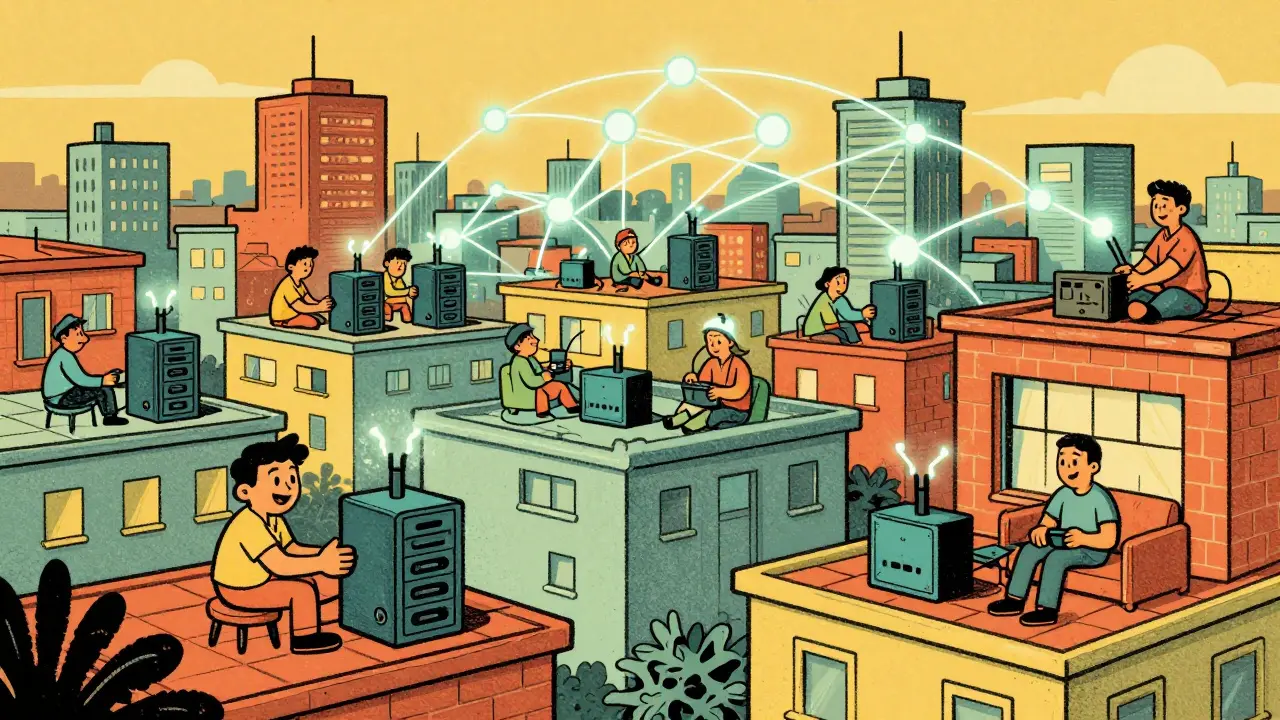
Most crypto projects are built on speculation. You buy a token hoping someone else will pay more for it later. It’s a game of musical chairs, and when the music stops, most people lose. DePIN, or Decentralized Physical Infrastructure Network, flips this script entirely. Instead of relying on hype, DePIN projects use tokens to pay real people for building real things-wireless hotspots, storage servers, and GPU clusters.
In July 2026, the DePIN sector has matured significantly. With over 75 active projects and a combined market cap exceeding $8.2 billion, these networks are no longer just concepts; they are operational businesses generating revenue from traditional customers. The core question isn't "will this go up?" but rather "how does this economic model sustain itself?" Understanding DePIN token economics is crucial because it determines whether a network survives the inevitable consolidation phase that experts predict will wipe out 70% of current projects by 2026.
The Core Mechanism: Incentivizing Physical Action
At its heart, a DePIN project solves a coordination problem. Traditional infrastructure companies like AT&T or AWS spend billions centrally planning where to place cell towers or data centers. This is slow, expensive, and often inefficient. DePIN uses blockchain technology to coordinate thousands of individuals who own hardware, turning their idle resources into a shared network.
The economic engine here is the token. Unlike fiat currency, which is controlled by central banks, DePIN tokens are programmable incentives. When you deploy a Helium hotspot in your living room, you aren't just buying hardware; you're joining a global wireless network. The protocol automatically verifies that your hotspot is providing coverage and rewards you with HNT tokens. This creates a flywheel effect:
- More providers join: Attracted by token rewards, more users buy hardware.
- Better coverage emerges: As density increases, the network becomes more valuable to consumers.
- Revenue grows: Mobile carriers and IoT companies pay to use the network.
- Tokens gain utility: Revenue is used to buy back and burn tokens, reducing supply and increasing scarcity.
This model bridges the gap between digital assets and physical reality. It’s similar to how Uber pays drivers, but instead of a central company taking a cut, the smart contract distributes rewards transparently based on verifiable proof of work.
Anatomy of a Sustainable Token Model
Not all token distributions are created equal. A poorly designed economy leads to hyperinflation, where early adopters dump their tokens, crashing the price and killing the network. Successful DePIN projects follow specific structural rules outlined in recent industry reports.
First, look at supply and distribution. A healthy DePIN token typically allocates 40-50% of its total supply to network participants-the people actually running the hardware. If too much supply is held by venture capitalists or the founding team, the incentive structure breaks. For example, many successful projects reserve only 15-20% for the team, with strict vesting schedules spanning 3-4 years. This prevents sudden sell-offs that could destabilize the market.
Second, consider token utility. A token must have a job beyond being traded on exchanges. In the Helium ecosystem, HNT is required to purchase data credits for sending messages over the network. In Filecoin, FIL is used to pay for storage space. Without concrete use cases, the token becomes speculative baggage. Utility drives demand, which supports price stability.
Third, examine governance mechanisms. Who decides how the treasury is spent? Most mature DePINs use quadratic voting or delegated voting. Helium, for instance, employs a three-tier system where HNT holders elect validators, who then govern network upgrades. This ensures that those with skin in the game make decisions, aligning long-term interests with network health.

Revenue Models: From Speculation to Sustainability
The biggest differentiator between DePIN and meme coins is revenue. Meme coins like Dogecoin rely purely on community sentiment and viral marketing. They have no cash flow. DePIN projects, however, generate income from non-crypto customers. In Q2 2024 alone, Helium reported $28.3 million in service revenue from enterprise IoT contracts.
This revenue is critical for two reasons. First, it proves product-market fit. If telecom companies are paying for your network, it works. Second, it enables deflationary mechanics. Many projects, such as IoTeX, allocate a portion of their service revenue (often around 30%) to buy back and burn their native tokens. Since its implementation in early 2023, this mechanism has reduced IOTX supply by 2.1% annually, creating upward pressure on price independent of market hype.
Let’s compare this to the broader crypto market. During the 2022 crash, Filecoin’s FIL token showed remarkable resilience compared to other altcoins. Why? Because enterprise clients continued paying for storage services regardless of Bitcoin’s price. This revenue floor provided stability that pure-play DeFi protocols lacked. Data from CoinGecko shows that DePIN tokens with real revenue streams exhibit 30-40% less volatility than average crypto assets.
| Feature | DePIN Projects (e.g., Helium) | Meme Coins (e.g., Dogecoin) |
|---|---|---|
| Value Driver | Real-world service usage & revenue | Community sentiment & speculation |
| Revenue Source | Enterprise contracts, consumer subscriptions | None (transaction fees only) |
| Token Utility | Paying for services, staking, governance | Speculative trading, tipping |
| Volatility | Lower (30-40% less than avg) | Extremely High |
| Sustainability | High (if revenue covers costs) | Low (dependent on new buyers) |

Risks and Challenges in DePIN Economics
Despite the promise, DePIN is not without significant risks. The barrier to entry is higher than simply buying a coin on an exchange. Participants need hardware, technical knowledge, and patience. Hardware costs range from $50 for basic sensors to over $2,000 for high-performance computing nodes. This excludes many potential contributors and concentrates power among wealthier participants.
Regulatory uncertainty remains a major hurdle. As of late 2024, 67 countries lack specific regulations for DePIN. Chainalysis reports that 78% of jurisdictions are unclear on how to treat token rewards for infrastructure provision. Are they wages? Capital gains? Securities? This ambiguity scares away institutional investors and complicates tax reporting for individual node operators.
Furthermore, there is a risk of revenue overstatement. Delphi Digital warned in June 2024 that some projects may inflate their enterprise contract claims. Without transparent, on-chain verification of revenue flows, it’s hard to distinguish genuine success from marketing fluff. Messari’s Ryan Watkins emphasized that projects implementing on-chain buy-and-burn mechanisms offer far greater trust than those relying on traditional audits.
User experiences reflect this complexity. On Reddit, long-time Helium operators report stable earnings after initial setup, while newer entrants in networks like Render Network complain about inconsistent demand and high electricity costs eating into profits. One user documented earning only $18.50 monthly after expenses on a $450 hardware investment. This highlights the importance of due diligence before deploying capital.
The Future Landscape: Consolidation and Growth
Looking ahead to 2026 and beyond, the DePIN sector is entering a phase of consolidation. Messari forecasts that 70% of current projects will fail, leaving only those with sustainable revenue models and efficient tokenomics. This is a healthy process. It weeds out speculative ventures and strengthens the survivors.
Growth projections remain strong. MarketsandMarkets predicts the DePIN market will hit $22.3 billion by 2027, growing at a 47.2% CAGR. Enterprise adoption is accelerating, with 38 Fortune 500 companies now using DePIN services for IoT connectivity and distributed computing. Major updates, such as Helium’s transition to Solana for higher throughput and Filecoin’s implementation of smart contracts via FVM, demonstrate the sector’s technical maturation.
For investors and participants, the key takeaway is clear: focus on fundamentals. Look for projects with verified revenue, transparent token burns, and strong community governance. Avoid those promising quick riches without a clear path to profitability. DePIN represents a shift from speculative gambling to value creation, but only if the economic models are sound.
What makes DePIN token economics different from regular crypto?
DePIN tokens are tied to physical infrastructure and real-world services. Unlike meme coins that rely on speculation, DePIN tokens derive value from actual usage, such as paying for wireless data or cloud storage. This creates a revenue stream that can support token prices through mechanisms like buybacks and burns.
How do DePIN projects generate revenue?
They charge traditional customers for services. For example, mobile carriers pay DePIN networks for offloading traffic, or businesses pay for decentralized storage. This fiat or crypto revenue is then used to reward infrastructure providers and often to buy back tokens, reducing supply.
Is it profitable to run a DePIN node?
It depends on the project, location, and hardware costs. Established networks like Helium can provide steady returns if you have good coverage and low electricity costs. However, newer or niche networks may have inconsistent demand, leading to lower or negative returns after expenses. Due diligence is essential.
What are the main risks of investing in DePIN tokens?
Key risks include regulatory uncertainty, hardware obsolescence, and project failure. Many DePIN projects may not survive the coming consolidation phase. Additionally, token prices can be volatile if revenue growth slows or if large amounts of vested tokens are sold by early investors.
Which DePIN projects are considered leaders in 2026?
Helium, Filecoin, and Render Network are currently the market leaders, holding significant market share in wireless, storage, and computing respectively. These projects have demonstrated consistent revenue generation and large user bases, making them relatively safer bets within the sector.