
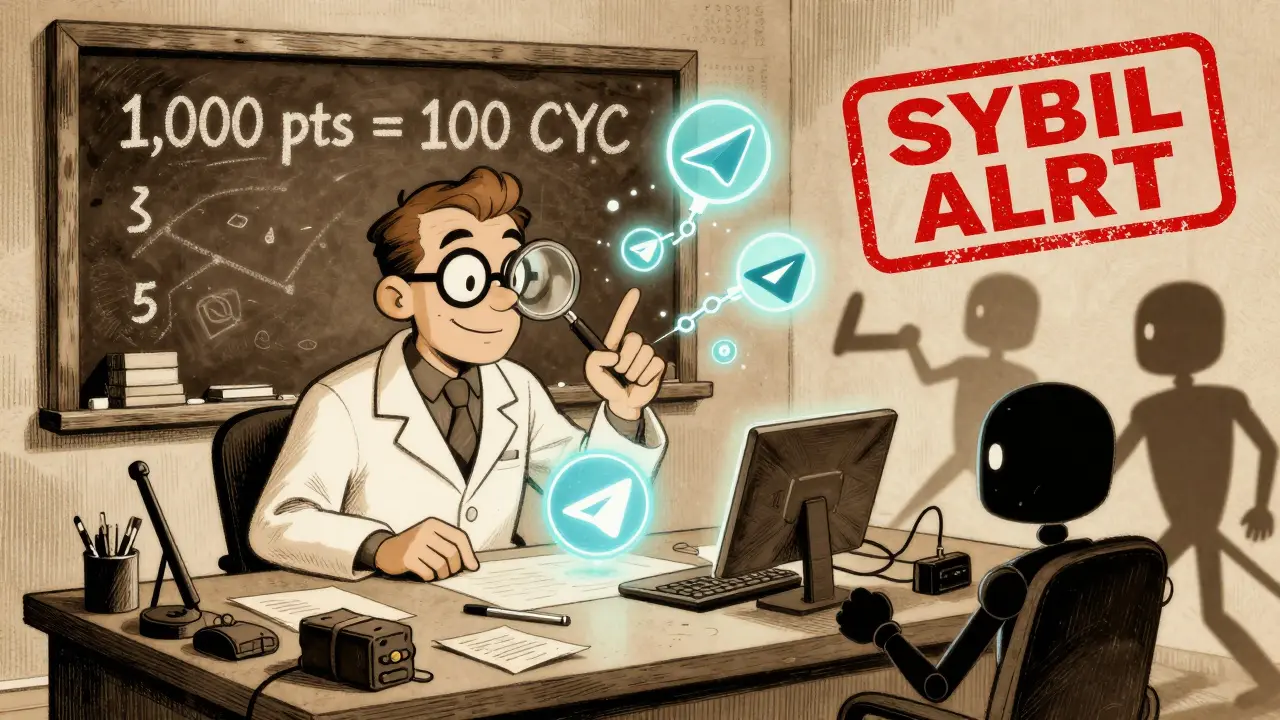
When Cyclone Protocol launched its CYC airdrop in early 2021, it didn’t just hand out free tokens. It built a system designed to reward real participation - not just sign-ups. The goal? To create a decentralized, privacy-first community where the people who helped build the protocol actually owned it. Unlike most airdrops that give the same amount to everyone who joins a Telegram group, Cyclone’s approach was layered, technical, and strict. If you didn’t actively engage, you got nothing. If you tried to game the system, you got flagged. And if you did it right, you walked away with real value - all while keeping your transactions private.
How the CYC Airdrop Actually Worked
The airdrop wasn’t a snapshot. It wasn’t a random draw. It was a points-based system that tracked your actions over weeks. Participants earned points by completing specific tasks: joining official channels, verifying wallet addresses, inviting others who actually completed setup, and staying active in the community. The more you did - and the more carefully you did it - the more CYC you earned. The total supply distributed through the airdrop was 1,500 CYC tokens. But here’s the catch: those tokens weren’t split evenly. They were divided proportionally based on your point total. Someone with 1,000 points got 10 times more than someone with 100 points. That meant the most active users - the ones who helped spread the word, tested the tech, and followed instructions - were the ones who benefited most. To track points, Cyclone used a Telegram bot. You had to link your wallet to it. If your wallet wasn’t properly connected, your points didn’t count. If your referrals didn’t connect their wallets, your points got cut. If the bot detected spammy behavior - like creating 20 fake accounts - your entire account got disqualified. This wasn’t just about fairness. It was about protecting the integrity of the protocol from bots and sybil attacks.Why Cyclone Protocol Rejected Pre-Mining
Most crypto projects start with a big chunk of tokens set aside for the team, investors, or venture capital. Cyclone Protocol didn’t do that. At all. The team publicly committed to zero pre-mining, zero private allocations. Every single CYC token was distributed through participation. No insiders got a head start. No early backers got special treatment. Even the developers had to earn their tokens like everyone else. This wasn’t just marketing. It was a core philosophy. Cyclone was built on the idea that privacy should be a public good - not a product sold to the highest bidder. If you wanted to own part of the protocol, you had to contribute to it. That meant using the anonymity pools, helping test the system, or bringing in others who did the same. The airdrop wasn’t a giveaway. It was a recruitment tool for a decentralized network.The Tech Behind the Privacy
Cyclone Protocol uses zkSNARKs - a type of zero-knowledge proof - to hide the link between who deposits funds and who withdraws them. Think of it like putting cash into a locked box, then pulling out cash from a different box without anyone knowing you’re the same person. The protocol creates anonymity pools where users deposit assets. Later, they withdraw to a new address. The blockchain sees the deposit and the withdrawal, but it can’t connect them. This same technology was used in the airdrop distribution. When you claimed your CYC tokens, you didn’t get them sent directly to your wallet. Instead, you received a cryptographic note - a kind of private key tied to your points. You had to use that note to withdraw your tokens to your own address. Lose the note? You lose the tokens. No recovery. No help desk. No second chances. This design ensured that even the act of claiming your airdrop was private. No one could see how much you got. No one could track your wallet before and after the claim. That’s rare. Most airdrops broadcast your address and amount on-chain. Cyclone made sure you could stay anonymous from start to finish.
Eligibility and Common Pitfalls
Many people thought joining a Telegram group was enough. It wasn’t. The bot tracked more than just presence. It checked for:- Wallets properly linked to the Telegram bot
- Referrals who completed the full setup
- Consistent activity over time (not just one-day sign-ups)
- No duplicate accounts or bot-like behavior
Security and Scam Risks
Airdrops are prime targets for scammers. Cyclone’s team warned users constantly: never share your cryptographic note. Never enter your wallet seed phrase into any website or bot. Never click links sent via DM. The official Telegram bot never asked for your private key. If someone did, it was a fake. Many users lost their CYC tokens because they downloaded fake apps or gave away their notes. Once a note is used to withdraw tokens, it’s burned. If someone else gets it first, your tokens are gone. There’s no undo button. No customer support. That’s the trade-off for privacy. The project also advised users to verify all links through the official website - cycloneprotocol.io - and to never trust third-party guides or YouTube videos that promised "easy airdrop hacks." The only valid method was the one documented in the official Telegram channel and GitHub repo.
What Happened After the Airdrop
The airdrop was just the start. After distribution, Cyclone planned to launch a DAO for community governance. Token holders would vote on new anonymity pools, fee structures, and asset integrations. They also planned to introduce yield aggregation - letting users earn rewards from multiple asset pools by providing liquidity. The protocol expanded from IoTeX to Ethereum, Polkadot, and Heco. That meant more users, more liquidity, and more privacy options. But it also meant more complexity. The team kept refining the system: reducing token emissions for inactive pools, improving transparency, and making it easier for users to understand their rewards. Today, CYC trades on several exchanges, though liquidity remains low compared to major privacy coins like Monero or Zcash. The protocol’s focus on multi-chain support and fair distribution still sets it apart. But the real legacy of the airdrop isn’t the token price. It’s the model: a decentralized, privacy-first token launch where the community didn’t just get tokens - they built the system that gave them to them.Why This Airdrop Still Matters
Most airdrops today are lazy. They use snapshots. They reward wallets that held a token for a day. They’re designed to attract speculators, not users. Cyclone’s airdrop was different. It required effort. It punished gaming. It rewarded real participation. And it did it all while keeping the process private - from start to finish. It’s a blueprint for how privacy projects can launch without selling out to investors. It shows that fairness and decentralization aren’t just buzzwords - they can be built into code. And it proves that users will go through real work for real privacy - if they know it’s worth it.Was the CYC airdrop free to join?
Yes, joining the CYC airdrop was free. There were no fees to participate. However, users needed to cover small gas fees to connect their wallets to the Telegram bot and later claim their tokens. These fees were minimal and varied depending on the blockchain used (IoTeX was cheaper than Ethereum).
How many CYC tokens did participants receive?
There was no fixed amount. Each participant received a portion of the 1,500 CYC total based on their accumulated points. Some users received as little as 10 CYC, while the most active participants earned over 100 CYC. The exact amount depended on how many tasks they completed and whether their referrals also completed setup.
Can I still claim CYC tokens from the airdrop?
No. The airdrop period ended in mid-2021. The claiming window closed after the distribution was finalized. The protocol has moved on to other phases, including liquidity incentives and DAO governance. No further airdrop claims are being accepted.
Why did some users lose their points?
Points were reduced or removed for several reasons: failing to link wallets properly, referrals who didn’t complete setup, spamming the Telegram group, using multiple accounts, or bot-like behavior. The system automatically flagged suspicious activity, and the team manually reviewed appeals only if users provided proof of legitimate participation.
Is CYC still being used today?
Yes. CYC is still the native token of Cyclone Protocol and is used to incentivize anonymity providers, liquidity providers, and governance participants. While trading volume is low, the protocol continues development on multi-chain privacy features and community-led upgrades through its DAO.
Mark Cook
December 17, 2025 AT 19:00Bradley Cassidy
December 18, 2025 AT 17:04Craig Nikonov
December 19, 2025 AT 00:38Elvis Lam
December 20, 2025 AT 10:27Emma Sherwood
December 20, 2025 AT 13:58Florence Maail
December 21, 2025 AT 23:35Chevy Guy
December 22, 2025 AT 14:38Kelsey Stephens
December 22, 2025 AT 19:33Amy Copeland
December 24, 2025 AT 01:26Cheyenne Cotter
December 25, 2025 AT 14:03Sally Valdez
December 26, 2025 AT 04:41Sammy Tam
December 26, 2025 AT 20:10Jonny Cena
December 27, 2025 AT 03:56George Cheetham
December 27, 2025 AT 09:49Sue Bumgarner
December 27, 2025 AT 17:28Kayla Murphy
December 29, 2025 AT 04:38Jack Daniels
December 30, 2025 AT 11:11