

Swapping stablecoins usually feels like a waste of time. You want to move $10,000 from USDC to USDT, and instead of getting exactly $10,000 back, you lose fees and slippage that eat into your capital. On general-purpose exchanges, this friction is painful. But what if the platform was built specifically to solve this exact problem? That is where Curve Finance is a decentralized exchange protocol optimized for trading assets with similar values, particularly stablecoins, using a unique bonding curve algorithm to minimize slippage. When you pair Curve’s specialized engine with the speed and low costs of Arbitrum is an Ethereum Layer 2 scaling solution that enables faster and cheaper transactions while maintaining security, you get one of the most efficient environments for stablecoin arbitrage and liquidity provision in 2026.
This review breaks down whether Curve on Arbitrum is actually worth your attention compared to other options. We will look at how it works, what you pay, the risks involved, and who should use it. No fluff, just the mechanics that matter for your wallet.
How Curve Works on Arbitrum
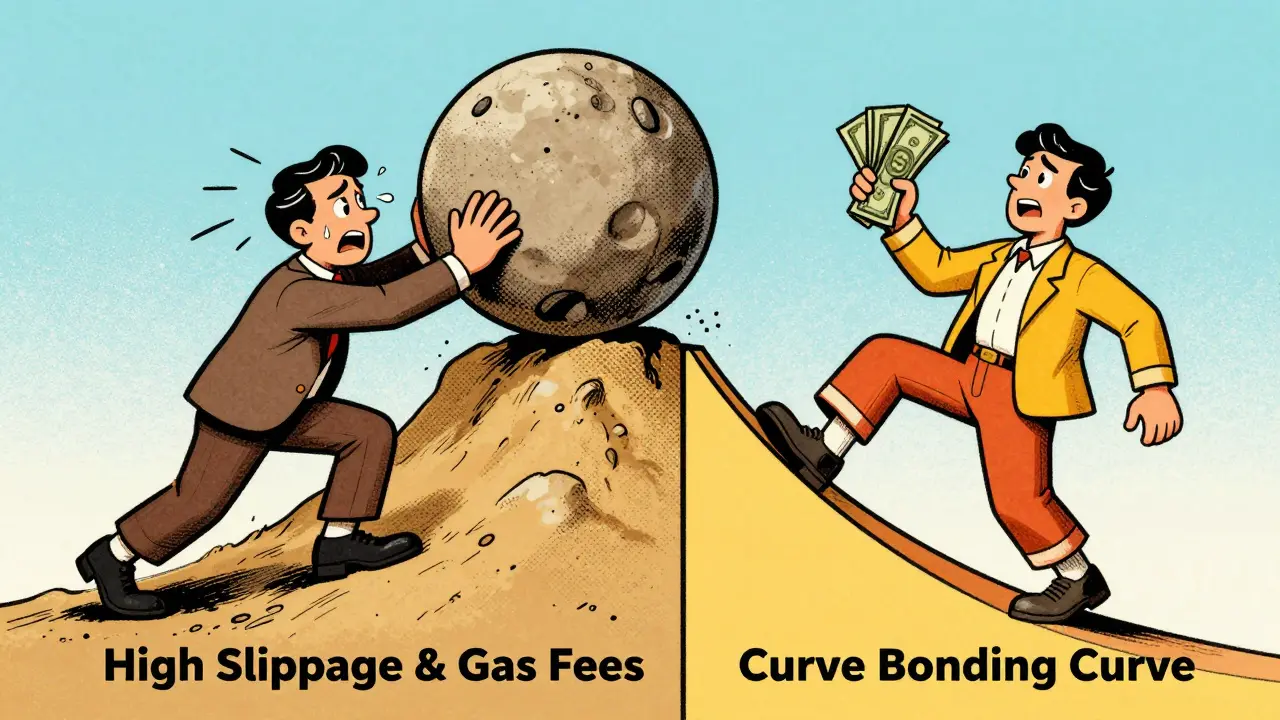
To understand why Curve dominates stablecoin trading, you have to look under the hood. Most decentralized exchanges (DEXs) use a constant product formula ($x \times y = k$). This works fine for volatile pairs like ETH/USDC, but it creates massive slippage when swapping two assets that are supposed to be worth the same thing, like DAI and USDC. If the pool has a slight imbalance, the price impact spikes because the math assumes volatility.
Curve uses a different approach called a bonding curve algorithm is a mathematical function used by Curve Finance to calculate prices based on asset reserves, designed to keep trades near parity for similar-value assets. Think of it as a flat plateau rather than a steep hill. As long as the assets stay close to their peg (e.g., both are worth $1.00), the slippage remains incredibly low, even for large trades. This makes Curve the go-to spot for whales moving millions in stablecoins without crashing the market price.
Running this on Arbitrum changes the economics entirely. On Ethereum mainnet, gas fees could cost you $5-$20 per swap, which destroys profitability for smaller trades. On Arbitrum, those same transactions often cost less than $0.10. This combination allows retail traders to access institutional-grade execution quality without needing deep pockets for gas.
Fees and Costs Breakdown
Cost is king in DeFi. Here is what you can expect when using Curve on Arbitrum in 2026:
- Trading Fees: These vary by pool. Standard stablecoin pools typically charge between 0.04% and 0.30%. Pools involving more volatile assets or newer tokens might charge up to 0.50%. Compare this to Uniswap V3, which often charges 0.05% to 0.30%, but remember that Uniswap’s slippage on stablecoins can effectively double your total cost.
- Network Gas Fees: Arbitrum keeps these negligible. A simple swap might cost $0.05-$0.15. Complex interactions, like providing liquidity or claiming rewards, might push this to $0.50-$1.00 during peak congestion. This is still a fraction of Ethereum L1 costs.
- Slippage: For standard stablecoin pairs (USDC/USDT, DAI/USDC), slippage is often less than 0.01% for trades under $100,000. For larger amounts, it scales linearly rather than exponentially, keeping it predictable.
If you are trading volatile tokens like ETH or ARB against stablecoins, Curve is not the best tool. Stick to general AMMs there. But for stable-to-stable swaps, Curve’s fee structure combined with Arbitrum’s low gas makes it hard to beat.
Liquidity Depth and Pool Variety
Liquidity is the lifeblood of any DEX. Without it, you face high slippage or failed transactions. Curve on Arbitrum has become a hub for deep liquidity over the past few years. The platform supports multiple blockchain networks, with multi-chain deployment spanning 27 networks, and Arbitrum is one of its most active chains.
The most liquid pools on Arbitrum include:
- 3Pool: A mix of USDC, USDT, and DAI. This is the backbone of the ecosystem, offering massive depth and minimal slippage.
- StETH Pool: Allows swapping between staked ETH (Lido) and regular ETH. While not a stablecoin pool, it benefits from Curve’s low-slippage design since the assets track closely.
- Gauge Voting Pools: Specialized pools that offer boosted yields through CRV emissions. These attract significant liquidity due to incentive programs.
However, do not expect to find every obscure meme token here. Curve is specialized. It focuses on assets with similar values. If you need to trade a new launchpad token, you will likely need to bridge to another DEX like Uniswap or SushiSwap on Arbitrum.
| Feature | Curve (Arbitrum) | Uniswap V3 (Arbitrum) |
|---|---|---|
| Best For | Stablecoins & Similar-Value Assets | Volatile Tokens & Wide Range of Pairs |
| Slippage (Stablecoins) | Very Low (<0.01% for small trades) | Moderate to High (depends on concentration) |
| Trading Fee Range | 0.04% - 0.50% | 0.01% - 1.00% |
| User Interface | Complex, Data-Rich | Simple, Intuitive |
| Yield Opportunities | High (via CRV incentives + Gauge voting) | Moderate (Concentrated Liquidity strategies) |
Risks and Security Considerations
No DeFi platform is immune to risk. While Curve’s smart contracts are considered battle-tested with an extensive auditing history, you must understand the specific threats.
Smart Contract Risk: Curve’s code has been audited by top firms multiple times. However, bugs can still exist. The protocol’s complexity, especially around its governance and reward distribution mechanisms, increases the attack surface. Always check for recent audit reports before depositing large sums.
Operational Security: Recent incidents, including DNS attacks targeting Curve’s infrastructure, have raised eyebrows. While these did not compromise user funds directly, they highlighted vulnerabilities in off-chain systems. Users should always verify URLs and use bookmarked links to avoid phishing sites. Never click links from social media posts.
Impermanent Loss: If you provide liquidity, you face impermanent loss. In stablecoin pools, this risk is minimal because the assets stay pegged. However, if a stablecoin depegs (like UST did in 2022), you could be left holding the bag. Only provide liquidity to pools with reputable, well-capitalized stablecoins.
Tokenomics Complexity: Curve’s governance relies on the vote-escrowed CRV model. To maximize yields, you often need to lock CRV tokens and participate in gauge voting. This system is powerful but confusing for beginners. If you do not understand how voting works, you might miss out on boosted rewards or accidentally misallocate your capital.
Who Should Use Curve on Arbitrum?
Curve is not for everyone. Its value proposition is highly specific. Here is how to decide if it fits your strategy:
Use Curve if:
- You frequently swap between stablecoins (USDC, USDT, DAI, FRAX).
- You are an arbitrageur looking to exploit small price differences across protocols.
- You want to provide liquidity to stablecoin pools for steady, low-volatility yield.
- You are comfortable with a slightly more complex interface in exchange for better execution.
Avoid Curve if:
- You primarily trade volatile tokens like ETH, BTC, or altcoins.
- You prefer a simple, plug-and-play interface without learning about gauge voting or CRV locking.
- You are concerned about recent operational security incidents and prefer platforms with simpler architectures.

Getting Started: Step-by-Step Guide
Ready to try it? Here is how to make your first swap on Curve via Arbitrum:
- Connect Your Wallet: Ensure you have a compatible wallet like MetaMask or Rabby installed. Switch your network to Arbitrum One.
- Select Your Pool: Go to the Curve website (verify the URL carefully). Choose the pool you want to trade in. For stablecoins, start with the 3Pool or a dedicated USDC/USDT pool.
- Approve Tokens: If it is your first time using a token on Curve, you will need to approve the contract to spend your funds. This incurs a small gas fee.
- Execute Swap: Enter the amount you want to swap. Check the output amount and slippage tolerance. Confirm the transaction in your wallet.
- Claim Rewards (Optional): If you provided liquidity, navigate to the “Gauges” section to claim your CRV and other incentives. Remember to stake them if you want to boost future earnings.
Final Thoughts
Curve Finance on Arbitrum remains the gold standard for stablecoin efficiency. It solves a real problem-high slippage on similar-value assets-and does so at a fraction of the cost of Ethereum mainnet. While its interface and governance model may intimidate newcomers, the savings on large trades and the potential for boosted yields make it indispensable for serious DeFi users.
Just remember to do your own research. Verify contract addresses, stay aware of security updates, and only invest what you can afford to lose. The DeFi landscape evolves fast, and today’s best tool might be tomorrow’s legacy protocol.
Is Curve Finance safe to use on Arbitrum?
Curve Finance has battle-tested smart contracts with extensive auditing history, making it one of the more secure options in DeFi. However, no platform is 100% risk-free. Recent DNS attacks highlight operational vulnerabilities, so always verify URLs and use bookmarks. Smart contract risks remain, though lower than many newer protocols.
What are the fees for trading on Curve Arbitrum?
Trading fees on Curve range from 0.04% to 0.50% depending on the pool. Stablecoin pools are typically at the lower end (0.04%-0.30%). Network gas fees on Arbitrum are negligible, often costing less than $0.10 per transaction, making it much cheaper than Ethereum mainnet.
Can I trade volatile tokens like ETH on Curve?
Yes, but it is not recommended for pure speculation. Curve is optimized for assets with similar values. While you can trade ETH against stETH or wrapped BTC, general-purpose DEXs like Uniswap offer better tools and interfaces for volatile asset trading. Curve excels in stablecoin and pegged-asset pairs.
How do I earn yield on Curve Arbitrum?
You earn yield by providing liquidity to pools. You receive LP tokens representing your share. Additionally, Curve distributes CRV tokens to liquidity providers. By locking CRV and participating in gauge voting, you can boost your rewards significantly. This process is complex but offers higher returns than passive staking.
Why use Arbitrum instead of Ethereum mainnet for Curve?
Arbitrum is an Ethereum Layer 2 solution that offers drastically lower gas fees and faster transaction speeds. On Ethereum mainnet, gas fees can exceed $10-$20 per swap, eroding profits for small trades. On Arbitrum, fees are cents, making Curve accessible for retail traders and enabling frequent arbitrage strategies.