

You have a digital wallet on your phone. You probably also know what happens when you buy something online with a credit card. Now imagine trying to run a business using only that personal wallet for every customer transaction. It sounds messy, doesn't it? That is exactly why the terms crypto wallet and crypto payment gateway are not interchangeable.
One is a tool for holding and moving your own money. The other is infrastructure built for businesses to accept money from others. Confusing the two can lead to security risks, accounting nightmares, or lost sales. Let's break down exactly how they differ, who needs which one, and why modern merchants rarely rely on wallets alone.
Core Definitions: What Are They Actually Doing?
A crypto wallet is software or hardware that manages private keys to control cryptocurrency assets on a blockchain. Think of it as your digital safe. It does not actually store coins inside an app. Instead, it holds the cryptographic keys that prove you own those coins recorded on the public ledger. When you send Bitcoin or Ethereum, your wallet signs the transaction to authorize the move.
In contrast, a crypto payment gateway is merchant-facing infrastructure that facilitates accepting cryptocurrency payments at checkout. This acts like the bridge between a customer's wallet and a business's bank account or ledger. It generates invoices, detects payments on the blockchain, and often converts volatile crypto into stable fiat currency instantly. While a wallet focuses on custody and control, a gateway focuses on automation and settlement.
Who Uses What? Individuals Versus Businesses
The primary user defines the tool. If you are an individual investor, a DeFi participant, or someone collecting NFTs, you need a wallet. Your goal is likely long-term holding, trading, or interacting with decentralized applications. You want direct access to your assets without intermediaries taking a cut or imposing restrictions.
If you are running an e-commerce store, a SaaS platform, or offering freelance services, you need a payment gateway. Your customers might use MetaMask, Trust Wallet, or even exchange accounts. You do not care which specific wallet they use; you just want the order marked as paid in your system. Gateways abstract away the complexity of different chains and wallets, presenting a unified checkout experience for your buyers while handling the backend verification for you.
Architecture: Keys Versus Checkout Flows
Under the hood, these tools operate on completely different layers. A wallet sits at the protocol layer. It connects directly to blockchain nodes. Its main job is generating addresses from your private keys and broadcasting signed transactions. Security here means keeping those private keys offline or encrypted so no one else can spend your funds.
A payment gateway operates at the application layer. It consists of three main parts: the frontend interface (checkout page), the processor (which watches the blockchain for confirmations), and the network layer (which aggregates multiple chains). When a customer pays, the gateway creates a unique invoice address. It monitors that address. Once the network confirms the transaction, the gateway sends a signal to your website to unlock the product or service. Crucially, many gateways handle the conversion from crypto to fiat so you never have to manage the volatility yourself.
| Feature | Crypto Wallet | Crypto Payment Gateway |
|---|---|---|
| Primary User | Individuals, Investors | Merchants, Businesses |
| Main Function | Key Management, Signing | Checkout Automation, Settlement |
| Fees | Network Gas Fees Only | Processing Fee + Network Fees |
| Volatility Risk | User Bears Full Risk | Often Mitigated via Instant Conversion |
| Integration | Standalone App or Extension | API, Plugins, Webhooks |

The Cost Difference: Gas Fees Versus Processing Fees
Using a wallet is cheap, but only if you ignore your time. You pay network fees-often called gas-to miners or validators. These fluctuate based on congestion. There is usually no extra charge from the wallet provider itself. However, manually checking block explorers to see if a client paid you takes time. Time costs money.
Payment gateways charge a processing fee, typically ranging from 0.5% to 2% per transaction. Why pay more? Because the gateway provides services beyond simple transmission. It offers automated invoicing, instant fiat conversion, accounting reports, and customer support. For a business processing hundreds of orders, paying a small percentage saves dozens of hours of manual reconciliation and protects against price swings during settlement windows.
Custody Models: Who Holds the Money?
This is where things get tricky. Most wallets are non-custodial. You hold the keys. If you lose them, the money is gone forever. No customer support can help you. This gives you total freedom but also total responsibility.
Gateways vary. Some are custodial, meaning they hold the funds temporarily before converting and sending them to your bank. Others are non-custodial, routing payments directly to your wallet addresses. Newer solutions like TxNod take a strict non-custodial approach by design. Merchants connect their own hardware wallets (like Ledger or Trezor) via public keys. The gateway derives addresses but never touches the private keys. Funds settle straight to the merchant's wallet on-chain. This eliminates counterparty risk-if the gateway goes down, your money is still safe in your own hardware device. It also means zero chargebacks and no account freezes, since the platform never holds your assets.
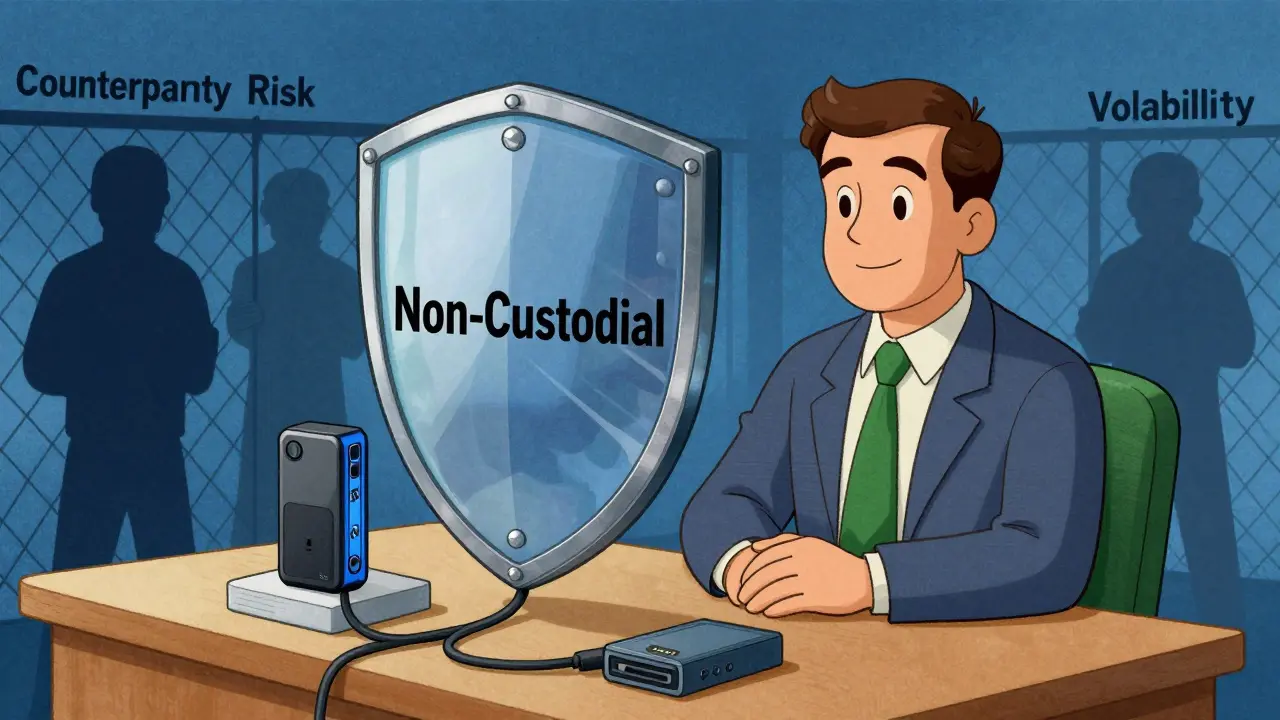
Volatility and Settlement Speed
If you receive Bitcoin in a personal wallet, you now own Bitcoin. If the market drops 10% an hour later, your revenue drops 10%. This is fine if you plan to HODL. It is terrible if you need to pay suppliers in dollars next week.
Payment gateways solve this by offering instant conversion. The moment the blockchain confirms the payment, the gateway swaps the crypto for USD, EUR, or a stablecoin like USDC. You set your prices in fiat, and you get settled in fiat. The customer pays in whatever crypto they prefer, but you avoid the headache of tracking daily market fluctuations. Some advanced gateways even allow settlement in stablecoins, giving you the speed of blockchain transfers with the stability of traditional currency.
Compliance and Business Operations
Running a business requires more than just receiving money. You need invoices, tax records, and proof of payment. Wallets provide a transaction history, sure, but they do not generate PDF invoices or integrate with QuickBooks and Xero. They do not screen customers for compliance issues.
Gateways are built for operations. They automatically generate detailed invoices, track payment status in real-time, and export data for accounting software. They often include KYC/AML tools to ensure you are complying with local regulations. For solo founders and indie hackers, this automation is crucial. It turns a chaotic stream of blockchain hashes into clean, readable financial data. Modern gateways also offer developer-friendly APIs and webhooks, allowing you to trigger actions-like unlocking a digital download-the second a payment clears.
Which One Do You Need?
If you are buying coffee or storing savings, stick with a wallet. Keep your keys secure, back up your seed phrase, and enjoy direct ownership. But if you are selling products, subscriptions, or services, a wallet alone will bottleneck your growth.
You need a payment gateway to scale. It handles the technical heavy lifting of multi-chain detection, customer experience optimization, and financial reconciliation. Whether you choose a traditional custodial provider or a modern non-custodial option that integrates with your existing hardware wallet, the goal is the same: make accepting crypto as easy as accepting a credit card, without the hidden risks.
Can I use my personal crypto wallet as a payment gateway?
Technically yes, but practically no. You can share your wallet address with customers, but you lack automated invoicing, instant fiat conversion, and accounting integration. You would need to manually verify every transaction on a block explorer, which does not scale for a business.
Do payment gateways hold my money?
It depends on the provider. Custodial gateways hold funds temporarily before settling to your bank. Non-custodial gateways route payments directly to your wallet addresses. Non-custodial options eliminate counterparty risk because the gateway never has access to your private keys or balances.
Why are payment gateway fees higher than wallet gas fees?
Gateways charge processing fees (usually 0.5%-2%) to cover services like instant currency conversion, fraud prevention, accounting integrations, and customer support. Wallets only charge network fees because they simply broadcast transactions without additional business services.
How do non-custodial gateways work with hardware wallets?
They connect via public keys (xpubs). You plug in your Ledger or Trezor to the gateway dashboard. The gateway derives unique payment addresses for each invoice but cannot spend the funds. Transactions settle directly to your hardware wallet, ensuring you maintain full custody while enjoying automated checkout features.
Is it better to accept crypto or fiat through a gateway?
Most merchants prefer fiat settlement to avoid volatility. Gateways allow customers to pay in any supported crypto, but instantly convert it to USD, EUR, or stablecoins before depositing it to you. This gives you the benefits of global crypto adoption without the risk of price swings.
Terry Hyland
June 15, 2026 AT 22:57they want you to trust these companies with your money. it is all a scam. the government will shut it down soon and you will lose everything. do not use crypto.
Monica Pathammavong
June 16, 2026 AT 22:15you guys are so dumb if you dont know this already. i have been saying for years that wallets are just for hoarders. gateways are for real business people who understand economics. why do people still think they can just send btc to a address and call it a day? its messy and unprofessional. stop being lazy.
Tim Lefebvre
June 17, 2026 AT 02:02hey there! i think this is a great point about the difference between custody and processing. i have used both and honestly for small businesses the gateway saves so much time on accounting. you dont have to track every transaction manually which is a huge pain. also the instant conversion helps with volatility issues. hope this helps!
Mekz Wheoki
June 18, 2026 AT 08:02another article explaining basic concepts like we are children. obviously a wallet holds keys and a gateway processes payments. who needs an explanation for this. it is insulting to anyone who has actually used blockchain technology before.
Danna Charris
June 19, 2026 AT 07:19the distinction is clear. one is for storage, the other for commerce. those who confuse them lack fundamental understanding of financial infrastructure. proper education is required before engaging in digital asset management.
Fede Faith
June 20, 2026 AT 20:53i really appreciate how this breaks down the technical differences. as someone running a small online store, switching to a non-custodial gateway was a game changer. i feel safer knowing my private keys never leave my hardware device. it gives me peace of mind while still offering automation features that save hours of work each week. highly recommend looking into options that support ledger integration directly.
Josh Dodson
June 21, 2026 AT 15:34great info here! i was confused about fees at first but now i get it. the processing fee covers a lot more than just network costs. it includes things like fraud protection and accounting tools which are super useful for growing businesses. keep learning and building!
Mauricio Contreras Loredo
June 23, 2026 AT 01:37oh wow, another take on crypto basics. i guess some people need hand holding through every single aspect of decentralized finance. but hey, better late than never i suppose. lets hope they learn something from this overly simplified guide.
sreeja boora
June 23, 2026 AT 15:02In India, we are seeing rapid adoption of blockchain technology for legitimate business purposes. However, regulatory compliance remains a critical factor that many international guides overlook. It is essential to consider local tax laws and reporting requirements when selecting a payment solution. The technological advantage must be balanced with legal responsibility.
Grace Newman
June 23, 2026 AT 15:18I am deeply concerned about the implications of centralized payment gateways acting as intermediaries. This creates points of failure and potential censorship. One must question the true nature of decentralization when relying on third-party services for settlement. The risk of surveillance and control by corporate entities cannot be ignored.
Abby Sivertsen
June 24, 2026 AT 08:31i see where you are coming from but personally i prefer the simplicity of just using a wallet for personal transactions. for business though i agree gateways make sense. it is nice to have options depending on what you need. everyone has different workflows and preferences.
Eric Scheinberg
June 24, 2026 AT 20:22The architectural separation between protocol layer key management and application layer checkout flows represents a fundamental design principle in modern fintech. Understanding this distinction is crucial for implementing secure and scalable payment systems. Developers should prioritize modularity and security in their integrations.
Filbert Reeves
June 25, 2026 AT 09:29actually most of this is wrong because the whole system is rigged anyway. they say non-custodial is safe but what if the hardware wallet company backdoors it? or what if the browser extension steals your keys? nothing is truly secure in this digital age. i just keep cash under my mattress and sleep well at night unlike all you paranoid tech enthusiasts who think you are hiding from the authorities.
Nick Rice
June 27, 2026 AT 08:05This is exactly why entrepreneurs need to educate themselves. You cannot build a successful business without understanding the tools you use. Take charge of your financial infrastructure and choose solutions that empower growth rather than hinder it. Success belongs to those who prepare properly.
Amit Thakur
June 28, 2026 AT 09:18From a technical perspective, the integration of xpubs with hardware wallets allows for seamless multi-signature setups and enhanced security protocols. This approach mitigates counterparty risks significantly compared to traditional custodial models. We should advocate for such robust architectures in enterprise environments.
pankaj chawla
June 29, 2026 AT 12:36I agree with the analysis presented here. The differentiation between individual custody needs and merchant processing requirements is well articulated. Implementing appropriate solutions based on specific use cases ensures operational efficiency and risk management.
Jessica Lane
June 30, 2026 AT 08:17This raises important questions about the future of digital commerce. How will regulatory frameworks evolve to accommodate these technologies? What safeguards are necessary to protect consumers and merchants alike? I believe further research into these areas will provide valuable insights for stakeholders involved in the ecosystem.
Andrea Burd
July 1, 2026 AT 12:18boring read. too much jargon for no reason. just tell us which one makes more money. nobody cares about the architecture details unless you are selling software. waste of time.
Akeem Whittaker
July 3, 2026 AT 07:47Understanding the core functionality of each tool is essential for making informed decisions. Merchants must evaluate their specific needs regarding automation, security, and compliance before choosing a solution. There is no one-size-fits-all answer in this space.
Manish Prajapat
July 4, 2026 AT 15:46The philosophical implication of trusting algorithms versus human intermediaries is profound. In a world increasingly dominated by code, maintaining sovereignty over one's assets becomes a moral imperative. We must remain vigilant against encroachments on our financial freedom.