
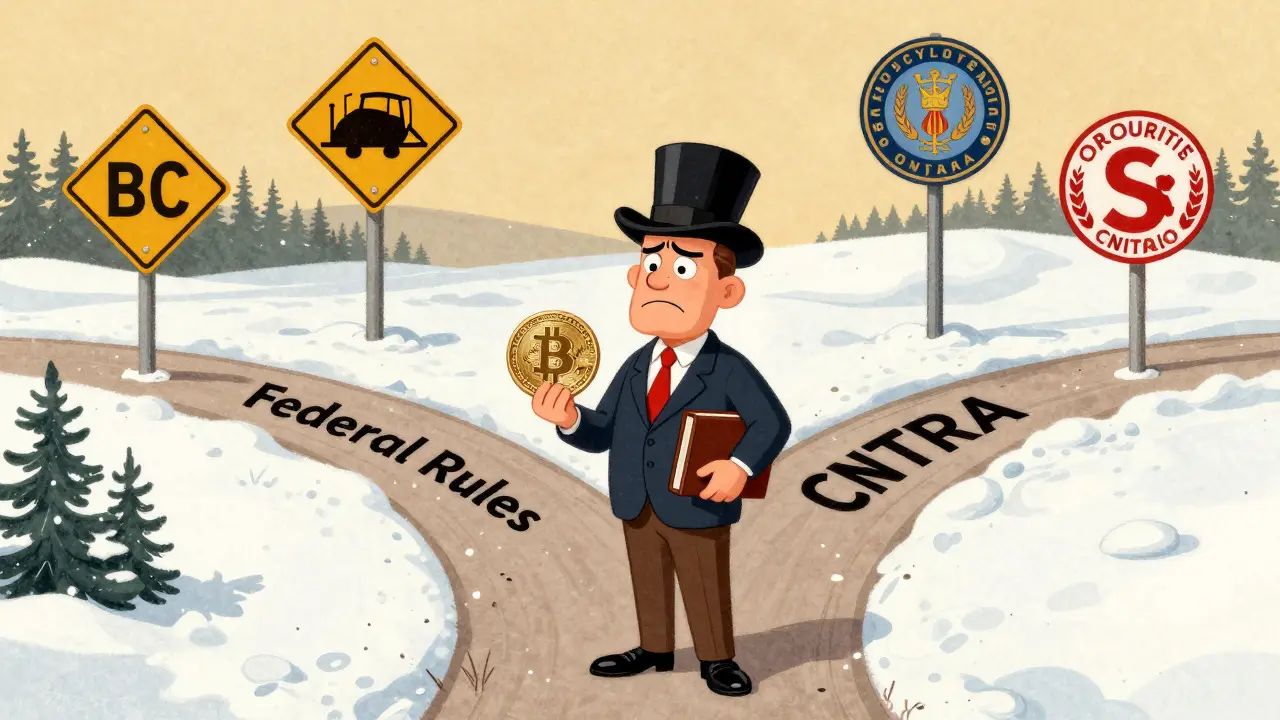
Buying Bitcoin or Ethereum in Canada isn't just about clicking a button on an app. It's about navigating a patchwork of federal rules and provincial quirks that can change depending on where you live. If you think the government is either banning crypto entirely or letting it run wild, you're missing the reality. The truth sits somewhere in the middle: strict oversight for businesses, specific tax rules for you, and regional restrictions that vary wildly from coast to coast.
As of mid-2026, cryptocurrency remains legal across Canada. However, the regulatory landscape has tightened significantly since the major updates in 2024 and 2025. The days of flying under the radar are over. Whether you are a casual investor, a business owner, or someone looking to start a mining operation, understanding these rules is no longer optional-it’s essential for staying out of trouble with the Canada Revenue Agency (CRA) and provincial securities commissions.
The Federal Framework: FINTRAC and the CRA
Before we get into the province-by-province breakdown, you need to understand the baseline rules that apply everywhere in Canada. The federal government treats cryptocurrency as a commodity rather than legal tender. This distinction matters because it dictates how your gains are taxed and how exchanges must operate.
FINTRAC is the first line of defense. Officially known as the Financial Transactions and Reports Analysis Centre of Canada, this agency ensures that crypto platforms aren't used for money laundering or terrorist financing. Since 2014, any Virtual Asset Service Provider (VASP)-which includes exchanges like Coinbase, Kraken, or local Canadian platforms-must register with FINTRAC. If an exchange isn't registered, you shouldn't be using it. As of 2026, compliance checks have become more rigorous, meaning exchanges now demand more identity verification (KYC) than ever before.
Then there is the taxman. The Canada Revenue Agency views crypto transactions through the lens of capital gains or business income. Here is the golden rule: only 50% of your capital gains are taxable. If you buy Bitcoin for $1,000 and sell it for $2,000, your gain is $1,000. You pay tax on $500 at your marginal income tax rate. But watch out-if the CRA decides you are trading frequently enough to be considered a business, they may tax 100% of your profits. Keeping detailed records of every transaction, including trades between different cryptocurrencies, is non-negotiable.
British Columbia: The Mining Crackdown
If you are thinking about setting up a crypto mining farm in British Columbia, pause. BC has become one of the most restrictive provinces for energy-intensive crypto operations. Historically, BC Hydro offered some of the cheapest electricity in North America, attracting miners from around the world. That era ended abruptly.
In December 2022, the BC government issued a direction allowing BC Hydro to suspend new cryptocurrency mining projects for 18 months. This was followed by legislative amendments to the BC Utilities Commission Act, effective May 17, 2024. These changes gave the utility provider permanent powers to prohibit, restrict, or regulate electricity service specifically for mining projects. Why? Because the surge in mining activity was driving up electricity prices for regular residents and straining the grid during peak winter demand.
For the average investor, this doesn't change much. You can still buy and hold crypto on authorized platforms. But if you are a business looking to expand into BC, you face significant hurdles regarding power supply. The message from Victoria is clear: residential power needs come first.
Quebec: High Rates for Miners
Quebert takes a different approach than its western neighbor. Instead of an outright ban or suspension, Quebec implemented a punitive pricing structure. In January 2023, the Régie de l'énergie approved the suspension of capacity allocation processes for cryptographic blockchain use. More importantly, they introduced a specific electricity rate for new crypto mining projects utilizing at least 50 kilowatts of installed capacity.
This rate is set at 16.603 cents per kWh. While that might sound low compared to industrial rates in other parts of the world, it is significantly higher than the subsidized residential rates that previously made Quebec a mining hub. The goal is to discourage large-scale mining operations that compete with local industries for hydroelectric power. For individual investors, the impact is minimal, but the provincial regulator keeps a close eye on market manipulation and unauthorized trading platforms.

Ontario and Alberta: Securities Oversight
In Ontario and Alberta, the focus shifts less to energy and more to securities regulation. Both provinces are home to major financial hubs, so their securities commissions-the Ontario Securities Commission (OSC) and the Alberta Securities Commission (ASC)-are particularly active.
These regulators enforce the rules set by the Canadian Securities Administrators (CSA). They maintain lists of authorized crypto trading platforms. Operating an exchange without authorization is a serious offense. For investors, this means checking if your preferred platform is approved in your specific province. Some platforms, like Kraken (Payward Canada Inc.) and Crypto.com (Foris DAX CAN ULC), have secured decisions across multiple provinces, including Ontario, Alberta, BC, Manitoba, and Saskatchewan. Others may only be licensed in specific jurisdictions.
The OSC has also been vocal about investor protection, issuing warnings about unregistered digital asset offerings. If you are buying tokens that promise future returns, the OSC likely considers them securities, which brings them under strict scrutiny. Always verify the status of any token offering through the CSA’s public database.
Platform Authorization: Who Can You Trust?
Navigating which platforms are legal in your province can be confusing. The CSA maintains a public list of authorized trading platforms, but this list evolves. As of 2025 and continuing into 2026, several key players have received formal decisions:
- Kraken (Payward Canada Inc.): Authorized in Alberta, BC, Manitoba, and Saskatchewan.
- Crypto.com (Foris DAX CAN ULC): Received decision on May 8, 2025.
- Newton Crypto Ltd.: Amended decision on March 12, 2025.
- Ndax Canada Inc.: Decision on April 1, 2025.
- Fidelity Digital Assets Services: Operates as an Exempt Marketplace and Clearing Agency (Decision Jan 18, 2023).
- Netcoins Inc.: Multiple amended decisions, most recently October 6, 2023.
Note that "authorized" does not mean "endorsed." It simply means they meet the minimum regulatory standards for investor protection and anti-money laundering compliance. Always do your own due diligence.
Taxation Nuances Across Provinces
While the federal tax rate applies uniformly, your final tax bill depends on your provincial income tax bracket. Capital gains are added to your total income, pushing you into higher tax brackets in high-tax provinces like Quebec or Nova Scotia. Conversely, provinces with lower personal income taxes, such as Alberta or Saskatchewan, may result in a lower overall tax burden on your crypto profits.
Remember that certain activities are tax-free. Buying crypto with Canadian dollars, transferring funds between your own wallets, holding crypto long-term, and receiving crypto as a gift do not trigger immediate tax events. Taxes are only triggered when you dispose of the asset-selling for CAD, spending it on goods, or swapping it for another cryptocurrency.
| Province | Primary Regulatory Focus | Key Restriction/Rule |
|---|---|---|
| British Columbia | Energy Supply | BC Hydro can restrict/suspend power for new mining projects. |
| Quebec | Energy Pricing | Premium rate of 16.603¢/kWh for large-scale mining. |
| Ontario | Securities Compliance | Strict enforcement of authorized trading platforms. |
| Alberta | Securities Compliance | Active monitoring of unregistered digital assets. |
| Federal (All) | AML/Tax | FINTRAC registration required; 50% inclusion rate for capital gains. |
Investment Funds and New Clarity
For institutional investors and those interested in ETFs, the landscape has brightened. Recent amendments published by the CSA in April 2025 regarding National Instrument 81-102 Investment Funds provided greater clarity for Public Crypto Asset Funds. These rules specify which crypto assets funds can hold, investment restrictions, and custody requirements. This move aims to protect retail investors who want exposure to crypto through traditional financial instruments, ensuring that their assets are held securely by qualified custodians.
Canada remains the birthplace of Ethereum and the first country to approve a Bitcoin ETF. This historical innovation leadership continues, but it comes with a heavy dose of compliance. The regulatory framework is designed to balance innovation with investor protection, preventing the kind of chaotic crashes seen in less regulated markets.
Is cryptocurrency legal in all Canadian provinces?
Yes, cryptocurrency is legal across all Canadian provinces. However, the regulatory environment varies, particularly regarding mining operations and securities oversight. You can buy, sell, and hold crypto anywhere, but you must use FINTRAC-registered exchanges and report gains to the CRA.
Do I pay tax on crypto gifts?
No, receiving cryptocurrency as a gift is generally not a taxable event for the recipient. However, the person giving the gift may need to report a capital gain if the value of the crypto has increased since they acquired it.
Can I mine Bitcoin in British Columbia?
Technically yes, but it is highly restricted. BC Hydro has the authority to prohibit or restrict electricity service for new mining projects. Existing miners may face pressure to reduce consumption, and new entrants should expect significant barriers to securing affordable power.
What happens if I use an unauthorized exchange?
Using an unauthorized exchange carries risks. While you won't necessarily be fined personally, you lack the investor protections provided by provincial securities commissions. If the exchange fails or commits fraud, recovering your funds becomes difficult. Always check the CSA’s list of authorized platforms.
How does Quebec charge miners differently?
Quebec charges a specific rate of 16.603 cents per kWh for new crypto mining projects using at least 50 kW of capacity. This is higher than standard residential rates, designed to discourage large-scale mining that competes with local industry for hydroelectric power.